
Why Tracking Keyword Rankings Still Matters (And How to Do It Right)
Every few years, someone publishes a "keyword rankings are dead" hot take. And every few years, that take ages about as well as milk in the sun.
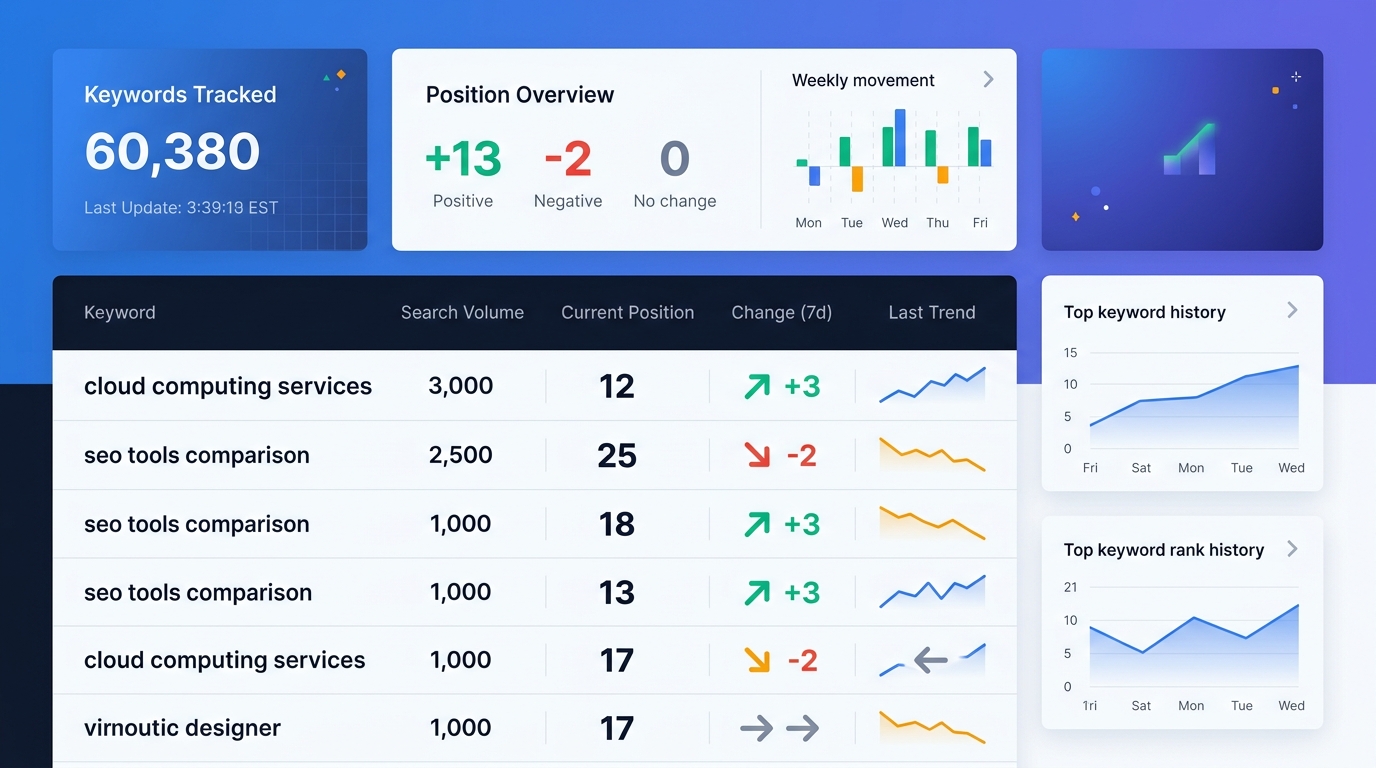
Why Tracking Keyword Rankings Still Matters (And How to Do It Right)
Every few years, someone publishes a "keyword rankings are dead" hot take. And every few years, that take ages about as well as milk in the sun. Here's what I know after managing SEO campaigns for over a decade: the teams that stopped paying attention to keyword rankings didn't become more sophisticated. They became blind. They lost the ability to detect problems early, justify their budgets, or explain why traffic tanked after an algorithm update. Rankings aren't the only metric that matters, but dismissing them is like a stock trader ignoring price charts because "fundamentals are what really count."
Let me explain why rank tracking deserves a permanent seat at your SEO table, and more importantly, how to do it without drowning in vanity data.
The Case Against Rankings (And Why It Falls Apart)
The anti-rankings crowd usually makes three arguments. First, personalized search means everyone sees different results. Second, zero-click searches have reduced the value of organic positions. Third, there are "better" metrics like traffic and conversions.
Each point contains a grain of truth wrapped in a bad conclusion.
Yes, search results vary by location, device, and user history. But rank tracking tools already account for this by pulling anonymized results from specific geolocations and device types. The data isn't perfect. It doesn't need to be. It needs to be directional, and it absolutely is.
Yes, over 50% of Google searches now end without a click. But that makes SERP tracking more important, not less. You need to know whether your content appears in featured snippets, local packs, and AI overviews, because those SERP features can dramatically shift your visibility even when your raw position number looks fine.
And yes, traffic and conversions matter more as bottom-line metrics. But rankings are a leading indicator. By the time you see a traffic drop in Google Analytics, the ranking decline happened weeks ago. If you'd been monitoring positions, you could've caught it sooner. Understanding why search rankings drop and catching those signals early is the difference between a quick recovery and a quarter of lost revenue.
What Rank Tracking Actually Tells You
Your keyword ranking is simply the position your page holds in search results for a specific query. As DashThis explains it, if your page appears 4th in Google results for "SEO reporting tool," your keyword ranking for that query is #4. Simple enough.
But the real value of SEO monitoring goes way beyond that single number. Here's what a well-configured rank tracking setup reveals:
Trend direction over time. A keyword bouncing between position 6 and 9 over four weeks is normal fluctuation. That same keyword sliding from position 6 to position 18 over four weeks is a red flag. Without tracking, you can't tell the difference.
Content performance patterns. When you track rankings across clusters of related keywords, you start seeing which content pillars are gaining authority and which are stalling. This is how SEO evolves from content creation into strategic decision-making about where to invest your next round of effort.
Competitive movement. If your competitor suddenly starts outranking you for 30 keywords in the same topic cluster, something changed. Maybe they published a content hub. Maybe they earned a bunch of backlinks. Rank tracking is your early warning system.
SERP feature opportunities. Modern tracking tools show you which of your keywords trigger featured snippets, People Also Ask boxes, video carousels, or AI-generated overviews. As Nightwatch.io puts it, rank tracking transforms SEO from guesswork into strategy by showing what's working and where visibility is evolving.
The Biggest Mistake: Tracking Vanity Keywords
Here's where most people get rank tracking wrong. They dump 500 keywords into a tool and track everything. Half those terms have no search volume. A quarter are so competitive that ranking for them would take years. And nobody ever cleans the list.
The most common mistake is tracking too many vanity keywords that generate zero business value. The best practice, and I've learned this the hard way, is to focus tracking on "money keywords" — the terms that actually drive sales, leads, or meaningful engagement.
I break my tracked keywords into three tiers:
Money keywords (top priority): Terms with clear commercial or transactional intent that directly connect to revenue. These get weekly review.
Authority keywords: Informational terms that build topical relevance and feed your content funnel. Monthly review is fine.
Monitoring keywords: Branded terms and competitive benchmarks you want to watch but don't actively optimize for. Check these quarterly.
This tiered approach keeps your dashboard focused. You're spending your attention where it generates the most return, which pairs well with strategies that convert traffic into actual revenue rather than just vanity metrics.
How to Set Up Rank Tracking That Actually Works
Enough theory. Here's the practical framework I use when setting up keyword tracking tools for a new project.
Step 1: Define Your Keyword Universe
Start with 50 to 100 keywords, max. Pull them from three sources:
Google Search Console (terms you already rank for)
Competitor analysis (terms your top 3 competitors rank for that you don't)
Customer research (the actual phrases your customers use when describing their problems)
Categorize each keyword by intent type: informational, navigational, commercial, or transactional. Then assign each one to a tier using the system above.
Step 2: Pick the Right Tool for Your Scale
For small sites tracking under 200 keywords, tools like SE Ranking or Nightwatch.io offer a good balance of accuracy and affordability. For enterprise sites tracking thousands of terms, platforms like seoClarity or Semrush provide the depth you need, especially for monitoring SERP features at scale across thousands of keywords and pages.
Whatever tool you choose, make sure it supports:
Daily or weekly position updates (weekly is fine for most businesses)
Location-specific tracking (essential for local SEO)
SERP feature detection (snippets, local packs, AI overviews)
Competitor comparison on the same keywords
Step 3: Build a Reporting Cadence
Raw ranking data is noise without context. Build a simple reporting rhythm:
Weekly: Review money keywords. Flag any position changes greater than 5 spots.
Monthly: Analyze trends across all tiers. Identify pages gaining or losing ground. Cross-reference with traffic data.
Quarterly: Full audit. Remove keywords that no longer align with your business goals. Add new terms based on content you've published.
This cadence prevents the "set it and forget it" trap where teams configure tracking once, then never look at it again.
Step 4: Connect Rankings to Business Outcomes
This is where most SEO teams fail. They report "we moved from position 8 to position 3" without explaining what that means in dollars. The data itself is only valuable when it's clean and connected to outcomes, something that applies to every metric in your marketing stack.
For every money keyword, track:
Position change over time
Estimated search volume
Organic CTR (from Search Console)
Conversions attributed to organic landing pages
When you can say "our target keyword moved from position 7 to position 3, increasing monthly organic sessions to that page by 340%, generating 28 additional demo requests," that's a story executives care about.
The Search Visibility Metric You Should Be Watching
Individual keyword positions are useful, but search visibility gives you the big picture. It's a composite score that represents how visible your domain is across all tracked keywords, weighted by search volume and position.
Think of it as a stock market index for your SEO performance. The S&P 500 doesn't tell you how any single stock performed, but it tells you how the market is doing overall. Search visibility works the same way for your organic presence.
Most keyword tracking tools calculate this automatically. If your visibility score drops 15% in a week, something significant happened, even if no single keyword moved dramatically. It could be a broad algorithm update, a technical issue affecting crawling, or a competitor making an aggressive content push.
I check search visibility more than any other single SEO metric. It's the fastest way to answer the question "are things getting better or worse?" without getting lost in individual keyword noise.
Adapting Your Approach for AI Search
Google's AI Overviews and other generative search features have changed what "ranking" means. You can hold position 1 in the traditional organic results and still be invisible if an AI-generated answer block pushes your listing below the fold.
This doesn't mean rankings are irrelevant. It means your SERP tracking needs to account for these new elements. When you review your keyword data, pay attention to which queries trigger AI overviews, and whether your content is cited within them.
The keywords most affected tend to be informational queries with clear, definitive answers. Commercial and transactional keywords still surface traditional results more often. This is another reason to prioritize money keywords in your tracking — they're less likely to get buried under AI-generated content.
Aligning your content strategy with these shifts matters. If you're thinking about how your SEO strategy needs to evolve alongside AI recommendations, start by auditing which of your tracked keywords are being impacted by AI features.
What to Do When Rankings Drop
Don't panic. Seriously.
A one-day or even one-week dip means almost nothing. Google constantly tests different results, and temporary fluctuations are the norm. You're looking for sustained trends over 2 to 4 weeks.
When you do see a sustained decline:
Check if it's site-wide or isolated to specific pages
Look for a corresponding Google algorithm update (there's almost always one)
Audit the affected pages for technical issues: slow load times, broken internal links, thin content
Compare against competitors who gained positions — what changed on their pages?
Review your meta descriptions and title tags for the affected URLs, since poor CTR signals can accelerate ranking declines
The Practical Takeaway
Stop treating rank tracking as either gospel or garbage. It's a diagnostic tool, like a thermometer. It doesn't cure the disease, but it tells you when something's wrong and whether your treatment is working.
Set up tracking for 50 to 100 keywords that actually connect to revenue. Use a proper tool, not manual Google searches. Review money keywords weekly, everything else monthly. Connect position changes to traffic and conversion data so you can speak the language of business outcomes. And pay attention to search visibility as your single best "state of the union" metric for organic performance.
Rankings alone won't save your SEO program. But ignoring them will absolutely sink it.

Sarah Chen
SEO strategist and web analytics expert with over 10 years of experience helping businesses improve their organic search visibility. Sarah covers keyword tracking, site audits, and data-driven growth strategies.
Frequently Asked Questions
- Why is tracking keyword rankings important for SEO?
- Rank tracking serves as a leading indicator that helps detect problems early—ranking declines often happen weeks before traffic drops in Analytics. It also helps justify SEO budgets, explains traffic changes after algorithm updates, and reveals opportunities like featured snippets and AI overviews that affect visibility.
- What keywords should I track for my SEO campaign?
- Focus on 50-100 keywords total, organized into three tiers: money keywords with commercial intent (reviewed weekly), authority keywords for topical relevance (monthly), and monitoring keywords like branded terms (quarterly). Source keywords from Google Search Console, competitor analysis, and customer research about their actual problems.
- How often should I review keyword rankings?
- Review money keywords weekly and flag any position changes greater than 5 spots, analyze trends across all tiers monthly, and conduct a full audit quarterly to remove misaligned keywords and add new ones based on published content.
- What is search visibility and why does it matter?
- Search visibility is a composite score representing your domain's overall visibility across all tracked keywords, weighted by search volume and position. It functions like a stock market index for SEO performance—a 15% drop signals something significant happened even if no single keyword moved dramatically.
- How do AI search features like AI Overviews affect keyword ranking tracking?
- AI-generated answer blocks can push traditional organic results below the fold, meaning you can rank #1 and still be invisible. Track which keywords trigger AI overviews and whether your content is cited within them—informational queries are most affected, while commercial and transactional keywords typically show traditional results.
- What's the biggest mistake people make with rank tracking?
- The most common mistake is tracking too many vanity keywords with no search volume or business value. Instead, focus on money keywords that directly connect to revenue, and remove keywords quarterly that no longer align with business goals.
- Should I manually check my Google rankings?
- No—avoid checking rankings manually by searching Google yourself because results are personalized by your browsing history, location, and logged-in account, making the data useless for benchmarking. Use dedicated rank tracking tools that pull anonymized results from specific geolocations and device types.
- How should I respond to a sudden ranking drop?
- Don't panic over one-day or one-week dips; look for sustained trends over 2-4 weeks. Check if the decline is site-wide or isolated, look for corresponding algorithm updates, audit for technical issues, and compare against competitors who gained positions before making changes.
Explore more topics