
Building Your First Content Marketing Strategy: A Step-by-Step Framework
Most content marketing strategies fail before a single word gets published. Not because the writing is bad, not because the topics are wrong, but because there was never a real strategy to begin with.
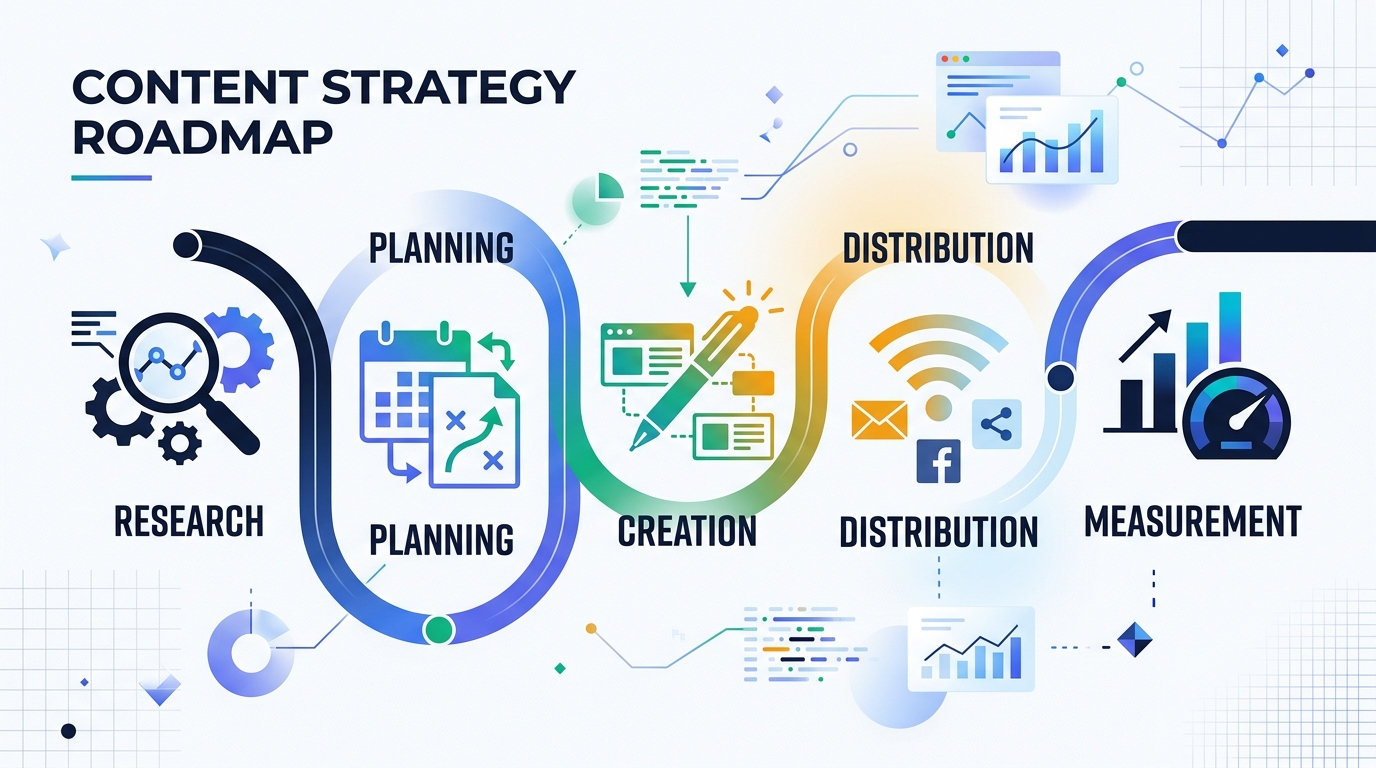
Building Your First Content Marketing Strategy: A Step-by-Step Framework That Actually Works
Most content marketing strategies fail before a single word gets published. Not because the writing is bad, not because the topics are wrong, but because there was never a real strategy to begin with. There was a list of blog post ideas in a spreadsheet, maybe a vague goal like "increase brand awareness," and a lot of enthusiasm that fizzled out by week six. I've watched this happen at three different companies I've worked with, and I've been guilty of it myself. The difference between teams that generate measurable content marketing ROI and teams that burn out producing content nobody reads comes down to one thing: a documented framework they actually follow.
So here's the framework I use now. It's not theoretical. It's built from years of getting it wrong, then slowly getting it right.
Why Most "Strategies" Are Just Content Lists
Before we get into the steps, let's be honest about a distinction most people skip. A content marketing strategy is not the same as a content plan. Strategy is the why and for whom. Planning is the what and when. Mixing them up is how you end up with 50 blog posts that drive traffic but zero conversions.
According to NYT Licensing's breakdown of strategy frameworks, a real content strategy framework includes analyzing your target audience, establishing goals, creating an editorial calendar, and measuring results. That sounds simple. But the Content Marketing Institute found that only 11% of marketers rate their content strategy as excellent. The other 89% are winging it with varying degrees of sophistication.
The framework below has seven steps. Each one builds on the previous. Skip one, and the rest get weaker.
Set Goals That Connect to Revenue
"Increase organic traffic" is not a goal. It's a wish. A real goal sounds like this: increase marketing-qualified leads from blog content by 30% in six months.
Every goal in your content strategy framework should tie back to a business outcome. Traffic is a vanity metric unless it converts. I use a simple hierarchy:
Business goal — what the company needs (more revenue, lower churn, market expansion)
Marketing goal — how marketing contributes (generate 200 SQLs per quarter)
Content goal — how content specifically helps (publish 12 comparison posts targeting bottom-of-funnel keywords)
This hierarchy forces you to work backward from revenue instead of forward from "we should blog more." If you're struggling with the conversion side, there's a solid breakdown of strategies that turn traffic into actual revenue worth reading alongside this.
Define Your Audience With Uncomfortable Specificity
"Small business owners" is not an audience. "Operations managers at B2B SaaS companies with 50-200 employees who are evaluating their first project management tool" is an audience.
The best advice I've seen on this came from a Reddit thread on content strategy: "Map your buyer's journey first. Then build content around problems they're trying to solve, not what you're trying to sell." That single sentence is worth more than most marketing courses.
Here's what I document for every audience segment:
Role and seniority — who are they at work?
Core pain points — what keeps them up at night?
Information sources — where do they already go for answers?
Buying triggers — what event makes them start searching?
Objections — what would stop them from choosing you?
Tools like Google Analytics and Semrush give you behavioral data. But the real gold comes from talking to your sales team and reading support tickets. Those conversations reveal the language your audience actually uses, which matters enormously for both content creation and SEO.
And bad data in your marketing tools will sabotage this entire process. If you haven't audited your analytics recently, understanding how data quality issues silently undermine your ROI is worth your time before you build strategy on shaky foundations.
Audit What You Already Have
Most companies have more content than they think. Blog posts, landing pages, case studies, old webinars, sales decks, help docs. Before you create anything new, catalog what exists.
For each piece, I track:
Topic and target keyword
Funnel stage (awareness, consideration, decision)
Performance (traffic, engagement, conversions)
Freshness (is it still accurate?)
Quality (would you be proud to share it today?)
This audit usually reveals three things. First, you have gaps at specific funnel stages — almost always the middle. Second, you have content that used to perform but has decayed. Third, you have material that could be repurposed into entirely new formats. Turning one strong piece into an evergreen strategy that compounds over time is one of the highest-ROI moves in content marketing.
Choose 3-4 Content Pillars
Content pillars are the broad themes you'll consistently publish around. They sit at the intersection of what your audience cares about and what your brand has authority to discuss.
For a project management SaaS, pillars might be:
Remote team productivity
Project planning best practices
Cross-functional collaboration
Resource allocation and capacity planning
Everything you publish should ladder up to one of these pillars. This constraint is a feature, not a bug. It prevents the scattered "let's write about everything" approach that dilutes your authority and confuses search engines about what your site is actually about.
I aim for pillars that are broad enough to generate dozens of subtopics but narrow enough that you could realistically become the go-to resource within 12-18 months.
How to Structure Your Editorial Calendar
Here's where content planning gets concrete. An editorial strategy without a calendar is just ambitions floating in the air.
I distinguish between two layers, and HubSpot's content strategy guide frames it well: an editorial calendar states the themes for each month or quarter, while the content calendar gets into the specifics of individual posts, owners, deadlines, and distribution plans.
Your editorial calendar should map content to:
Funnel stages — aim for a balanced mix across awareness, consideration, and decision content
Content pillars — every piece ties back to a pillar
Formats — blog posts, videos, infographics, interactive tools, email sequences
Keywords — primary and secondary targets per piece
Owners and deadlines — who writes, who reviews, when it ships
On cadence: OptinMonster's research emphasizes that consistency matters more than volume. Publishing two excellent posts per week beats publishing ten mediocre ones. I've seen teams try to go from zero to eight posts per month and collapse under the weight. Start with a pace you can sustain for six months without heroics.
Distribute Like You Mean It
Publishing a blog post and sharing it once on LinkedIn is not distribution. It's a wish and a prayer.
For every piece of content, I plan distribution across three channel types:
Owned channels — your blog, email list, push notifications
Earned channels — PR mentions, guest posts, affiliate shares, community posts on Reddit or niche forums
Paid channels — social ads, sponsored newsletters, content syndication
The ratio depends on your maturity. Early-stage companies with small audiences need more paid and earned. Established brands with big email lists can lean harder into owned.
Here's a practical distribution checklist I use for every blog post:
Publish on site with proper on-page SEO
Send to email list (segmented if possible)
Share across 2-3 social platforms with tailored copy for each
Repurpose key points into a short video or carousel
Answer related questions on Reddit or Quora, linking back where appropriate
Pitch for inclusion in relevant newsletters
Adobe's research on content marketing fundamentals highlights that interactive content like ROI calculators and product selectors bridges marketing and experience. If you can turn a blog post into an interactive tool, you've created something worth linking to, which feeds your SEO flywheel.
Measure, Learn, Adjust
The measurement cadence I use: weekly for tactical metrics, monthly for strategic review, quarterly for major pivots.
Weekly tracking:
Traffic by source
Engagement metrics (time on page, scroll depth)
Conversion events
Monthly review:
Which topics drove the most qualified traffic?
Which pieces converted at the highest rate?
Where are the funnel gaps?
Quarterly strategy check:
Are our content pillars still aligned with business goals?
Which formats are outperforming?
What should we stop doing?
The quarterly review is where real learning happens. I've killed entire content pillars that were driving traffic but zero pipeline. I've doubled down on formats I initially dismissed (case studies, which I used to find boring to produce, became our highest-converting content type at one company).
And don't ignore engagement signals like bounce rate. If visitors are leaving immediately, the problem might not be your content quality at all. Understanding what constitutes a healthy bounce rate and how to diagnose issues will sharpen your measurement practice considerably.
The Part Nobody Talks About: Patience
Here's what every framework glosses over. Content marketing is slow. Really slow. Most strategies need 6-12 months of consistent execution before the compounding effects kick in. The teams that win aren't the ones with the cleverest strategy doc. They're the ones that kept publishing, kept measuring, and kept iterating when month three felt like shouting into a void.
Your first version of this framework will be wrong. Parts of it, anyway. Your audience research will have blind spots. Your content pillars will need refinement. Your editorial calendar will get disrupted by product launches and shifting priorities.
That's fine. The point of a content marketing strategy isn't to predict the future perfectly. It's to give you a structure for making better decisions faster, and a measurement system that tells you when to change course.
Build the framework. Follow it for 90 days. Then tear apart whatever isn't working and rebuild those pieces. That cycle of disciplined execution plus honest evaluation is the whole game.

Sarah Chen
SEO strategist and web analytics expert with over 10 years of experience helping businesses improve their organic search visibility. Sarah covers keyword tracking, site audits, and data-driven growth strategies.
Frequently Asked Questions
- What is the difference between content marketing strategy and content planning?
- Strategy is the why and for whom, while planning is the what and when. A real content strategy framework includes analyzing your target audience, establishing goals, creating an editorial calendar, and measuring results, whereas a content plan focuses on the tactical execution details.
- How do I set effective content marketing goals?
- Goals should tie back to business outcomes using a hierarchy: business goal (what the company needs), marketing goal (how marketing contributes), and content goal (how content specifically helps). Use the S.M.A.R.T. framework to make goals specific, measurable, achievable, relevant, and time-bound—for example, 'publish 12 comparison posts targeting bottom-of-funnel keywords' rather than 'create more content.'
- What should I include in audience research for content marketing?
- Document role and seniority, core pain points, information sources, buying triggers, and objections for each audience segment. The most valuable insights come from talking to your sales team and reading support tickets, as these conversations reveal the language your audience actually uses.
- Why are content pillars important in content strategy?
- Content pillars are broad themes that sit at the intersection of what your audience cares about and what your brand has authority to discuss. They prevent scattered 'write about everything' approaches that dilute authority and confuse search engines, and should be narrow enough to become the go-to resource within 12-18 months.
- How often should I publish content for content marketing?
- Consistency matters more than volume—publishing two excellent posts per week outperforms publishing ten mediocre ones. Start with a publishing pace you can sustain for six months without heroic effort rather than trying to immediately reach high volumes.
- What should a content distribution strategy include?
- Distribute across three channel types: owned channels (your blog, email list, push notifications), earned channels (PR mentions, guest posts, community posts), and paid channels (social ads, sponsored newsletters, content syndication). The ratio depends on your company's maturity and audience size.
- How often should I measure content marketing performance?
- Track weekly for tactical metrics like traffic and engagement, conduct monthly strategic reviews to identify which topics drove qualified traffic and conversions, and perform quarterly strategy checks to assess if content pillars align with business goals and which formats are outperforming.
- How long does it take to see results from a content marketing strategy?
- Most content marketing strategies need 6-12 months of consistent execution before compounding effects kick in. Teams that succeed are those that continue publishing, measuring, and iterating even when early results feel slow.
Explore more topics