
How to Increase Your Website Conversion Rate: 25 Data-Backed Strategies
A one-second delay in page load time costs you 7% of your conversions. If your site earns $10,000 a day, that single second is bleeding $700 every 24 hours.
How to Increase Your Website Conversion Rate: 25 Data-Backed Strategies That Actually Work
A one-second delay in page load time costs you 7% of your conversions. If your site earns $10,000 a day, that single second is bleeding $700 every 24 hours. I share that number because it's the perfect example of what website conversion optimization really is: identifying the tiny, specific levers that compound into massive revenue differences. Not vague advice about "making things better." Specific, measurable changes backed by real data.
I've spent years running CRO strategies across SaaS products, e-commerce stores, and lead gen sites. What follows are 25 strategies that have actually moved numbers, not in theory but in practice. Some are obvious. Some will surprise you. All of them are backed by data.
Start With What Your Users Are Telling You (Strategies 1-5)
1. Map user intent before you touch a single pixel. Every visitor arrives with a reason. Are they researching? Comparing? Ready to buy? If your page answers the wrong question, no amount of button color testing will save you. As Pixeto's CRO research puts it, understanding why visitors come to your site is step one, and reducing friction is step two.
2. Install behavioral analytics and actually use them. Heatmaps, scroll maps, and session recordings from tools like Hotjar or Microsoft Clarity reveal what your analytics dashboard can't. Thalys, a European railway operator, used heatmaps to discover poor messaging on their homepage. After data-driven redesigns, their conversion rate jumped from 2.9% to 17.4%. That's a 500% increase from simply watching how people used their site.
3. Run exit-intent surveys. A single question popup when someone is about to leave, something like "What stopped you from completing your purchase?", gives you qualitative gold that no analytics tool can replicate.
4. Audit your conversion funnel stage by stage. Don't just look at the final conversion number. Break it apart. Where are people dropping off? A 60% cart abandonment rate tells a different story than a 90% bounce rate on your pricing page.
5. Segment your traffic sources. Conversion rates vary wildly by channel. Direct traffic averages around 3.3%, paid search hits 3.2%, and B2B services can slump below 1%. Treating all visitors the same with identical landing pages is leaving money on the table. And if your data itself is unreliable, even the best segmentation won't help, which is why cleaning up your marketing data should be a prerequisite to any CRO program.
Fix Your Landing Pages (Strategies 6-11)
6. One page, one goal. Every high-converting landing page I've ever built follows this rule. One message, one call to action, zero distractions. The moment you add a secondary navigation menu or a "check out our blog" link, you're giving people an exit ramp.
7. Nail your value proposition in the first 8 seconds. That's roughly how long visitors decide whether to stay or bounce. Your headline needs to communicate what you do, who it's for, and why it matters. "We help X achieve Y without Z" is a framework that works reliably.
8. Declutter ruthlessly. PearlsOnly increased revenue by 10% by removing unnecessary elements from their checkout page. Every element on your page should earn its place. If it doesn't support the primary conversion goal, cut it.
9. Rewrite your CTA copy. Morningstar improved mobile CTA clicks by 44.11% by changing "Contact us" to "Inquire now." The button text matters more than the button color. Focus on action-oriented, benefit-driven language.
10. Optimize for mobile as if your revenue depends on it, because it does. Over 60% of e-commerce traffic comes from mobile devices. Touch-friendly CTAs, readable text without zooming, and fast-loading pages aren't optional. If you haven't run a dedicated mobile performance audit recently, you're likely losing conversions you don't even know about.
11. Use visual hierarchy to guide the eye. People scan web pages in an F-pattern. Place your most important information, your headline, value proposition, and primary CTA, along this natural reading path. High-performing landing pages can convert above 10% according to AdExpert's analysis, and layout plays a huge role in getting there.
Build Trust Before You Ask for the Sale (Strategies 12-16)
12. Display reviews and testimonials prominently. Customers who read reviews convert 120.3% more than those who don't. That's not a marginal improvement. Tortuga, the travel backpack brand, displays over 3,000 five-star reviews directly on their homepage. As VWO's CRO research points out, without your audience's trust, no optimization strategy will work.
13. Place trust signals near friction points. Security badges on the checkout page. Money-back guarantee next to the price. Media mentions near the signup form. Context matters. A trust badge buried in the footer does nothing.
14. Show user-generated content everywhere. Active engagement with UGC, things like customer photos, video reviews, and unboxing clips, increases conversion likelihood by 102%. Sites that display UGC average a 3.2% conversion rate, and when visitors actually scroll through it, that number climbs further.
15. Add real-time social proof. "47 people are viewing this right now" or "Sarah from Portland just purchased" notifications work because they tap into FOMO. But here's my strong opinion: only use authentic data. Fake scarcity and manufactured urgency destroy the very trust you're trying to build.
16. Include a clear, generous return policy. A visible return or refund policy reduces purchase anxiety. Make it easy to find, easy to read, and genuinely customer-friendly.
Speed and Technical Optimization (Strategies 17-19)
17. Get your load time under 2 seconds. Sites loading in 0.8 seconds outperform 94% of the web. Use Google PageSpeed Insights to identify bottlenecks. Common wins include compressing images, deferring non-critical JavaScript, and enabling browser caching.
18. Simplify your forms. Qualicorp increased form sign-ups by 17% by removing redundant fields. Every additional field you add is friction. Ask yourself: do you really need their phone number right now? Consider progressive profiling to collect data over multiple interactions instead.
19. Enable autocomplete and inline validation. Nobody wants to fill out a form, hit submit, and then see a wall of red error messages. Validate in real-time. Highlight errors as they happen. Auto-fill what you can.
Test Everything, Assume Nothing (Strategies 20-22)
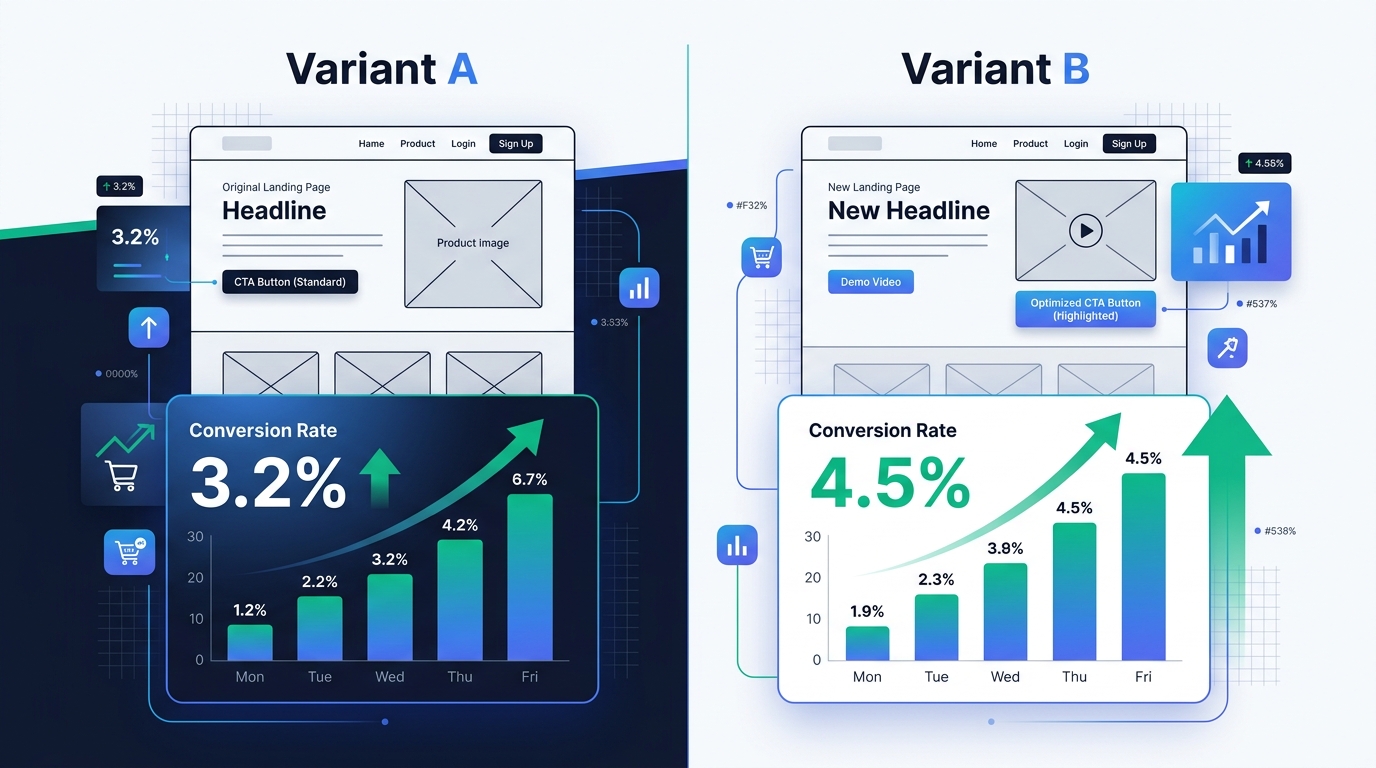
20. Make A/B testing your default operating mode. This is the cornerstone of any serious CRO program. Start with a hypothesis, something specific like "Changing the hero image to show the product in use will increase add-to-cart clicks." Create two versions. Run the test. Measure. SingleGrain recommends testing one element at a time so you can isolate exactly what caused the change.
21. Prioritize tests by potential impact and traffic volume. Don't waste time A/B testing footer link colors when your checkout page has a 70% abandonment rate. Use a prioritization framework: how much traffic does the page get, how much potential revenue is at stake, and how easy is the test to implement?
22. Test your pricing page more than anything else. In my experience, the pricing page is the most under-tested, highest-impact page on most websites. Layout, plan names, feature comparisons, the default selected tier. Small changes here directly affect revenue.
Advanced Tactics That Compound Results (Strategies 23-25)
23. Deploy AI chatbots for lead qualification. Amtrak's chatbot "Julie" answers 5 million questions annually, saved them $1 million, and increased bookings by 30%. You don't need that scale to benefit. Even a simple chatbot that qualifies visitors with targeted questions keeps warm leads in your funnel when they're not ready to convert immediately. This pairs well with a broader approach to generating and nurturing website leads over time.
24. Personalize based on behavior, not just demographics. 81% of customers prefer personalized experiences. Tools like Dynamic Yield and Nosto can serve different content based on browsing history, past purchases, or even time of day. WordStream's analysis highlights brands like Haus Labs, whose shade-finder quiz narrows thousands of products down to one perfect recommendation, simplifying the purchase decision dramatically.
25. Recover abandoned carts with multi-touch sequences. A single "you left something behind" email recovers some revenue. A three-email sequence with escalating incentives, paired with retargeting ads, recovers significantly more. Add SMS to the mix if you have permission.
Putting It All Together
The mistake I see most teams make with website conversion optimization isn't picking the wrong tactics. It's trying to implement all 25 at once with no system for measuring what actually worked.
Pick three strategies from this list. The three that align most closely with where your funnel is leaking. Implement them. Measure for two to four weeks. Then pick three more.
The teams that consistently increase conversion rate aren't the ones with the biggest budgets or the fanciest tools. They're the ones that treat every page as a hypothesis, every change as an experiment, and every user interaction as data worth learning from.
Your conversion funnel isn't a set-it-and-forget-it asset. It's a system that rewards attention, iteration, and a genuine obsession with removing every unnecessary barrier between your visitor and the action you want them to take.
Start with the leaks. Fix them one at a time. Let the data tell you what's working. That's the whole game.

Sarah Chen
SEO strategist and web analytics expert with over 10 years of experience helping businesses improve their organic search visibility. Sarah covers keyword tracking, site audits, and data-driven growth strategies.
Frequently Asked Questions
- How much does a 1 second page load delay cost in conversions?
- A one-second delay in page load time costs 7% of conversions. For a site earning $10,000 daily, that equals $700 lost every 24 hours.
- What is the best way to improve website conversion rates?
- Start by understanding user intent and identifying specific friction points in your funnel, then implement targeted changes backed by data rather than making vague improvements. Pick three high-impact strategies at a time, measure results for 2-4 weeks, and iterate based on what the data shows.
- How long do website visitors have to decide if they'll stay or leave?
- Visitors typically decide whether to stay or bounce within the first 8 seconds, so your headline must clearly communicate what you do, who it's for, and why it matters in that timeframe.
- What percentage of customers convert more when they read reviews?
- Customers who read reviews convert 120.3% more than those who don't, making reviews and testimonials one of the most impactful trust-building elements you can display on your site.
- How fast should a website load for optimal conversions?
- Sites should aim to load in under 2 seconds, with ideal performance at 0.8 seconds, which outperforms 94% of the web according to benchmark data.
- How much do behavioral analytics tools like heatmaps improve conversion rates?
- Behavioral analytics can dramatically improve conversions—for example, Thalys railway increased their conversion rate from 2.9% to 17.4% (500% improvement) after using heatmaps to fix messaging and design issues.
- What percentage of e-commerce traffic comes from mobile devices?
- Over 60% of e-commerce traffic comes from mobile devices, making mobile optimization critical for conversion success.
- How many fields should you include in a form for best results?
- Minimize form fields—each additional field creates friction and reduces conversions. Only ask for information you truly need immediately, and consider using progressive profiling to collect additional data over multiple interactions.
Explore more topics