
From Blue Links to AI Recommendations: Rebuilding Your SEO Strategy for 2026
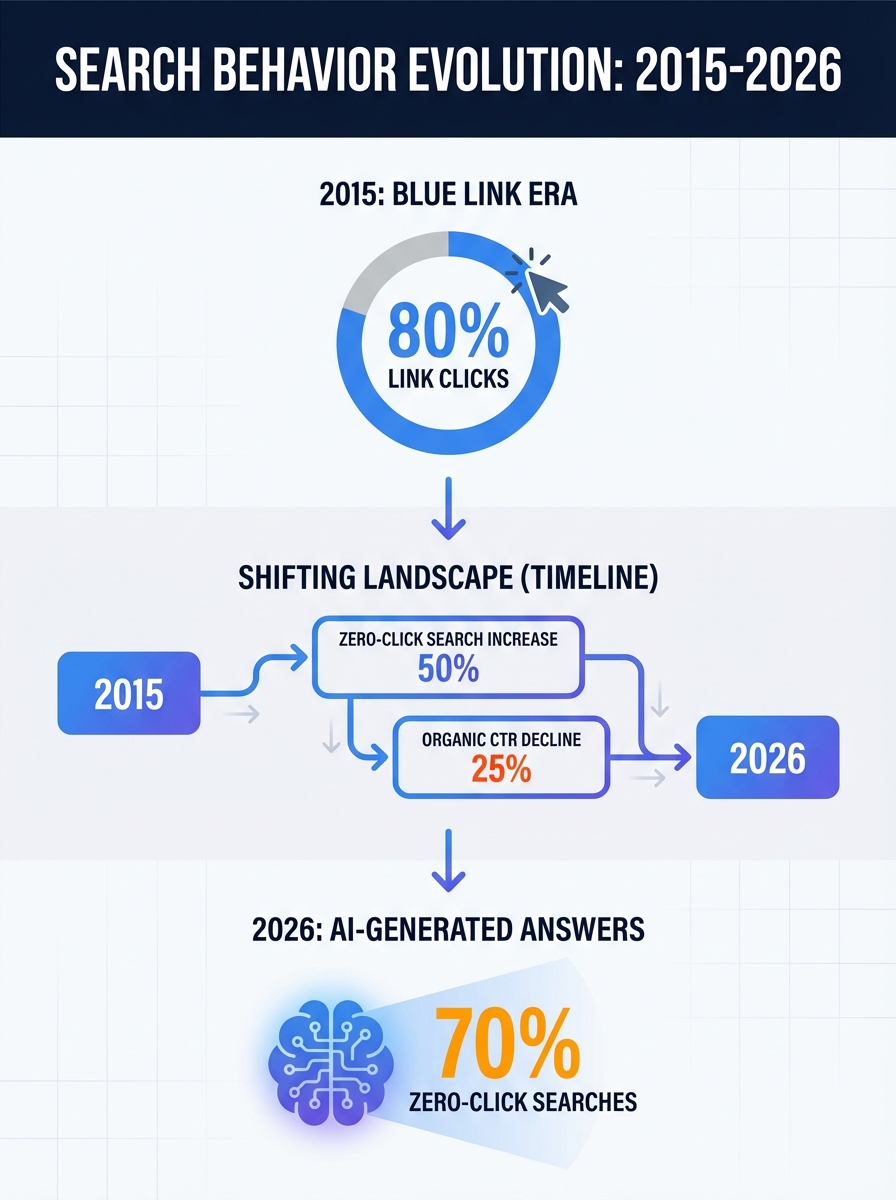
Sixty-eight percent of Google queries now end without a single click to any website. That number should terrify you if your entire SEO strategy still revolves around climbing the traditional results page. But here's the thing most people miss: the traffic didn't disappear. It shifted.
From Blue Links to AI Recommendations: Rebuilding Your SEO Strategy for 2026
Sixty-eight percent of Google queries now end without a single click to any website. That number should terrify you if your entire SEO strategy still revolves around climbing the traditional results page. But here's the thing most people miss: the traffic didn't disappear. It shifted. Users are still searching, still finding answers, still making buying decisions. They're just doing it inside AI-generated summaries, conversational interfaces, and recommendation engines that never send them to your site at all. The question isn't whether SEO is dead. It's whether you're optimizing for a search experience that barely exists anymore.
The Search Behavior Shift You Can't Ignore
The old model was linear. Someone typed a query, scanned a list of blue links, clicked through to a website, and explored. That behavior pattern defined two decades of search marketing. Now the dominant pattern is different: ask, get an answer, take action. As Forbes reported on this shift, the platforms shaping that new pattern include ChatGPT, Claude, Gemini, Perplexity, and Google itself through its AI Overviews feature.
The data tells a brutal story. When Google's AI Overviews appear on a search result, the click-through rate on the top organic result drops by 34.5%. Organic CTR has fallen from 1.41% to 0.64% year-over-year on queries where AI Overviews show up. And those overviews now appear in 4.5% to 12.5% of all searches, with certain categories like health seeing coverage as high as 82.5%.
This isn't a minor adjustment to your traffic projections. This is a structural change to how people consume information online. And it demands you think beyond keyword rankings as your primary success metric.
What GEO Actually Means (And Why You Should Care)
You've probably heard the term Generative Engine Optimization by now. Alongside it, you'll see Answer Engine Optimization (AEO) and Large Language Model Optimization (LLMO). These aren't marketing buzzwords invented to sell consulting retainers. They describe a real discipline: optimizing your content and brand presence so that AI systems cite you when generating answers.
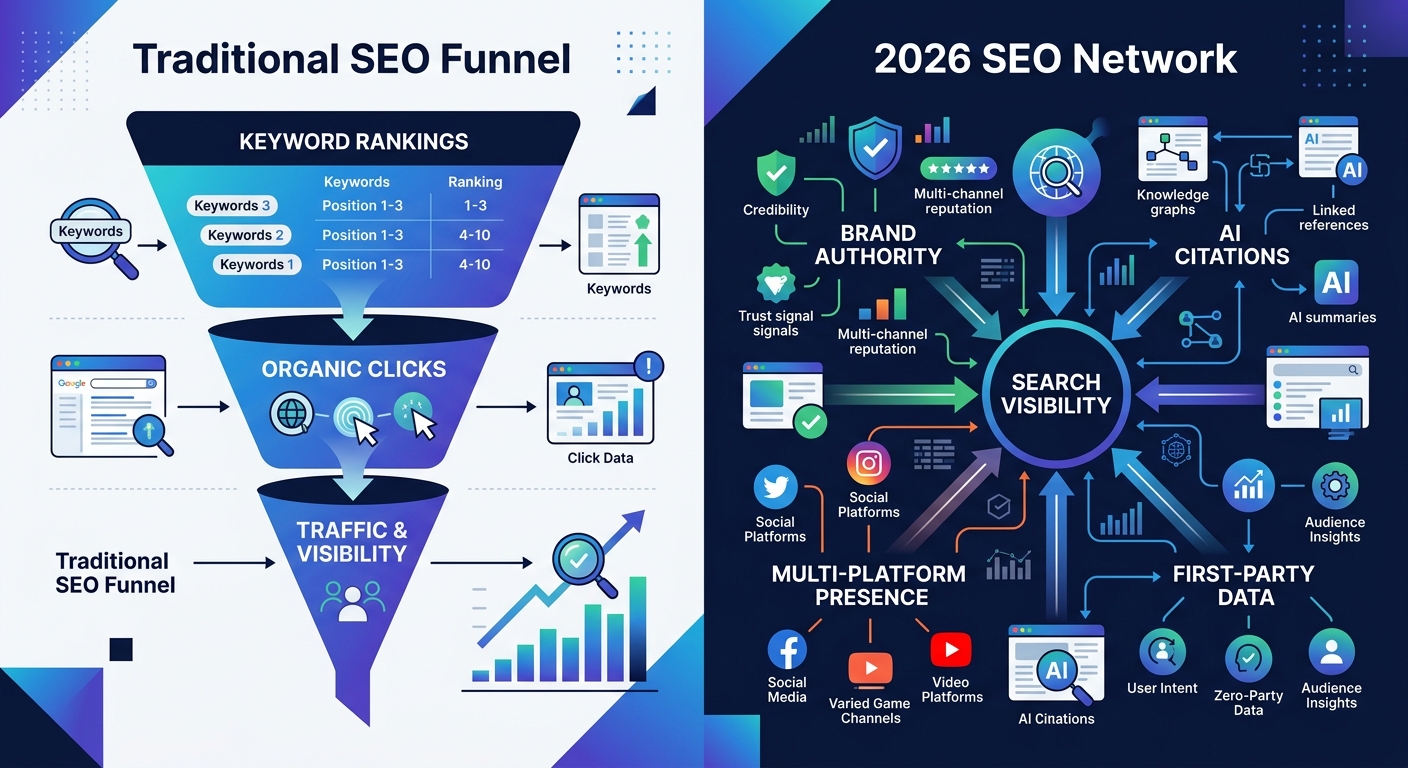
Here's the mental model shift. Traditional SEO asked: "How do I rank for this keyword?" GEO asks: "How do I become the source that AI models trust enough to reference?"
Those are fundamentally different questions. The first is about algorithmic positioning. The second is about SEO strategic positioning in the broadest sense, building the kind of authority, clarity, and trustworthiness that makes both humans and machines want to cite you.
Google still processes roughly 14 billion daily searches compared to ChatGPT's 37.5 million. So yes, traditional search isn't going anywhere soon. But the trajectory is clear, and the users migrating to AI-first search tend to be the high-intent, complex-research users you most want to reach.
The Content Structure AI Actually Reads
AI systems parse your content differently than humans do. They're looking for clear, literal statements of fact. They struggle with nuance, sarcasm, and vague headers.
Microsoft's own guidance on optimizing content for AI search answers makes this explicit: instead of a vague heading like "Learn More," use something like "What Makes This Dishwasher Quieter Than Most Models?" Your headings act as chapter titles that define clear content slices for AI systems to parse and potentially cite.
This pairs directly with how you approach writing meta descriptions that earn clicks, but the stakes are higher now. Your structured content isn't just helping users decide whether to click. It's determining whether AI systems surface your brand at all.
Building AI-Driven Search Visibility Through Brand Authority
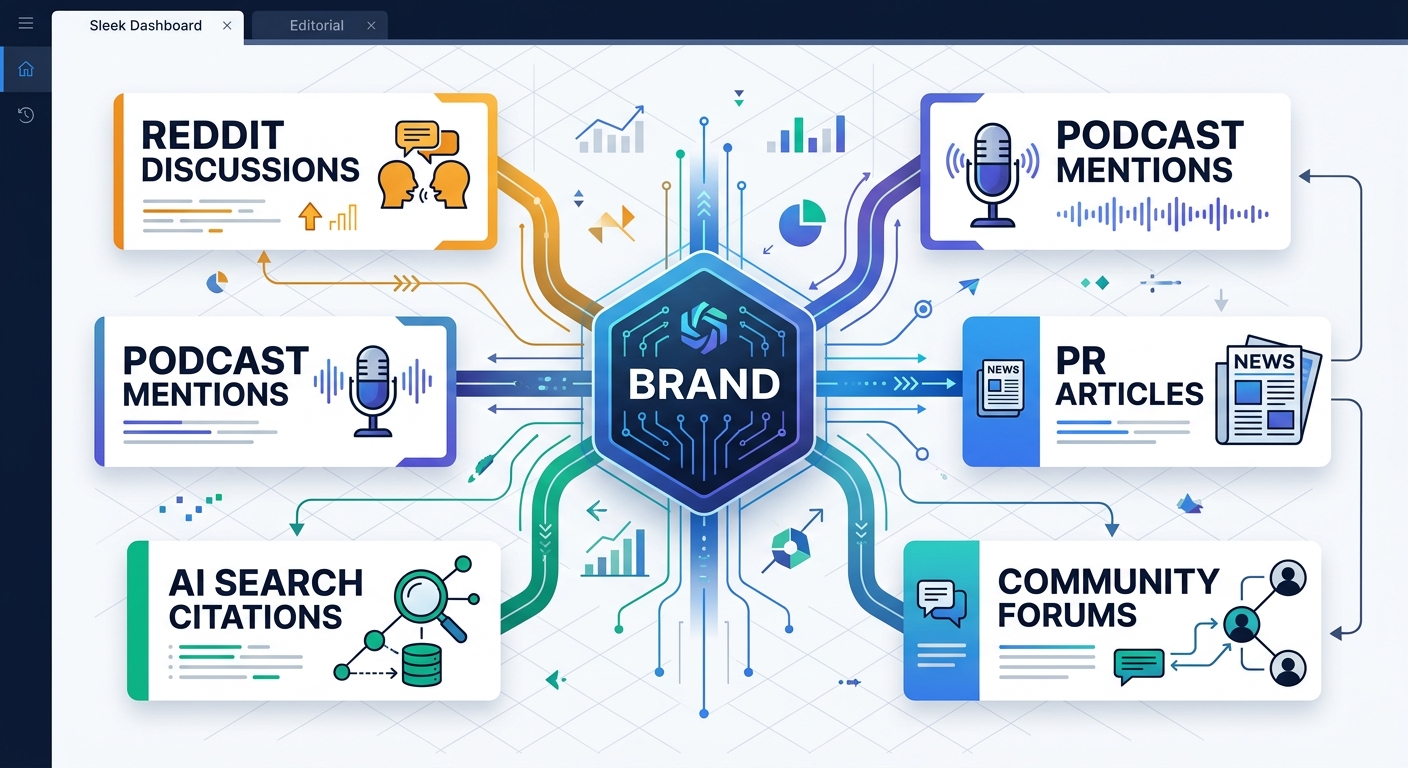
Here's the finding that changed how I think about SEO this year: brand mentions without links now correlate more strongly with AI Overview visibility than backlinks alone. An analysis of 75,000 brands found that being mentioned across the web, even without a hyperlink, matters more for AI visibility than traditional link building.
Think about why. Large language models are trained on massive text corpora. They develop associations between brands and topics based on frequency and context of mentions. If your brand consistently appears in discussions about your industry, in expert quotes, in community forums, and in press coverage, the model "knows" you're relevant. A backlink is just one signal among many.
This means your AI-driven search visibility strategy needs to include:
Publishing original research and data that others will reference (even without linking)
Securing PR placements and podcast appearances where your brand gets mentioned in context
Participating in communities where your audience hangs out, whether that's Reddit, industry Slack groups, or niche forums
Building clear author profiles with credentials and demonstrated expertise
Reddit has seen a 603% increase in organic traffic since mid-2023 because search engines now prioritize authentic user-generated content. Being present and genuinely helpful in those spaces isn't just community building. It's SEO.
First-Party Data as Your Competitive Moat
When every competitor can publish AI-assisted content on the same topics, what differentiates you? Your data. Your experiences. Your unique perspective on the market.
First-party data SEO is the practice of building content around data and insights that only you possess. Customer survey results, internal benchmarks, proprietary case studies, original experiments. AI models can't generate this content because it doesn't exist anywhere else on the internet. And that's precisely what makes it valuable as a source.
Sites that rely heavily on AI-generated content without unique human input saw average traffic declines of 34% after Google's December 2025 core update. The algorithm is getting better at distinguishing between content that adds something new to the conversation and content that merely rehashes what already exists.
The winning approach is hybrid. Use AI tools for research, outlining, and rough drafts. Then layer in what only humans can provide: original analysis, firsthand experience, expert judgment, and proprietary data. If you're running audits to find hidden errors in your marketing data, the insights from those audits become the kind of unique content that AI systems want to cite.
This is where understanding your performance metrics becomes doubly important. You need both technical performance signals that keep search engines happy and content quality signals that keep AI systems citing you.
Five Steps to Rebuild Your Visibility Strategy
Enough theory. Here's the framework I've been using with teams who need to adapt their SEO approach without abandoning what already works.
Step 1: Audit Your Existing Content for AI Readability
Go through your highest-traffic pages. For each one, ask: if an AI system read this page, could it extract a clear, factual answer to a specific question? If your content is structured around vague headers, buried insights, and lengthy intros before the useful information, it's not AI-friendly.
Rewrite headers to be specific and declarative. Front-load key facts in each section. Add structured data markup (JSON-LD) for articles, products, FAQs, and business information.
Step 2: Map Your Brand's Citation Landscape
Where does your brand get mentioned across the web? Track mentions in forums, news articles, social media, and AI outputs. Tools exist to monitor whether ChatGPT, Perplexity, or Google's AI Mode mention your brand for relevant queries.
If you're invisible in these spaces, you know where to focus. Getting cited by authoritative sources requires publishing content worth citing: expert opinions, original data, and clearly stated positions on industry topics.
Step 3: Diversify Your Search Presence
Stop thinking of SEO as Google optimization. Your audience searches on YouTube, TikTok, Reddit, LinkedIn, and AI platforms. Each has its own search recommendation algorithms and each requires a slightly different approach to content formatting and distribution.
Build a content cluster strategy that spans platforms. A pillar article on your site can spawn a YouTube explainer, a Reddit comment thread where you share genuine expertise, a LinkedIn post with your hot take, and a podcast episode diving deeper. This cross-platform presence is what builds the brand signals that AI systems pick up on.
Step 4: Invest in Branded Search
Generic informational queries are the ones most disrupted by AI Overviews. Branded queries, where someone searches specifically for your company or product, are far more resilient. When someone types your brand name into a search bar, AI isn't going to summarize your competitor's content.
Run awareness campaigns across social platforms. Building a genuine social media presence isn't just about engagement metrics anymore. It's about driving the branded search volume that becomes your most reliable traffic source.
Step 5: Rethink Your Measurement Stack
You can't manage what you don't measure, and your old dashboard probably isn't measuring the right things anymore. If your primary KPI is still "organic sessions," you're only seeing part of the picture.
Add these to your measurement framework:
Impression share across AI Overviews and featured snippets
Brand mention volume across forums, news, and AI outputs
Share of voice in AI-generated answers for your core topics
Assisted conversions from content that builds awareness without generating direct clicks
Topical authority scores based on your content cluster coverage
The old metrics still matter. Understanding why rankings drop and how to recover is still critical work. But these new signals tell you whether your broader visibility strategy is working in the AI search era.
The Hard Truth About What Comes Next
Traditional SEO isn't dead. Google still drives enormous traffic, and the fundamentals of technical optimization, quality content, and authority still work. But if you're only optimizing for the blue links, you're optimizing for a shrinking share of how people find information.
The shift toward AI recommendations means your brand needs to be the answer, not just a result. That requires thinking about SEO strategic positioning as a brand-building exercise, not just a traffic acquisition tactic. Publish things only you can publish. Be present where your audience actually spends time. Structure your content so machines can understand and cite it. And measure success by whether you're becoming a trusted source, not just whether you climbed from position seven to position four.
The teams I see winning right now are the ones who stopped treating SEO as a channel and started treating it as a visibility strategy that spans every platform where their audience asks questions. That's the rebuild worth doing.

Sarah Chen
SEO strategist and web analytics expert with over 10 years of experience helping businesses improve their organic search visibility. Sarah covers keyword tracking, site audits, and data-driven growth strategies.
Frequently Asked Questions
- What percentage of Google searches now end without clicking a website?
- Sixty-eight percent of Google queries now end without a single click to any website, as users are finding answers through AI-generated summaries, conversational interfaces, and recommendation engines instead of visiting traditional websites.
- How much does click-through rate drop when Google's AI Overviews appear?
- When Google's AI Overviews appear on a search result, the click-through rate on the top organic result drops by 34.5%, with organic CTR falling from 1.41% to 0.64% year-over-year on queries where AI Overviews show up.
- What is Generative Engine Optimization (GEO) and how does it differ from traditional SEO?
- GEO is the practice of optimizing content so that AI systems cite you when generating answers. Unlike traditional SEO which asks "How do I rank for this keyword?", GEO asks "How do I become the source that AI models trust enough to reference?"
- Do brand mentions without links help with AI search visibility?
- Yes, brand mentions without links now correlate more strongly with AI Overview visibility than backlinks alone. Large language models develop associations between brands and topics based on the frequency and context of mentions across the web.
- How should I structure article headings to be AI-friendly?
- Use specific and declarative headings that clearly state what each section answers, such as "What Makes This Dishwasher Quieter Than Most Models?" instead of vague headers like "Learn More" or "Our Approach", since AI systems parse content differently and need clear chapter titles to extract and cite information.
- What happened to websites using AI-generated content without unique human input?
- Sites that rely heavily on AI-generated content without unique human input saw average traffic declines of 34% after Google's December 2025 core update, as the algorithm improved at distinguishing between content that adds something new versus content that merely rehashes existing information.
- What is first-party data SEO and why does it matter?
- First-party data SEO involves building content around data and insights only you possess, such as customer survey results, proprietary case studies, and original experiments. This content is valuable because AI models cannot generate it elsewhere on the internet, making it citation-worthy for AI systems.
- Which search queries are most resistant to disruption from AI Overviews?
- Branded queries, where someone searches specifically for your company or product, are far more resilient to AI Overview disruption compared to generic informational queries, since AI won't summarize a competitor's content when someone searches for your brand name.
Explore more topics