
Conversion Optimization Guide Documents Five Tests Showing 8% to 31% Lift from Landing Page, Form, and UX Changes
Five documented conversion rate optimization tests produced lifts between 8 percent and 31 percent by addressing landing page focus, form length, and checkout friction, according to a guide published on enstinemuki.com on September 13.

Conversion Optimization Guide Documents Five Tests Showing 8% to 31% Lift from Landing Page, Form, and UX Changes
Five documented conversion rate optimization tests produced lifts between 8 percent and 31 percent by addressing landing page focus, form length, and checkout friction, according to a guide published on enstinemuki.com on September 13. The examples center on improving existing traffic rather than acquiring new visitors, with one calculation showing how a SaaS company moving from 3 percent to 4.2 percent conversion would generate 240 additional trials from 20,000 monthly landing page visits without additional ad spend.
The guide presents case studies from B2B software companies, marketing agencies, ecommerce brands, and cybersecurity firms that isolated single conversion variables and measured results. Each example includes before-and-after conversion rates tied to specific page elements rather than general optimization advice.
Landing Page Simplification Test
A B2B software team testing a paid search landing page changed the headline from "Work Smarter With Better Operations" to "Cut Weekly Inventory Reporting Time by 40%," according to the guide. The revised page removed two secondary CTAs above the fold and repositioned a customer quote near the hero section.
The original landing page converted at 4.8 percent while the simplified version converted at 6.1 percent, representing a 27 percent relative lift. The guide attributes the improvement to matching the landing page message to the paid search ad topic rather than using generalized business terminology.
Form Field Reduction Analysis
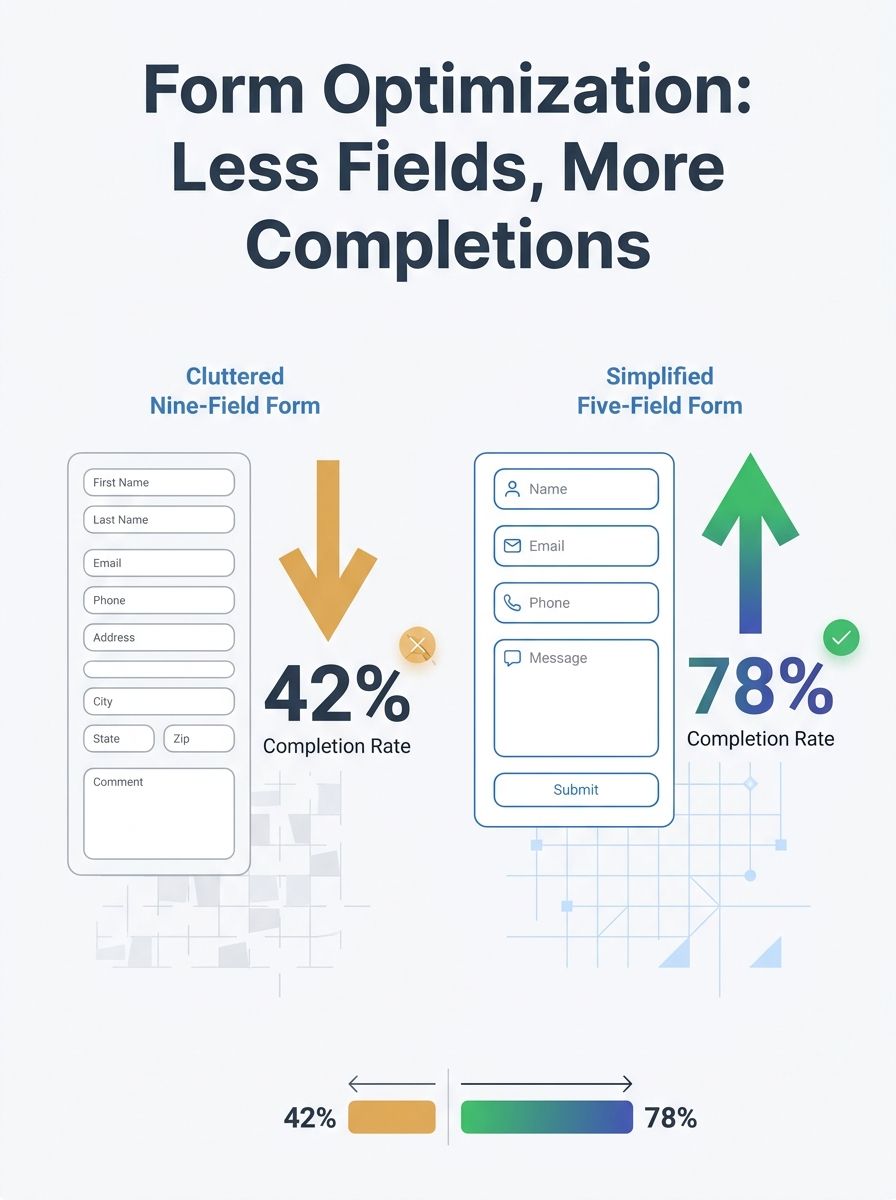
A marketing agency tested a nine-field consultation form against a five-field version by removing "Company size," "Budget," "Industry," and "How did you hear about us?" fields, the guide shows. The longer form completed at 11.2 percent while the shorter form completed at 17.6 percent, with no meaningful drop in lead quality after sales team review.
The guide recommends single-column layouts, inline validation for immediate error correction, and replacing generic "Submit" buttons with outcome-focused copy such as "Get My Quote." Privacy reassurance placement near sensitive fields also appears in the suggested optimization list.
Call-to-Action Button Testing
An ecommerce subscription brand tested three CTA button labels on a product page: "Subscribe," "Start My Monthly Box," and "Get My First Box," according to the published examples. The third option increased button clicks by 14 percent and completed purchases by 8 percent compared to the generic "Subscribe" baseline.
The guide suggests the concrete phrasing worked because users could visualize the outcome. CTA optimization extends beyond wording to placement decisions, with long mobile pages potentially requiring sticky bottom buttons and pricing pages needing repeated CTAs after major sections.
Headline Copy Comparison
A cybersecurity company changed its homepage headline from "Security That Moves at the Speed of Innovation" to "Find and Fix Cloud Security Risks Before Attackers Do," producing a 31 percent increase in demo clicks over a four-week test period, the guide reports. The second version named the audience's pain point and showed a specific outcome rather than using abstract language.
The guide outlines five questions conversion copy should answer: what the product is, who it serves, what problem it solves, why users should trust it, and what action to take next. Specific proof elements such as customer counts, ratings, security badges, and case study results strengthen conversion copy more than general claims like "Built for modern teams."
Mobile Checkout Optimization
An online retailer identified mobile conversion drop-off between cart and payment through session recordings, discovering the checkout page loaded a promotional popup, forced account creation, and hid guest checkout below the fold, according to the guide. The team removed the checkout popup, moved guest checkout above account creation, and reduced mobile checkout load time from 5.4 seconds to 2.8 seconds.
The three changes produced a 12 percent increase in completed mobile orders. The conversion impact of page load speed has been documented separately showing a 7x gap between one-second and five-second load times.
Reading Between the Lines
The published guide positions conversion optimization as a traffic multiplication strategy rather than a traffic acquisition strategy, with the calculation showing 240 additional trials from a 1.2 percentage-point conversion improvement at fixed visit volume. That framing challenges the common marketing instinct to solve conversion problems by buying more ads.
The five examples share a pattern of removing obstacles rather than adding persuasion elements. The landing page test removed competing CTAs. The form test removed fields. The checkout test removed popups and hidden elements. The CTA and headline tests replaced vague language with concrete outcomes. Organizations evaluating CRO platform options may find testing methodologies more impactful than feature lists when selecting tools.
The guide's emphasis on session recordings and specific metrics suggests conversion optimization requires measurement infrastructure before creative testing. The absence of testing timelines, sample sizes, and statistical significance calculations in the published examples leaves practitioners to determine their own testing rigor standards.

Alex Chen
Alex Chen is a digital marketing strategist with over 8 years of experience helping enterprise brands and agencies scale their online presence through data-driven campaigns. He has led marketing teams at two successful SaaS startups and specializes in conversion optimization and multi-channel attribution modeling. Alex combines technical expertise with strategic thinking to deliver actionable insights for marketing professionals looking to improve their ROI.
Related Articles

Website Speedy Publishes Ten-Tool Comparison Guide Categorizing CRO Platforms by Conversion Challenge Type
Website Speedy published a comparative analysis of ten conversion rate optimization platforms on July 17, categorizing tools by the specific conversion barriers they address rather than ranking them by popularity, according to the guide posted on the company's blog.

Website Performance Analysis Shows 7x Conversion Gap Between One-Second and Five-Second Page Loads
A statistical compilation published August 24, 2026 quantifies the revenue cost of slow-loading websites, showing pages that load in one second convert at 3.05% while five-second pages convert at just 0.41%, according to data published by Mean CEO.

Local Marketing Analysis Identifies Conversion Gap Costing Service Businesses High-Intent Leads
An analysis published June 12, 2026, by the Rockland County Times identifies a structural blind spot in local marketing programs: businesses optimize for map pack visibility but fail to build conversion systems for the high-intent traffic they generate, according to the publication's examination of
Explore more topics