
Website Performance Analysis Shows 7x Conversion Gap Between One-Second and Five-Second Page Loads
A statistical compilation published August 24, 2026 quantifies the revenue cost of slow-loading websites, showing pages that load in one second convert at 3.05% while five-second pages convert at just 0.41%, according to data published by Mean CEO.

Website Performance Analysis Shows 7x Conversion Gap Between One-Second and Five-Second Page Loads
A statistical compilation published August 24, 2026 quantifies the revenue cost of slow-loading websites, showing pages that load in one second convert at 3.05% while five-second pages convert at just 0.41%, according to data published by Mean CEO. The analysis aggregates industry studies, platform benchmarks, and published case data from Shopify, Google, Portent, and multiple enterprise implementations to document the commercial impact of Core Web Vitals performance.
Conversion Rate Deterioration Tied to Millisecond Delays
The compiled statistics show conversion degradation scales linearly with load time delays. Every 100 milliseconds of added page-load latency reduces conversion rates by approximately one percent, according to multiple industry benchmarks cited in the analysis. Shopify's internal data, referenced in the report, shows a steeper relationship: each 100-millisecond delay correlates with 3.5 percent lower conversion rates across ecommerce transactions.
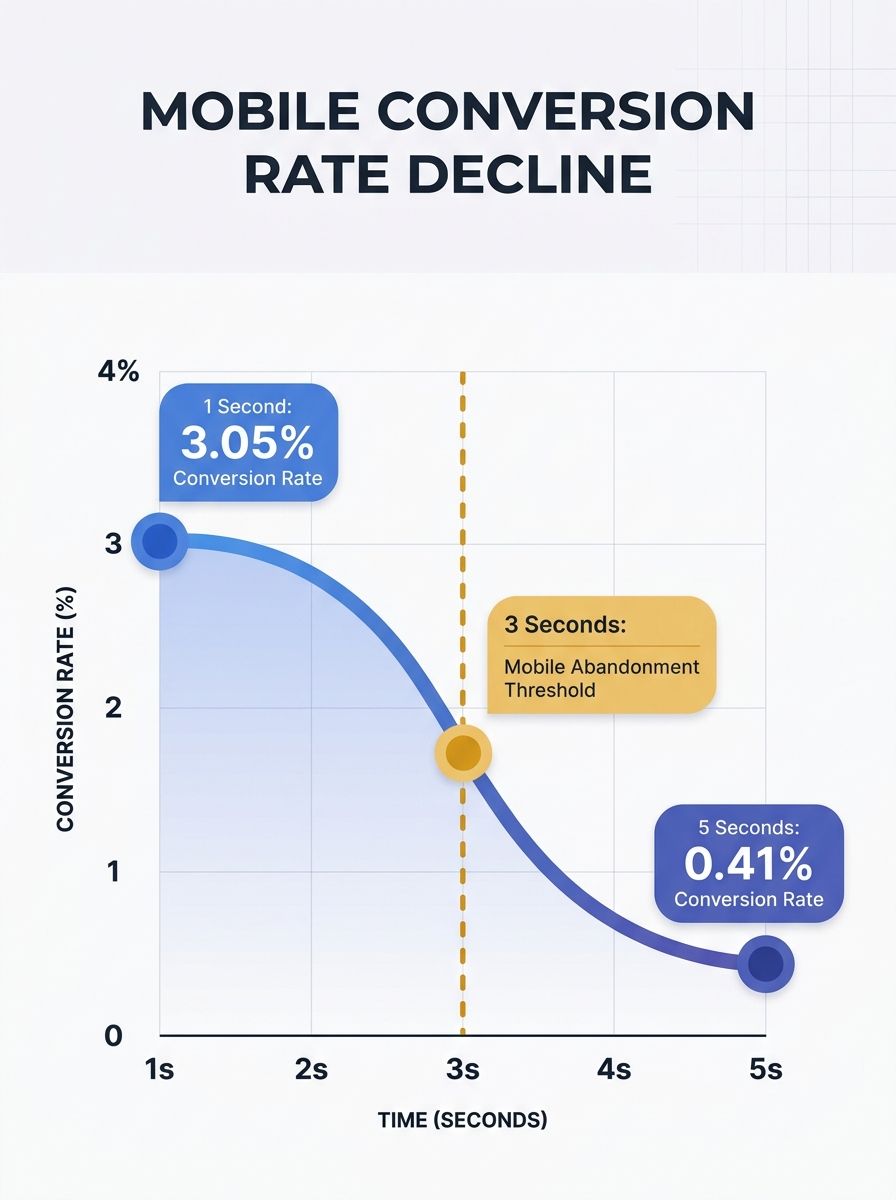
Portent's research found conversion rates decline from 3.05 percent at one-second load times to 2.0 percent at two seconds, 1.13 percent at three seconds, and 0.41 percent at five seconds. Mobile abandonment accelerates past the three-second threshold, with 53 percent of mobile visits abandoned when pages exceed that duration.
Google's published research, cited in the compilation, documented conversion lifts of up to 27 percent when load time improved from three seconds to one second. The analysis frames page speed not as a technical polish task but as a direct sales variable that compounds across traffic volume.
Enterprise Case Studies Quantify Revenue Impact
Published implementations from Rakuten, Vodafone Italy, RedBus, and Yelp document measurable revenue and conversion gains tied to Core Web Vitals improvements. Rakuten reported 33.13 percent higher conversion rates and 53.37 percent more revenue per visitor following Core Web Vitals optimization work, according to case data referenced in the analysis.
Vodafone Italy improved Largest Contentful Paint (LCP) by 31 percent and recorded an eight percent increase in sales. RedBus focused on Interaction to Next Paint (INP) and saw a seven percent sales lift. Yelp reduced mobile First Contentful Paint from 4.4 seconds to 1.8 seconds and measured a 15 percent increase in conversions on contact pages.
"Every extra 100 milliseconds can cost about one percent in conversions, and for bootstrapped founders that is not a technical footnote, it is margin leakage," wrote Violetta Bonenkamp, founder of Mean CEO, in the published analysis. The report emphasizes that performance delays function as an invisible tax on customer acquisition costs, particularly for companies operating with tight cash buffers.
Mobile Web Core Web Vitals Pass Rate Remains Below 50 Percent
Approximately 49.1 percent of the mobile web passes Core Web Vitals thresholds in 2026, according to field data cited in the analysis. The statistic indicates that more than half of mobile web properties fail to meet Google's benchmarks for loading speed (LCP), interactivity (INP), and visual stability (Cumulative Layout Shift).
The analysis frames this performance gap as a competitive opening for disciplined optimization efforts. Companies that meet Core Web Vitals thresholds on mobile devices differentiate themselves from the majority of web properties that continue to deliver slow or unstable experiences, according to the report's interpretation of PageSpeed Matters and Chrome User Experience Report data.
The report links Core Web Vitals performance to both organic search visibility and paid traffic efficiency, arguing that conversion rate degradation from slow pages erodes return on ad spend and content marketing investments equally.
Geographic and Funding Context Boosts Performance Costs
The analysis emphasizes that performance costs compound faster for European startups and bootstrapped companies operating with lower capital reserves than venture-backed U.S. peers. "When cash is constrained, waste compounds faster than growth," Bonenkamp wrote, framing speed optimization as a financial discipline rather than a technical preference.
The report argues that a slow website can neutralize gains from advertising spend, content production, SEO, and sales outreach by introducing conversion leakage before prospects evaluate pricing, messaging, or product features. For service businesses and lead-generation sites, the analysis notes that speed impacts extend beyond ecommerce contexts, citing Yelp's contact-page conversion lift as evidence that responsiveness affects inquiry volume across business models.
The compiled statistics draw from sources published between 2025 and 2026, including Shopify platform data, web.dev case studies, and published performance analyses. The report acknowledges that conversion impact varies by industry vertical, traffic quality, and checkout complexity, cautioning that directional benchmarks do not guarantee identical results across different business contexts.
What This Means for Marketing Managers
Marketing managers allocating budget across paid acquisition, content production, and conversion optimization now have quantified evidence that page speed delivers measurable return on investment. The seven-times conversion differential between one-second and five-second load times suggests that performance optimization may yield higher marginal returns than incremental increases in traffic volume or creative testing for sites currently failing Core Web Vitals thresholds.
The mobile abandonment data—53 percent of visits lost after three seconds—indicates that performance issues filter prospects before messaging, offer structure, or pricing ever reach evaluation. Marketing teams tracking conversion attribution and customer acquisition costs should audit whether slow page loads are inflating CAC by reducing conversion denominators while advertising costs remain constant.
The report's emphasis on INP (interactivity) and CLS (layout stability) alongside traditional load-time metrics suggests that marketing managers should expand performance audits beyond initial page-load speed to include post-load responsiveness and visual stability, particularly for mobile-first audiences where the majority of web traffic now originates.

Sarah Chen
SEO strategist and web analytics expert with over 10 years of experience helping businesses improve their organic search visibility. Sarah covers keyword tracking, site audits, and data-driven growth strategies.
Related Articles
Google Tightens Core Web Vitals LCP Threshold to 2.0 Seconds, Only 33% of Mobile Sites Pass
Google tightened its Largest Contentful Paint threshold from 2.5 seconds to 2.0 seconds in a March 2026 Core Web Vitals update, forcing website operators to reevaluate optimization strategies that previously passed the performance benchmark, according to a June 5, 2026 analysis published by The Visu

More Than Half of Websites Fail Core Web Vitals, Manufacturing Sector Shows Disproportionate Performance Gaps
Only 48 percent of websites pass Google's Core Web Vitals benchmarks on mobile, according to data compiled by Lform Design from the HTTP Archive Web Almanac, with manufacturing websites showing disproportionate exposure due to below-standard load times averaging over six seconds.

Local Marketing Analysis Identifies Conversion Gap Costing Service Businesses High-Intent Leads
An analysis published June 12, 2026, by the Rockland County Times identifies a structural blind spot in local marketing programs: businesses optimize for map pack visibility but fail to build conversion systems for the high-intent traffic they generate, according to the publication's examination of
Explore more topics