
Google AI Overviews Guide Details Search Console Reporting Limits and Site Control Options
A comprehensive guide on Google AI Overviews published by Relevant Audience on September 15 explains how the feature selects sources, what data Search Console surfaces, and which controls prevent content from appearing in AI-generated summaries, noting that Search Console's generative AI performance

Google AI Overviews Guide Details Search Console Reporting Limits and Site Control Options
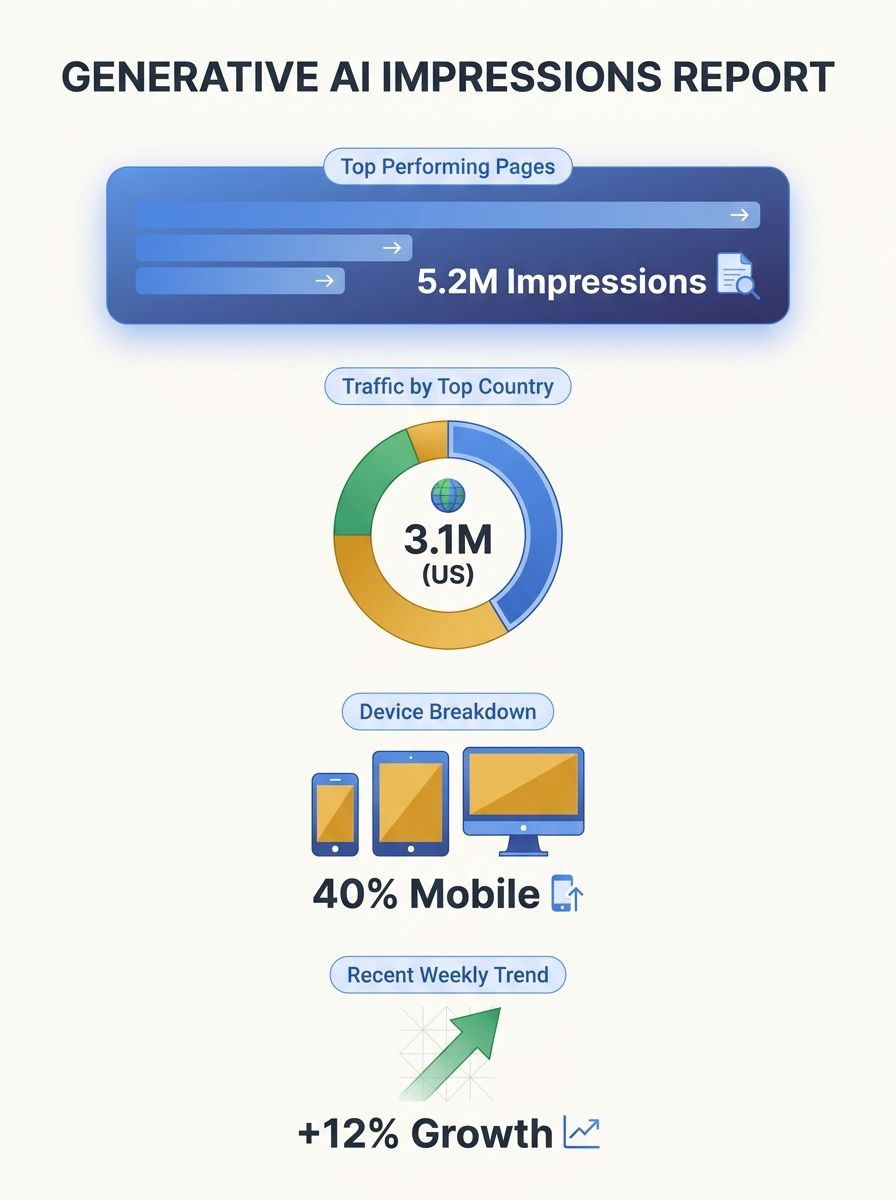
A comprehensive guide on Google AI Overviews published by Relevant Audience on September 15 explains how the feature selects sources, what data Search Console surfaces, and which controls prevent content from appearing in AI-generated summaries, noting that Search Console's generative AI performance report—rolled out to all websites globally as of August 31, 2026—shows impressions by page, country, device, and date but includes no click or query data, according to the guide.
The guide addresses how Google transitioned AI-generated answers from the Search Generative Experience (SGE) tested through Search Labs in 2023 to AI Overviews launched in the United States at Google I/O in May 2024, with staged expansion to additional countries and languages since. AI Overviews appear for queries Google's systems determine would benefit from a multi-source summary, typically complex questions requiring information synthesis.
Search Console Reporting Constraints
The generative AI performance report in Search Console operates as a filtered view of data already captured in the Web search report, meaning the numbers must not be added to regular totals. The report's structure creates three significant gaps for analysis. First, it contains no click data and no query data, preventing click-through rate calculation. Second, every link inside an AI Overview receives the position of the AI Overview block itself, so the position metric does not indicate where a specific link appeared within the summary. Third, Google does not publish the impression threshold required for the report to appear; sites with insufficient AI Overview impressions may see no report at all.
The report distinguishes impressions across AI Overviews and AI Mode, Google's separate conversational search experience. Both features link to websites and both count toward the generative AI performance metrics, but AI Mode presents longer answers with follow-up question support while AI Overviews integrate into standard result pages.
Source Selection Mechanics
Google's documentation for site owners states that pages must be indexed and eligible for snippet display to appear as AI Overview links, with no additional technical requirements or special schema needed. The guide notes that pages stating facts clearly in single sentences—with actor, date, and figure all present—are easier for AI systems to use than pages spreading answers across multiple paragraphs or using general phrasing. This structure principle aligns with generative engine optimization methods documented in recent agency analyses.
The AI system retrieves passages from multiple pages and grounds its generated answer in them, differing from featured snippets which quote text from a single page. AI Overviews create new text from several sources and display multiple links, spreading visibility across sites rather than concentrating it on one URL. Links may appear beside the text, below it, or behind an expand button depending on Google's current layout testing.
Content Exclusion Controls
Site owners can prevent content from appearing in AI Overviews using three levels of control. The data-nosnippet attribute applies to specific page sections. The nosnippet or max-snippet robots meta tags operate at page level, limiting text usage in both standard results and AI features. The Search generative AI control in Search Console, available to all websites as of August 31, 2026, blocks participation at the property level.
The guide explicitly states that Google-Extended—the crawler control announced for blocking content from AI training data—does not affect AI Overview inclusion. This distinction matters for sites attempting to manage where their content appears across Google's AI products.
Traffic Impact Varies by Query Type
The guide observes that AI Overviews push organic results lower on the page and some users obtain answers without clicking. The effect differs by content category. Simple informational queries such as definitions show higher answer-completion rates than queries requiring action like purchasing, booking, or business contact. Sites cited inside AI Overviews gain top-of-page visibility while organic listings below the summary may see reduced click-through.
The guide recommends comparing click-through rate for identical pages before and after AI Overviews began appearing for specific query groups, and identifying which query types show rising impressions with declining clicks. This analysis approach helps distinguish AI Overview impact from other ranking or click-through factors.
Why This Matters Now
AI Overviews now appear frequently enough that Search Console built dedicated reporting for them, completing global rollout last month. The reporting gaps—no clicks, no queries, no intra-box position data—limit how precisely site owners can measure the feature's traffic contribution or loss. The absence of query data prevents matching specific content to the searches triggering AI Overview inclusion, making optimization difficult beyond the general principle of stating facts clearly in extractable sentences.
The distinction between blocking AI training (Google-Extended) and blocking AI Overview inclusion (nosnippet controls and the Search Console setting) requires active configuration decisions. Sites assuming Google-Extended handles both use cases will continue appearing in search AI features while blocking only the model training pipeline. The guide's clarification arrives as 73 percent of marketers now prioritize AI-generated answer optimization, making the technical control mechanisms directly relevant to current search strategy.
The structural difference from featured snippets shifts competitive dynamics. A featured snippet winner captures the top position; an AI Overview distributes visibility across several sources, changing what "ranking well" means when the summary itself satisfies many users before they reach the link list.

Sarah Chen
SEO strategist and web analytics expert with over 10 years of experience helping businesses improve their organic search visibility. Sarah covers keyword tracking, site audits, and data-driven growth strategies.
Related Articles

The Dual-Engine Visibility Strategy: Getting Your Content Into Both Google Search and AI Overviews in 2026
Google's own AI optimization guide, published May 15, 2026, explicitly advises site owners against creating separate AI-specific content. That guidance contradicts the central premise of every "AEO specialist" selling parallel content strategies for traditional search and generative AI surfaces.

AI Overviews Now Trigger on 48% of Google Searches, Slashing Organic CTR Up to 61%
AI Overviews now appear on 48 percent of all Google search queries—a 58 percent increase over the past three months—and zero-click searches have climbed to 83 percent on queries that trigger the feature, according to data published by Quasa on May 24. The shift has driven organic click-through rate

Google's May 2026 Search Redesign Cuts Publisher Traffic by 70% to 89% as AI Answers Replace Click-Through Results
Google announced the largest redesign of its search interface in 25 years at its May 2026 developer conference, introducing a conversational search box that accepts text, images, video, and file uploads while deploying automated information agents that monitor topics and push updates without user qu
Explore more topics