
Google Redesigns Search Around AI Agents and Conversational Tasks in Largest Update Since 2001
Google unveiled a fundamental redesign of its Search product at Google I/O 2026 on May 20, shifting the platform from keyword-based queries and blue links to AI-powered agents that continue working in the background, conversational interfaces that maintain context across interactions, and personaliz

Google Redesigns Search Around AI Agents and Conversational Tasks in Largest Update Since 2001
Google unveiled a fundamental redesign of its Search product at Google I/O 2026 on May 20, shifting the platform from keyword-based queries and blue links to AI-powered agents that continue working in the background, conversational interfaces that maintain context across interactions, and personalized dashboards built in real time around ongoing user tasks, according to Storyboard18.
The changes represent what Google called its largest search box redesign in more than 25 years, expanding input options beyond text to include images, videos, files, and Chrome tabs while introducing information agents that monitor topics without requiring repeated manual searches.
AI Mode Crosses One Billion Monthly Users as Query Volumes Double Each Quarter
Google's AI Mode has reached one billion monthly active users, with query volumes more than doubling every quarter since the feature launched, the company reported at the conference. Search activity across the platform hit an all-time high in the first quarter of 2026 as users increasingly adopted AI-driven interactions over traditional keyword searches.
The shift reflects a broader movement away from isolated search sessions toward continuous assistance. Users no longer need to return to Google repeatedly to check for updates on tracked topics. Instead, information agents now monitor changes and surface relevant updates automatically.
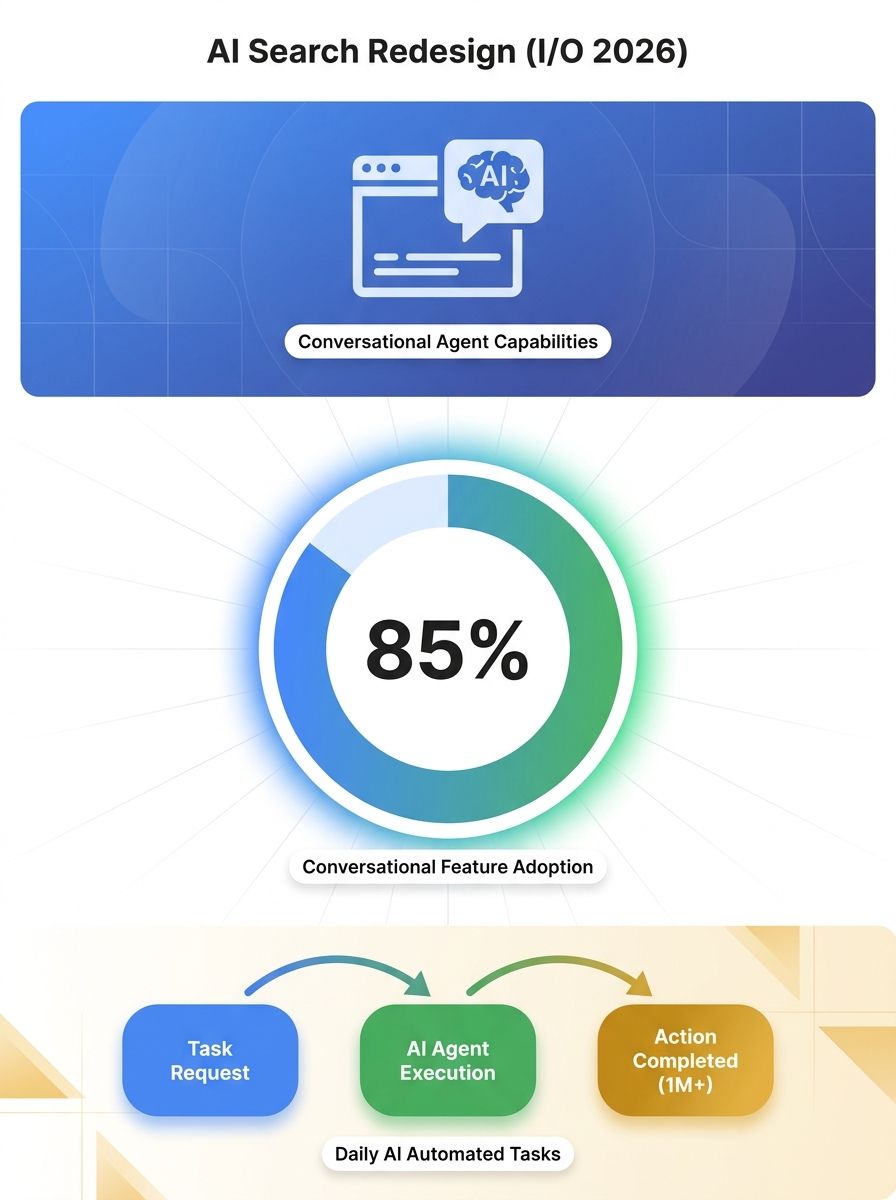
The company demonstrated agents that track apartment listings based on user-specified criteria, monitor product launches, follow sports updates in real time, and surface information without requiring manual query refinement. Each agent maintains context across sessions, eliminating the need to re-enter search parameters.
Search Box Redesign Expands Input Types and Question Framing
The redesigned search box now accepts multi-modal inputs including text, images, video files, documents, and content from open Chrome tabs. Google described the interface changes as the most significant update to the search box in over 25 years, moving beyond simple autocomplete suggestions to AI-powered question framing that helps users articulate more specific queries.
Users can now ask longer, more detailed questions that would have previously required multiple searches or manual filtering. The system interprets context from uploaded files and images, allowing searches that reference visual content directly rather than requiring text descriptions of what users are looking at.
The conversational layer allows follow-up questions directly within AI Overviews while maintaining the thread of previous queries. A user searching for wedding venues can ask an initial question, then continue with "What about options under $10,000?" or "Show me locations within 30 miles" without losing context from the original search.
Information Agents Move Search Tasks Into Background Monitoring
Google introduced information agents designed to shift Search from a pull model to a continuous monitoring system. Users specify requirements once and the agent continues scanning for updates, removing the need to manually check for changes.
The apartment search demonstration showed a user entering criteria such as price range, neighborhood, and square footage. The agent then monitors new listings that match those parameters and surfaces relevant options as they appear, rather than requiring the user to repeat the same search daily.
Similar agents track product availability, sports scores, news developments, and other time-sensitive information. The system generates alerts when monitored topics change, effectively turning Search into a persistent assistant rather than a query-response tool.
For marketing teams and SEO specialists managing client visibility, this shift means traditional optimization strategies focused on ranking for individual keyword queries may no longer capture how users interact with Search. Building tracking capabilities for AI answer engines becomes critical as agent-driven interactions obscure traditional click-through metrics.
Personalized Dashboards and Task-Specific Mini Apps
Google demonstrated Search's ability to generate custom interfaces around ongoing tasks, creating what the company described as mini apps built in real time. A user planning a wedding can specify preferences and receive a personalized dashboard tracking venue options, vendor availability, budget allocation, and timeline milestones.
The system assembles these dashboards by pulling structured data from multiple sources and organizing it around user-defined goals. Similar interfaces were shown for home moves, fitness tracking, travel planning, and project management.
These task-oriented experiences represent a departure from Search as a neutral information retrieval tool toward a goal-completion platform. The shift requires marketers to consider how their content fits into structured workflows rather than simply ranking for isolated queries.
Organizations relying on Search visibility must now account for how their content appears within agent-generated dashboards and task-specific interfaces. Adapting content strategy as search behavior shifts toward AI query intent becomes essential as Google moves beyond matching keywords to understanding and executing multi-step user goals.
Reading Between the Lines
Google's redesign signals the end of Search optimization built entirely around individual keyword rankings. When agents monitor topics continuously and dashboards assemble information automatically, the unit of optimization shifts from the query to the task. Marketing teams that continue focusing solely on ranking for specific terms will miss how users now interact with Search, where context persists across sessions and results compile over time rather than appearing in a single ranked list.
The one billion monthly users already engaging with AI Mode and the doubling of query volumes each quarter indicate this is not an experimental feature but a fundamental platform shift. SEO strategies built around traditional metrics like click-through rates and position tracking will increasingly fail to capture actual search visibility as more interactions happen through agents that surface information without requiring clicks to external sites. Organizations need audit frameworks that measure presence in agent-generated results and structured dashboards, not just blue-link rankings.
The task-oriented mini apps represent the clearest departure from conventional Search. When Google builds custom interfaces around user goals, the question is no longer "Does my page rank?" but "Does my content populate the relevant section of a user's dashboard?" Marketers who adapt content architecture to signal topic authority across interconnected content clusters will hold advantage as Search increasingly functions as a goal-completion platform rather than a query-response system.

Alex Chen
Alex Chen is a digital marketing strategist with over 8 years of experience helping enterprise brands and agencies scale their online presence through data-driven campaigns. He has led marketing teams at two successful SaaS startups and specializes in conversion optimization and multi-channel attribution modeling. Alex combines technical expertise with strategic thinking to deliver actionable insights for marketing professionals looking to improve their ROI.
Related Articles

Google Responds to "SEO Is Dead" Panic After I/O, Points Industry to Real Economic Risk
Google issued an official statement on May 21 clarifying that AI Mode is not the default Search experience, one day after the Google I/O 2026 keynote triggered widespread claims that traditional SEO had become obsolete. The @NewsFromGoogle account stated users "will continue to get a range of result

Google's May 2026 Search Redesign Cuts Publisher Traffic by 70% to 89% as AI Answers Replace Click-Through Results
Google announced the largest redesign of its search interface in 25 years at its May 2026 developer conference, introducing a conversational search box that accepts text, images, video, and file uploads while deploying automated information agents that monitor topics and push updates without user qu

AI Overviews Now Trigger on 48% of Google Searches, Slashing Organic CTR Up to 61%
AI Overviews now appear on 48 percent of all Google search queries—a 58 percent increase over the past three months—and zero-click searches have climbed to 83 percent on queries that trigger the feature, according to data published by Quasa on May 24. The shift has driven organic click-through rate
Explore more topics