
Building Your AI Answer Engine Tracking Stack: Moving Beyond Traditional SEO Tools in 2026
AI referral traffic to websites grew 357% year-over-year through mid-2025, according to Similarweb's Generative AI Report, and email marketers are absorbing the downstream effects whether they realize it or not.
Building Your AI Answer Engine Tracking Stack: Moving Beyond Traditional SEO Tools for Email Growth
AI referral traffic to websites grew 357% year-over-year through mid-2025, according to Similarweb's Generative AI Report, and email marketers are absorbing the downstream effects whether they realize it or not.
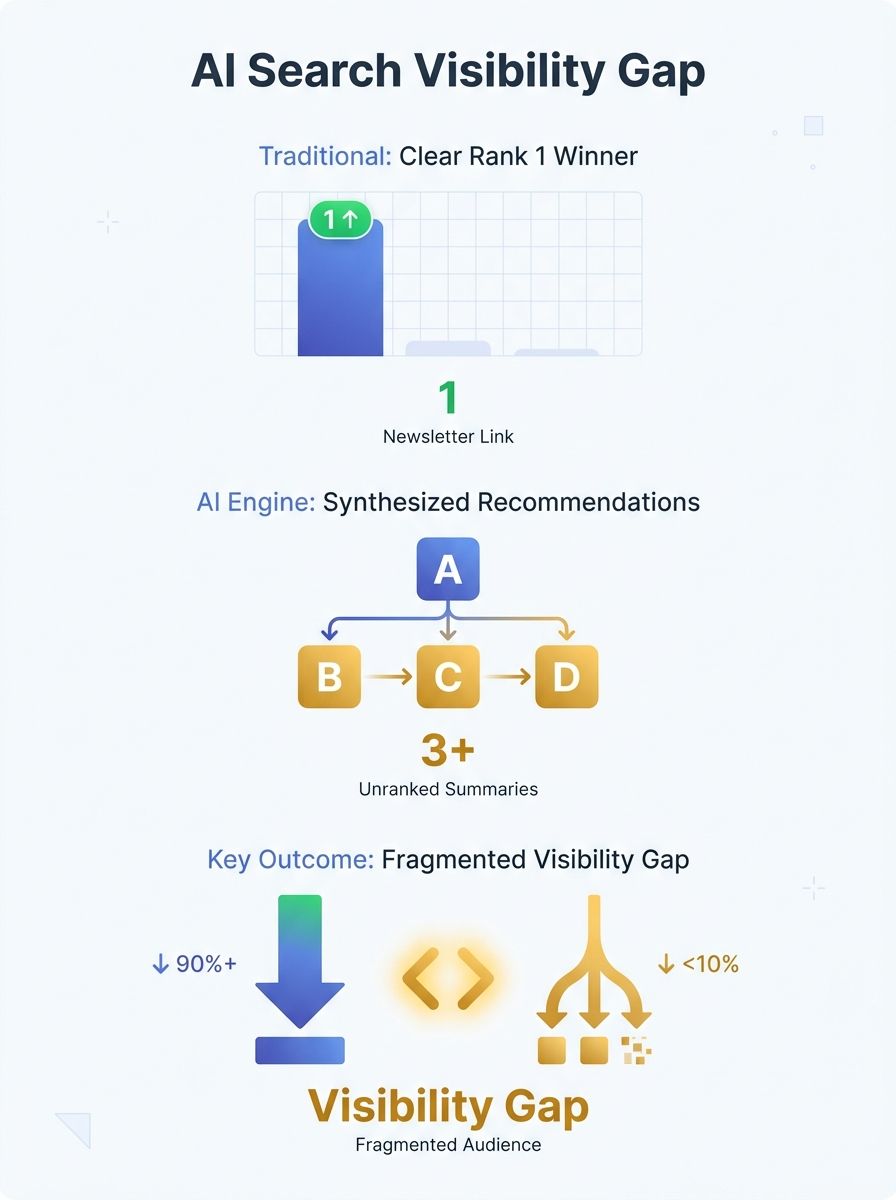
When ChatGPT, Perplexity, or Google AI Overviews recommend a competitor's newsletter instead of yours, that lost subscriber never shows up in your analytics as a missed opportunity. They simply never arrive. Your open rates look fine. Your click-throughs hold steady. But the top of your funnel quietly narrows because the AI layer between your audience and your content has become a filter you can't see, measure, or influence with traditional tools.
This is why email marketing teams need their own AI answer engine tracking stack—one built specifically to monitor how AI platforms describe, recommend, and cite your brand when potential subscribers are still in discovery mode.
The Visibility Gap Email Marketers Can't Afford to Ignore
Think about how your subscribers find you. Paid ads, organic search, social, word of mouth. These are the channels you measure. But an expanding share of your potential audience now asks AI assistants questions like "best email newsletters for SaaS marketing" or "which brands send the best product launch emails" before they ever type your URL.
AI Overviews now trigger for roughly 13% of Google queries and cause a 34.5% drop in click-through rates for the top organic result, according to Omnius's AI Search Industry Report. If your content strategy for growing email lists depends on organic search traffic, that's a material hit to your acquisition pipeline.
And Google is only one surface. ChatGPT processes over 3 billion queries per day, accounting for 87.4% of all AI referral traffic. Perplexity, Gemini, Claude, and Microsoft Copilot each have their own citation patterns. Your brand might rank beautifully in traditional SERPs while being completely absent from AI-generated answers on the same topic.
The tools most email marketers rely on—Google Analytics, Search Console, their ESP dashboards—were built for a world where clicks and page views were the primary signals. They don't tell you whether an AI system mentioned your brand, how it described your newsletter, or whether it recommended a competitor instead. This gap in search analytics beyond Google is where subscriber acquisition increasingly lives and dies.
What an AI Answer Engine Tracking Stack Actually Looks Like
The good news: a functional tracking stack doesn't require ten new tools. HubSpot's recommended approach is to start with a free baseline using their AEO Grader to understand your current AI visibility before spending anything, then add one primary monitoring tool that covers your priority answer engines.
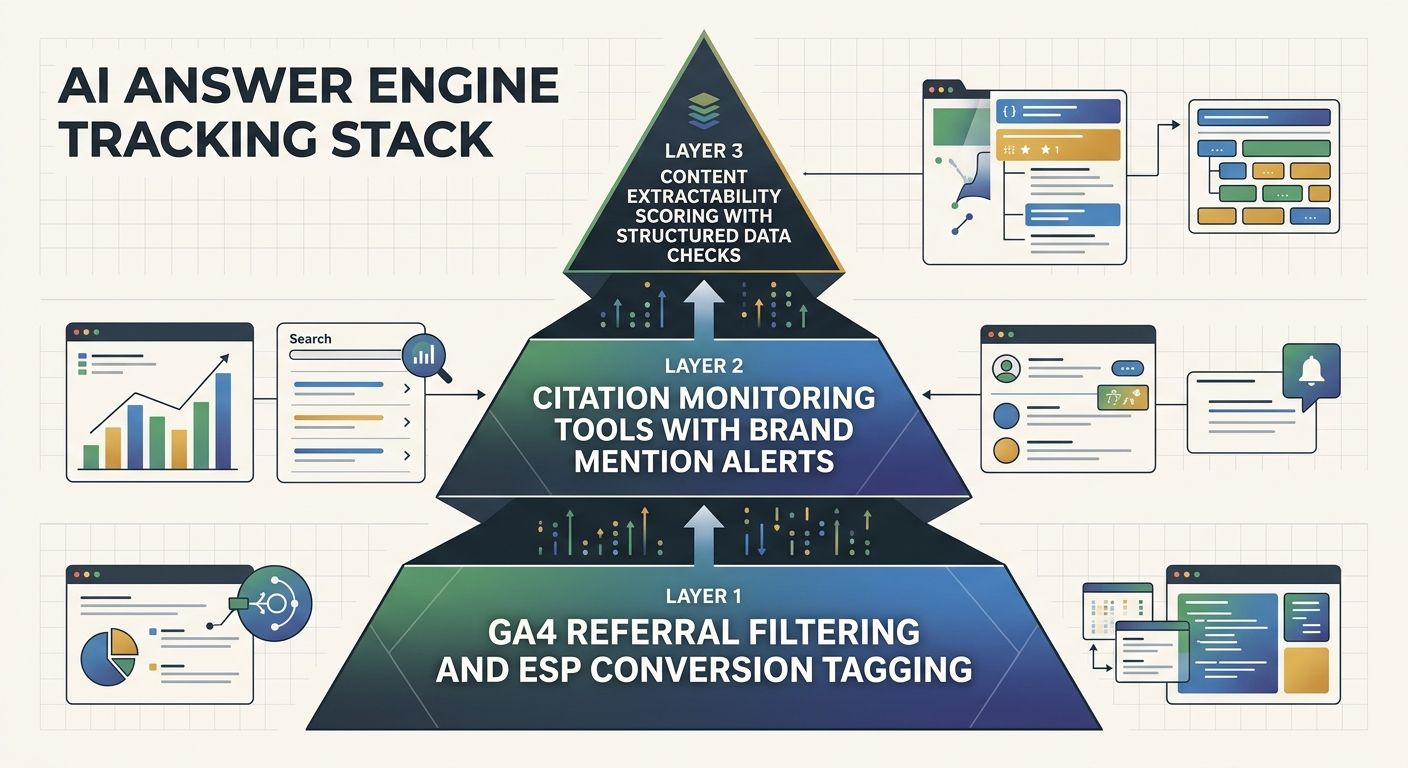
Here's the architecture I'd recommend for email marketing teams:
Layer 1: AI Referral Traffic Identification
Your existing Google Analytics 4 setup can already capture some of this. Filter your traffic sources to isolate visits from chat.openai.com, perplexity.ai, gemini.google.com, and copilot.microsoft.com. In GA4, navigate to Reports, then User, then Tech, then Tech details and add Session medium as a secondary dimension to separate AI-referred sessions from organic ones.
Then map those sessions to email conversion events. If someone arrives via an AI referral and signs up for your newsletter, that's a data point most teams are currently missing entirely. Tag these conversions separately in your ESP so you can track the downstream engagement—open rates, click rates, lifetime value—of AI-referred subscribers versus other channels.
Layer 2: Citation and Brand Mention Monitoring
This is where purpose-built AI search monitoring tools become essential. The leading platforms in this space include AIclicks, Profound, Gauge, Ahrefs Brand Radar, and Peec AI, each with different strengths in tracking how AI systems cite and describe your brand.
For email marketers specifically, you want a tool that can:
Monitor whether AI platforms recommend your newsletter when users ask about your topic area
Track how your brand is described in AI-generated answers (sentiment and accuracy matter here)
Alert you when a competitor starts appearing in answers where you previously held ground
Show citation trends over time rather than point-in-time snapshots, since SparkToro's research shows significant variability in AI recommendations even with identical prompts
Otterly.AI is worth evaluating here because it tracks brand presence across Google AI Overviews, ChatGPT, Gemini, Microsoft Copilot, and Perplexity simultaneously—the exact platforms where your potential subscribers are forming opinions about which newsletters to trust.
Layer 3: Content Extractability Scoring
AI answer engines don't read your landing pages the way humans do. They extract structured data, pull from FAQ sections, and favor content that delivers direct answers in the first 40–60 words of a section. If your email signup pages are heavy on persuasive copy and light on structured, extractable content, AI systems will skip over you in favor of competitors whose pages are easier to parse.
Tools like SE Ranking and HubSpot's AEO Grader can benchmark your content's AI readiness and identify where your pages fall short. This connects directly to email growth because the pages AI engines evaluate are often the same pages your organic visitors land on before subscribing.
This pairs well with the principles covered in adapting content strategy as search behavior shifts, especially the idea that query intent in AI contexts skews more conversational and comparison-oriented than traditional keyword searches.
Connecting AI Tracking Data to Your Email Metrics
Raw AI visibility data is useless if it sits in a separate dashboard from your email performance metrics. The integration layer is what turns tracking into actionable intelligence.
Here's the workflow I've seen work at scale:
Weekly AI citation audit → content gap identification → landing page optimization → email signup conversion tracking
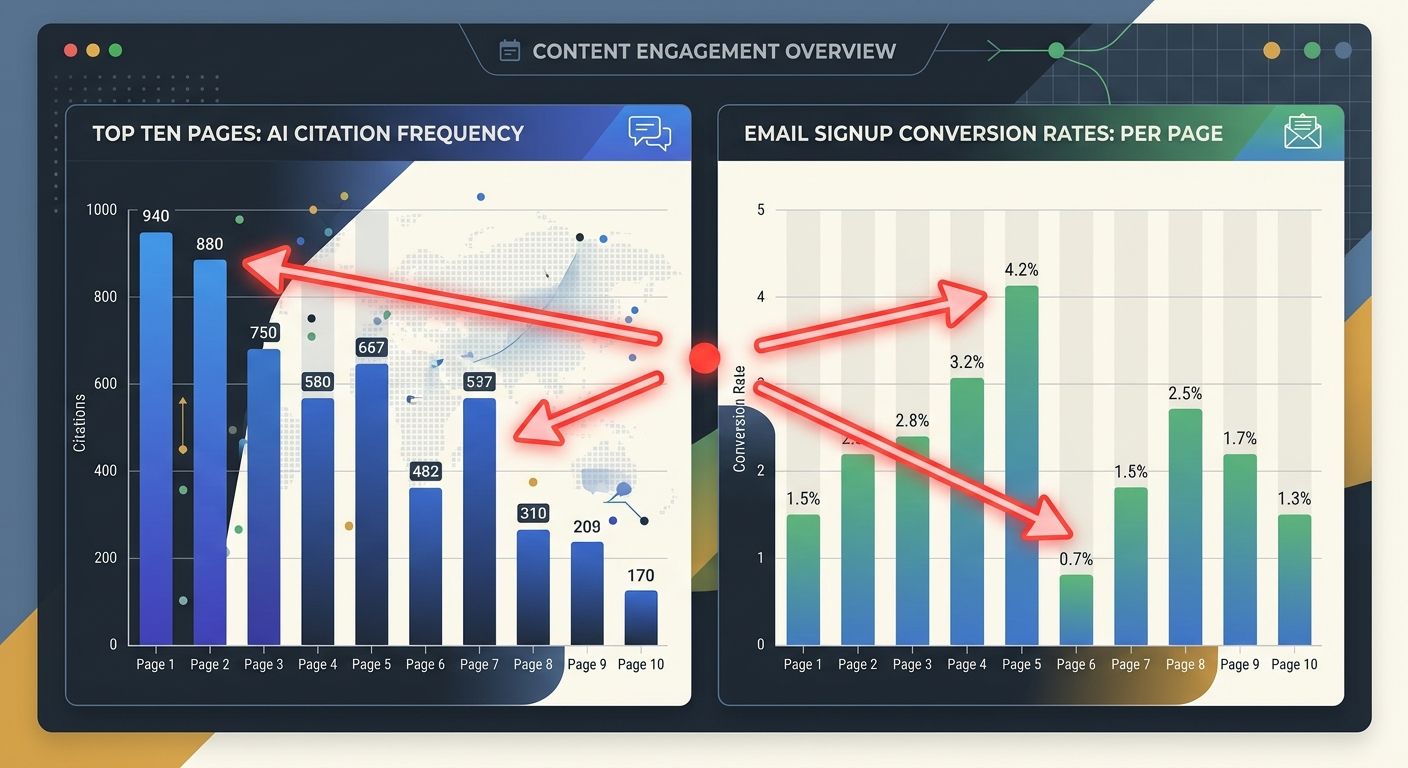
Pull your AI citation data every week and cross-reference it against your top email signup pages. If a page drives significant organic email signups but has zero AI citations, that page is vulnerable. As AI answer engines capture more of the discovery layer, that page's subscriber contribution will erode over time.
Conversely, if a page gets cited frequently by AI platforms but has no email capture mechanism, you're leaving subscribers on the table. Adding a newsletter signup to AI-cited content is one of the highest-leverage moves email marketers can make right now.
This kind of cross-channel analysis connects well with building integrated planning systems that scale across teams, since AI tracking data needs to flow between your SEO, content, and email marketing functions to drive results.
The Schema and Structured Data Layer
AI systems rely on structured data to identify and extract information reliably. For email marketers, three schema types deserve immediate attention.
FAQPage schema on any content page that answers questions related to your newsletter's topic area. If you run a fintech newsletter, your FAQ content about personal finance topics makes you a citable source for AI engines responding to those queries.
Article schema with clearly defined author entities, publication dates, and topic categories. AI engines use this metadata to assess authority and recency—two factors that directly influence whether your content gets cited.
NewsletterDigitalDocument schema (a Schema.org type many teams overlook) that explicitly marks content as a newsletter, helping AI engines correctly categorize your publication when users ask about email newsletters in your space.
Brands that have strong traditional rankings already have an advantage here, since 38% of AI Overview citations come from pages in the top 10 Google results. But traditional rankings alone don't guarantee AI visibility, which is precisely why this tracking stack matters.
Building Authority Where AI Engines Actually Look
AI models don't only scrape your website. They pull from third-party sources—review platforms, industry publications, Reddit threads, expert roundups—and synthesize those signals into their responses. For email newsletter brands, this means your presence on platforms like Substack leaderboards, newsletter review sites, and industry recommendation threads directly impacts whether AI engines recommend you.
Conductor's recently launched AgentStack platform points toward where this is heading: automated competitive gap analysis in AI-generated answers and real-time brand sentiment tracking across LLM platforms. The teams using these tools can see exactly where competitors are getting cited and reverse-engineer the content and third-party mentions driving those citations.
For email marketers, the practical implication is that your newsletter's AI visibility depends partly on assets you don't directly control. Guest articles, podcast appearances, press mentions, and positive reviews on third-party platforms all feed the AI citation graph. Building this off-site authority layer is as important as optimizing your own pages.
If you're already tracking whether your analytics data matches actual performance, extending that rigor to AI citation data prevents the same kind of dashboard-reality gap from emerging in this new channel.
Choosing Tools Without Overcomplicating Your Stack
The AEO tool market is crowded and growing fast. You don't need every tool—you need the right three or four. Here's how I'd prioritize for email marketing teams:
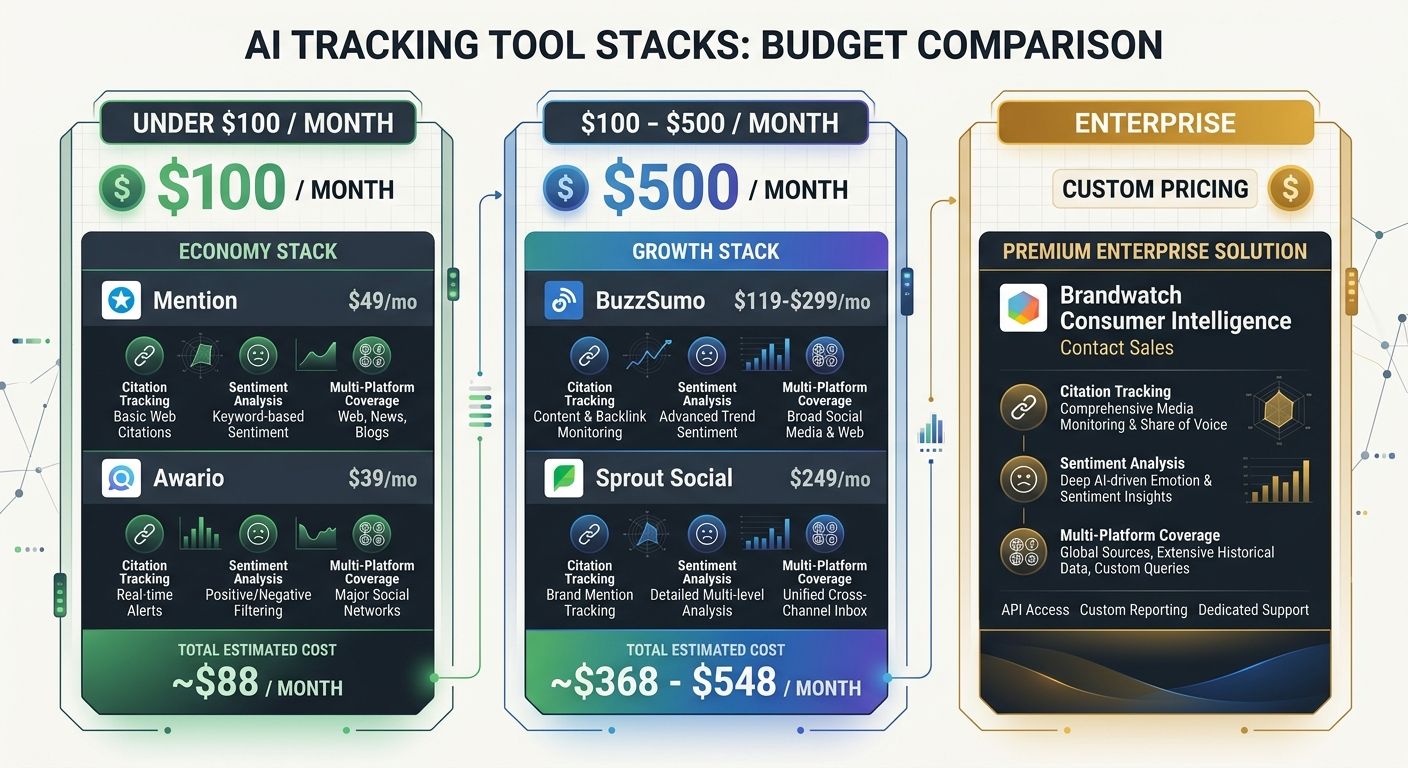
If your budget is under $100/month: Start with HubSpot's AEO Grader (free) for baseline visibility scoring, add GA4 referral source filtering (free), and pick one affordable monitoring tool like RankScale ($20/month) for ongoing citation tracking.
If your budget is $100–500/month: Add a dedicated AI search monitoring tool like Profound or AIclicks for multi-platform tracking, and integrate Ahrefs Brand Radar if you're already in the Ahrefs ecosystem. Use your ESP's API to connect AI referral data directly to subscriber cohort analysis.
If you have enterprise resources: Consider Conductor's AgentStack or Meltwater's GenAI Lens for real-time sentiment tracking and automated competitive intelligence across all major AI platforms. Layer in automation workflows for repetitive monitoring tasks so your team can focus on strategy rather than data collection.
The tools are important, but execution matters more. A team running weekly manual audits with free tools will outperform a team paying for enterprise software that nobody checks.
What Still Isn't Settled
Several unresolved questions will shape how this AI-powered search monitoring stack evolves over the next 12–18 months.
AI citation attribution standards don't exist yet. There's no UTM equivalent for AI referrals, which means the traffic you can track in GA4 represents only the fraction of AI-influenced discovery where users actually click through. Subscribers who learn about your newsletter from an AI answer and then navigate directly to your site show up as direct traffic, invisible to any attribution model.
Model update cycles break historical data. OpenAI is already retiring GPT-4o, and each model update can reshuffle which sources get cited. Trend analysis across model generations requires tools that track model versions alongside citation data—a capability most platforms are still building out.
Google's AI opt-out testing introduces uncertainty. If users or publishers can opt out of AI Overviews in Gemini 3, the competitive dynamics of AI visibility could shift significantly. Email marketers who've invested in AI-optimized content may find the rules changing under them.
Sentiment accuracy across platforms varies widely. An AI engine might recommend your newsletter enthusiastically in one response and describe it neutrally in the next, even for identical queries. SparkToro's research on this variability means single data points are unreliable, and you need weeks of trend data before drawing conclusions about your SEO tool stack integration strategy.
The email marketing teams that build their AI answer engine tracking infrastructure now, while the standards are still forming, will have months of baseline data to work with when these questions resolve. Waiting for the perfect tool stack means starting from zero while competitors already have trend lines showing what works and what doesn't. The tracking gap is real, it compounds every quarter you leave it unmeasured, and the subscriber pipeline impact becomes harder to reverse the longer your brand stays invisible in the AI discovery layer.

Alex Chen
Alex Chen is a digital marketing strategist with over 8 years of experience helping enterprise brands and agencies scale their online presence through data-driven campaigns. He has led marketing teams at two successful SaaS startups and specializes in conversion optimization and multi-channel attribution modeling. Alex combines technical expertise with strategic thinking to deliver actionable insights for marketing professionals looking to improve their ROI.
Explore more topics