
From Keyword Research to AI Query Intent: Adapting Your Content Strategy as Search Behavior Shifts
Surfer's internal query fan-out research documented a pattern that rewrites the value calculation behind every backlink you pursue: when an AI system processes a user's search, it doesn't evaluate your page against a single query.
From Keyword Research to AI Query Intent: Adapting Your Link Building Strategy as Search Behavior Shifts
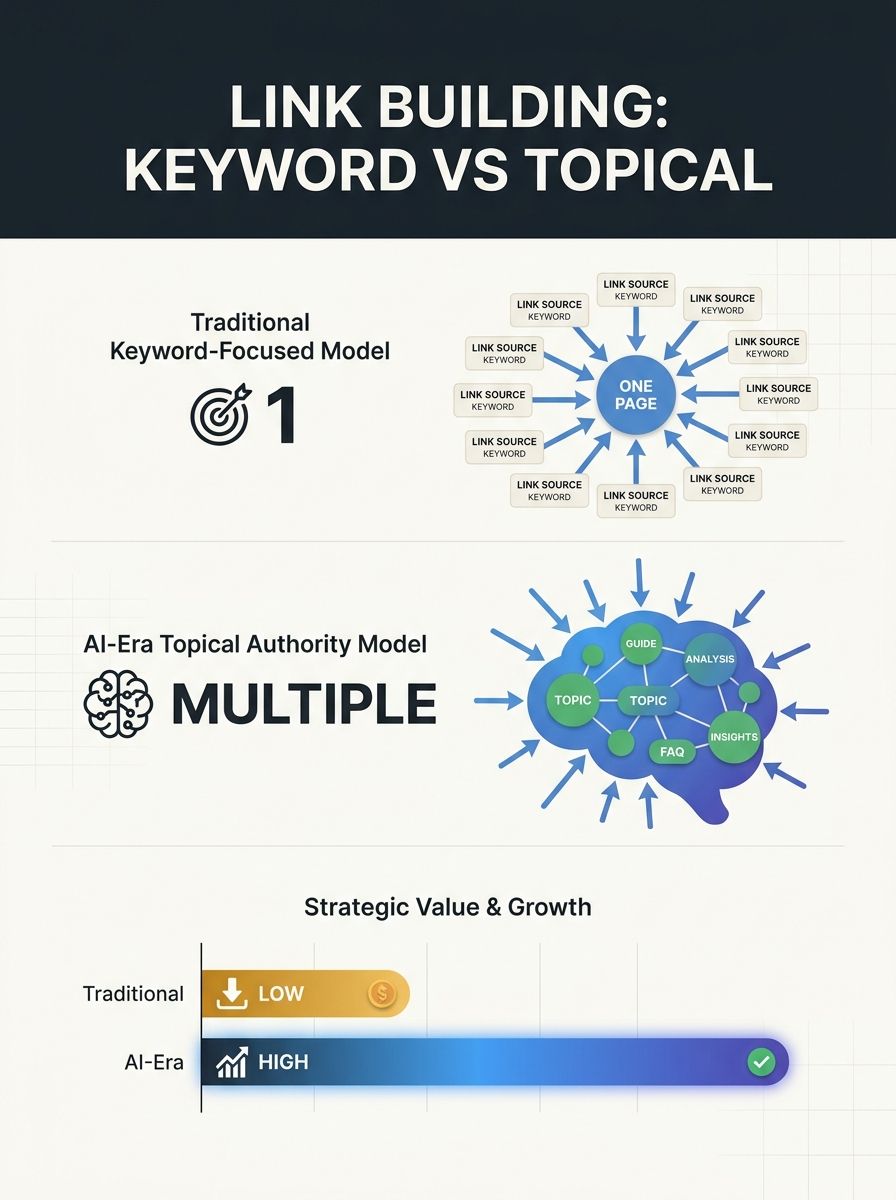
Surfer's internal query fan-out research documented a pattern that rewrites the value calculation behind every backlink you pursue: when an AI system processes a user's search, it doesn't evaluate your page against a single query. It expands that prompt into a cluster of related sub-queries, assessing your content's ability to answer five, ten, or even fifteen related questions at once. The implication for link building is immediate. A backlink to a page optimized for one keyword phrase used to pass authority for that one phrase. Now, that same link passes authority across an entire query cluster, but only if your content architecture can support the weight.
This shift from individual keyword targeting to query fan-out optimization means the pages you build links to, the anchor strategies you use, and the internal structures those links feed into all need rethinking. The old model of building backlinks to rank for "best CRM software" is being outpaced by a model where AI systems evaluate whether your site can answer every sub-question a buyer might have about CRM software selection, integration, pricing, and migration.
Why AI Search Query Intent Breaks Traditional Link Targeting
Traditional link building operates on a straightforward premise: identify high-value keywords, create content targeting them, and acquire backlinks with relevant anchor text to boost those specific rankings. The keyword is the atomic unit. Each page earns its own authority through its own link profile.
AI search systems don't work this way. As Google Cloud's documentation on semantic search explains, these systems focus on understanding contextual meaning and intent behind queries rather than matching keywords. When a user types "What CRM is best for a 10-person remote sales team handling $2M in annual contracts?" into an AI interface, the system doesn't look for pages targeting that exact phrase. It decomposes the query into components: team size suitability, remote work features, deal volume handling, pricing tiers, integration requirements. Then it evaluates which sources provide credible answers across those dimensions.
This means a page with 50 backlinks targeting "best CRM" might lose AI visibility to a site with 20 backlinks distributed across pages that collectively cover CRM selection criteria in depth. The site with distributed topical coverage wins because AI systems are measuring authority at the topic level, not the page level.
And this connects directly to what we're seeing in traffic data. If you've been tracking how AI Overviews are reshaping search traffic patterns, you've likely noticed that pages with strong individual keyword rankings are losing clicks to AI-generated summaries. The pages that retain visibility are the ones AI systems cite as authoritative sources across multiple related queries.
Natural Language Search Patterns Create New Link Opportunities
The behavioral data here is striking: 50% of B2B buyers now begin their product research inside AI chatbots rather than traditional search engines, and 89% of B2B buyers use generative AI at some point during purchasing decisions. These users don't type keyword fragments. They write full sentences. They ask follow-up questions. They describe their specific situations in detail.
These natural language search patterns generate a completely different set of linkable content opportunities. When someone asks an AI chatbot "How do I migrate from Salesforce to HubSpot without losing my custom reporting," the AI system looks for content that addresses migration processes, data integrity during transitions, custom report recreation, and platform-specific limitations. If your content covers only "HubSpot vs Salesforce comparison" at a surface level, you won't be cited regardless of how many backlinks that comparison page has.
The link building opportunity sits in the gap between what AI users ask and what currently exists to answer them. Content targeting long-tail, question-based queries achieves 30 to 40 percent higher visibility in LLM-generated responses compared to generic head-term content. Pages built around these specific, conversational queries also tend to attract more natural backlinks because they solve concrete problems that people share with colleagues.
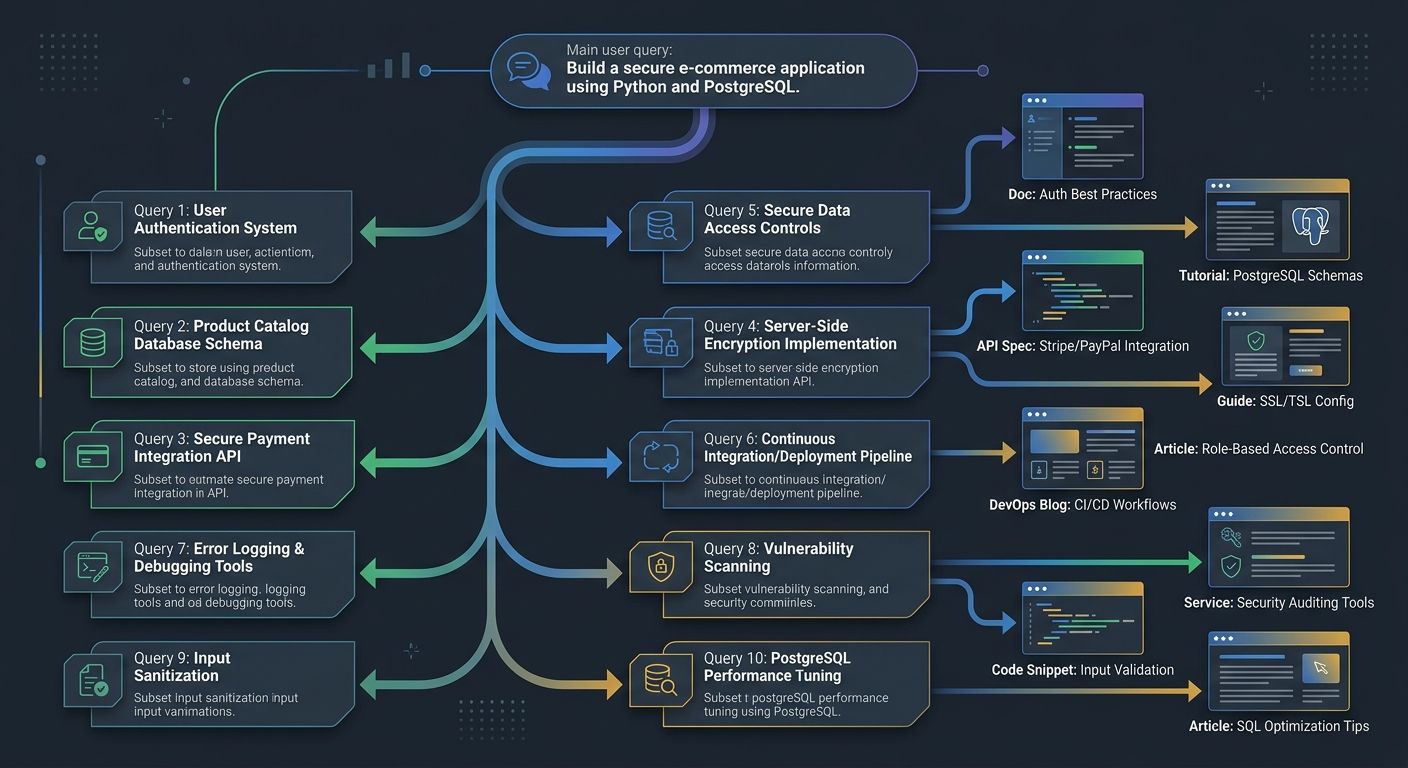
I've worked with enterprise clients who rebuilt their link acquisition strategy entirely around this principle. Instead of pursuing links to a single pillar page about their core topic, they created detailed answer pages for the 20 most common questions their sales team heard during calls. Each page attracted links organically from forums, industry newsletters, and resource roundups because the specificity made the content genuinely useful. Combined, those 20 pages established the kind of topical authority in AI search that a single page with ten times the backlinks couldn't match.
The Architecture Problem: Internal Links as AI Authority Signals
Search Engine Land's analysis of topical authority in AI search draws a critical distinction that most link builders overlook. According to their framework, N-E-E-A-T-T is an entity framework that measures the publisher and author, not the content. Your site's topical authority depends on three layers: coverage (do you have the content?), architecture (is it organized so AI can classify it?), and entity signals (are the publisher and author recognized authorities?).
The architecture layer is where internal linking becomes a link building concern, even though it involves no external acquisition. Your internal link architecture tells AI systems how your content relates to itself. A page about CRM migration that links to your pages on data integrity, custom reporting, and platform comparisons tells AI systems that your site treats CRM migration as a coherent topic with multiple dimensions. A page about CRM migration with no internal links to related content looks like an isolated piece, regardless of its external backlink count.
This changes how you should think about link building campaigns. Before acquiring a single external link, audit the internal structure of the content you're building links to. Ask whether the target page connects to at least three other pages that cover related sub-topics. If it doesn't, build those connections first. The external link will deliver more authority across more AI-generated queries once the internal architecture supports it.
Building Linkable Assets for Semantic Coverage
Semantic keyword research has replaced traditional keyword research as the foundation for identifying what to build links to. Instead of looking at search volume for individual phrases, you need to map the full semantic territory around your core topics.
The process works like this:
Identify your primary topic (e.g., "enterprise data migration")
Use tools like AlsoAsked, AnswerThePublic, and Google's People Also Ask to map every question variant around that topic
Test AI chatbots with conversational prompts about your topic to see which sources get cited and which sub-questions the AI addresses
Group those questions into clusters that share underlying intent
Create content that covers each cluster, with internal links connecting them
Build external links to the cluster hub pages, knowing the authority will flow through your internal architecture to supporting pages
This approach to semantic keyword research produces content that's both link-worthy and AI-citation-worthy. When your content answers the full range of questions AI systems decompose from user prompts, it becomes the kind of resource that other sites naturally reference.
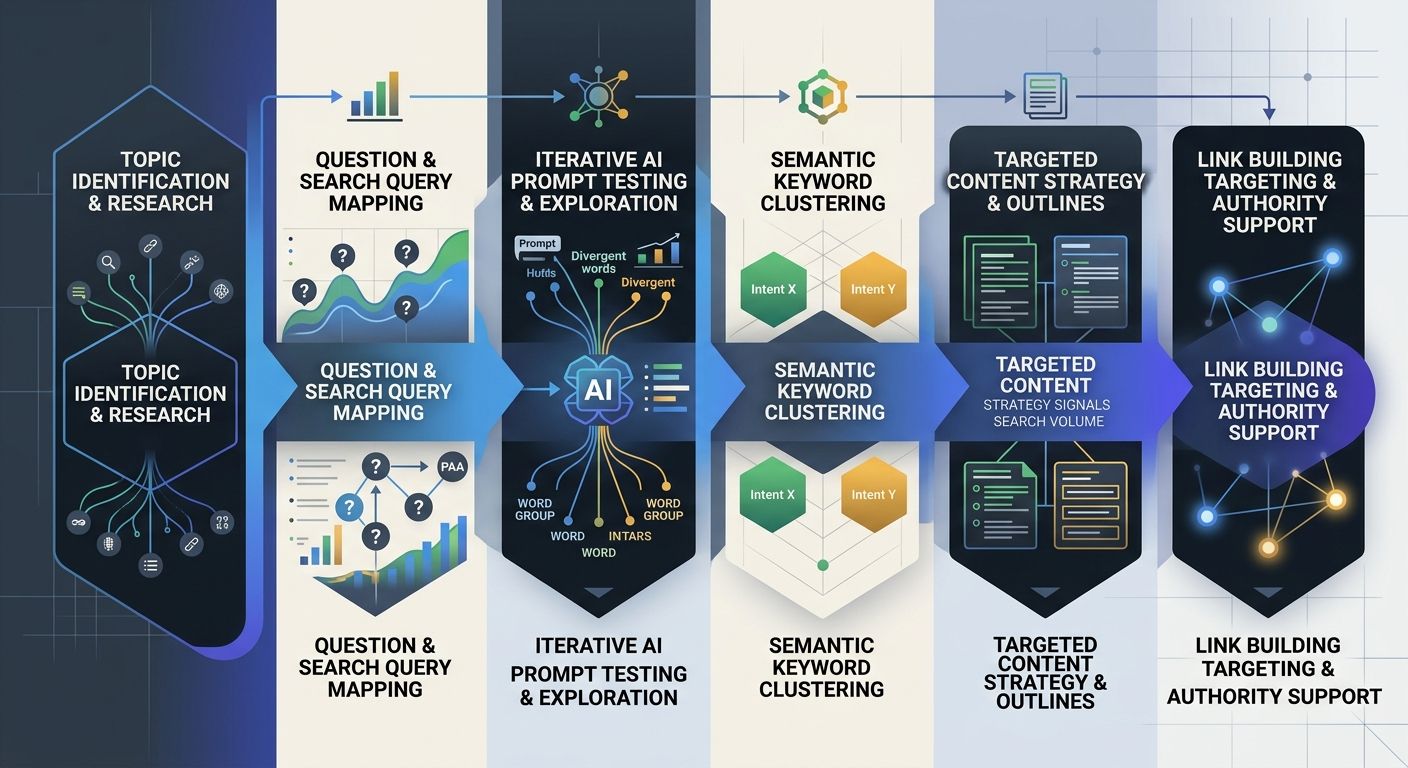
If you've been following the query fan-out tools guide published on this site, you already have a sense of how AI systems expand queries. The link building implication is direct: every sub-query in a fan-out is a potential citation opportunity, and every citation opportunity is a reason for another site to link to your content.
From Link Acquisition to Citation Acquisition
The distinction between a backlink and a citation matters more now than at any point in SEO's history. A backlink passes PageRank. A citation in an AI-generated response passes something different: brand visibility at the exact moment a user is making a decision.
Research from Conductor on building topical authority for AI search shows that AI systems overlay performance metrics and content structure analysis to determine which sources deserve citation. Their AI Topic Map approach clusters content by theme and identifies where a site has coverage gaps that prevent it from being treated as an authority.
This means your link building strategy should target citation potential as aggressively as it targets domain authority. Some practical ways to do this:
Build original research assets. AI systems preferentially cite content with unique data points, specific statistics, and attributed sources. A survey report about your industry with original data will attract both traditional backlinks and AI citations.
Structure content for extraction. Use question-based H2 headings that match how users phrase queries. Provide direct answers within the first 40 to 60 words of each section. Include statistics with clear attribution. These structural choices make your content easier for AI to cite, which makes it more visible, which attracts more organic links.
Target the "AI gap" competitors. Run the same prompts through ChatGPT, Perplexity, and Google's AI Overviews. Document which brands appear and which don't. If competitors in traditional search are absent from AI results, the gap between strong rankings and AI visibility represents a link building opportunity where you can establish authority before they do.
The companies earning AI citations consistently share a pattern: they don't have the most backlinks, but they have the most complete topical coverage with clear internal architecture connecting related content.
Measuring Link Impact in an AI Search World
Traditional link building metrics like Domain Authority, referring domain count, and anchor text distribution still matter for classic Google rankings. But they tell you nothing about whether your links are helping you earn AI citations.
New measurement approaches are emerging. According to ClickRank's guide on semantic intent detection, Google's ability to understand meaning and purpose behind queries means that link context has become as important as link placement. A backlink from a topically relevant page within a well-structured site passes more semantic authority than a backlink from a high-DA page in an unrelated niche.
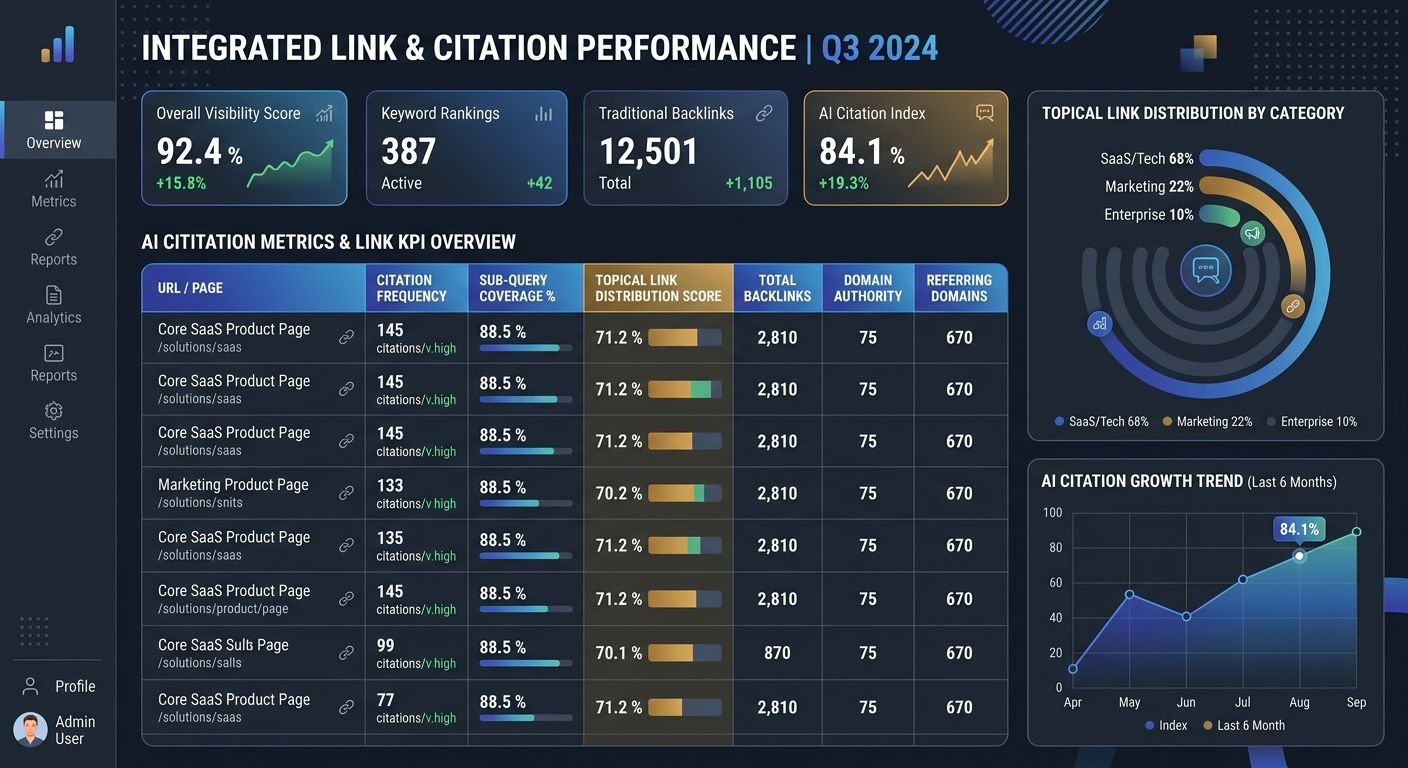
The metrics I track with clients now include:
AI citation frequency: How often does your content appear in AI-generated responses for your target topic cluster?
Sub-query coverage: What percentage of fan-out sub-queries does your content architecture address?
Topical link distribution: Are your backlinks concentrated on one page or distributed across your topic cluster?
Citation competitor overlap: Which sites consistently appear alongside yours (or instead of yours) in AI responses?
These metrics won't replace your existing link building dashboards, but they add a layer that predicts future performance more accurately than traditional signals alone. If you're wrestling with why rankings drop despite strong technical SEO, the missing variable might be topical link distribution rather than anything on-page.
What The Numbers Still Can't Answer
The data on AI search behavior and query fan-out gives us clear direction, but several important questions remain unresolved.
We don't yet have reliable benchmarks for how many AI citations translate to measurable business outcomes. A brand appearing in an AI chatbot's response about CRM selection is clearly valuable, but quantifying that value against, say, a position-three organic ranking with a 3.2% click-through rate requires attribution models that most analytics stacks can't support yet.
We also don't know how stable AI citation patterns are over time. Traditional rankings fluctuate with algorithm updates, and we've developed tools and processes to track those shifts. AI citation can change when the underlying language model updates, when new training data gets incorporated, or when a competitor publishes a single comprehensive resource. The volatility characteristics of AI citations are still being mapped.
And there's an open question about diminishing returns. If every site in a niche adopts topical cluster architecture with distributed internal linking and question-based content, does AI search fragment its citations across more sources, diluting everyone's visibility? Or does it consolidate further around whichever site crosses a threshold first? The competitive dynamics of AI citation authority are still playing out, and the data we have today captures an early-mover landscape that may look very different by the time most organizations adapt their link building strategies to account for it.
What we can say with confidence is that the relationship between links and search visibility is becoming more complex and more architectural. The era of building links to individual pages for individual keywords is giving way to something that rewards systematic topical coverage, intentional internal structure, and content that answers the full scope of questions a user might bring to an AI interface. The organizations tracking these shifts closely, measuring citation frequency alongside traditional metrics, and adjusting their link acquisition targets accordingly will have a significant head start as AI search continues to absorb traffic from conventional results pages.

Sarah Chen
SEO strategist and web analytics expert with over 10 years of experience helping businesses improve their organic search visibility. Sarah covers keyword tracking, site audits, and data-driven growth strategies.
Explore more topics