
Content Architecture as Your SEO Foundation: How to Structure Pages So Google Understands Your Topic Clusters
Every internal link on your site carries three distinct signals to Google: relevance context from the anchor text, authority weight from PageRank flow, and topical association from the surrounding content.

Content Architecture as Your SEO Foundation: How to Structure Pages So Google Understands Your Topic Clusters
Every internal link on your site carries three distinct signals to Google: relevance context from the anchor text, authority weight from PageRank flow, and topical association from the surrounding content. When these three signals align across dozens of pages pointing toward a central pillar, Google interprets that cluster as evidence of genuine subject matter depth. When they don't align — when your internal linking architecture is random, when pages sit orphaned three subdirectories deep, when anchor text says "click here" — Google sees a collection of loosely related pages instead of a coherent body of expertise. The mechanism underneath this interpretation is content architecture, and most sites get it wrong because they treat structure as a design decision rather than as the primary channel through which Google reads topical authority.
The Hub-and-Spoke Signal System
Content architecture SEO follows a model that Google's ranking systems have rewarded consistently since the shift toward entity-based understanding: the hub-and-spoke cluster.
A pillar page covers a broad topic at medium depth. Cluster pages (spokes) target specific subtopics, each exploring a narrow question in detail. Every cluster page links back to the pillar with descriptive anchor text, and the pillar links out to each cluster page. This bidirectional linking creates a closed topical loop that tells Google: "These pages belong together, and the pillar is the authoritative center."
The mechanism works because Google's algorithms evaluate pages in context. A single blog post about "email segmentation" competes with millions of others. But when that post sits within a cluster of 12 related pages covering deliverability, A/B testing, automation triggers, and list hygiene, and all of them link to and from a central "email marketing strategy" pillar, Google has structural evidence that your site covers this topic with depth.
According to Knapsack Creative's analysis of topical authority in SEO, when your entire content ecosystem supports your primary services, rankings rise across the board — across dozens of buyer-intent queries simultaneously instead of one keyword at a time.
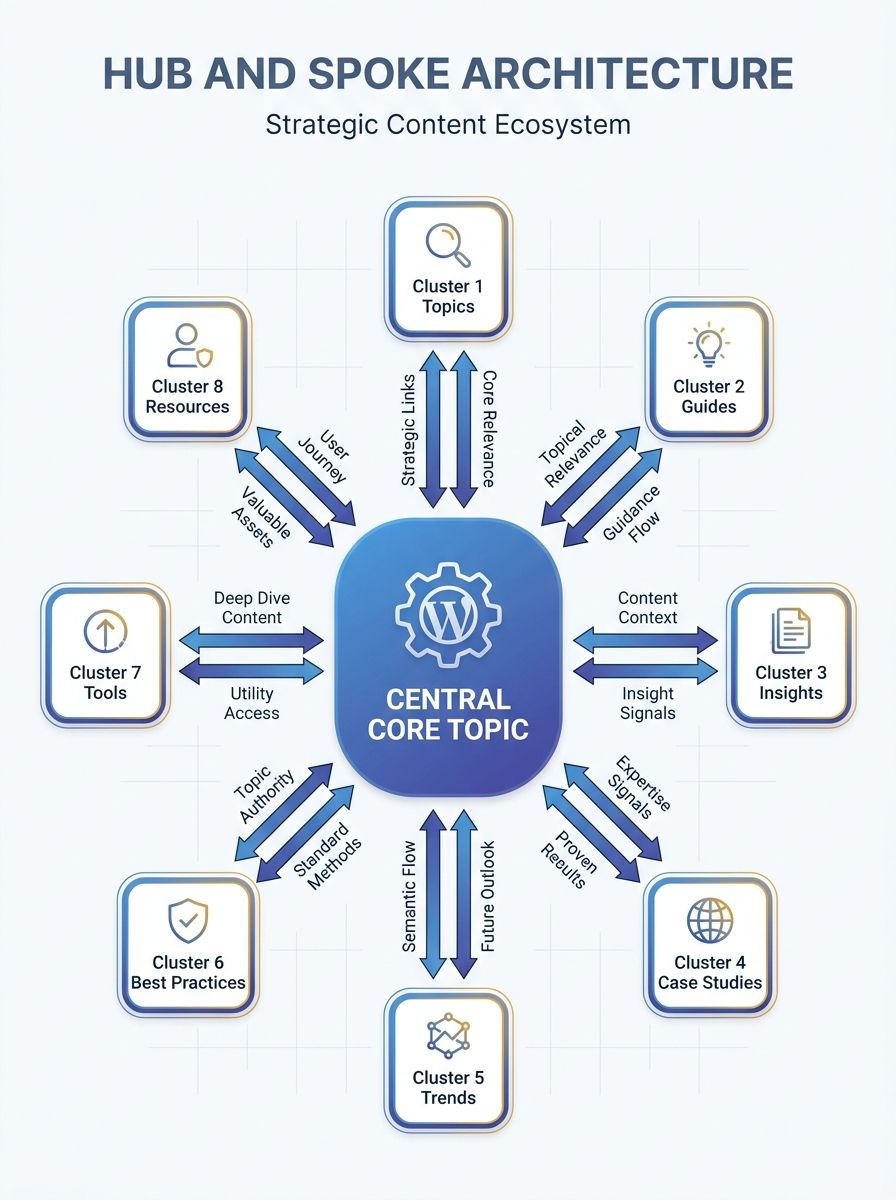
If you've run a site architecture audit for topic clusters and found disconnected pages floating outside any cluster, those pages are actively diluting your crawl budget and fragmenting the topical signals you're trying to build.
How PageRank Flows Through Your Link Graph
Internal links are the plumbing system that distributes authority across your site. This is the part most marketers understand conceptually but execute poorly in practice.
Your homepage and any pages with strong external backlinks carry the highest PageRank. When those pages link to a pillar page, authority flows downward. When the pillar links to cluster pages, authority distributes further. The structure acts like a cascade: the more deliberate and shallow the architecture, the more authority reaches your important pages.
According to Rankability's guide on internal links as a ranking factor, internal links serve as the "plumbing" that moves PageRank from strong pages to priority URLs. And Google now interprets internal links beyond simple PageRank flow, evaluating content relevance, user intent, and contextual signals around each link.
This means two things for your architecture:
Link placement matters. A contextual link within a relevant paragraph carries more weight than a link buried in a footer or sidebar.
Anchor text carries semantic meaning. Google's own documentation states that anchor text should be "descriptive, concise, and relevant, helping users and Google understand the linked content." Writing "learn more here" throws away one of your strongest content hierarchy search signals.
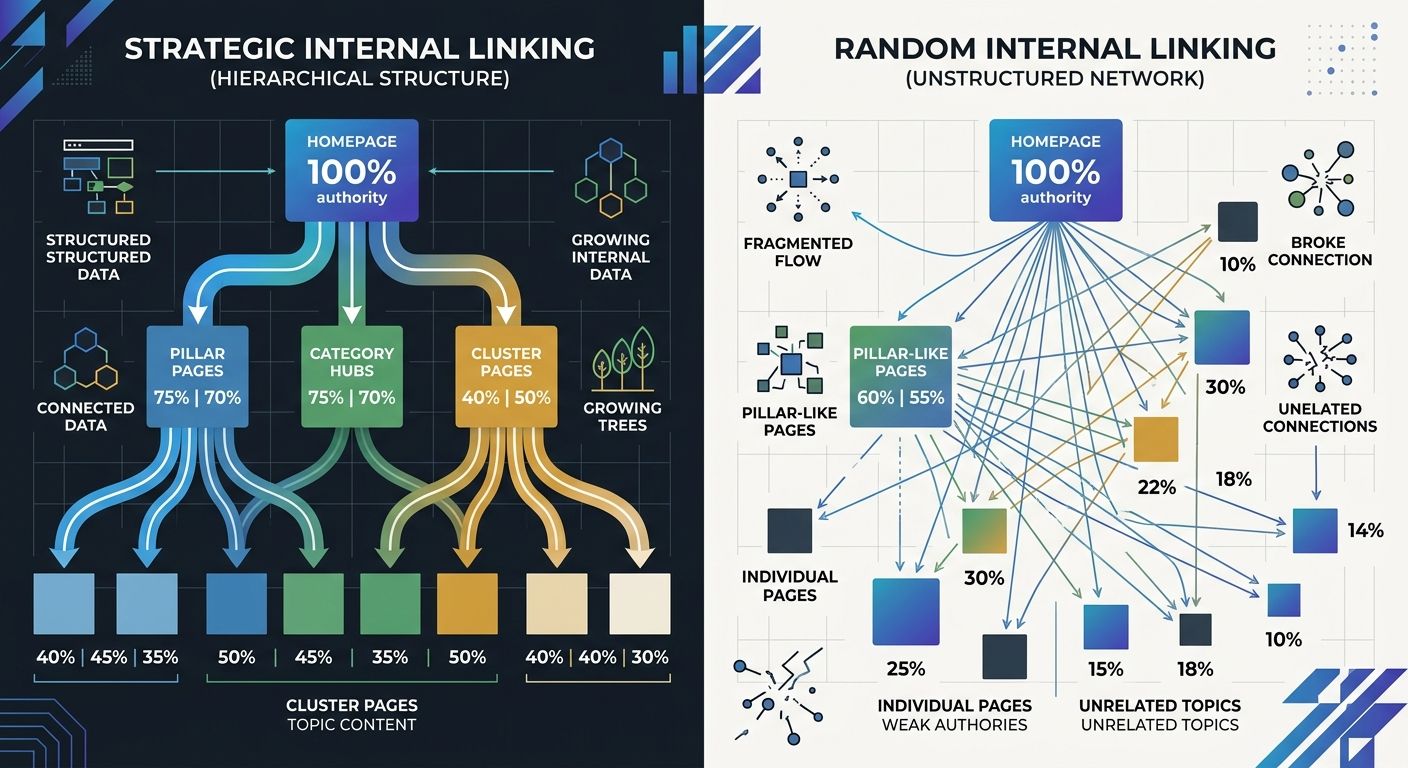
The conversion angle here is direct. When authority flows properly to your pillar pages, those pages rank higher. Pillar pages, by design, sit at the decision-making layer — they're where users evaluate whether your solution fits their problem. Higher rankings on pillar pages mean more qualified traffic entering your site at exactly the point where conversion paths begin.
Click Depth and Crawl Budget Allocation
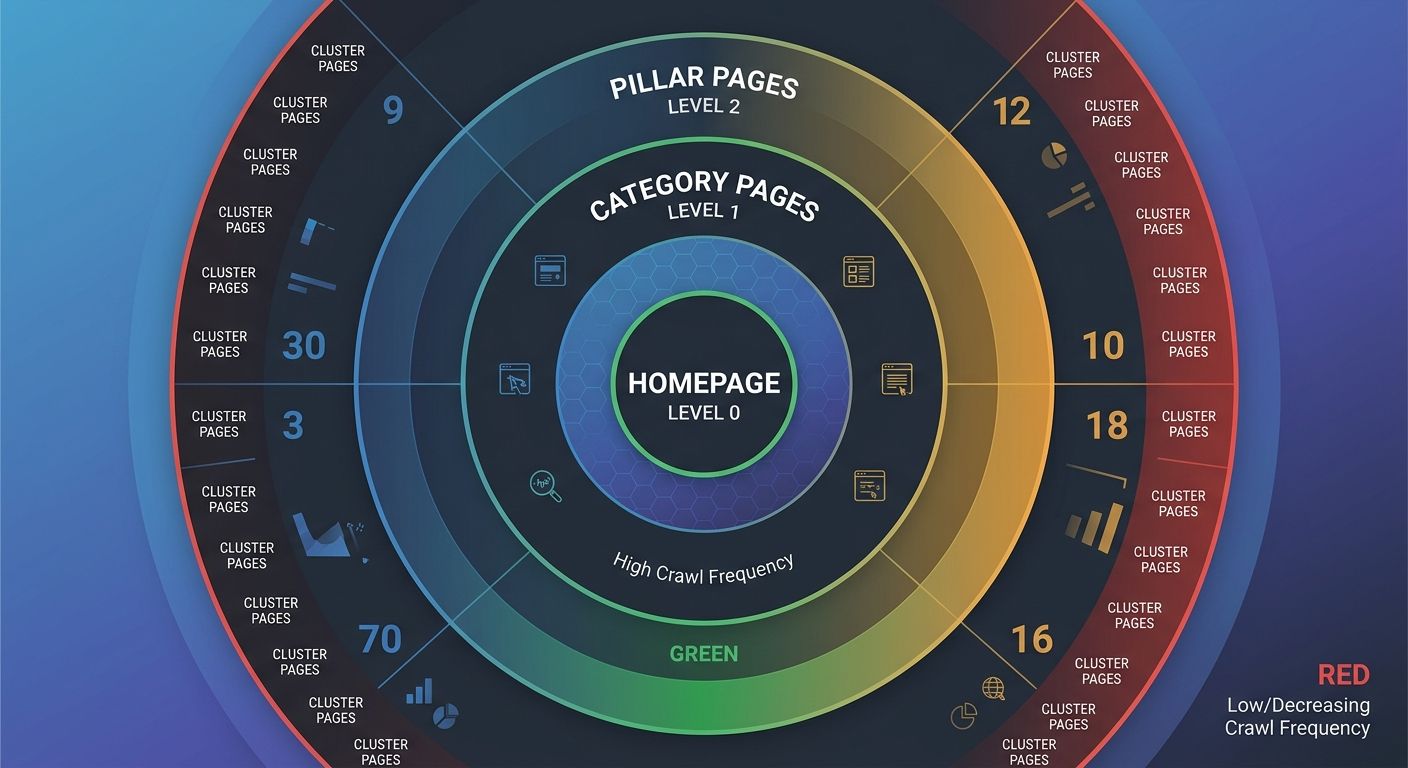
Googlebot assigns crawl priority partly based on how many clicks a page sits from the homepage. Pages within two or three clicks get crawled frequently. Pages buried four, five, or six levels deep may go weeks between crawls, and some never get indexed at all.
If your homepage links to 8 category pages, and each category links to 10 pillar pages, and each pillar links to 15 cluster pages, you've made 1,200 pages accessible within three clicks. Add a fourth level and you've pushed content into territory where crawl frequency drops significantly.
As Moz's foundational SEO guide describes, crawl accessibility forms the base of the SEO hierarchy of needs. If Google can't efficiently reach your pages, nothing else you do with keyword optimization, schema markup, or link building makes a measurable difference.
This is where content architecture SEO intersects directly with the conversion funnel. If your high-intent product comparison pages or case study pages sit five clicks deep, they're functionally invisible. You might have the most compelling bottom-of-funnel content in your industry, but if Googlebot barely touches it, that content won't rank, won't drive traffic, and won't convert.
If you're seeing symptoms of this problem in your analytics (pages that should rank but don't, content that gets impressions but minimal clicks), you may want to run a crawlability audit to diagnose indexing gaps.
Anchor Text as the Semantic Connector
Anchor text is the most underused architectural signal available to you. Every time you link from one page to another within your site, the visible text of that link tells Google what the target page is about.
When you write "our guide to email segmentation" and link it to your segmentation page, Google registers a relevance signal: the target page has something to do with email segmentation. When 15 different cluster pages all link to the same pillar using varied but semantically consistent anchor text — "email marketing best practices," "building an email strategy," "a complete email marketing approach" — those signals compound. Google develops a clear picture of what that pillar page covers and what queries it should rank for.
The anti-pattern is equally visible. When your anchor text is generic ("click here," "read more," "this article"), you're wasting one of the most direct communication channels between your content and Google's understanding algorithms. And when anchor text conflicts, with one page linking to your pricing page as "free trial" while another links to it as "enterprise solutions," you're sending mixed signals about what that page actually covers.
This mechanism connects to how you build on-page SEO elements like titles, meta descriptions, and schema. Your internal anchor text, page titles, H1 tags, and schema should all tell a coherent story about each page's purpose. When they diverge, Google hedges its interpretation, and your rankings suffer for it.
From Topical Signals to Conversion Paths
Here's where site structure topical authority pays off commercially, and where this shifts from a pure SEO concern into a conversion optimization discipline.
A well-designed content architecture mirrors the buyer's journey. Cluster pages targeting informational queries ("what is email segmentation," "email segmentation vs. personalization") capture users at the awareness stage. The pillar page, ranking for mid-funnel queries ("email segmentation strategy"), catches users who've already defined their problem. And from the pillar, internal links guide users toward product pages, case studies, or demo requests — the conversion endpoints.
This path is engineered through internal linking architecture. Each link in the chain moves the user one step closer to a decision, and each link simultaneously tells Google that these pages form a coherent topic with a clear purpose hierarchy.
The sites I've seen perform best on conversion metrics share a common structural trait: their highest-authority pages (homepages, popular blog posts, externally linked resources) funnel PageRank toward the pages that actually generate revenue. They don't distribute authority evenly across every page. They concentrate it where commercial intent lives.
If you're trying to build this kind of systematic approach into your team's workflow, mapping architecture work into a repeatable sprint cadence keeps it from becoming a one-time project that decays over the following quarters.
Where The Model Breaks
Content architecture is powerful, but it has real limitations that don't get discussed enough.
The cluster model assumes clean topic boundaries. In practice, topics overlap. A page about "email deliverability" might logically belong to both your "email marketing" cluster and your "technical infrastructure" cluster. Linking it to two pillar pages dilutes the signal. Linking it to only one creates an artificial omission in the other cluster. There's no perfect solution — you pick the primary cluster, link it there, and accept the tradeoff.
Architecture alone doesn't create authority. You can build a perfect hub-and-spoke structure with 50 cluster pages, but if every page contains 400 words of surface-level content, Google won't treat your site as authoritative. The structure signals depth; the content has to actually deliver it. As one practitioner noted on Reddit, building topical authority means creating a content ecosystem that answers every related question your audience might have. The architecture organizes that ecosystem, but it doesn't substitute for the substance within it.
Clusters need maintenance. New subtopics emerge, old content becomes outdated, and internal links break. A cluster that was architecturally sound 18 months ago may have drifted into incoherence as new pages were published without linking them into the existing structure. Treating architecture as a set-and-forget exercise is one of the fastest ways to erode the signals you've built.
And perhaps the trickiest challenge right now: the model doesn't account for how AI search interfaces restructure your traffic. AI Overviews and similar features may surface answers from your cluster pages without sending users to your site at all. Your architecture can be sound, your rankings strong, and your traffic may still decline because the search interface changed underneath you. Understanding how AI search reshapes traffic patterns is increasingly necessary context for evaluating whether your architecture investments are translating into actual conversions.
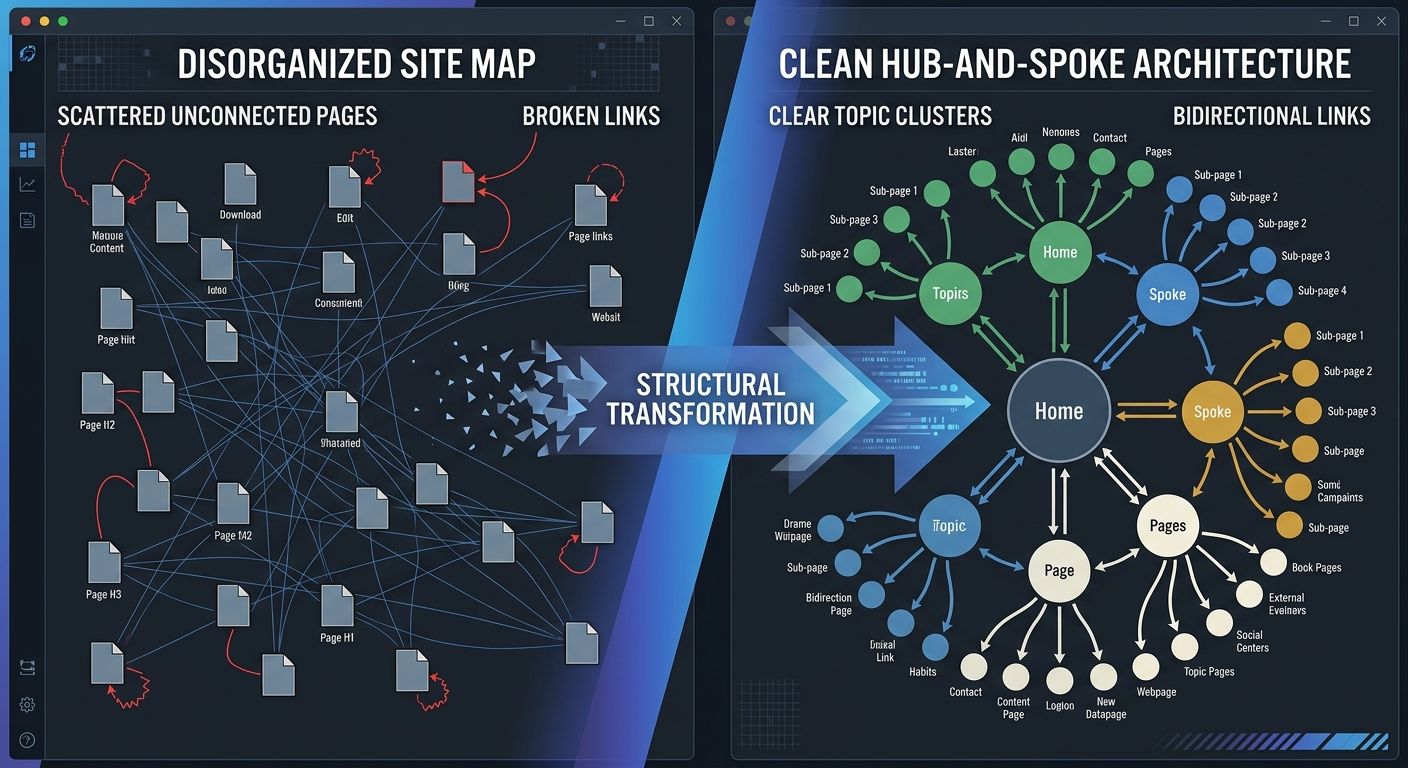
Content architecture remains the most reliable mechanism for communicating topical expertise to search engines. It works because it aligns with how Google's systems actually process websites: through links, through anchor text, through hierarchical proximity. But the structure is the foundation, and what you build on it — the content quality, the maintenance discipline, the adaptation to shifting search interfaces — determines whether that foundation ever translates into revenue. The sites that treat architecture as a living system, one that evolves alongside their content and their market, are the ones where good rankings consistently become good conversion rates.

Alex Chen
Alex Chen is a digital marketing strategist with over 8 years of experience helping enterprise brands and agencies scale their online presence through data-driven campaigns. He has led marketing teams at two successful SaaS startups and specializes in conversion optimization and multi-channel attribution modeling. Alex combines technical expertise with strategic thinking to deliver actionable insights for marketing professionals looking to improve their ROI.
Explore more topics