
The Site Architecture Data Audit: Diagnosing Why Your Topic Clusters Aren't Signaling Topical Authority to Google
Your topic clusters are architecturally incoherent, and publishing more content into them is making the problem worse.
The Site Architecture Data Audit: Diagnosing Why Your Topic Clusters Aren't Signaling Topical Authority to Google
Your topic clusters are architecturally incoherent, and publishing more content into them is making the problem worse. I've run site architecture audits for SaaS companies, e-commerce brands, and content publishers over the past three years, and the pattern repeats with uncomfortable consistency: teams invest months building pillar pages and cluster content, then wonder why Google treats them as a loose collection of blog posts rather than a coordinated authority signal. The content is usually fine. The linking structure underneath it is where everything falls apart.
A proper site architecture audit exposes the gap between what your content strategy intended and what Google's crawler actually encounters. The diagnosis typically comes down to three structural failures, each of which silently undermines topical authority signals across your entire domain.
Orphan Pages Are Invisible to Google's Authority Graph
The most common failure I find during topic cluster validation is the orphan page problem. An orphan page has no internal links pointing to it from related content. From a topical authority standpoint, it might as well not exist.
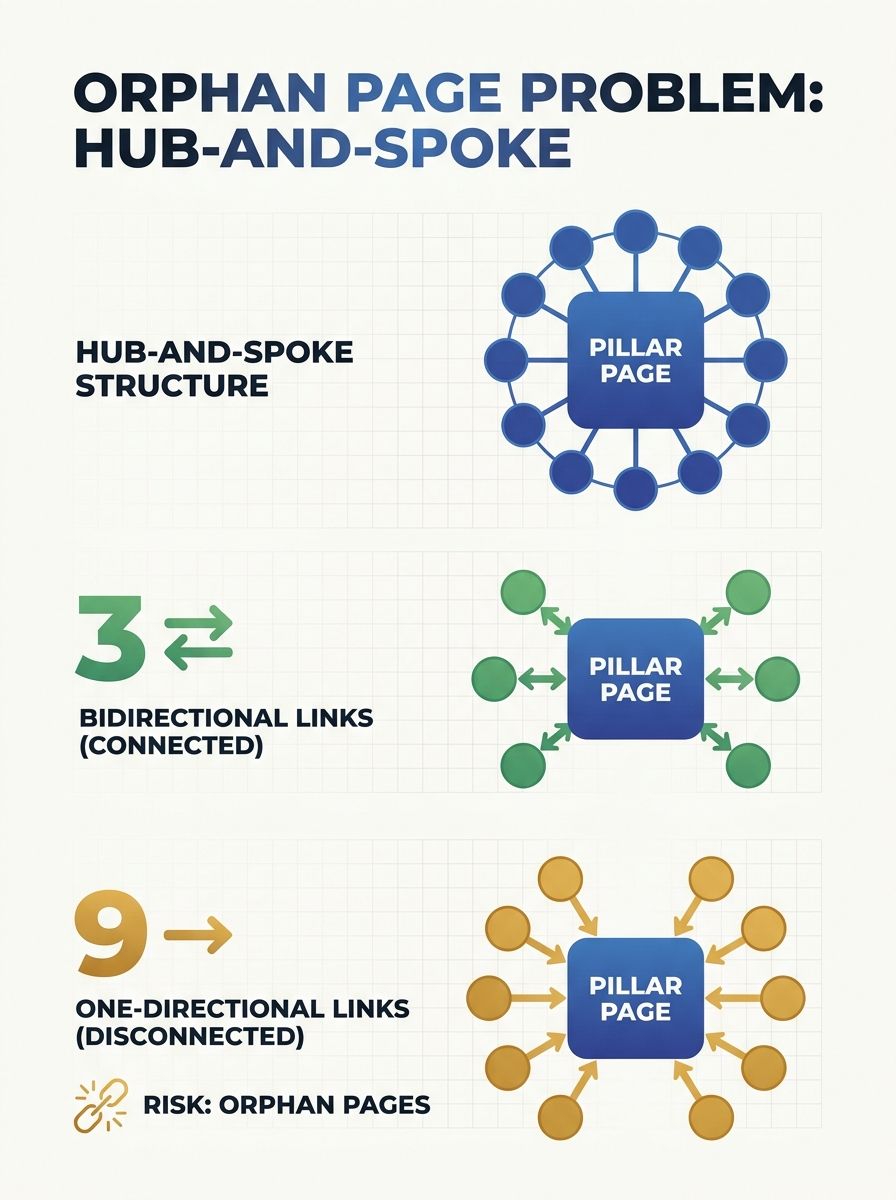
Here's how this happens in practice. A content team publishes a pillar page on "email marketing automation." Over the next four months, they produce twelve cluster articles covering subtopics: welcome sequences, drip campaigns, A/B testing subject lines, segmentation strategies. Each cluster article links back to the pillar page. But here's the structural gap: the pillar page links to only three of the twelve cluster articles. The other nine sit orphaned from the hub, connected in one direction only.
Google needs that circular linking structure to understand that your site offers thorough coverage of a topic, as Search Engine Land's topical authority guide explains. When the circle is broken, when cluster pages link up to the pillar but the pillar doesn't link back down, you've built a one-way street where authority can't flow.
Running this check takes about thirty minutes with a crawling tool like Screaming Frog. Export all internal links, filter by your cluster URL paths, and map the connections bidirectionally. I build a simple spreadsheet: Column A is the cluster page URL, Column B tracks whether the pillar links to it (yes/no), Column C tracks whether it links to the pillar (yes/no), and Column D counts cross-links to sibling cluster pages.
The results are usually sobering. In one audit I ran for a B2B SaaS client, 34 of 51 cluster pages had zero inbound internal links from their designated pillar. Those 34 pages generated a combined 12 organic sessions per month. The 17 properly linked pages generated over 4,800.
This connects directly to what Google's leaked onsiteProminence attribute revealed: Google doesn't just track external backlinks. It meticulously maps how authority flows within your own site. Orphan pages receive none of that internal flow. If you've been exploring how mobile-first indexing reshapes your internal linking architecture, this orphan page problem compounds dramatically on mobile, where navigation menus and sidebars are often collapsed or stripped entirely.
Anchor Text That Carries Zero Topical Signal
The second structural failure is subtler but equally damaging. Even when internal links exist between cluster pages, the anchor text often communicates nothing about the target page's topic.
I've catalogued anchor text across hundreds of internal links during site architecture audits, and the distribution is predictable. Generic anchors like "read more," "click here," "this article," and "learn more" account for 40-60% of all internal link text on sites that haven't been audited. Another 20-30% use the exact URL as the anchor. The remaining fraction uses descriptive, topic-relevant phrases.
This matters because Google uses anchor text to understand what the linked page is about. Research on site architecture for topical authority confirms that generic anchors add no topical signal, while descriptive anchors like "local SEO audit process" or "email segmentation for e-commerce" tell Google precisely what relevance the target page carries.
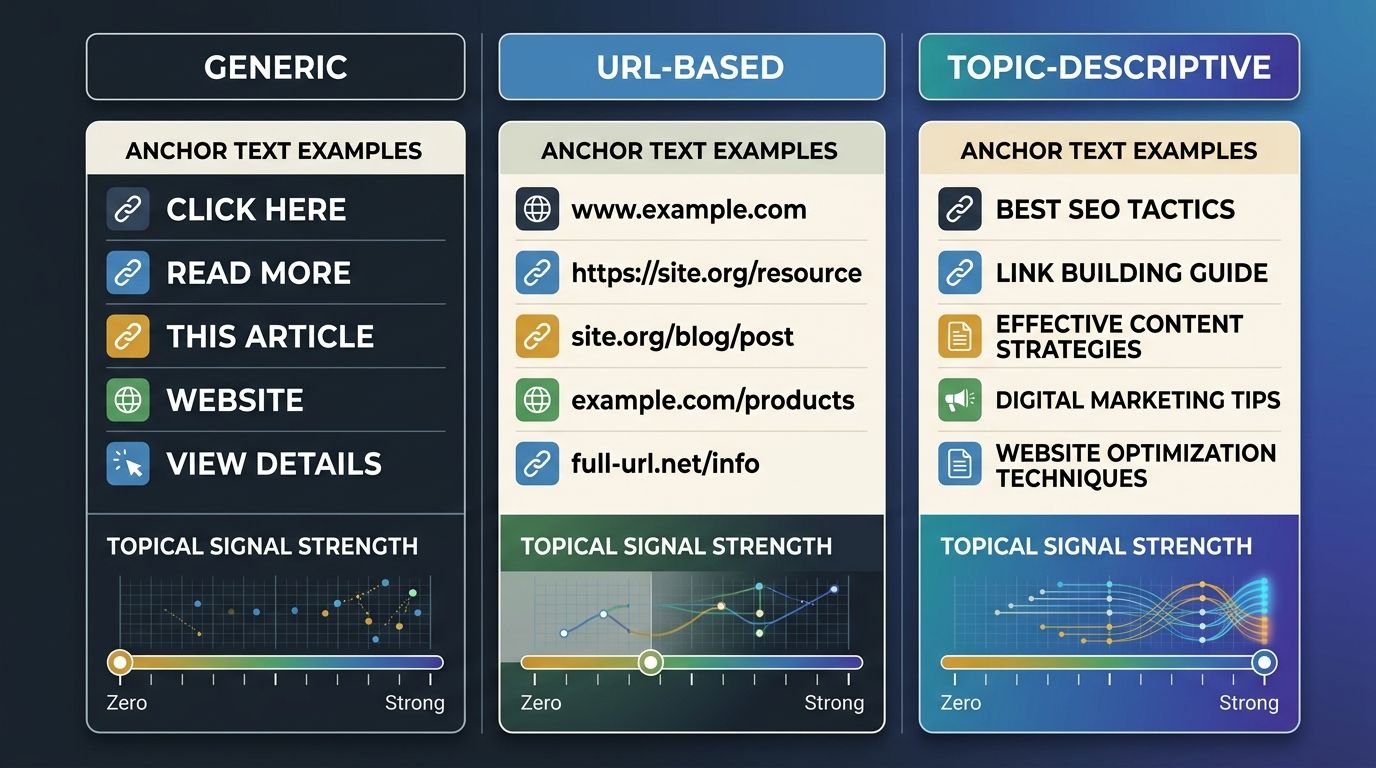
Here's the internal linking analysis framework I use to fix this:
Export all internal links from your crawling tool, including the anchor text and source/target URLs.
Tag each anchor as generic, URL-based, branded, or topic-descriptive.
Calculate the topic-descriptive ratio per cluster. Anything below 60% needs remediation.
Prioritize rewrites on links from high-authority pages (those with the most backlinks or internal links pointing to them), since those pass the most signal.
Match anchor text to the target page's primary keyword theme, not the exact-match keyword. If the target page focuses on "drip campaign best practices," anchors like "building effective drip sequences" or "automated drip campaigns" work well.
The rewrite process is tedious. On a site with 200 cluster pages, you might be updating 800+ anchor text instances. But the ranking impact is measurable within two crawl cycles if the rest of your structure is sound. I've seen clusters jump from page three to the top five for competitive head terms after anchor text remediation alone, with no new content published. If you're already working from a keyword prioritization framework to guide your content roadmap, use those same keyword themes to inform your anchor text rewrites. The alignment between your keyword strategy and your link text strategy should be explicit, not accidental.
When Cluster Pages Compete Instead of Cooperating
The third failure mode is cannibalization within clusters. This happens when multiple cluster pages target overlapping search intents, and Google can't determine which one should rank. Instead of one strong page earning visibility, three mediocre pages split signals and none of them perform.
Cannibalization is a content strategy problem, but it manifests as a linking architecture problem. Here's why: when two cluster pages cover nearly identical ground, the internal links pointing to them carry similar anchor text and come from similar contextual paragraphs. Google receives redundant signals and has to choose. It often chooses poorly, or cycles between the competing pages across ranking updates.
The diagnostic step is straightforward. Pull your Google Search Console performance data, filter by cluster-relevant queries, and look for URLs that share the same query set. If "email segmentation strategies" and "how to segment your email list" are both ranking (or attempting to rank) for the same ten queries, you have a cannibalization problem.
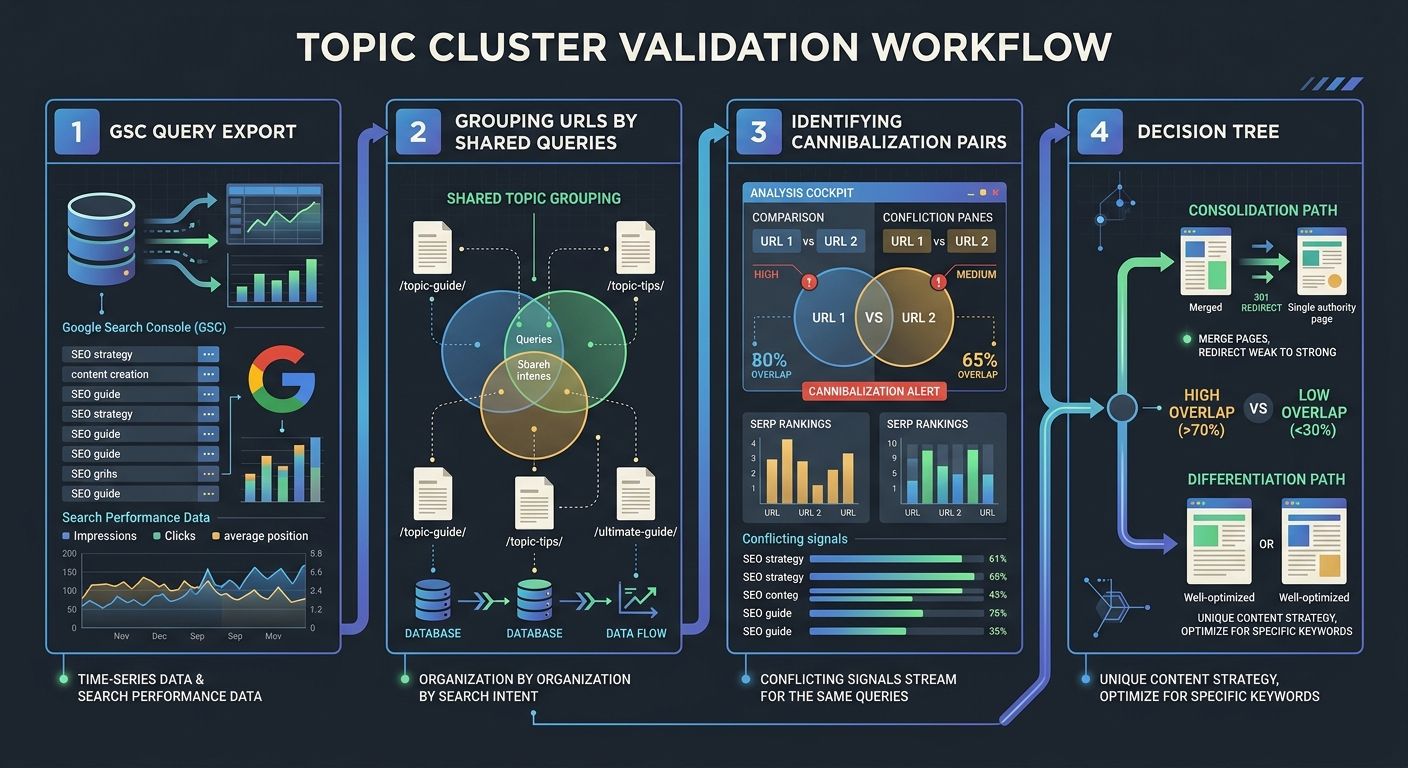
The fix involves one of two paths:
Consolidation. Merge the competing pages into a single, thorough piece and 301 redirect the weaker URL to the stronger one. Update all internal links to point to the surviving page. This concentrates link equity, topical signals, and crawl budget into one asset. Understanding how topic clusters interact with other architecture signals like XML sitemaps helps you make cleaner consolidation decisions, because you'll know which signals Google weighs when choosing between competing URLs.
Differentiation. If the two pages serve genuinely different user intents that happen to overlap in keyword data, rewrite one page to sharpen its angle. Then adjust internal links so each page receives anchor text that emphasizes its distinct focus. A page about "email segmentation for e-commerce" should receive different anchors than "behavioral segmentation in SaaS onboarding," even though both currently rank for "email segmentation."
I run this cannibalization check quarterly, and I'd recommend the same cadence for any site producing more than ten pieces of cluster content per month. The overlap creeps in faster than you'd expect, especially when multiple writers contribute to the same topic cluster without a shared editorial framework governing what each piece covers. Getting your content consistency metrics right at the operational level prevents many of these cannibalization problems from forming in the first place.
Where the Architecture Argument Runs Into Its Own Limits
I've made the case that broken architecture destroys topical authority signals, and I stand behind that diagnosis across every audit I've run. But I want to pressure-test it honestly, because architecture alone doesn't explain everything.
Content depth still matters enormously, and no amount of architectural perfection compensates for thin articles. Google evaluates whether your coverage is shallow or substantive, and as Keyword Insights' guide to topical authority notes, each cluster page needs to dive deep into its specific subtopic for the hub-and-spoke structure to accomplish what it's designed to accomplish. You can have perfect bidirectional linking, topic-rich anchor text, and zero cannibalization, and still fail to build authority if every cluster article is 400 words of surface-level advice. The architecture creates the conditions for authority signals to flow. The content determines whether there's any authority worth flowing.
Entity alignment between your SEO and content teams plays an equally important role, and most organizations get this wrong. Teams that operate in silos, where content creates pages without schema markup and SEO implements technical fixes without understanding editorial intent, end up with architecturally connected pages that lack entity coherence. Google's understanding of topical authority increasingly relies on entity relationships, and those relationships need to be explicit in both your content and your on-page markup.
And external links still feed the system. Internal architecture distributes authority, but that authority has to originate somewhere. Backlinks from relevant, authoritative external sites are the initial energy source. A perfectly structured cluster with zero external citations is a closed loop with nothing circulating inside it. That's why a site architecture audit should always be paired with an external link analysis for each cluster, measuring not just total backlinks, but whether those backlinks point to the right pages within your cluster hierarchy.
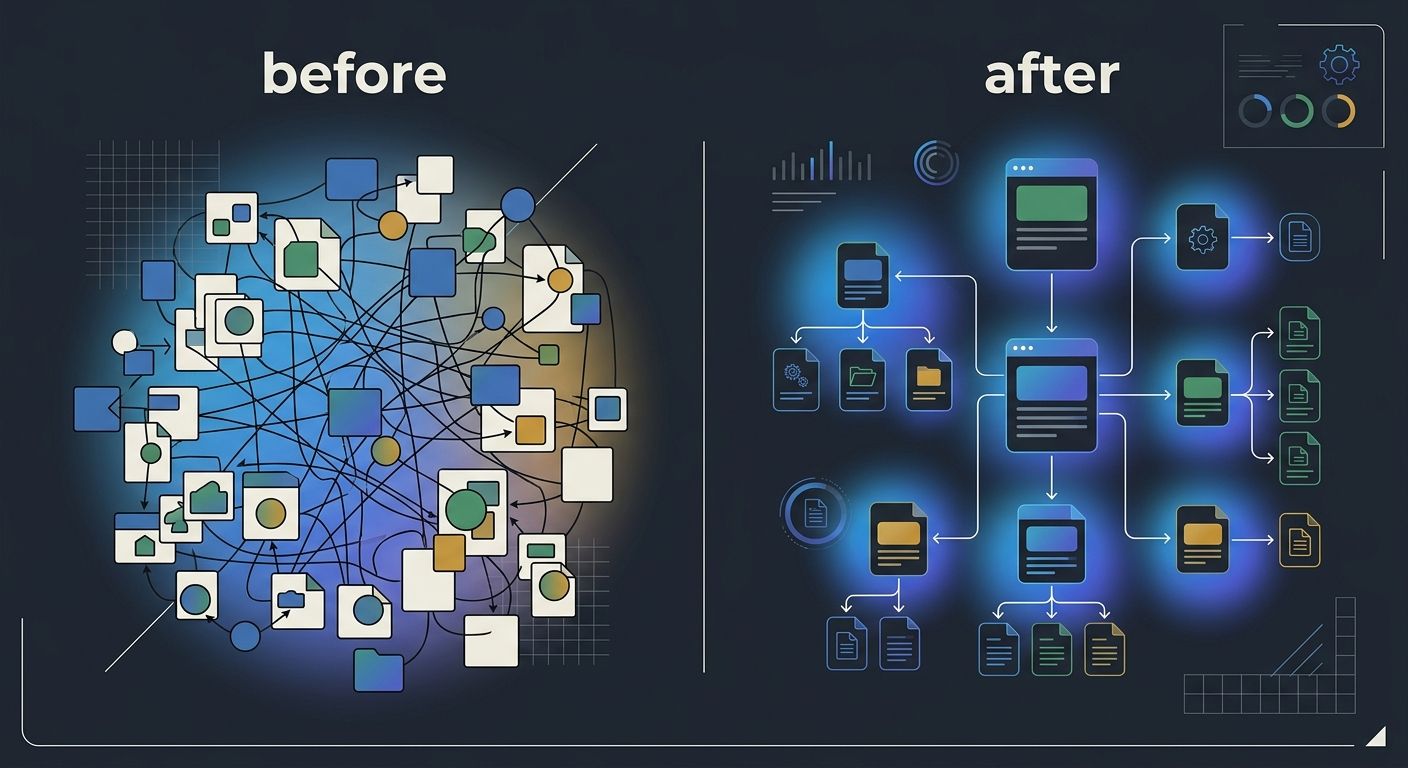
So the honest version of my thesis is this: broken site architecture is the single most common reason topic clusters fail to signal authority, and it's the failure mode with the highest fix-to-impact ratio. Content rewrites take weeks. Earning backlinks takes months. Fixing your internal linking graph takes days, and the returns show up in Search Console within one to two crawl cycles. When I'm asked where to start a topical authority recovery, the internal linking analysis always comes first, because it's the fastest lever that produces the most measurable change. Everything else in the audit can follow.

Alex Chen
Alex Chen is a digital marketing strategist with over 8 years of experience helping enterprise brands and agencies scale their online presence through data-driven campaigns. He has led marketing teams at two successful SaaS startups and specializes in conversion optimization and multi-channel attribution modeling. Alex combines technical expertise with strategic thinking to deliver actionable insights for marketing professionals looking to improve their ROI.
Explore more topics