
Content Personalization Bottleneck: Why 78% of Marketers Can't Scale Without Better Tools
Adobe, Salesforce, and Braze all shipped major personalization features between Q3 2025 and Q1 2026. The collective pitch was familiar: AI would finally close the gap between the content marketers want to create and the content they can actually produce.
Content Personalization Bottleneck: Why 78% of Marketers Can't Scale Without Better Tools
Adobe, Salesforce, and Braze all shipped major personalization features between Q3 2025 and Q1 2026. The collective pitch was familiar: AI would finally close the gap between the content marketers want to create and the content they can actually produce. Adoption surged across enterprise and mid-market teams alike. Then a Salesforce survey landed in November 2025, and eMarketer published the findings in April 2026: 78% of marketers worldwide still can't produce enough personalized content to meet demand. The tools arrived. The bottleneck didn't budge.
I've spent the better part of eight months watching clients wrestle with this exact problem. And the pattern is so consistent it's worth tracing from the beginning, because the content production bottleneck didn't appear overnight. It followed a predictable sequence that most teams could have anticipated if they'd looked at the right data.
The AI Personalization Gold Rush
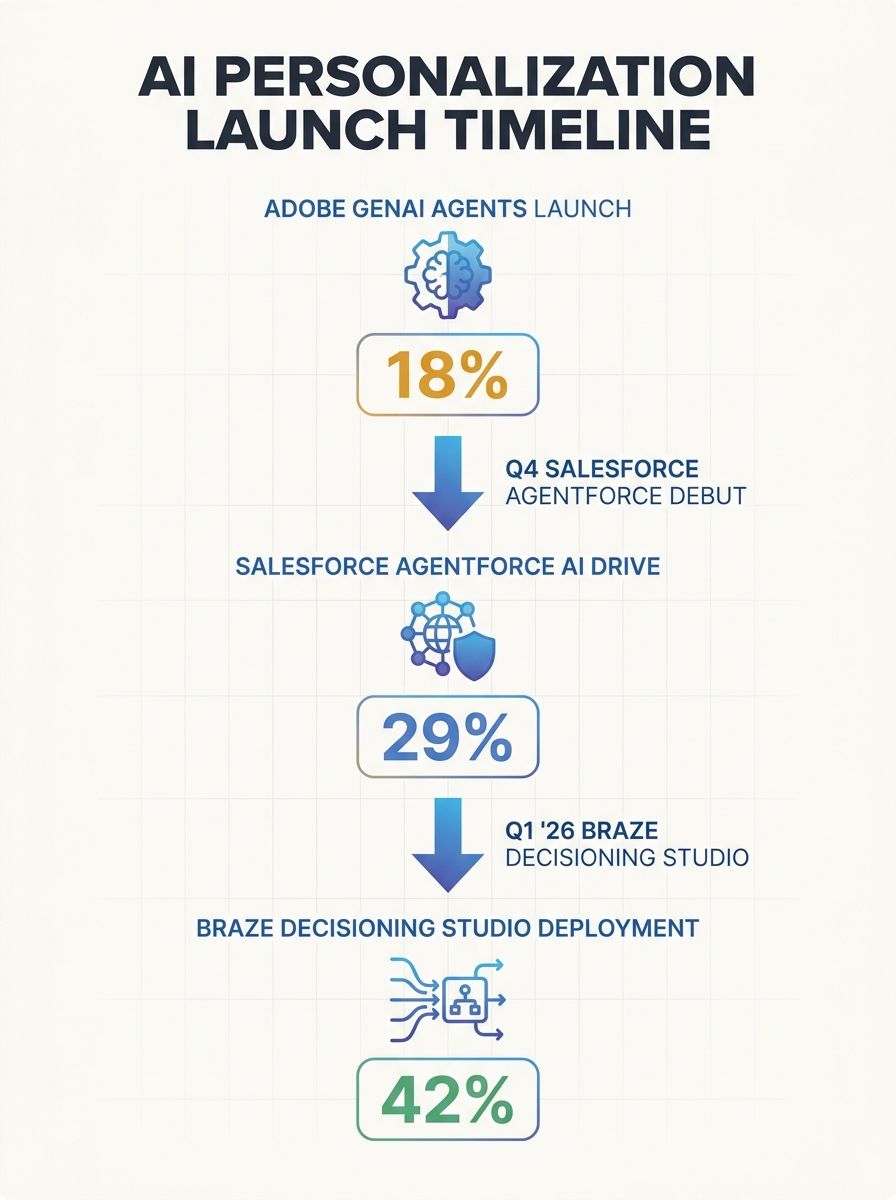
The wave started building in mid-2025. Adobe launched GenAI-powered content creation agents designed to generate variations across every channel from a single brief. Salesforce pushed Agentforce and autonomous real-time recommendations through its personalization platform. Braze introduced Decisioning Studio, which acts as an optimization co-pilot for customer journeys. Dedicated personalization platforms started appearing as standalone layers in the martech stack for personalization, separate from any single channel tool.
Marketing teams bought in fast. The promise of content personalization at scale was too attractive to ignore, especially for organizations already struggling to keep up with channel proliferation. If AI could turn one creative brief into thirty variations, the math seemed obvious. Scale the tooling, scale the output.
But adoption metrics told a misleading story. Teams were activating features without addressing the structural prerequisites. And the structural prerequisites turned out to be the entire problem.
When 98% of Teams Hit the Same Wall
The eMarketer report that surfaced the 78% production gap also included a more alarming statistic: 98% of marketers using AI for personalization reported at least one significant hurdle, with data siloed across channels ranking as the number-one blocker.
This is where the chronology matters. Teams bought personalization tools first. Then they tried to feed those tools with customer data. Then they discovered their data lived in six different systems that didn't talk to each other.
The sequence should have been reversed.
According to Forrester research cited by BannerFlow, 53% of B2C marketing decision-makers said it's difficult to update their data strategy to adapt to data deprecation. And as Contentful's analysis put it, effective personalization requires the coordinated orchestration of data collection, segmentation, cross-channel profile synchronization, and execution. Skip any one of those layers, and the AI tools generate personalized content that's personalized to the wrong signals.
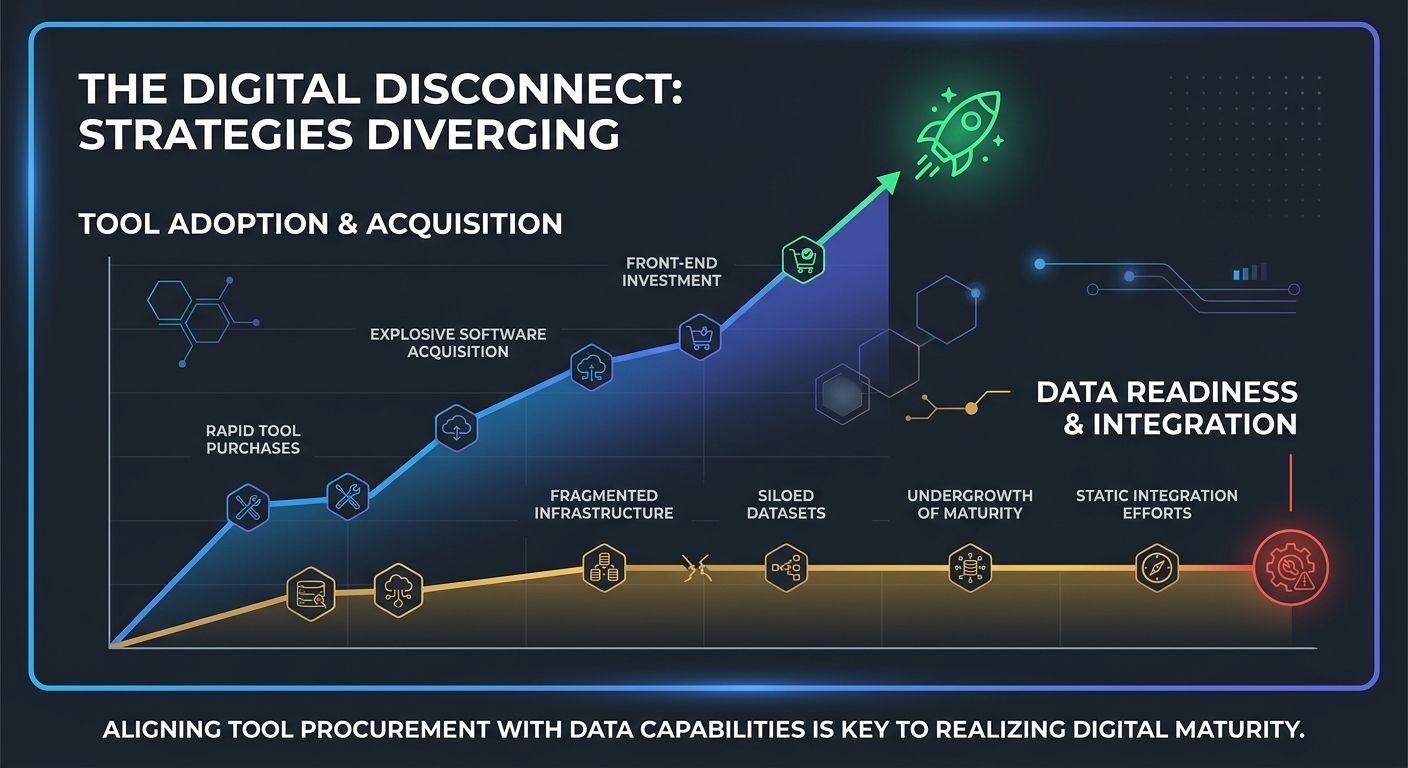
I saw this play out with a B2B SaaS client in Q4 2025. They'd invested $180K in a personalization platform, connected it to their CRM, and started generating dynamic email variations. Open rates climbed 12%. But pipeline influence was flat because the personalization engine was working off incomplete account data. It was personalizing based on job title and industry, missing the behavioral signals (product usage patterns, support ticket history, content consumption) that actually predict purchase intent. If you've dealt with similar dashboard-vs-reality gaps in your analytics, you know how frustrating this gets.
The Content Production Gap Nobody Planned For
Even when teams solved the data problem, they hit a second wall: raw content capacity planning. AI can generate variations, but it needs source content to vary. And most marketing teams were already running at capacity before personalization entered the conversation.
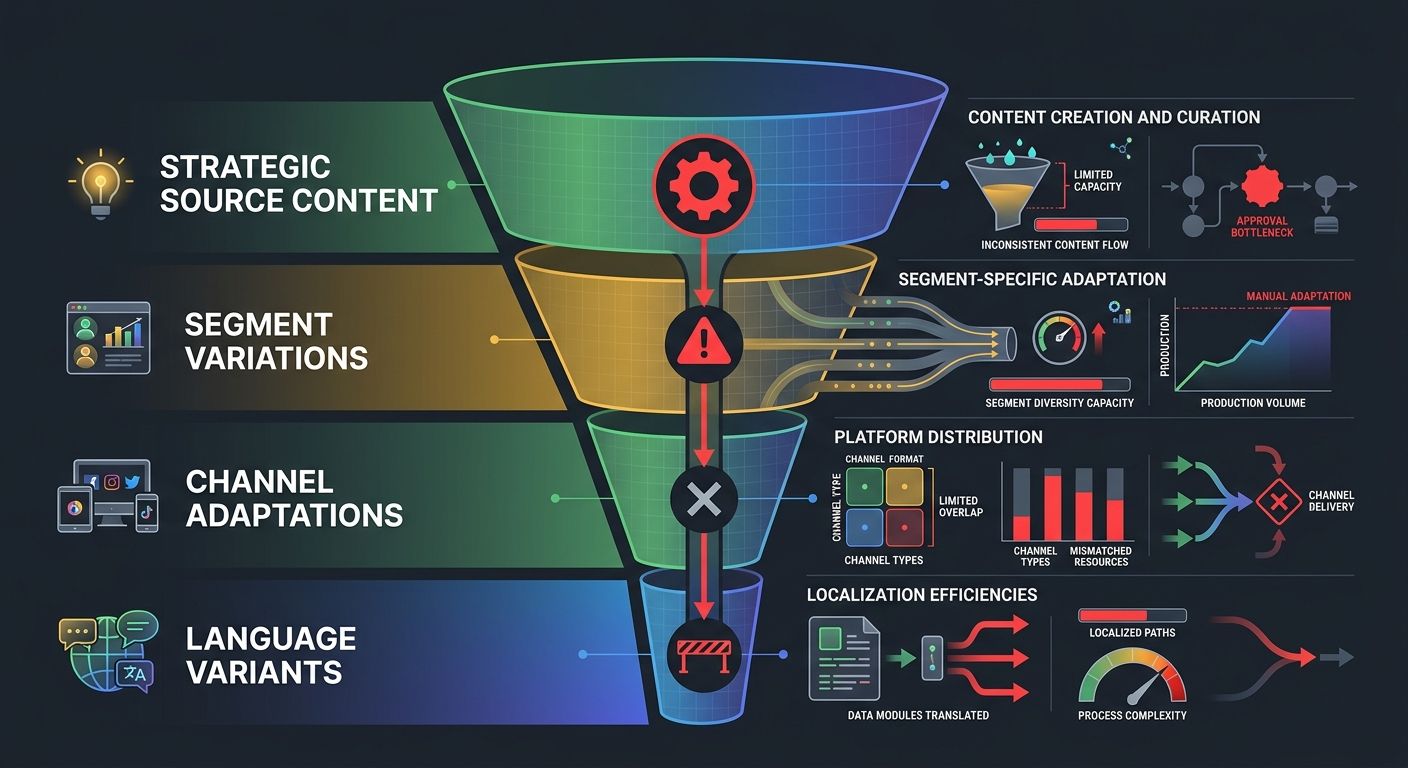
Here's what the production math actually looks like for a mid-market B2B company trying to personalize across three segments, four channels, and two languages:
Base content pieces needed per month: 40
Segment variations: 40 × 3 = 120
Channel adaptations: 120 × 4 = 480
Language variants: 480 × 2 = 960
That's 960 content assets per month from a team that was struggling to produce 40. Marketing automation for personalized content can handle the variation layer, but someone still has to create the strategic source material, define the personalization logic, and QA the output.
This is the content production bottleneck in its purest form. And it's why AWS published a case study showing that agentic AI reduced webpage assembly time from four hours to roughly ten minutes — a 95% reduction. That kind of compression matters, but only for teams that had the upstream content strategy already built. The assembly was never the hard part. Knowing what to assemble was.
Teams working on content authenticity and quality-driven strategies are actually better positioned here, because they've already learned that volume without strategic intent produces noise.
What the Teams That Broke Through Actually Changed
Between January and March 2026, I worked with three enterprise marketing organizations that measurably improved their personalization output. The pattern across all three was similar enough to be instructive.
They invested in a Customer Data Platform before anything else
Twilio Segment, which centralizes behavioral and profile data across the entire stack, kept showing up in the implementations that worked. These teams treated the CDP as foundational infrastructure, not an add-on. Identity resolution and audience building happened at the data layer, and the personalization tools downstream consumed clean, consistent profiles rather than pulling from fragmented sources.
This echoes the approach that dedicated analytics stack planning requires: pick the data foundation first, then choose the tools that sit on top of it.
They tiered their personalization efforts by account value
The most effective teams stopped trying to personalize everything equally. They built three tiers:
High-value accounts: Fully custom content with manual research and bespoke messaging. These averaged a 29% reply rate and 67% meeting conversion in B2B outreach tests.
Mid-tier accounts: Templated structures with 3–5 personalized elements pulled from automated research signals (funding rounds, tech stack changes, recent hires).
Volume tier: Well-crafted value-first templates with dynamic tokens for name, company, and industry context.
This tiered model acknowledges something important: content personalization at scale doesn't mean equal personalization for every contact. It means smart allocation of finite creative resources.
They built cross-functional content workflows
The production bottleneck is almost always a coordination problem, not a talent problem. Companies like General Mills and Microsoft addressed this by implementing integrated content hubs that gave every stakeholder visibility into the workflow. When your cross-team planning system actually scales, the content production bottleneck starts to dissolve because people stop duplicating work and waiting in invisible queues.
Where the Data Lands Today
The 78% figure from the Salesforce survey hasn't moved meaningfully as of April 2026. But the composition of the problem has shifted.
Early in this cycle, the gap was about tools. Teams didn't have the technology to generate variations at speed. That gap has largely closed. Adobe, Salesforce, Braze, Sitecore, and a wave of smaller platforms all offer functional content personalization engines. The martech stack options for 2026 are deeper and more specialized than they've ever been.
The remaining gap is structural. It lives in three places:
Data unification: 98% of AI-using marketers still report friction, with silos as the primary cause. CDPs help, but they require governance and maintenance that most teams underestimate.
Content capacity planning: Source content creation remains manual, strategic, and slow. AI compresses the variation and assembly layers but doesn't eliminate the need for original thought.
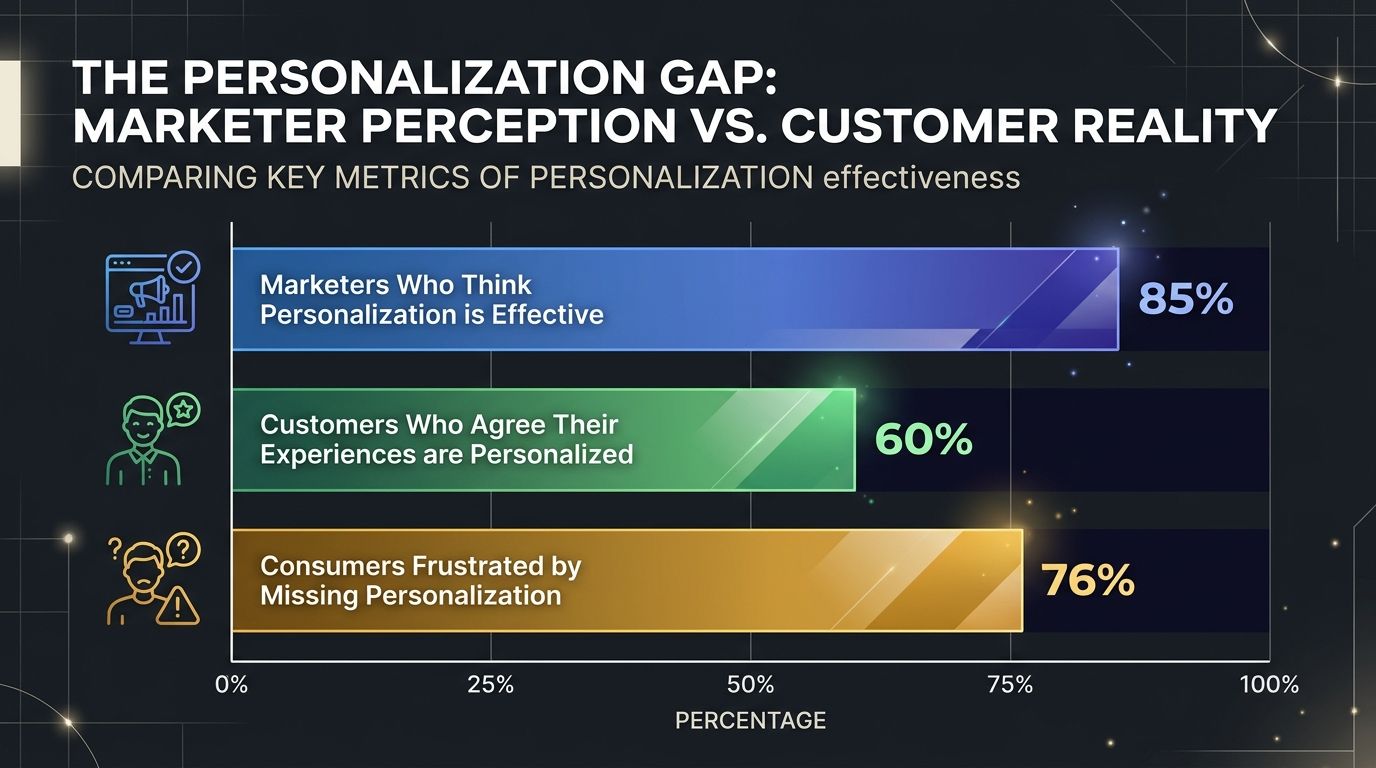
Measurement: 85% of companies believe they personalize effectively. Only 60% of customers agree. That 25-point perception gap means most teams are measuring activity (emails sent, variations created) instead of outcomes (incremental revenue lift, reply-to-deal conversion).
The teams that will close this gap over the next twelve months are the ones treating personalization as an operational discipline, not a feature to toggle on. That means investing in data infrastructure before creative tooling, building tiered content strategies that match effort to account value, and measuring full-funnel impact rather than vanity metrics. The tools are ready. The organizations, for the most part, are still catching up.

Alex Chen
Alex Chen is a digital marketing strategist with over 8 years of experience helping enterprise brands and agencies scale their online presence through data-driven campaigns. He has led marketing teams at two successful SaaS startups and specializes in conversion optimization and multi-channel attribution modeling. Alex combines technical expertise with strategic thinking to deliver actionable insights for marketing professionals looking to improve their ROI.
Explore more topics