
Authenticity Over Volume: Why 2026 Content Strategy Demands Less (But Better) Output
Publishing five blog posts per week is not a strategy. It's a coping mechanism. And the data now proves what many of us suspected for years: the brands winning attention, trust, and actual revenue from content aren't the ones publishing the most.
Authenticity Over Volume: Why Your 2026 Content Strategy Demands Less (But Better) Output
Publishing five blog posts per week is not a strategy. It's a coping mechanism. And the data now proves what many of us suspected for years: the brands winning attention, trust, and actual revenue from content aren't the ones publishing the most. They're the ones publishing the least amount of forgettable noise. High-quality, relevant content generates 9.5 times more leads than low-quality, non-targeted content. That's not a marginal improvement. That's an order-of-magnitude difference that should make every marketing leader question their editorial calendar.
I spent the first quarter of this year helping three mid-size B2B companies cut their publishing frequency by 60%. Every single one saw engagement go up. Two of them saw organic traffic increase within eight weeks. The third held steady on traffic but doubled their conversion rate from content. The pattern is clear: content marketing authenticity isn't a feel-good buzzword. It's the competitive advantage hiding in plain sight.
The Flood Made Everything Worthless
Here's what happened. Between 88% and 93% of marketers now use AI daily to produce content. That sounds like a productivity win until you realize it means every competitor in your space is generating the same AI-assisted articles, hitting the same keyword targets, with the same sanitized tone. The result? A flood of "good enough" content that nobody remembers, shares, or acts on.
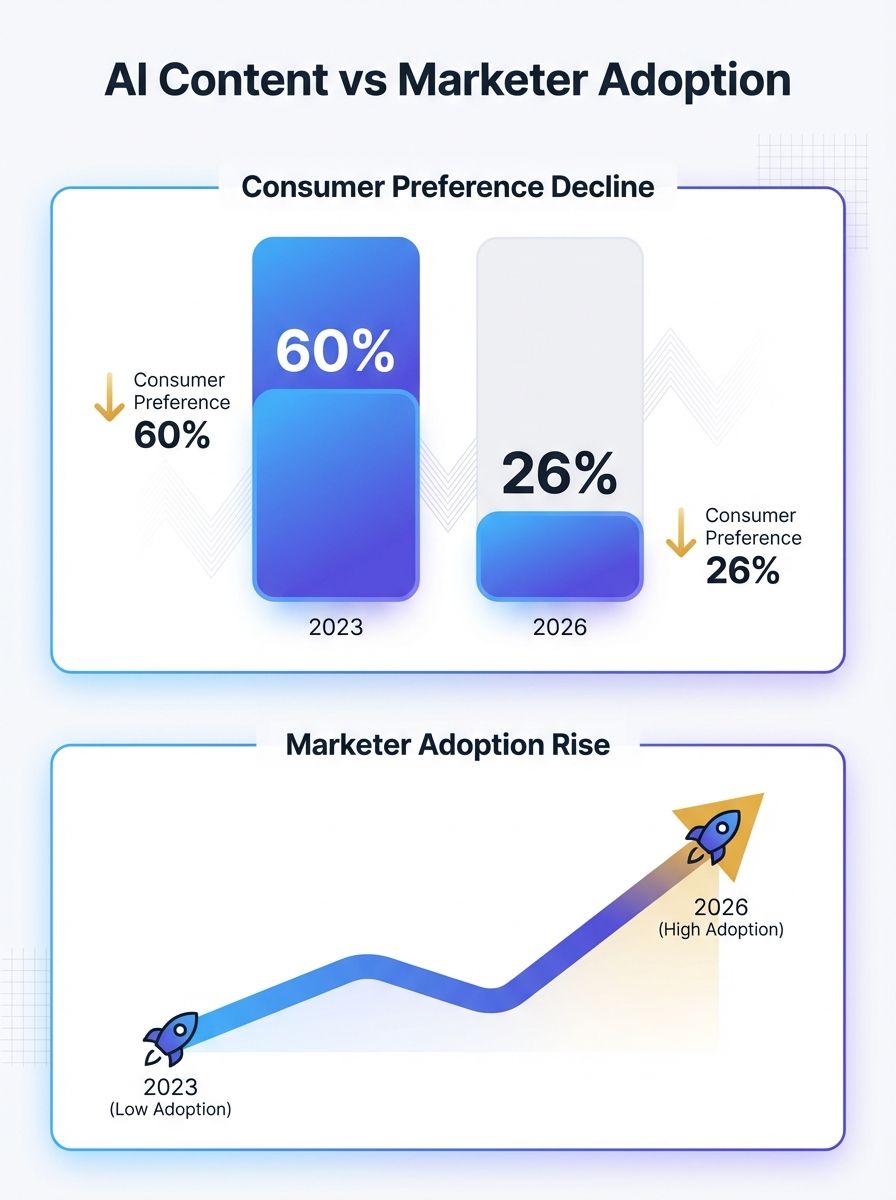
EY's analysis of media trends puts it bluntly: AI is accelerating volume and speed of content, but it's also flattening it. When everything sounds the same, nothing stands out. And audiences have noticed. According to Sprout Social, 62% of consumers are less likely to engage with content they know is AI-generated. Only 26% of consumers prefer AI-generated creator content now, down from 60% in 2023. That collapse in trust happened fast.
The more synthetic content floods feeds, the more audiences crave authenticity. This isn't nostalgia. It's a rational response to noise. When your inbox, your LinkedIn feed, and your search results are all stuffed with interchangeable AI-polished prose, the piece that sounds like an actual human with actual opinions becomes magnetic.
What "Authenticity" Actually Means (It's Not What You Think)
I need to be precise here because "authenticity" has been abused into meaninglessness by marketing Twitter. I'm not talking about sharing your morning routine or crying on camera for engagement. I'm talking about three specific, measurable qualities in your content.
1. A Recognizable Voice
Your content should sound like it was written by someone specific. Not a committee. Not a template. Someone with opinions, blind spots, and a way of explaining things that readers can identify without seeing the byline. This is what voice in content strategy really means. Allstate nailed this years ago. Their spokesman never claims to be a customer, but he dresses casually, looks like an everyday person, and tells folksy stories. The voice is consistent and human.
When you're building your first content marketing strategy, defining that voice early is more important than choosing your topic clusters. I'd argue you should pick 3-5 adjectives that describe how your brand communicates and ruthlessly edit everything that doesn't match. "Analytical, direct, and slightly irreverent" is a voice. "Professional and informative" is not. That's a default, and defaults are invisible.
2. Original Insight, Not Repackaged Information
AI can summarize. AI can synthesize. What it can't do is tell your audience something they haven't heard before based on experience they haven't had. The content that actually earns trust includes original research, proprietary data, client stories, and expert opinions that can't be scraped from ten existing articles and blended into an eleventh.
This is why surface-level "how-to" content has been completely commoditized. If your article could have been written by someone who's never done the thing they're writing about, it has no defensible value. Describe a narrative about how your product or approach helped someone overcome a specific difficulty. That story can't be replicated by a competitor's AI.
3. Transparency About What You Don't Know
Brands that practice radical honesty see up to 42% more positive mentions within weeks. That includes admitting mistakes, explaining pricing decisions, and showing work in progress. I've written posts where I said "we tried X and it didn't work" that outperformed my most polished thought leadership pieces by 3x in engagement. People are starving for someone who'll just be straight with them.
The Practical Framework: Audience-First Content Planning
So how do you actually implement this? I'll share the exact framework I've been using with clients. It starts with a mindset shift: stop thinking about what you want to publish and start thinking about what your specific audience genuinely needs to hear from you, specifically.
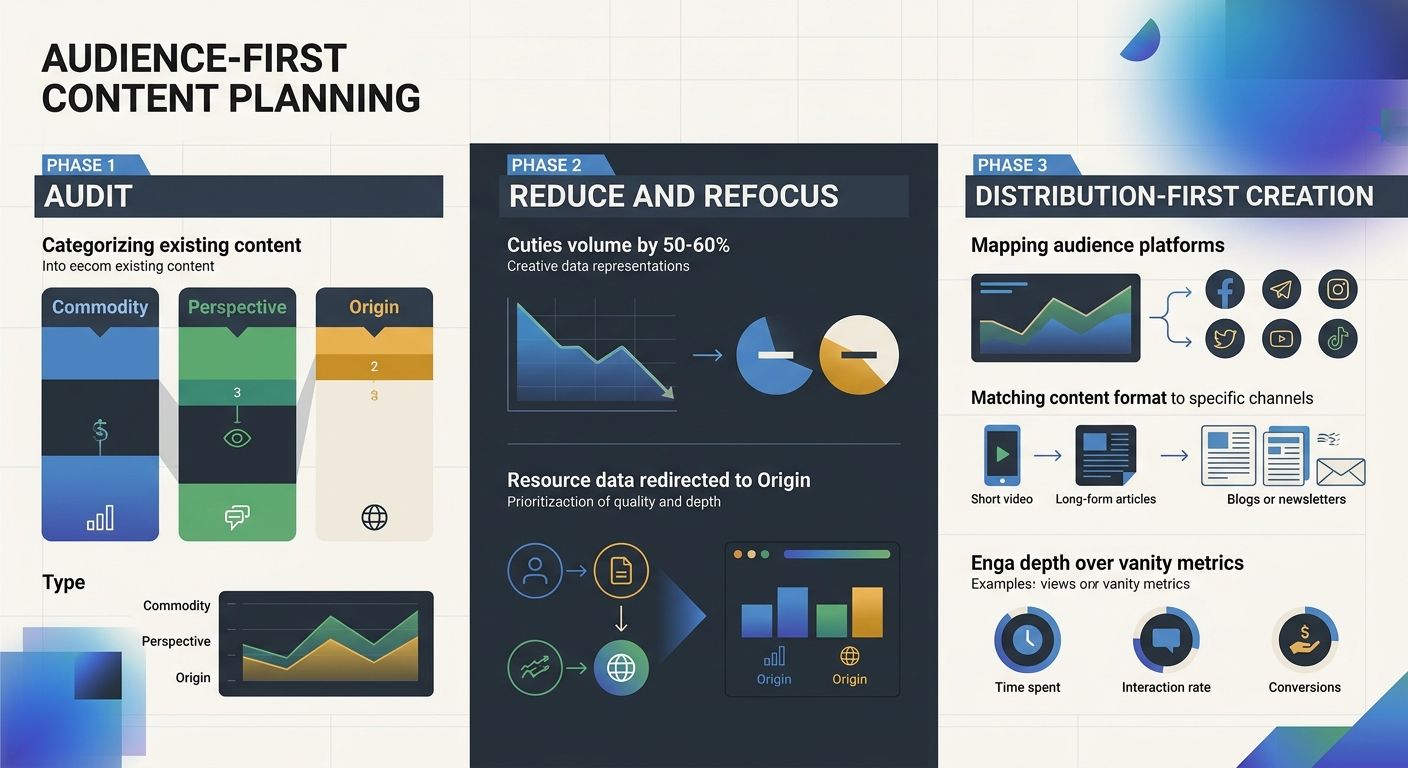
Step 1: Audit Your Existing Content Ruthlessly
Pull up everything you've published in the last six months. Categorize each piece as one of three types:
Commodity content — information available everywhere, no unique angle
Perspective content — common topic, but filtered through genuine experience
Origin content — something only you could have written based on your data or experience
If more than 50% falls into the commodity bucket, you've identified the problem. When you audit and reverse-engineer your content strategy, this categorization is the most revealing exercise you can do.
Step 2: Cut Volume and Redirect Resources
The math is simple. If you're publishing four mediocre posts per week, redirect that effort into one genuinely excellent piece. Spend the saved time on original research, interviewing customers, and actually thinking through your arguments. Content quality over quantity 2026 isn't aspirational advice. It's what the best-performing brands are already doing. Audiences prefer one deeply valuable, authentic piece per week over daily generic posts.
Step 3: Design Distribution Before Creation
Most teams create content and then figure out distribution as an afterthought. Flip it. Your content distribution strategy should dictate what you create. If your audience lives on LinkedIn, write for the constraints and culture of LinkedIn. If they're in Slack communities, create content that's worth sharing in a DM, not just clicking from a feed.
This connects directly to how you grow your social media presence — distribution isn't about blasting links across every platform. It's about matching format and voice to where your people actually pay attention. 73% of businesses now prioritize organic distribution for authenticity, and that means investing in community building over broadcast campaigns.
Step 4: Use AI as Research Assistant, Not Ghost Writer
I use AI tools every day. They're excellent for competitive research, structuring outlines, identifying gaps in my arguments, and summarizing dense source material. What I don't do is let them write the final output. The moment you hand over your voice to a language model, you've surrendered the one thing that makes your content defensible.
The winning approach is hybrid: AI handles efficiency, humans provide insight, emotion, and the specific expertise that comes from actually understanding your analytics data or doing the hard work of talking to customers. Your audience can tell the difference. They always could, but now they're actively looking for the seams.
Why This Matters for SEO Too
If you think this is purely a branding play, look at what's happening with search. Google's EEAT framework explicitly rewards experience, expertise, authoritativeness, and trustworthiness. AI answer engines are increasingly citing content that demonstrates original research and genuine authority. Brands conducting original research or sharing unique insights see higher citation rates in AI search results from Google's AI Mode and Perplexity.
Your audience-first content planning approach directly feeds SEO performance because content with genuine perspective earns more backlinks, gets cited by AI systems, and holds attention longer. When you're optimizing for AI answer engines alongside traditional search, depth and authenticity aren't nice-to-haves. They're ranking factors in everything but name.
And if your content ranks but nobody converts, you've got a different problem entirely. There's a real connection between authenticity and conversion — content that matches search intent while sounding human will always outperform the technically optimized piece that reads like it was assembled from a keyword brief.
What Lo-Fi Authenticity Looks Like in Practice
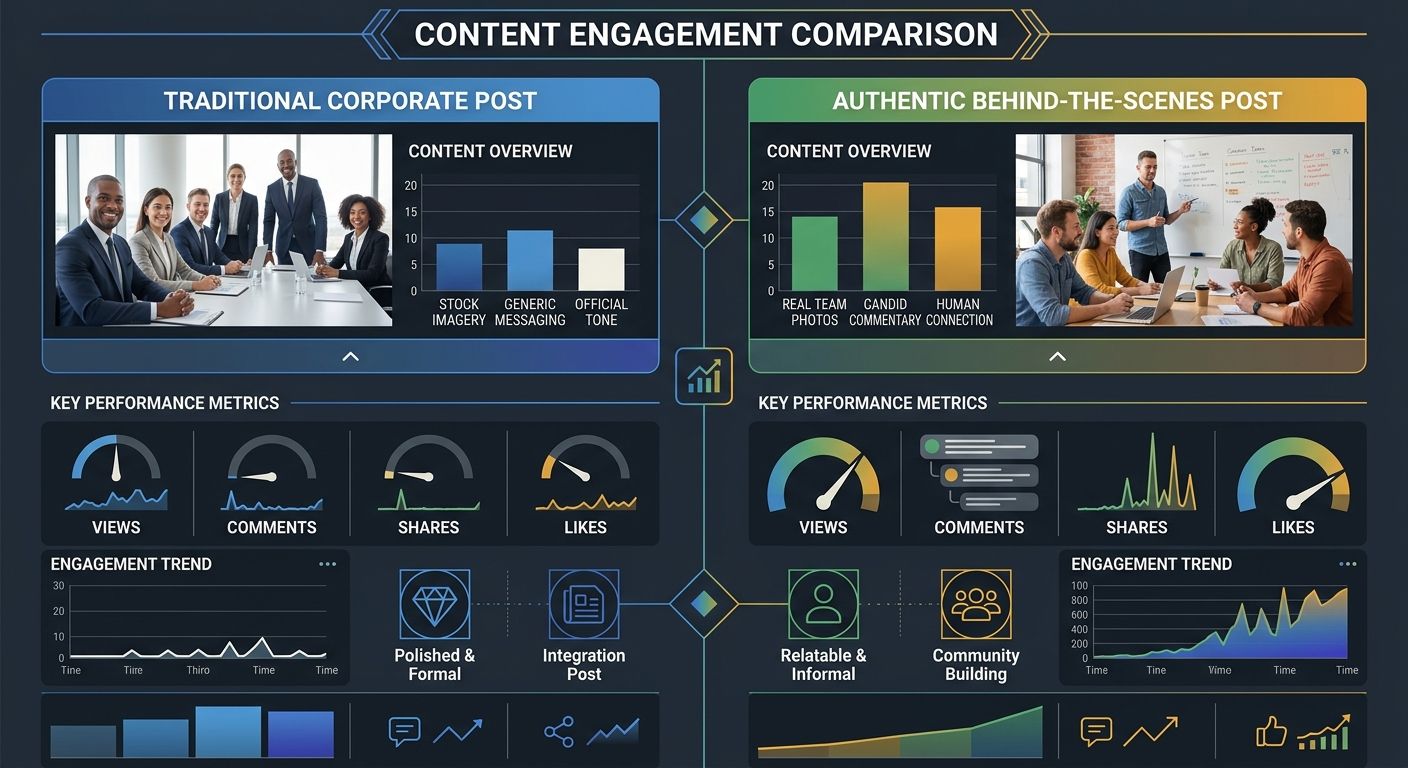
Data from multiple agencies shows that lo-fi, casual content generates 1.8 to 2 times more comments than highly produced campaigns. Shaky camera work, unscripted moments, and real behind-the-scenes footage aren't flaws. They're signals of humanity.
Some practical examples that work:
Reposting user-generated content from actual customers, as Sprout Social documents in their analysis of brands like Kodak
Publishing "what went wrong" retrospectives alongside your success stories
Letting individual team members write in their own voice instead of homogenizing everything through a brand style guide
Recording short video explanations where the speaker clearly isn't reading a script
Sharing the real data from your campaigns, including the failures
Take your audience behind the scenes and show them what goes on in your day-to-day operations. This isn't about being unprofessional. It's about being specific and real in a landscape where everything else is generic and polished.
The Takeaway You Can Implement This Week
Pull your editorial calendar for the next month. Count the pieces you have planned. Now cut that number in half. For every piece you cut, take the time and budget you would have spent and invest it in making the remaining pieces genuinely useful, genuinely opinionated, and genuinely yours. Define your voice in 3-5 adjectives, audit your existing content for commodity versus origin pieces, and design your distribution before you start drafting.
The brands building lasting trust in content aren't publishing more. They're publishing things only they could have written. That's the entire strategy. Everything else is noise.

Sarah Chen
SEO strategist and web analytics expert with over 10 years of experience helping businesses improve their organic search visibility. Sarah covers keyword tracking, site audits, and data-driven growth strategies.
Explore more topics