
Cross-Team SEO Workflows: Building an Integrated Planning System That Actually Scales
Cross-functional SEO execution fails at the coordination layer. Organizations run audits, pick keywords, and publish content, but the mechanism that drives scalable operations—shared dashboards, automated handoffs, unified entity strategies—never gets built.
Cross-Team SEO Workflows: Building an Integrated Planning System That Actually Scales
Cross-functional SEO execution fails at the coordination layer. Organizations run audits, pick keywords, and publish content, but the mechanism that drives scalable operations—shared dashboards, automated handoffs, unified entity strategies—never gets built. With 86% of SEO workflows now involving AI automation at some stage, the bottleneck isn't intelligence or tooling. It's coordination architecture. And until you fix the architecture, every new tool you add just creates another silo that someone has to manually reconcile.
Mapping Every Handoff Point
The first layer of any cross-functional SEO planning system is the handoff map. This is exactly what it sounds like: a documented, visual representation of every point where a task moves from one person or team to another.
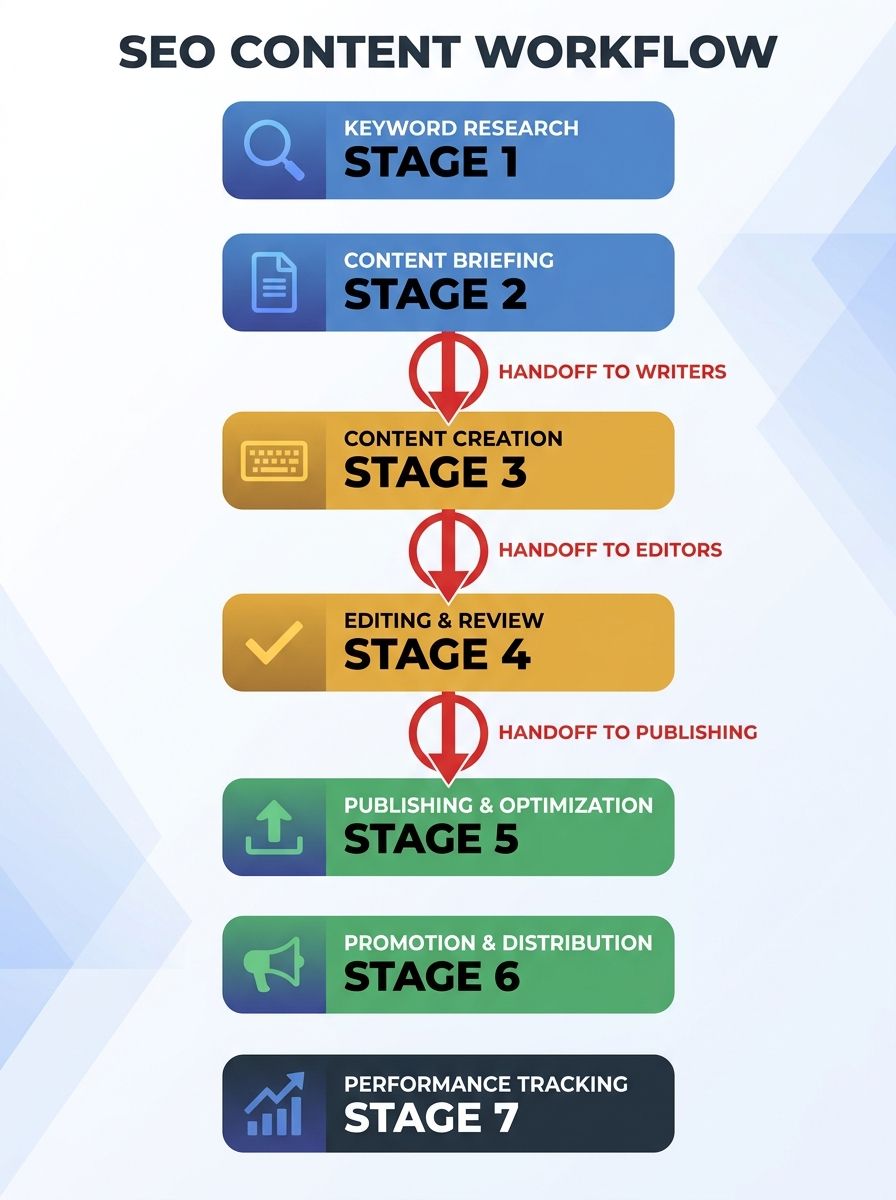
Think about a single blog post. Keyword research happens in one tool. The brief gets drafted in a doc. A writer picks it up from a project board. An editor reviews it. A developer implements schema markup. Someone publishes it. Someone else tracks performance. That's at least seven handoffs for one piece of content, and most organizations have zero formal documentation of this flow.
According to a workflow strategy guide from monday.com, structured SEO workflows provide the operational backbone needed to produce high-quality content at scale. When every piece follows a similar production path, you can identify bottlenecks, measure cycle times, and optimize systematically. You might discover that your review stage consistently takes three days longer than planned, signaling a need for additional editorial resources or process refinement.
The practical first step: sit down with representatives from every team that touches organic search. Map the workflow from keyword research through publication and promotion, identifying every handoff point where tasks move between people or systems. You'll almost certainly find at least two or three "dead zones" where work sits waiting because nobody officially owns the next step.
If you've ever compared SEO planning tools against manual spreadsheets, you already know how quickly coordination breaks down when the map lives in someone's head instead of a shared system.
The Shared Dashboard Layer
Once handoffs are mapped, the next component is visibility. And I don't mean a weekly email summary that three people read.
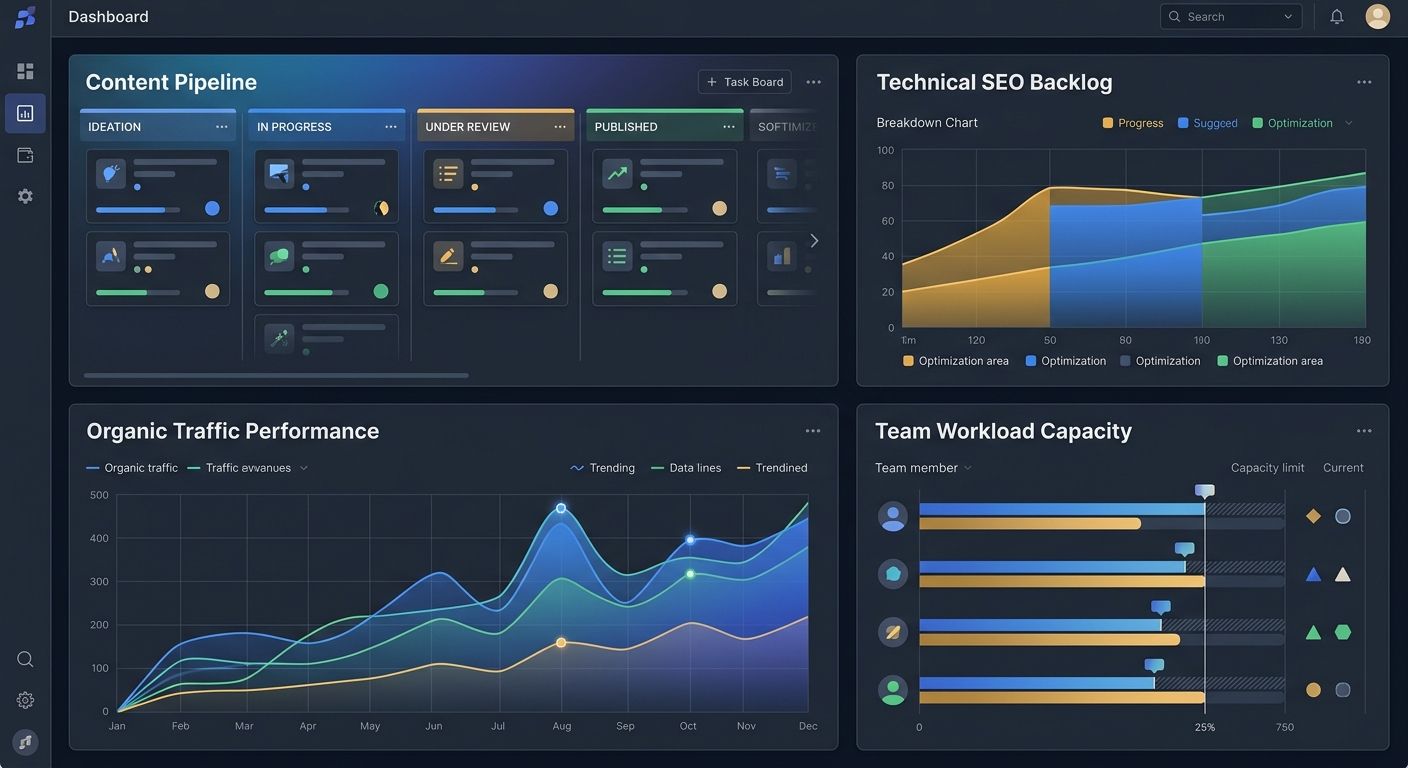
Cross-team dashboards solve a specific problem: when the SEO team sees one version of reality, the content team sees another, and the dev team sees a third, you get conflicting priorities and duplicated effort. The solution is a unified performance view with role-based access, meaning everyone sees the same underlying data but filtered to their responsibilities.
Modern SEO project management platforms support this natively. Teams can use shared dashboards and workload views to balance capacity and adjust priorities in real time, as described in monday.com's guide to SEO planning. The workload view specifically lets managers see who's overcommitted and who has capacity before assigning new tasks.
Here's what the dashboard layer should include at minimum:
Content pipeline status: what's in research, drafting, review, and publication stages
Technical SEO backlog: crawl errors, schema issues, and Core Web Vitals tickets assigned to engineering
Performance tracking: organic traffic, rankings, and conversion metrics tied to specific content or pages
Capacity indicators: who's at 100% and who can absorb a rush request
The dashboard isn't a nice-to-have. It's the information layer that makes everything else possible. Without it, your cross-functional SEO planning meetings devolve into status update sessions where half the room is hearing information for the first time.
This is also where the data quality problem becomes urgent. If your analytics tools use different metric definitions or inconsistent taxonomy, the dashboard just surfaces bad data faster. You need unified taxonomy across Google Analytics, Search Console, your CRM, and your SEO platforms before the shared view becomes trustworthy.
From Keywords to Entities
Here's where most scaling efforts stall. Teams align on process and tooling but never align on strategy. And in 2026, the strategic alignment that matters most is the shift from keyword-level planning to entity-level planning.
With AI Overviews and answer engines reshaping search results, traditional keyword-based SEO is insufficient. Search systems now evaluate entity authority across three dimensions: recognition (can the system identify which entities your content addresses), relationships (does it understand how those entities connect), and corroboration (do external sources validate your entity claims).
This has direct implications for cross-team workflows:
SEO conducts entity research using vector embedding analysis to identify core entities and their semantic associations
Content and SEO jointly run gap analysis, assessing coverage across the buyer journey and prioritizing assets based on business impact
Content creates, SEO implements: content builds guides and research pieces while SEO handles schema markup, internal linking, and backlink strategy
Both teams measure together: AI citations, organic visibility, and branded traffic inform the next cycle
One documented case study showed that after four months of this kind of aligned execution, a brand earned two AI Overview citations and increased visibility across multiple pages. Those results are unlikely when teams operate in silos.
If you're watching your rankings hold steady while traffic drops, you're probably experiencing how AI answer engines are eating traditional SEO traffic. Entity-based alignment is the structural fix, not a tactical patch.
Automated Task Routing and Approval Chains
SEO workflow automation is where AI enters the operational layer, not just the content creation layer. The goal is to remove manual coordination overhead so humans can focus on strategy and judgment.
Automated task routing works like this: when a writer marks a draft as "ready for review," the system automatically assigns it to the editor with available capacity. When the editor approves, it routes to the dev team for schema implementation. When the dev team marks the technical implementation complete, it triggers a publishing workflow. No one sends a Slack message asking "hey, is this ready?" No task sits in limbo because someone forgot to update a spreadsheet.
The components of effective SEO workflow automation include:
Automated task assignment with approval processes and progress tracking
Trigger-based notifications when dependencies are completed
Template blueprints for recurring tasks like quarterly audits or monthly content plans
API integrations connecting your CMS, project management software, and SEO platforms
That last point matters more than people realize. Enterprise SEO platforms offer APIs that integrate with Google Search Console, Google Analytics, Adobe Experience Manager, and CRM systems. When these connections exist, data flows automatically instead of requiring someone to export a CSV and email it to another team.
And this is where the developer's role in SEO becomes critical. If your engineering team isn't integrated into the automated workflow, technical SEO tickets either get deprioritized against product work or sit in a separate backlog that nobody monitors.
Why Gains Evaporate Without Governance
I've seen teams build beautiful cross-functional workflows, hit their traffic targets for two quarters, and then watch everything unravel. The pattern is almost always the same: no governance framework.
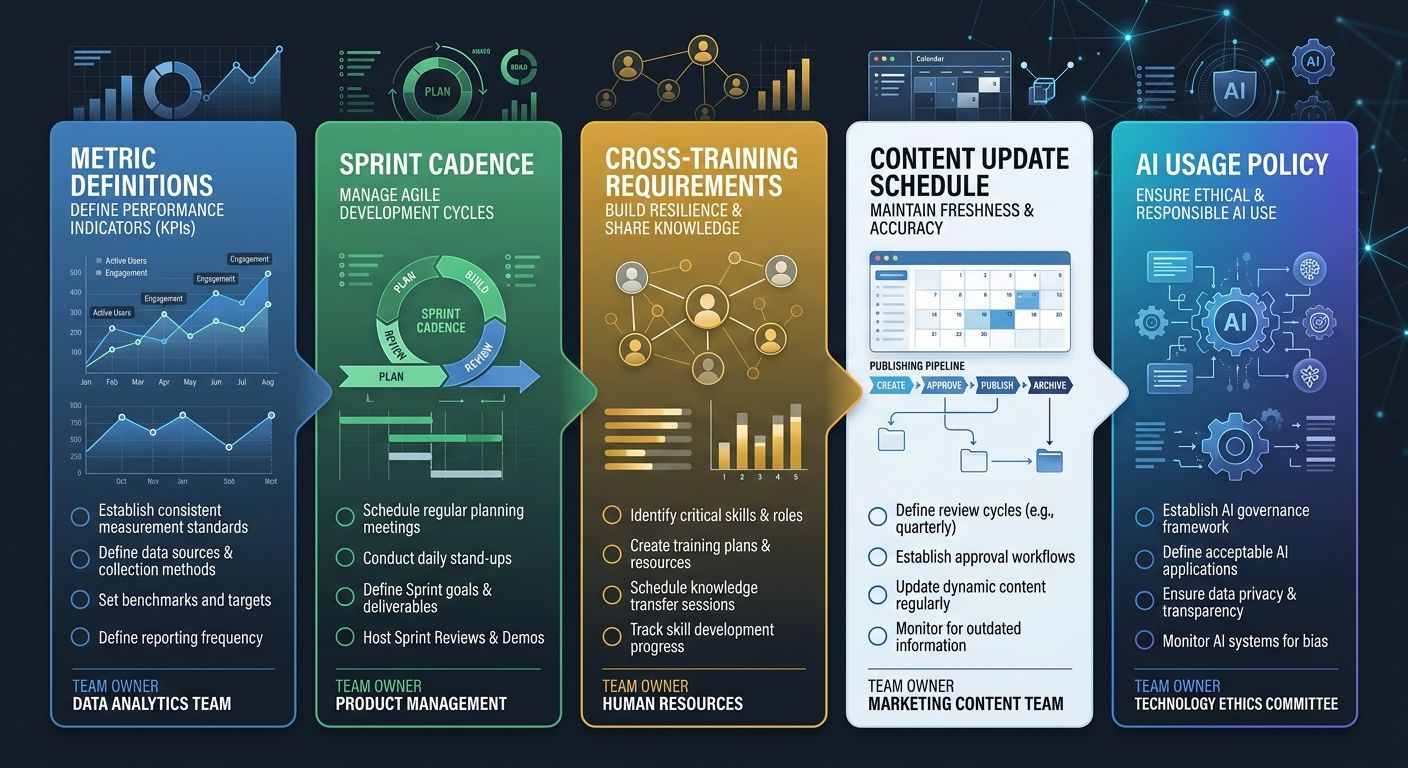
Governance means standardized rules for how the system operates over time. It includes:
Consistent metric definitions across every team and tool
Regular sprint planning with clear handoffs and dependency tracking
Cross-training so a single person's vacation doesn't create a two-week bottleneck
Fact-checking and update workflows to maintain content freshness
Building a technical SEO governance framework is the difference between a system that scales and one that works for six months and then collapses under its own complexity.
Governance also means deciding how AI fits into your production process. With 93% of successful marketers reviewing AI-generated content before publishing, the winning model is hybrid: AI handles research, outlining, data summarization, and first drafts, while humans add strategic nuance, original insights, and brand alignment. Document these roles explicitly. Don't let each team member improvise their own AI usage policy.
Connecting Organic Visibility to Pipeline
The final layer of the mechanism is measurement that ties SEO activity to business outcomes. Original content delivers an estimated 66% ROI, followed by content updates at 42.6% and technical fixes at 42.3%. But you can't capture that ROI if your measurement stops at "organic sessions went up."
The connection path looks like this: organic traffic flows into your analytics platform, which tracks conversions (form fills, demo requests, purchases). Those conversions feed into your CRM, where you can attribute pipeline and revenue back to specific pages or content clusters. CRM integration and advanced analytics frameworks are what let enterprise teams connect organic visibility to pipeline, revenue, and lifetime value.
An impact-versus-effort matrix helps here. Plot every proposed SEO initiative on two axes: expected business impact and resource investment required. Quick wins (high impact, low effort) get prioritized immediately. Strategic bets (high impact, high effort) get scheduled into quarterly sprints. Low-impact tasks get automated or eliminated.
Only 12% overlap currently exists between organic and AI search rankings, which means you're essentially running dual optimization strategies. Your planning system needs to account for both traditional SERP performance and AI retrieval visibility, and your measurement framework needs to track both. This is exactly why rethinking your content strategy around authenticity matters: the content that performs in AI citations tends to be original, well-sourced, and structurally clear.
First Sprint Setup
Stop trying to redesign everything at once. Start with a single content vertical or product line. Map the handoffs. Build the dashboard. Define three entity clusters. Automate one recurring workflow. Measure for 90 days.
The teams I've worked with that successfully scale their SEO operations share one trait: they treat cross-functional SEO planning as an engineering problem, not a people problem. The people are usually fine. The system they're working within is what's broken. Fix the system first, then optimize.

Alex Chen
Alex Chen is a digital marketing strategist with over 8 years of experience helping enterprise brands and agencies scale their online presence through data-driven campaigns. He has led marketing teams at two successful SaaS startups and specializes in conversion optimization and multi-channel attribution modeling. Alex combines technical expertise with strategic thinking to deliver actionable insights for marketing professionals looking to improve their ROI.
Frequently Asked Questions
- How many handoff points does a typical blog post go through in SEO workflows?
- A single blog post typically goes through at least seven handoffs, including keyword research, brief drafting, writing, editing, schema markup implementation, publication, and performance tracking. Most organizations have zero formal documentation of these handoff flows.
- What should a cross-team SEO dashboard include?
- An effective SEO dashboard should include content pipeline status, technical SEO backlog, performance tracking tied to specific pages, and capacity indicators showing team workload. Role-based access ensures everyone sees the same data filtered to their specific responsibilities.
- Why is entity-level planning replacing keyword-level SEO strategy?
- AI Overviews and answer engines now evaluate entity authority across recognition, relationships, and corroboration rather than individual keywords. Entity-level planning ensures content, SEO, and development teams align on core entities and their semantic relationships, which is necessary for visibility in AI search results.
- How does automated task routing improve SEO workflows?
- Automated task routing removes manual coordination by automatically assigning tasks based on availability, triggering notifications when dependencies are completed, and routing work between teams without manual Slack messages or spreadsheet updates.
- What is the difference between workflow systems that scale versus those that collapse?
- Scalable systems include governance frameworks with consistent metric definitions, regular sprint planning, cross-training, and documented rules for decision-making and prioritization. Without governance, gains typically evaporate after 6-12 months as the system becomes too complex to maintain.
- How much ROI does original content deliver compared to updates and technical fixes?
- Original content delivers an estimated 66% ROI, followed by content updates at 42.6% and technical SEO fixes at 42.3%. However, this ROI can only be captured if measurement connects organic traffic to conversions, pipeline, and revenue through CRM integration.
- What is the hybrid model for AI in SEO content production?
- The winning model has AI handle research, outlining, data summarization, and first drafts, while humans add strategic nuance, original insights, and brand alignment. 93% of successful marketers review AI-generated content before publishing.
- What percentage of SEO workflows now involve AI automation?
- 86% of SEO workflows now involve AI automation at some stage. However, the main bottleneck for scaling is coordination architecture rather than tooling or intelligence.
Explore more topics