
The Data Governance Audit: Why Your Analytics Stack Fails Without Formalized Data Management Processes
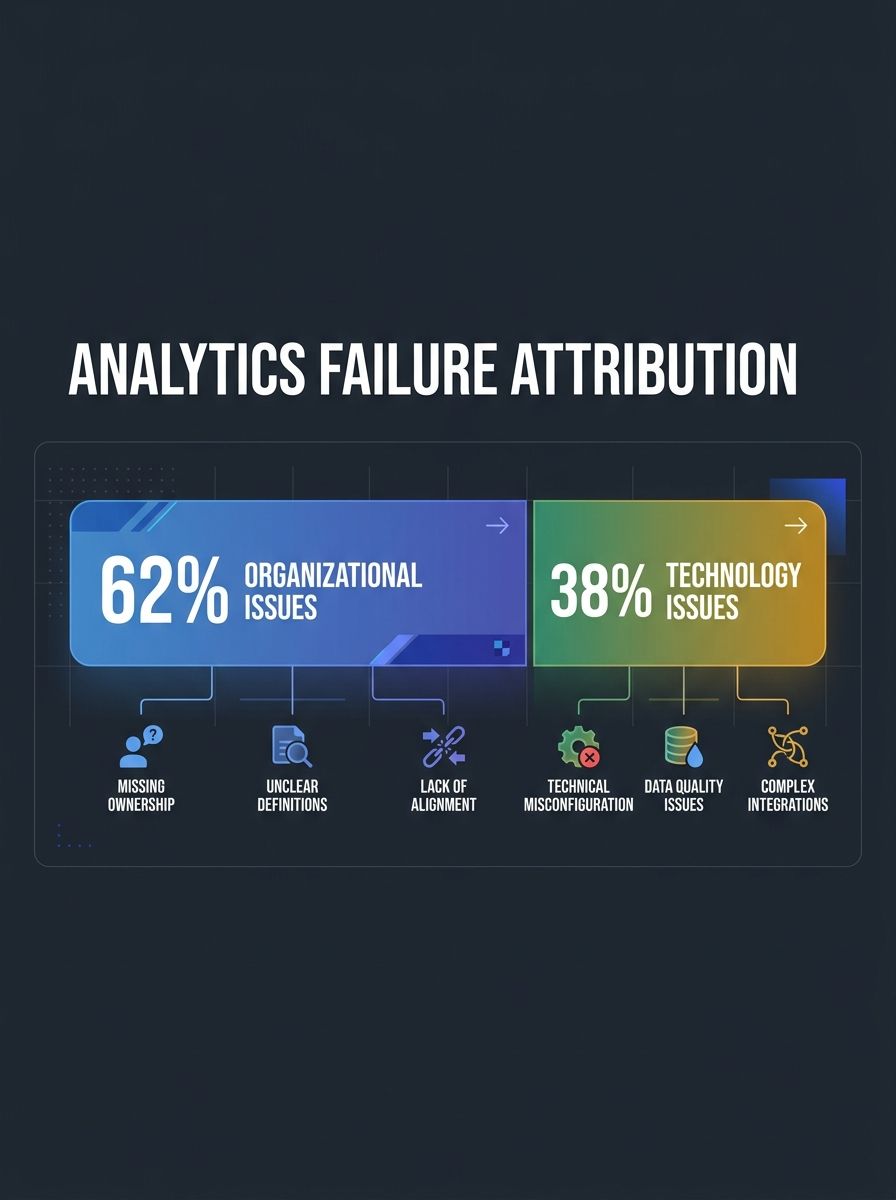
Sixty-two percent of analytics project failures trace to organizational and management breakdowns rather than technology problems, according to a clustering analysis of 19 industry expert commentaries compiled by Becker in 2017.

The Data Governance Audit: Why Your Analytics Stack Fails Without Formalized Data Management Processes
Sixty-two percent of analytics project failures trace to organizational and management breakdowns rather than technology problems, according to a clustering analysis of 19 industry expert commentaries compiled by Becker in 2017. Your analytics infrastructure collapses because nobody owns the rules governing how data gets collected, processed, and consumed.
Why the Failure Rate Is Organizational, Not Technical
The Becker analysis split analytics project failures into two categories: technology-driven (38%) and organizational/management-driven (62%). The organizational bucket included missing data ownership, undefined validation workflows, absent naming conventions, and lack of stakeholder alignment on what metrics actually mean. A 2014 Capgemini study reinforced the finding with starker numbers: only 27% of big data and analytics initiatives reported high success rates.
Melbourne Business School research framed the core issue directly: "An analytically immature organisation lacks most of the requirements to deliver on analytics projects successfully," including in-house capabilities, high-quality data, and buy-in from senior stakeholders. That immaturity isn't about missing software licenses. It's about missing governance processes.
Teams invest in GA4, Tableau, Power BI, and custom dashboards without establishing who owns data definitions, how events should be named, or what validation processes run before reports reach decision-makers. You can configure every GA4 event perfectly on day one, but without formalized processes for ongoing validation, parameter naming conventions drift within weeks. If you've encountered silent data loss in your GA4 setup, you've already seen what ungoverned analytics looks like operationally.
The Consumption Layer Gap That Governance Misses
Why do clean, well-structured data pipelines still produce reports nobody trusts? A 2025 Wiiisdom analysis found that 77% of organizations encounter inaccurate BI content in production at least once a month. The data warehouse is governed. The dashboards sitting on top of it are not.
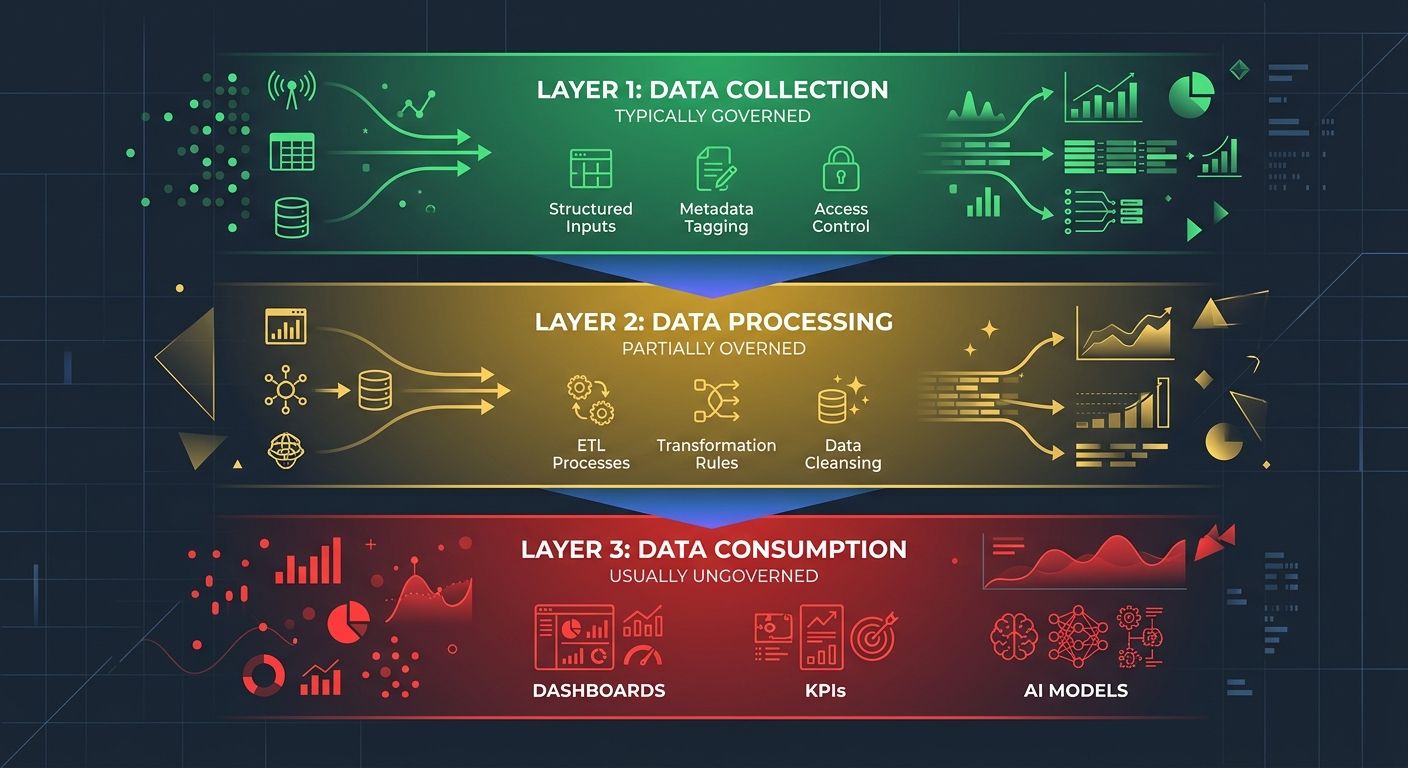
Data governance frameworks typically cover ingestion, storage, and access controls. They stop short of the dashboards, KPIs, and AI models where business users actually interact with data. Misconfigured filters, outdated calculation logic, and stale refresh schedules corrupt outputs even when underlying data is clean. The 2024 CDO Agenda documented that 63% of Chief Data Officers spend significant time on governance yet struggle to demonstrate business value, largely because the analytics layer operates outside their governance scope.
For marketing teams running GA4, this consumption gap shows up in specific ways. Trackingplan's 2026 digital marketing audit framework identifies three validation steps most teams skip: pixel firing verification, event parameter accuracy checks, and cross-platform consistency reviews. A single misconfigured tag creates cascading failures in every report that depends on it.
And the problem compounds. With 52% of organizations rating their data foundations as inadequate for generative AI applications, ungoverned analytics pipelines feed flawed training data into AI models that produce confidently wrong outputs at scale.
The Three-Layer Governance Audit: A Scoring Framework
I've run enough analytics audits to see the same failure pattern repeat across organizations of different sizes. Teams govern one layer and leave the other two unmanaged. The Three-Layer Governance Audit evaluates your analytics stack across collection, processing, and consumption, scoring each on five criteria: ownership clarity, naming conventions, validation frequency, documentation completeness, and change management protocols.
Collection Layer
GA4 data integrity starts at the tag level. Event data forms the core of GA4, and missing or incorrect event data makes reliable analysis impossible, according to Metric Vibes' GA4 accuracy analysis. Audit items here include verifying that every event fires with correct parameters using GTM preview mode, confirming currency and timezone settings match your business operations, and adding problematic payment gateway URLs to the "List unwanted referrals" settings in your GA4 console to prevent self-referral data pollution.
Trackingplan recommends scheduling weekly data quality audits that compare current-week metrics against historical baselines. Build alerting thresholds during calm traffic periods so baselines are accurate before campaign spikes introduce noise. The DebugView workflow for catching data collection failures gives you a structured process for isolating the source of discrepancies when your weekly checks surface anomalies.
Processing Layer
Processing governance covers how raw data transforms into reportable metrics: ETL pipeline documentation, calculated metric definitions, and attribution model configuration. Fivestones' GA4 audit checklist frames the objective as getting data that is "accurate, consistent, and usable for decision-making," which requires a roadmap that fixes analytics structure so marketing, product, and executive teams all work from the same numbers.
The breakdown at this layer is almost always definitional. What counts as a "conversion" differs between paid media and product teams. What qualifies as "engagement" varies by department. Without a governance document that locks down these definitions and assigns change ownership, each team builds its own version of truth.
Consumption Layer
This is where 77% of organizations encounter monthly inaccuracies. Governance here means certifying dashboards before they go live, monitoring refresh schedules, and lifecycle-managing BI assets so outdated reports get archived rather than left to mislead. Organizations using Tableau or Power BI can implement continuous certification workflows, tagging reports as "certified," "under review," or "deprecated."
When you're comparing analytics platforms for real-time monitoring, consumption governance should be a selection criterion. A platform supporting metadata tagging, version history, and access-based permissions gives your governance team the structural tools to enforce standards at the point where data becomes decisions.
Scoring Your Own Analytics Stack
Rate each layer on the five criteria using a 1–5 scale. The total possible score is 75 points, but distribution matters more than the aggregate.
Criteria | Collection | Processing | Consumption |
|---|---|---|---|
Ownership clarity | Who owns tag configuration? | Who owns ETL/transformation logic? | Who owns dashboard accuracy? |
Naming conventions | Event and parameter naming standards | Calculated metric definitions | Report naming and versioning |
Validation frequency | How often are tags audited? | How often are pipeline outputs checked? | How often are dashboards reviewed? |
Documentation | Is the tracking plan current? | Are transformation rules documented? | Are dashboard specs maintained? |
Change management | Process for modifying events? | Process for changing calculations? | Process for updating live reports? |
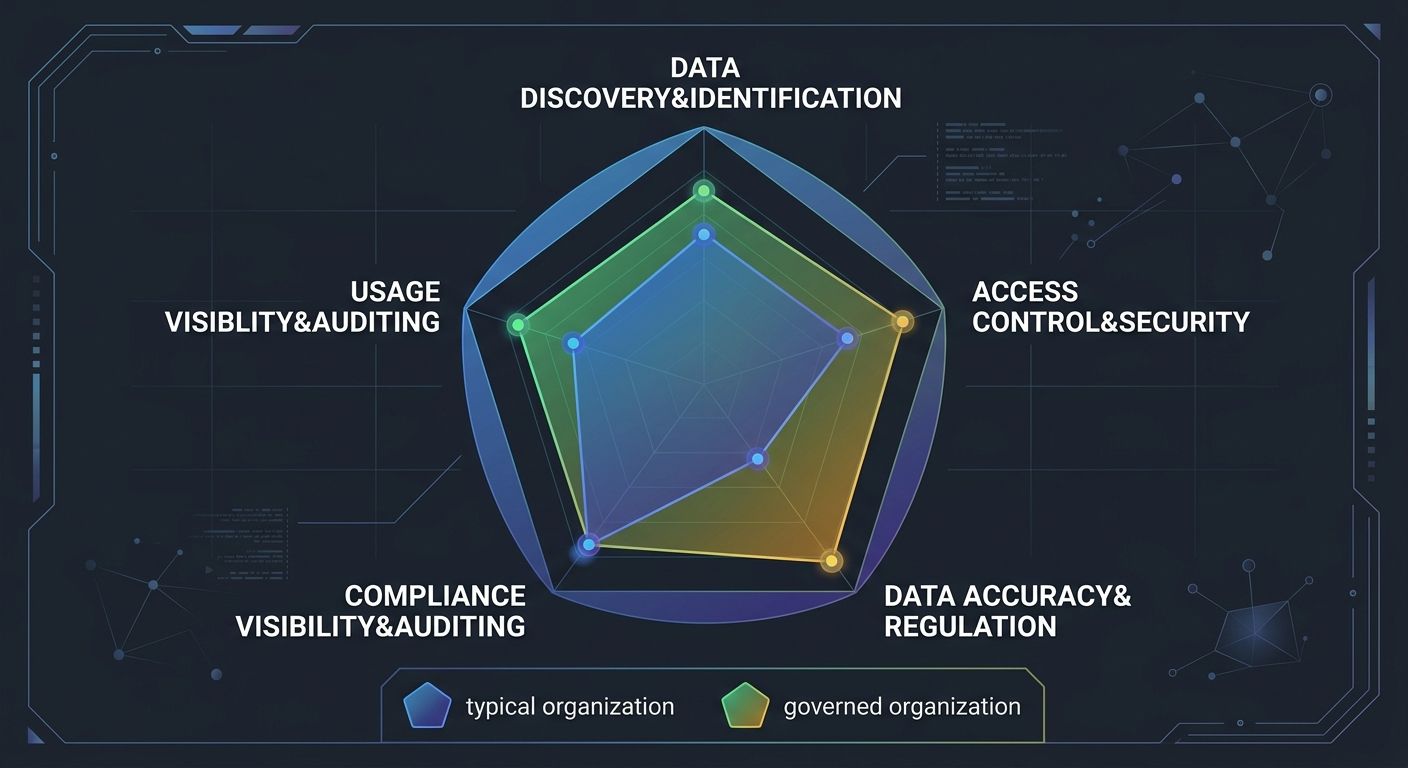
A score below 3 on any single criterion in any layer indicates an active governance gap degrading your analytics data quality. Teams that benchmark analytics performance against industry standards without first validating their own data governance are benchmarking noise against signal.
An organization scoring 4s across collection and processing but 1s across consumption has the exact profile producing the "last mile" failures documented in the Wiiisdom analysis. That pattern is the most common one I see in practice: solid engineering, absent report governance.
Four Organizations That Closed the Gap
Netflix applies data validation rules to its recommendation engine data, using governance to ensure behavioral signals feeding its personalization algorithms are accurate and consistent. The result, documented in Acceldata's governance model analysis, is measurably higher user engagement and retention — a direct line from data governance to business outcome.
The BBC established a unified semantic layer across its data products, reducing duplication of metric definitions and accelerating new data product development through certified, governed metrics. By standardizing definitions at the processing layer, the BBC eliminated conflicting KPIs that had slowed cross-team collaboration for years.
Acceldata's hospitality sector analysis found that hotels implementing cloud-based data governance frameworks reduced compliance-related IT costs by 30%. The savings came from automated classification, access controls, and audit logging that replaced manual compliance workflows that previously consumed 15+ hours per week from IT teams.
Domain Group's Chief Data Officer reported that aligning data definitions across the organization shortened model development time and improved machine learning workflow efficiency. When data scientists didn't spend weeks reconciling conflicting definitions, they moved from prototype to production measurably faster.
Each case shares a common sequence. The governance work preceded the analytics improvement. Netflix didn't build better recommendation algorithms and then govern the data. The BBC didn't build new data products and then standardize definitions afterward. Governance came first, and reliable analytics followed. This sequence matters because it contradicts the instinct most marketing teams have, which is to fix the dashboard and worry about process later.
If your own content architecture is failing to signal topic authority, the underlying cause often traces to the same structural problem: data management decisions made ad hoc rather than through a governed framework.
What The Data Doesn't Tell Us
The 62% organizational failure rate, the 77% inaccurate BI content figure, and the 27% project success rate all describe what's broken in the current state of analytics data quality. They don't answer how long governance programs take to produce measurable improvements in report accuracy, or what the minimum viable governance investment looks like for a mid-market marketing team with a three-person analytics function.
The Netflix, BBC, and Domain Group case studies demonstrate outcomes, but these are large organizations with dedicated data teams and CDO-level sponsorship. Whether the Three-Layer Governance Audit framework scales down to a 50-person marketing department running GA4 and two Looker Studio dashboards remains undertested in published research. Dataversity's recommendation to start with a single data domain suggests the principles translate, but documented evidence at that scale is thin.
What the numbers do confirm: data governance frameworks are the prerequisite for trustworthy analytics infrastructure, and the consumption layer is where organizations leave the biggest gap. Whether you're auditing why campaign reports contradict each other or diagnosing why your attribution numbers don't match finance's revenue figures, the root cause traces back to a governance question — who owns the definitions, and are those definitions enforced through a formalized, repeatable process that survives team turnover?

Alex Chen
Alex Chen is a digital marketing strategist with over 8 years of experience helping enterprise brands and agencies scale their online presence through data-driven campaigns. He has led marketing teams at two successful SaaS startups and specializes in conversion optimization and multi-channel attribution modeling. Alex combines technical expertise with strategic thinking to deliver actionable insights for marketing professionals looking to improve their ROI.
Related Articles

The Benchmarking Blindspot: Why Your Analytics Comparison Strategy Is Missing Critical Industry Context
GA4 benchmarking groups your site into one of 15 industry categories and compares engagement rate, sessions, and bounce rate against anonymized peers within that bucket.

The AI Visibility Audit: Why 76% of Brands Disappear From ChatGPT and Gemini Recommendations
The SearchScore AI Visibility Study, released June 1, 2026, analyzed 254 websites across ChatGPT, Gemini, and other generative AI search platforms and found that 76.4% of brands scored below 40% in AI visibility. Only 7.

The Multi-Channel SEO Visibility Audit: Why Google Rankings Alone Won't Cut It in 2026
Ranking number one on Google for your highest-value keyword can coincide with shrinking organic market share.
Explore more topics