
The Content Architecture Audit: Diagnosing Why Your Site Structure Isn't Signaling Topic Authority to Search Engines
Screaming Frog finished its crawl of a 412-page B2B SaaS site in eleven minutes and surfaced 47 orphaned URLs, zero internal links pointing to the company's primary product page, and a maximum click depth of nine for content that was supposed to be driving organic demo requests.

The Content Architecture Audit: Diagnosing Why Your Site Structure Isn't Signaling Topic Authority to Search Engines
Screaming Frog finished its crawl of a 412-page B2B SaaS site in eleven minutes and surfaced 47 orphaned URLs, zero internal links pointing to the company's primary product page, and a maximum click depth of nine for content that was supposed to be driving organic demo requests. The site belonged to a mid-market project management platform that had been publishing two to three blog posts per week for over two years. They had content. What they didn't have was architecture.
This is the full case study of a content architecture audit I ran over six weeks for this client, from the initial crawl data through the restructure and the measurable results that followed. If you're publishing consistently but watching your topical authority signals flatline, the problem is almost certainly structural.
Forty-Seven Orphaned Pages and a Flat Hierarchy
The initial audit started where every good diagnostic should: with the raw crawl data. When I pulled the site into Screaming Frog and cross-referenced against Google Search Console's indexed pages report, the picture was ugly.
Of 412 total URLs, 47 pages had zero inbound internal links. These were blog posts that had been published, indexed by Google, and then forgotten. No sidebar links, no contextual links from related content, no programmatic related-posts module pulling them in. They existed on the sitemap and nowhere else.
But the orphaned pages were a symptom, not the root cause. The real problem was the site's hierarchy. Every blog post sat at the same structural level: domain.com/blog/post-title. There were no subdirectories by topic, no pillar pages acting as hubs, and no visible organization that would tell a crawler, "These 15 posts are all about resource allocation, and this page is the definitive guide."
The site had a flat hierarchy where every piece of content competed equally for attention. From a site hierarchy SEO perspective, this is the equivalent of throwing 400 books onto a single shelf with no labels, no sections, and no index.
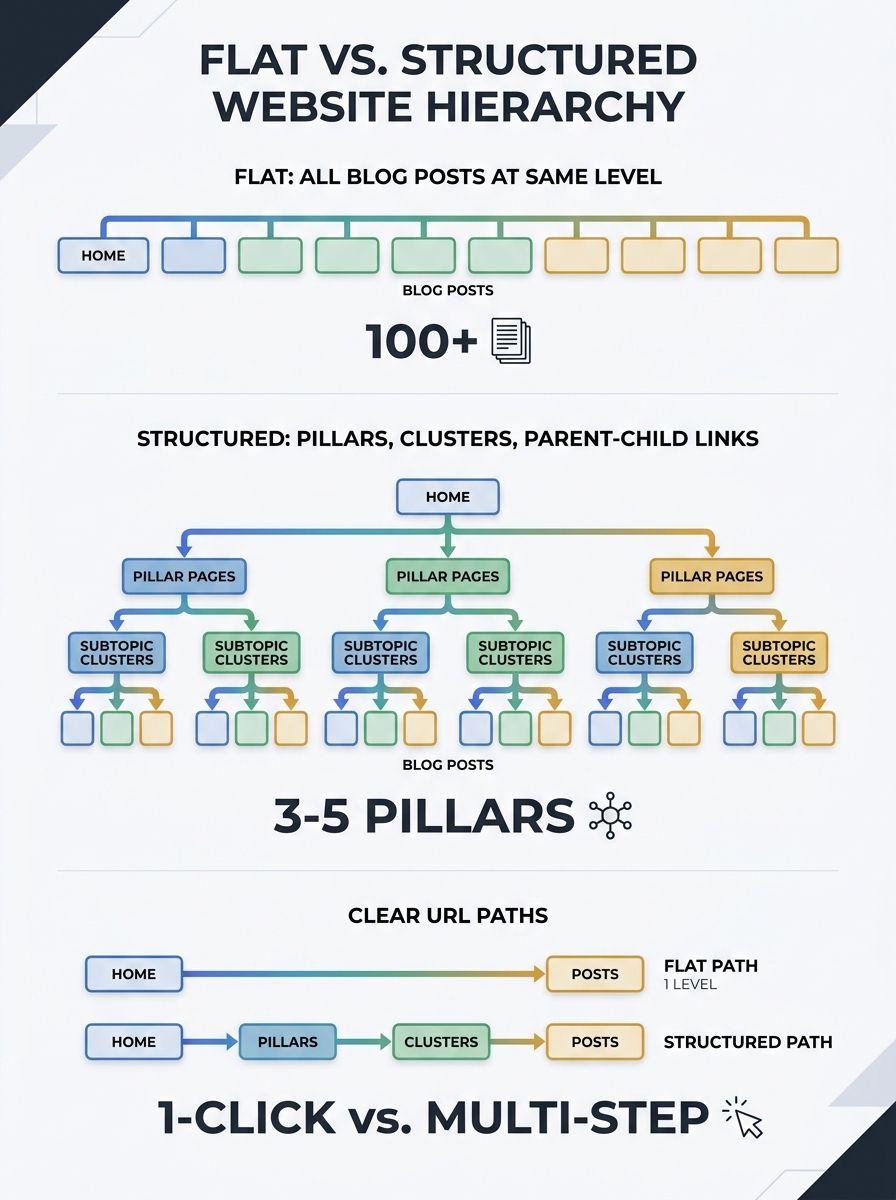
According to the ALM Corp 2026 website audit checklist, sites that are hard to crawl, hard to interpret, or hard to trust show weakness across multiple channels simultaneously. This site checked all three boxes.
When the Link Graph Told a Different Story
The second phase of the audit focused entirely on internal linking structure. I exported every internal link from the crawl, mapped them in a network visualization tool, and weighted each node by the number of inbound internal links it received.
The results were revealing. The homepage linked to ten category-level pages. Those category pages linked to a handful of featured posts. And then the linking stopped. The blog's 380+ posts linked to each other inconsistently: some posts had eight or nine contextual links to other articles, while most had one or two at best. The distribution looked like a power law curve where a tiny number of pages absorbed most of the internal link equity and hundreds of pages got almost none.
Here's what made this particularly damaging: the pages receiving the most internal links were "About Us," "Pricing," and three blog posts from 2023 that had been featured in the site's global footer. The company's actual money pages, the ones targeting high-intent keywords like "project management for construction teams" and "resource planning software," received fewer internal links than the company's holiday party recap post.
When I flagged this to the marketing director, her response was telling: "We assumed Google would figure out which pages matter based on the content itself." That assumption is widespread and wrong. As Rohring Results explains in their guide to internal linking and site structure optimization, a well-planned internal linking strategy helps search engines understand your content, improve crawlability, and strengthen overall SEO performance. Without explicit structural signals, Google treats your content the way a visitor would treat that unlabeled bookshelf.

The data I'd mapped here aligned closely with what I've described before about how topic clusters need deliberate architectural support to actually function. Publishing cluster content without connecting it through intentional linking is like building rooms without hallways.
Validating the Clusters Against Actual SERP Data
Phase three was content cluster validation, and this is where the audit shifted from diagnostic to prescriptive.
I started by defining what the site's topic clusters should be based on their product positioning and keyword research. We identified six core clusters:
Resource allocation and capacity planning
Construction project management
Team collaboration tools
Gantt chart and timeline software
Project budgeting and cost tracking
Remote project management
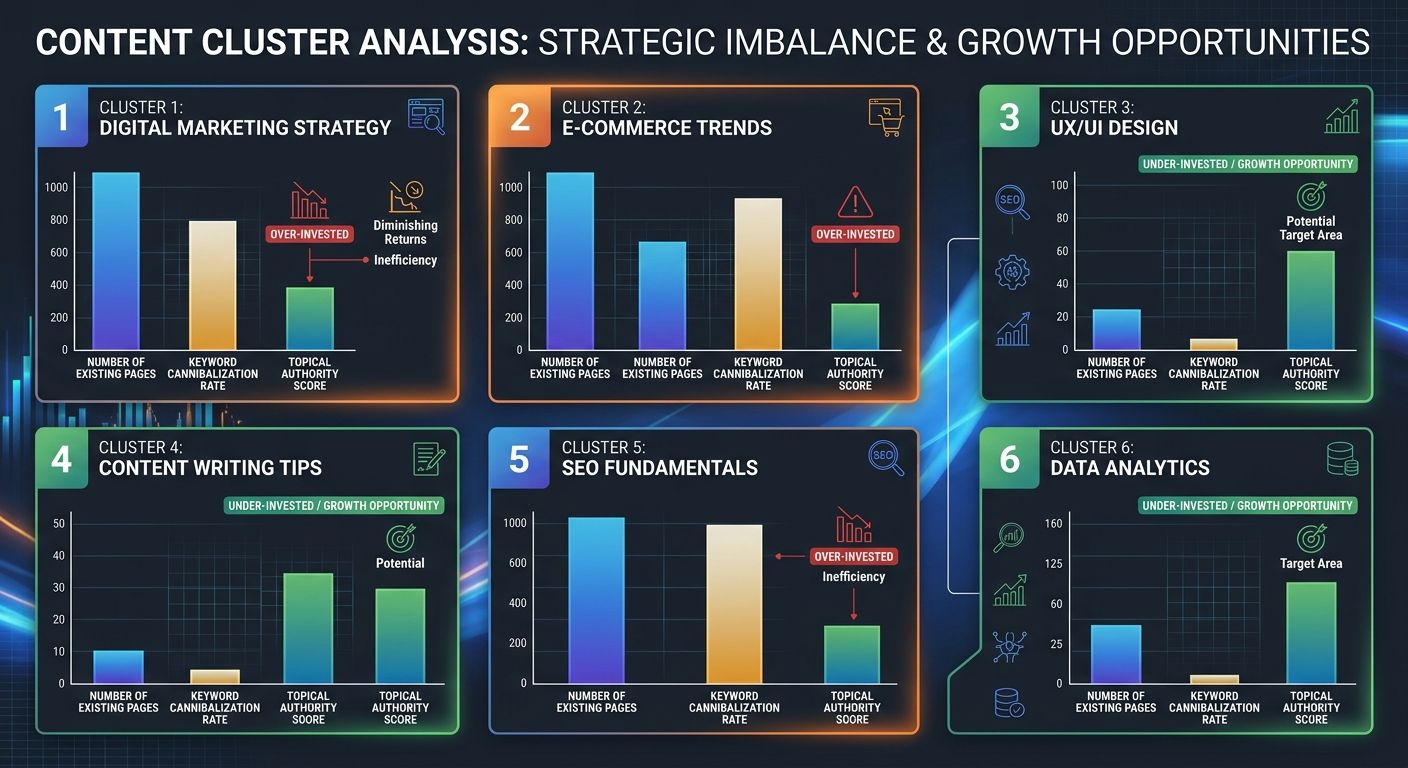
Then I mapped every existing piece of content to one of these clusters (or to a "miscellaneous" bucket for posts that didn't fit anywhere). The distribution was jarring: the construction project management cluster had 74 posts. Remote project management had three. Team collaboration had 41 posts, but 28 of them targeted nearly identical keywords and were cannibalizing each other in search results.
This is the pattern that Search Engine Land's guide on topical authority describes: when pages in a topic cluster start ranking together, that's evidence topical authority is building. When they don't, the architecture is failing to transmit the signals. In this case, zero of the six clusters showed that co-ranking behavior.
I also ran a search intent analysis on the top 50 posts by organic traffic. Seventeen of them ranked for informational keywords that had no clear connection to the product, things like "what is a stakeholder" and "project management history." These posts drove traffic but contributed nothing to topical authority around the company's actual product capabilities. We'd previously explored this kind of disconnect in our piece on finding hidden revenue loss from search intent mismatches, and the pattern here was textbook.
The Three-Sprint Restructure
Based on the audit findings, I designed a restructuring plan broken into three two-week sprints. This cadence matches what I've found works best for SEO execution at scale, where shorter cycles keep momentum high and allow for measurement between phases.
Sprint One: Pillar Page Creation and Link Architecture
We created six pillar pages, one per cluster. Each pillar page was a 2,500-to-3,500-word guide covering the full scope of its topic, structured with clear H2 sections that corresponded to the subtopics covered by cluster posts. Every pillar page linked down to its cluster posts, and we updated every cluster post to link back up to its pillar.
This hub-and-spoke model is the standard framework for building topical authority, and Search Engine Land's complete guide to topic clusters confirms the approach: one URL becomes the canonical hub, and subpages go deep on specific subtopics while linking back to it. The key detail most teams miss is that the bidirectional linking needs to happen at launch, not "whenever someone remembers to add it."
We also enforced a three-click-maximum depth rule. Any important page that required more than three clicks from the homepage to reach got promoted in the navigation or linked from a higher-level category page.
Sprint Two: Cannibalization Resolution and Content Consolidation
The 28 overlapping posts in the collaboration cluster got trimmed to 11. We merged the strongest-performing posts, 301-redirected the consolidated URLs, and rewrote thin content where the topic still warranted coverage. Posts in the "miscellaneous" bucket that couldn't be mapped to any cluster were evaluated individually. Twelve got redirected to relevant cluster content. Eight were kept as standalone resources with clear internal links added. Twenty-seven were marked for eventual sunsetting after their traffic data confirmed they contributed nothing meaningful.
Sprint Three: Anchor Text Optimization and Schema Implementation
The final sprint focused on two things: rewriting generic anchor text across the site's internal links (replacing "click here" and "read more" with descriptive, keyword-relevant phrases) and implementing Article schema markup on every pillar and cluster page.
We also added breadcrumb navigation with BreadcrumbList schema to reinforce the hierarchical relationship between pillar pages and their cluster content. This gave both users and crawlers a visible, machine-readable map of how the site's content fit together.
Eight Weeks After Launch
The restructure rolled out incrementally across the three sprints, with the final changes going live at the end of week six. I pulled a full comparison report at the eight-week mark.
The numbers told the story:
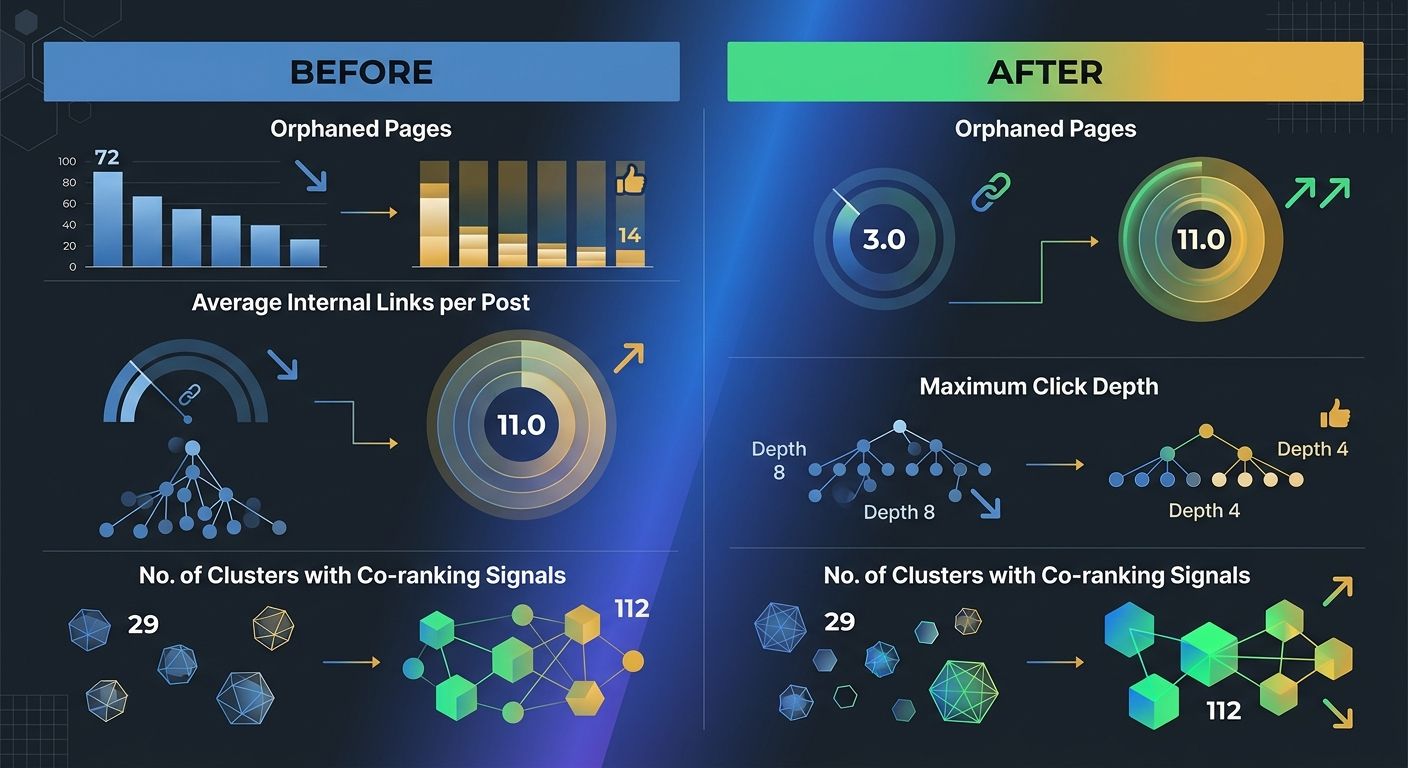
Indexed pages with zero internal links: Down from 47 to 2 (both intentional standalone landing pages)
Average internal links per cluster post: Up from 1.8 to 5.3
Maximum click depth for cluster content: Down from 9 to 3
Cluster co-ranking signals (multiple pages from the same cluster appearing in the top 20 for related keywords): Detected in 4 of 6 clusters, up from 0
Organic traffic grew 23% across the six cluster topics during those eight weeks, with the construction project management cluster showing the strongest gains at 34%. The remote project management cluster, which had only three posts before the audit, grew to nine posts during the sprint cycle and began ranking for 41 new keywords it had never appeared for previously.
The cannibalization cleanup had an immediate effect too. Three of the collaboration cluster posts that had been stuck bouncing between positions 12 and 25 consolidated into a single URL that reached position 6 within five weeks.
Where This Lands Now
The site continues to publish two posts per week, but every post now goes through a cluster assignment review before publication. Each new piece gets mapped to its parent cluster, linked to the pillar page, and cross-linked with at least three other cluster posts before going live. The content team uses a simple spreadsheet tracker for this, nothing fancy.
The broader lesson from this case study applies to any site producing content at volume. Publishing frequency alone doesn't build topical authority. Content architecture does. And the gap between "we have content about this topic" and "search engines recognize us as an authority on this topic" is entirely structural. It lives in your internal linking structure, your click depth, your pillar-to-cluster relationships, and your anchor text specificity.
If you haven't run a full content architecture audit on your own site, the diagnostic steps from this case study give you a playbook: crawl your site and count orphaned pages, visualize your internal link graph, validate your clusters against actual SERP co-ranking data, and measure your click depth for every priority URL. The data will show you exactly where your architecture is failing to transmit the authority your content has earned. And given that pages with high topical authority gain traffic 57% faster than those without it, the cost of ignoring these structural signals compounds every week you keep publishing into a broken hierarchy.
For more on how to run the data-side version of this kind of site architecture audit with topical authority diagnostics, we've covered the technical methodology in depth separately.

Alex Chen
Alex Chen is a digital marketing strategist with over 8 years of experience helping enterprise brands and agencies scale their online presence through data-driven campaigns. He has led marketing teams at two successful SaaS startups and specializes in conversion optimization and multi-channel attribution modeling. Alex combines technical expertise with strategic thinking to deliver actionable insights for marketing professionals looking to improve their ROI.
Related Articles

The Link Equity Flow Audit: Mapping How Authority Moves Through Your Site Architecture
The top 10% of pages on a typical enterprise site absorb more than 80% of all internal links, according to Digital Strategy Force's 2026 audit data, leaving the remaining pages starved of the authority they need to rank.

Site Architecture for SEO: How to Structure Your Website for Maximum Rankings
PageRank flows downhill through your site's link graph, losing equity at every click away from the homepage.

Site Architecture for SEO: Structure That Ranks & Scales
Restructuring site architecture has produced up to 175% increases in traffic and conversions in documented cases.
Explore more topics