
Google Dismantles AEO and GEO Myths in First Official Generative AI Optimization Guide
Five persistent optimization myths surrounding AI search features fell to documented debunking when Google published its first consolidated generative AI guide on May 15, directly challenging industry acronyms the company had flagged as potential spam indicators since August 2025, according to an an

Google Dismantles AEO and GEO Myths in First Official Generative AI Optimization Guide
Five persistent optimization myths surrounding AI search features fell to documented debunking when Google published its first consolidated generative AI guide on May 15, directly challenging industry acronyms the company had flagged as potential spam indicators since August 2025, according to an announcement by John Mueller, a member of Google's Search Relations team.
The guide, titled "Optimizing your website for generative AI features on Google Search," appeared on the Google Search Central Blog as the first official resource addressing how content surfaces inside AI Overviews and AI Mode. The timing aligns with months of criticism from Google representatives targeting what Mueller described in an August 14, 2025 warning as aggressive promotion of GEO, AIO, and AEO terminology that "may indicate spam tactics targeting marketing professionals."
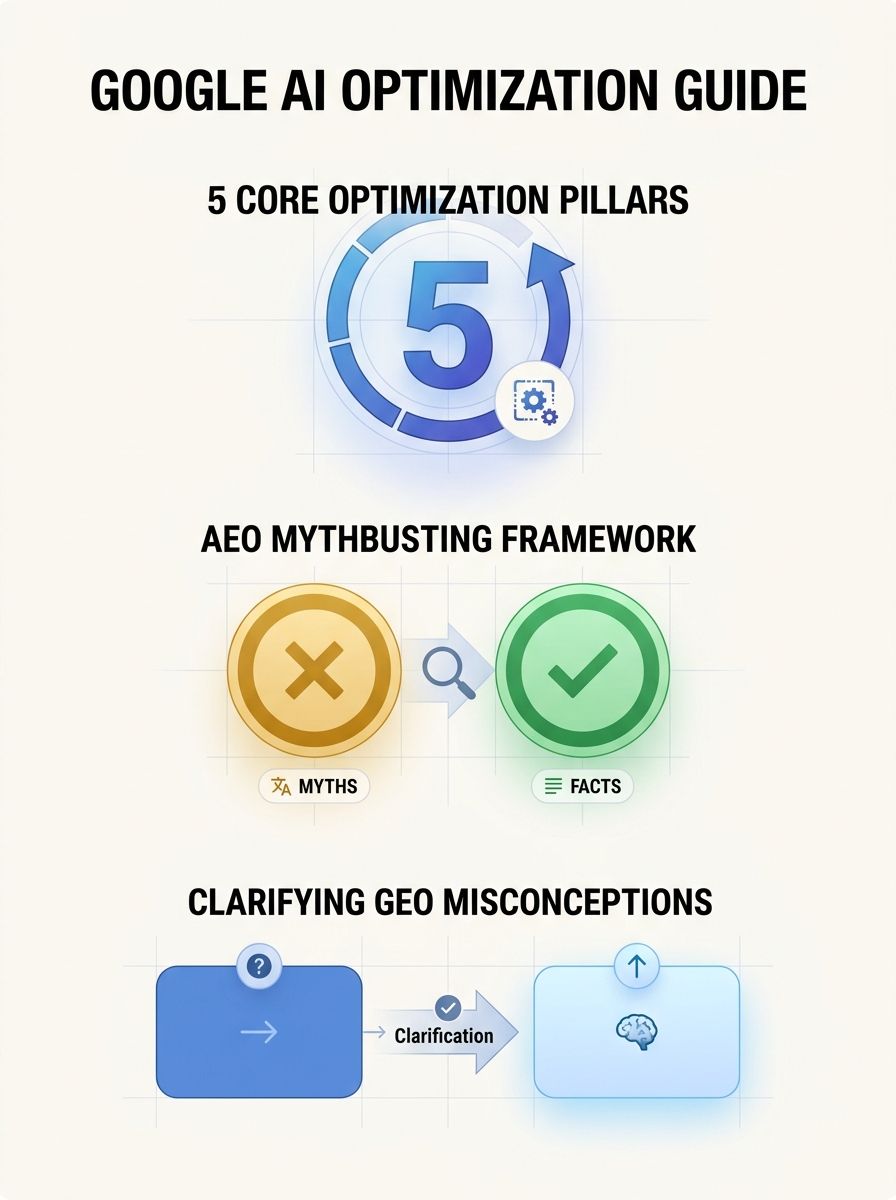
Google structured the guide around five distinct areas, with the third section dedicated specifically to mythbusting common "AEO/GEO" misconceptions. The company stated in the guide that it views much of the advice circulating under those acronyms as inaccurate or misleading. A December 17, 2025 podcast from Google's Search Relations team had previously concluded that optimizing for AI-powered search requires no fundamental changes from traditional SEO practices, making the May 15 guide a permanent written version of that position.
What the Guide Actually Recommends
The first area focuses on providing valuable, unique, non-commodity content—a principle that Google noted has anchored its quality guidance for years but gains urgency when AI systems synthesize answers from across the web. The second covers practical guidance for local, shopping, image, and video content, acknowledging that generative AI features operate differently across these formats.
The fourth section addresses AI agents, which Google described as "a quickly emerging and evolving space." This marks the first time Google has offered official documentation touching on AI agents capable of completing tasks on behalf of users rather than merely retrieving information. The fifth component explains why SEO best practices remain foundational to success with generative AI features, stating that the same principles governing visibility in traditional blue-link results also determine content selection for AI-generated responses.
Google's existing SEO Starter Guide, last updated December 10, 2025, explicitly dismisses several persistent myths: that meta keywords carry ranking weight (Google states they do not), that keyword density strategies help (Google classifies keyword stuffing as a spam policy violation), that exact-match domains confer significant ranking advantages, that content length alone determines ranking, and that E-E-A-T functions as a direct ranking factor. According to the documentation, "Thinking E-E-A-T is a ranking factor—No, it's not."
These clarifications directly contradict advice some practitioners have promoted as AI optimization strategies, particularly around content lengthening and E-E-A-T restructuring. The interplay between the new generative AI guide and the foundational SEO Starter Guide matters: a site that fails basic crawlability, blocks resources, or publishes thin content will not become eligible for AI Overviews through specialized optimization tactics, regardless of which acronym those tactics claim to represent.
The Broader Pattern of SEO Alignment
The mythbusting approach in Google's guide aligns with a broader industry pattern. Multiple SEO practitioners converged on the argument that fundamental SEO practices already serve AI search optimization, a position Google's guide now formally supports. The company's stance directly challenges the wave of generative engine optimization frameworks that emerged after Google first published guidance addressing AI search visibility.
The guide sits alongside rather than replaces Google's SEO Starter Guide, which covers fundamental mechanics including crawling, indexing, URL structure, duplicate content, meta descriptions, and link strategy. Content visibility depends on Google's crawler being able to access, parse, and understand a page—mechanics that have not changed with the introduction of AI features.
Why This Matters Now
Google's explicit rejection of AEO and GEO terminology resolves months of confusion about whether AI search requires distinct optimization practices. SEO specialists and content strategists who invested in specialized "generative engine optimization" frameworks now face documented confirmation that those approaches added no value beyond standard SEO best practices—and in some cases, according to Google's warnings, crossed into spam territory.
The guide's inclusion of AI agents creates a new planning requirement. While Google acknowledges this area is evolving, the documentation signals that agent-based search interactions will follow the same foundational principles as traditional search: accessible, structured, high-quality content. Teams building content strategies around AI systems' citation logic can now anchor those strategies in official guidance rather than speculative frameworks.
For agencies that built service offerings around GEO and AEO acronyms, Google's mythbusting section creates a credibility problem. The guide explicitly labels these terms as misconceptions and ties them to Mueller's prior spam warnings. Marketing managers evaluating agency proposals can now reference official documentation when screening out vendors promoting optimization approaches Google itself has rejected as misleading.
Alex Chen
Alex Chen is a digital marketing strategist with over 8 years of experience helping enterprise brands and agencies scale their online presence through data-driven campaigns. He has led marketing teams at two successful SaaS startups and specializes in conversion optimization and multi-channel attribution modeling. Alex combines technical expertise with strategic thinking to deliver actionable insights for marketing professionals looking to improve their ROI.
Related Articles

Google Publishes First Official Guide for AI Search Visibility as Agencies Double Down on Generative Engine Optimization
Google released its first official guidance for optimizing content in AI-generated search features in mid-May 2026, marking the company's most explicit acknowledgment that generative engine optimization has become a distinct practice alongside traditional search engine optimization, according to doc

Multiple SEO Practitioners Converge on Argument That Fundamental SEO Practices Already Serve AI Search Optimization
Three SEO practitioners argued within days of each other that the industry's debate over naming AI search optimization—whether to call it GEO, AEO, or another acronym—obscures a simpler reality: fundamental SEO practices developed over the past decade already align with what AI search systems requir

Google Responds to "SEO Is Dead" Panic After I/O, Points Industry to Real Economic Risk
Google issued an official statement on May 21 clarifying that AI Mode is not the default Search experience, one day after the Google I/O 2026 keynote triggered widespread claims that traditional SEO had become obsolete. The @NewsFromGoogle account stated users "will continue to get a range of result
Explore more topics