
Semantic SEO Framework Published Positioning Entity Mapping and Intent Alignment as Content-Planning Methodology
Entity mapping, attribute documentation, and search intent classification form the core methodology of semantic SEO rather than keyword density optimization, according to a practitioner framework RankPa published October 1 that repositions content planning around reader task completion.

Semantic SEO Framework Published Positioning Entity Mapping and Intent Alignment as Content-Planning Methodology
Entity mapping, attribute documentation, and search intent classification form the core methodology of semantic SEO rather than keyword density optimization, according to a practitioner framework RankPa published October 1 that repositions content planning around reader task completion.
The guide establishes semantic SEO as a content-planning discipline that extends keyword research by documenting entities, their attributes, relationships between concepts, and the specific task a searcher needs to complete, according to the framework. The methodology frames semantic SEO not as a Google ranking factor but as a structural approach to making page purpose interpretable by both readers and search systems.
RankPa defines the approach through five planning questions that expand beyond keyword selection: what the reader is trying to do, what the page's central subject is, which terms require definition, which facts need evidence, and what the reader should do next. The framework contrasts keyword-only planning—which centers on target phrases and may treat related terms as a checklist—with semantic content planning that starts with reader tasks and sets clear page boundaries.
Search Intent Classification Drives Page Structure
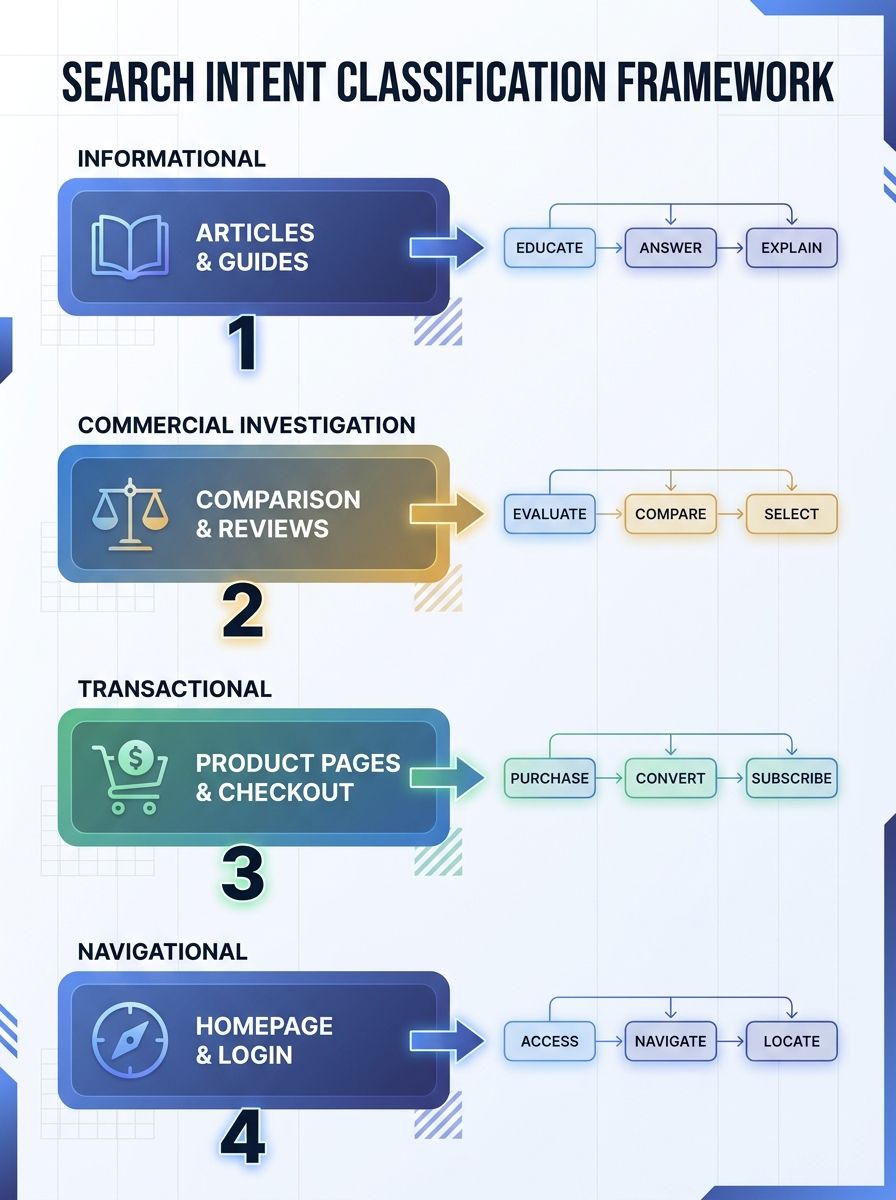
The framework assigns each URL one dominant search intent from four categories: informational (guides and tutorials where readers understand a topic), commercial investigation (comparison pages where readers evaluate choices), transactional (product or signup pages where readers take action), and navigational (destination pages where readers reach a known resource). Each intent type corresponds to a specific page format and reader outcome.
RankPa instructs practitioners to write a one-sentence job statement for the query before mapping entities or drafting headings, then inspect current search results to record recurring page types, titles, formats, and commercial signals. The guide notes that a query dominated by beginner guides likely requires a different page structure than one dominated by product comparison pages, and recommends treating SERP analysis as current evidence rather than permanent truth.
Secondary questions remain on a page when they support the main task but split into separate URLs when they require different formats, audience stages, depth, or conversion paths. The framework uses project management software as an example topic that could justify separate pages for a category explainer, feature comparison, pricing guide, and implementation guide—shared subject, different reader tasks.
Entity Mapping Requires Attribute and Relationship Documentation
The methodology defines an entity as a distinct thing (person, organization, place, product, process, or concept), an attribute as a meaningful property of that entity, and a relationship as the connection between entities. For a project management software buyer's guide, the core entity is the software category while supporting entities include projects, tasks, teams, workflows, integrations, and reporting.
Attributes in that example include pricing model, permissions, user limits, and integration options. Relationships explain that software manages projects, projects contain tasks, and integrations connect the software with other tools. The guide distinguishes this from subtopics, which it defines as explanatory areas or reader questions such as "How should a team compare pricing models?" that may involve several entities and attributes.
RankPa positions SERP features—autocomplete, related searches, recurring questions, and knowledge panels—as discovery tools rather than complete topic definitions. The framework instructs practitioners to confirm consequential facts through authoritative sources and establish context early when terms carry multiple meanings, using "Jaguar" as an example that could refer to an animal, automobile brand, or sports team.
The guide references Google Search Essentials documentation recommending use of searcher language in titles, headings, alt text, and link text, and aligns the semantic approach with Google's guidance to create helpful, reliable, people-first content rather than content made primarily to attract search visits. This positioning echoes recent analysis showing fundamental SEO practices already serve AI search optimization without requiring separate tactical layers.
Marketing Implications
The RankPa framework supplies SEO specialists and content strategists with a documented alternative to keyword-density approaches by formalizing entity mapping and intent classification as planning steps. Marketing teams can apply the four-intent taxonomy to audit existing content libraries and identify pages attempting to serve multiple incompatible reader tasks, then split those pages to improve conversion alignment and reduce bounce signals.
The entity-mapping methodology translates directly into structured data implementation and LLM citation optimization, as both depend on explicit documentation of subject, attributes, and relationships. Content operations teams can integrate the framework's planning questions into briefing templates to shift internal workflows from keyword-target assignments toward task-completion specifications.
The guide's treatment of semantic SEO as a content-planning discipline rather than a ranking tactic provides defensive documentation for teams facing pressure to implement unsupported optimization claims. By anchoring the approach in Google's published guidance on helpful content and searcher language, the framework gives practitioners evidence-based rationale for resource allocation decisions that prioritize reader utility over algorithmic speculation.

Sarah Chen
SEO strategist and web analytics expert with over 10 years of experience helping businesses improve their organic search visibility. Sarah covers keyword tracking, site audits, and data-driven growth strategies.
Related Articles

Multiple SEO Practitioners Converge on Argument That Fundamental SEO Practices Already Serve AI Search Optimization
Three SEO practitioners argued within days of each other that the industry's debate over naming AI search optimization—whether to call it GEO, AEO, or another acronym—obscures a simpler reality: fundamental SEO practices developed over the past decade already align with what AI search systems requir

The Search Intent Mismatch Audit: Why Your Content Ranks but Doesn't Convert
Pages that rank on page one but convert below 1% don't have a CRO problem. They have a content classification problem, where the page answers the wrong type of question for the person searching.

SaaS SEO Consultancy Publishes Product Page Framework Targeting Demo Request Conversion Gap
SaaS product pages frequently rank well for category searches while failing to generate qualified demo requests, according to a framework published by ClickyOwl on September 6 that restructures page optimization around buyer job mapping rather than keyword density.
Explore more topics