
How Google's Dual-Pane AI Search Mode Breaks Your Content Strategy (And How to Rebuild It)
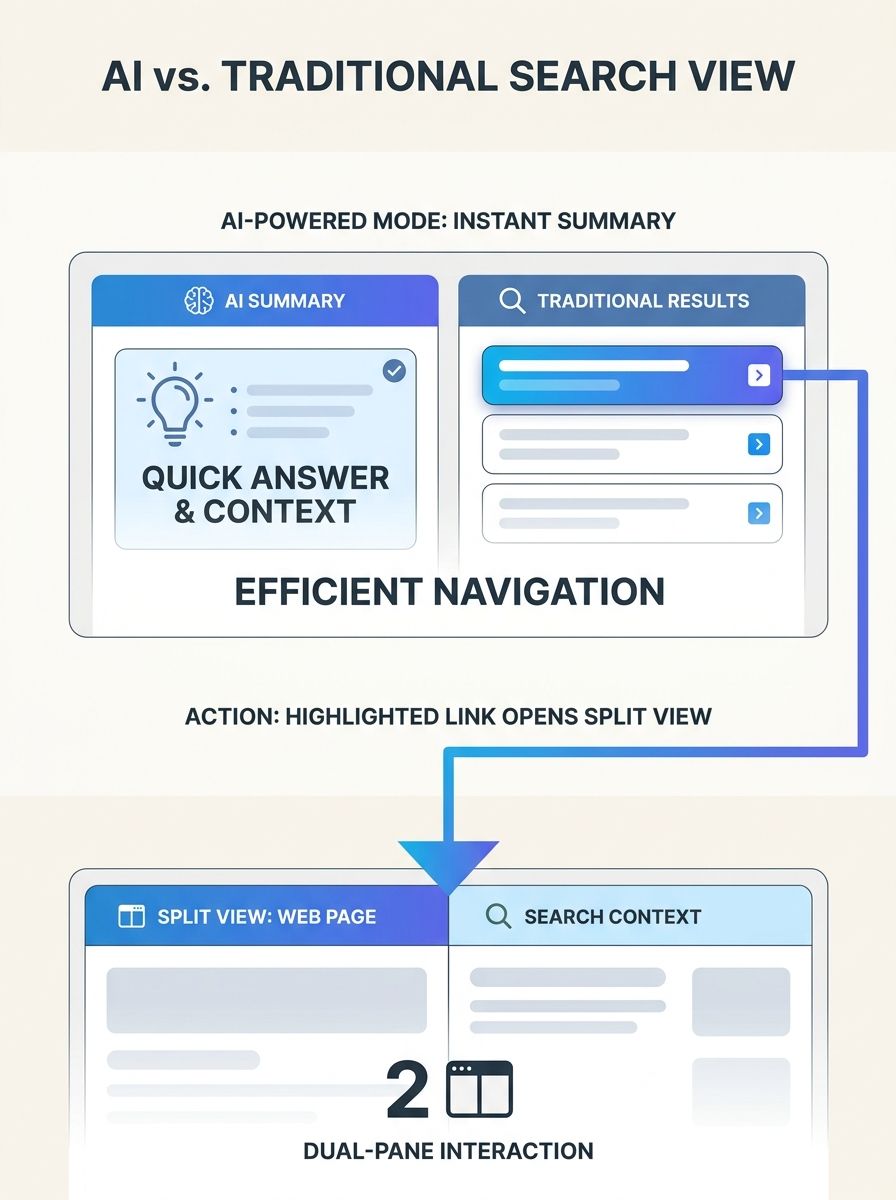
On April 20, Google flipped the switch on a dual-pane interface inside AI Mode that places an AI-generated summary and traditional web results side by side on the same screen. Clicking any link in the right pane now opens the page next to the AI summary rather than replacing it.
How Google's Dual-Pane AI Search Mode Breaks Your Content Strategy (And How to Rebuild It)
On April 20, Google flipped the switch on a dual-pane interface inside AI Mode that places an AI-generated summary and traditional web results side by side on the same screen. Clicking any link in the right pane now opens the page next to the AI summary rather than replacing it. The tab you used to hop to? Google wants to eliminate it entirely. And the implications for anyone who publishes content on the web are significant enough that I've spent the past 48 hours rethinking attribution models I've relied on for years.
This is a different kind of SERP change. Previous updates reshuffled rankings or added a feature box above organic results. The dual-pane layout restructures the fundamental viewing experience: your content now exists in a split-screen context where users read it alongside an AI synthesis that may or may not credit you. Every assumption about click-through rate, above-the-fold design, and time-on-page just got reframed.
The Dual-Pane Layout Redefines "Visibility"
For the past decade, SEO visibility meant one thing: position on the results page. Rank in the top three, and you captured the lion's share of clicks. The dual-pane interface undermines that model because users no longer need to leave the AI summary to evaluate your page. Google's blog post announcing the update describes the feature as ending "tab-hopping chaos," but what it really ends is the isolated viewing context your content was designed for. Your page now competes for attention in a half-screen window while the AI's synthesized answer occupies the other half.
The practical fallout is immediate. If your page's first visible frame—the content a user sees before scrolling—doesn't reinforce or extend the AI summary, users have no reason to keep reading your side of the screen. A recent analysis from Digital Applied suggests that above-the-fold snippet design now matters more than traditional CTR optimization because users are evaluating your content in direct visual comparison with Google's AI answer. Think about what that means for pages built around long introductions, cookie consent banners, or interstitial ads. Those friction points were already annoying. In a split-screen context, they're disqualifying.
I've been tracking AI summary visibility SEO patterns across several client sites since AI Overviews expanded to 180+ countries, and the data suggests a clear hierarchy forming. Pages that get cited in the AI summary receive a visibility boost in both panes. Pages that rank traditionally but aren't cited become nearly invisible because the user's eye is drawn to the AI pane first. The middle tier—pages that appear in web results but are paraphrased without attribution in the summary—are in the worst position of all, because the AI answer cannibalizes their value while they sit unnamed in the right column.
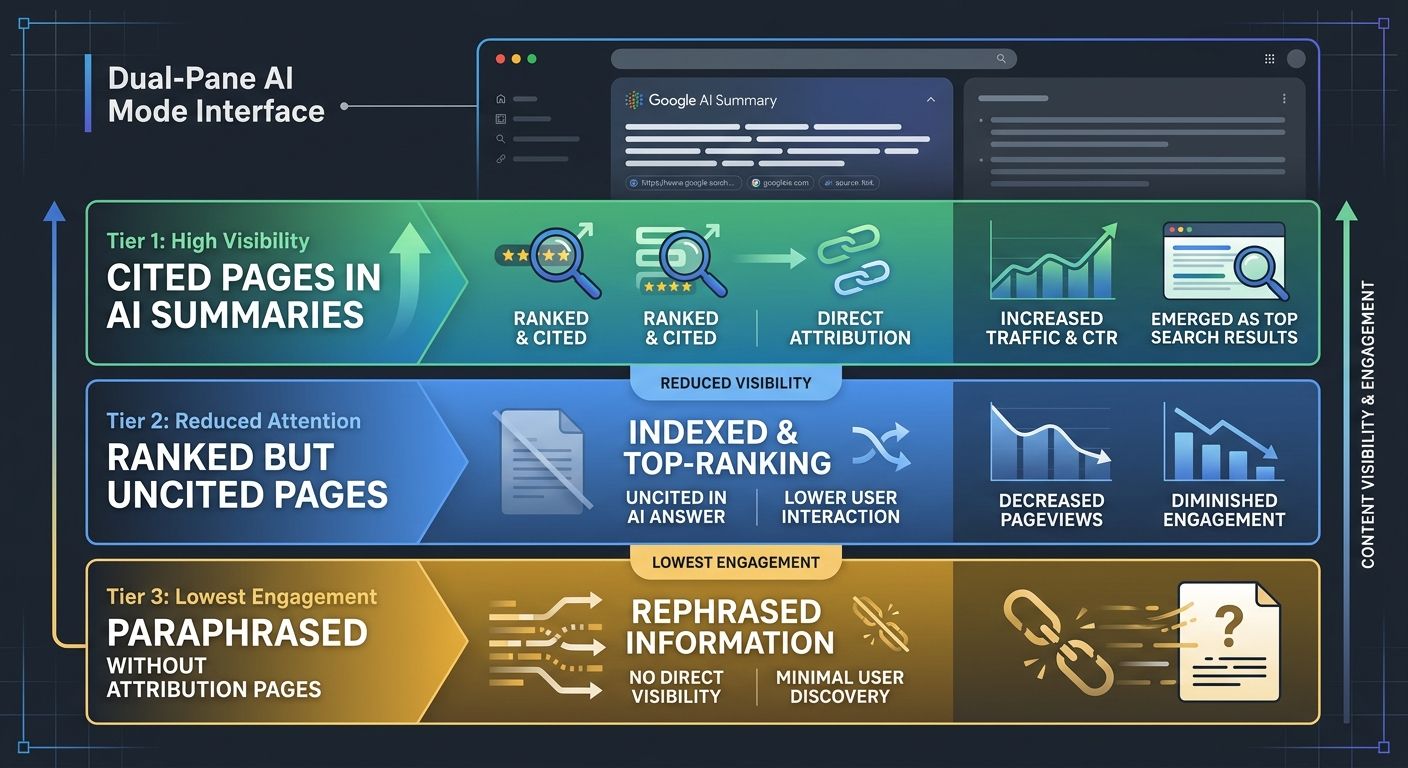
Brand authority is the single biggest differentiator in who gets cited. As Search Engine Land's optimization guide puts it, the more you associate your brand with relevant entities and topics, the more likely it is to appear in generative summaries for relevant queries. This matches what we've seen with brands that hold strong traditional rankings yet remain absent from AI search results. Ranking and citation are becoming two distinct games, and winning one doesn't guarantee the other.
Agentic Search Optimization Changes the Content Playbook
The dual-pane rollout coincides with another development that's easier to miss but arguably more consequential. AI Mode now runs on a custom version of Gemini 2.5, which uses a query fan-out technique to break user questions into subtopics and issue multiple simultaneous searches. Google's AI director Addy Osmani recently outlined what he calls "Agentic Engine Optimization," urging publishers to restructure content for AI agents that fetch, parse, and act on pages differently than humans do.
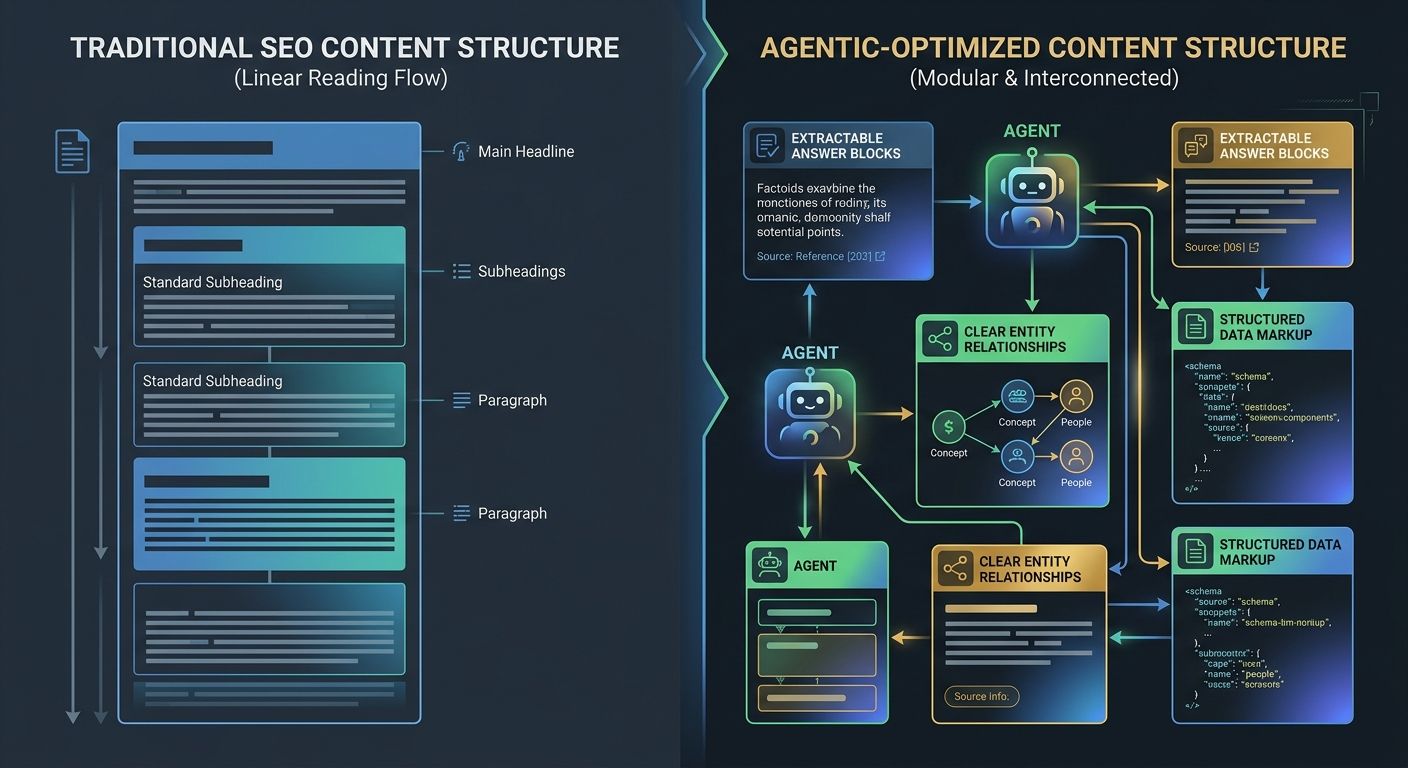
This is where agentic search optimization content strategy diverges from traditional SEO in a meaningful way. An AI agent pulling data from your page doesn't read top-to-bottom like a human. It extracts structured answers, entity relationships, and factual claims. If your crucial content is hidden behind paywalls, rendered via JavaScript that agents can't parse, or lacks machine-readable markup, it won't surface regardless of your domain authority. Structured data doesn't guarantee inclusion in AI Overviews, but as ALM Corp's analysis notes, it helps search systems understand content types, entities, relationships, and page purpose. The distinction matters: schema markup needs to reflect what's actually visible on the page, not serve as a separate metadata layer disconnected from the user experience.
For content teams, this means the unit of optimization is shifting from "the page" to "the parseable answer." Your 2,000-word guide might rank beautifully in traditional results, but if the specific claim an AI agent needs is buried in paragraph fourteen with no structural signals marking it as a distinct answer, the agent will pull that answer from a competitor who formatted it more clearly. I've written before about how content that ranks but doesn't convert represents a search intent mismatch, and the same principle applies to AI-generated answer attribution. Your content can rank without being cited, and in a dual-pane world, uncited ranking delivers diminishing returns.
Rebuilding for Attribution in the Split Screen
So what does the rebuild look like? Google's own Search Central documentation states that the best practices for SEO remain relevant for AI features, with no additional special optimizations required. I think that guidance is technically accurate and practically misleading. Yes, the fundamentals haven't changed—quality content, clear structure, authoritative sourcing. But the weight assigned to each factor has shifted dramatically, and pretending otherwise is how teams fall behind.
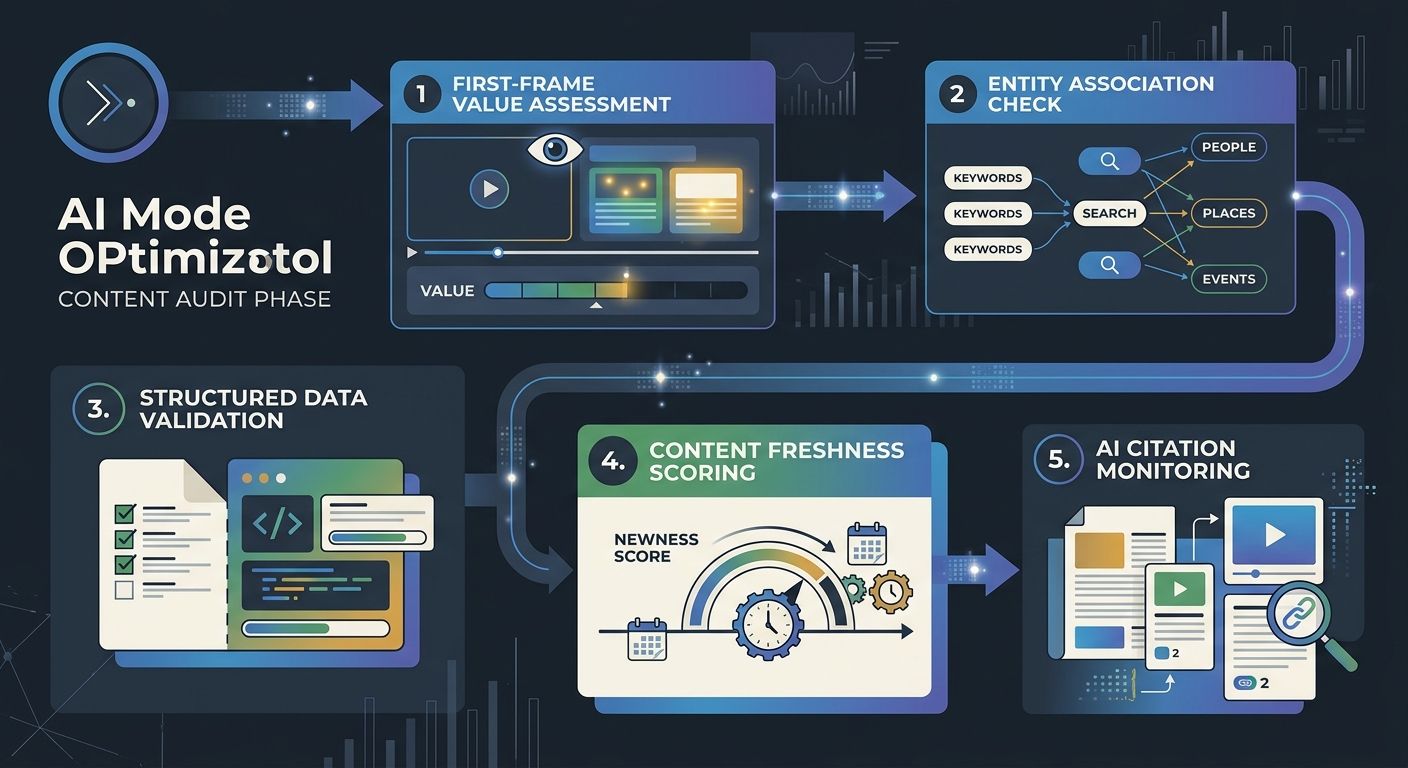
Here's how I'm restructuring content strategy across accounts right now. First, every page targeting a query likely to trigger AI Mode gets an audit for what I'm calling "first-frame value"—the content visible in the top 400 pixels of the page. In the dual-pane layout, that's your only real estate before the user decides whether to keep reading or return their attention to the AI summary. Cookie banners, newsletter pop-ups, and hero images with no text all consume that space. They need to go, or at minimum, they need to be deferred below a concise answer to the user's query.
Second, entity association is now a deliberate strategy, not a byproduct of good content. If your brand doesn't show up as a named entity connected to your target topics in Google's knowledge systems, you're unlikely to get cited. This means building topical authority through consistent publishing, earning mentions from recognized sources, and ensuring your structured data connects your brand name to the subjects you cover. The work we've done on integrated cross-team SEO planning becomes even more relevant here, because entity building requires coordination between content, PR, and technical SEO that most organizations don't have wired together.
Third, content freshness carries more weight in AI summaries than in traditional rankings. AI Overviews and AI Mode pull from content that demonstrates current relevance—recently updated statistics, timely analysis, dated references. Pages that haven't been touched in eighteen months can still rank for long-tail queries, but they're unlikely to earn citation in a system designed to synthesize the best current answer. Schedule content refresh cycles on a quarterly basis for any page targeting AI-visible queries, and treat those refreshes as substantive updates, not cosmetic timestamp changes.
Finally, Digiday's reporting on Google's evolving publisher policies confirms that Google must clearly and accurately attribute publisher sources in AI-generated summaries. That obligation exists in policy, but the enforcement and consistency of attribution in practice remain uneven. Monitoring whether your content is being cited—and whether that citation drives actual referral traffic—requires new instrumentation that most analytics stacks don't yet support.
Where the Measurement Problem Leaves Us Exposed
The honest answer about this dual-pane shift is that we're optimizing in a partial information vacuum. Google's dual-pane AI search mode represents the most significant change to search UX since the introduction of featured snippets, but the measurement infrastructure hasn't caught up. We can't reliably track impressions in AI Mode. We can't measure how users divide their attention between panes. We can't attribute conversions to AI citations versus traditional clicks with any confidence. And without those signals, every strategic recommendation—including the ones I've laid out above—carries a higher uncertainty margin than I'm comfortable with.
What I do know from the data available: pages structured for clear, extractable answers are appearing in AI summaries at higher rates than pages structured for long-form narrative engagement. Brand mentions in AI-generated answers correlate with increased branded search volume, even when the citation doesn't include a clickable link. And the organizations moving fastest on agentic search optimization content—the ones treating AI agents as a distinct audience alongside human readers—are reporting early indicators of maintained or improved referral traffic while competitors in the same verticals see declines. Whether those early signals hold as AI Mode expands globally remains to be seen. I'm running the same tests you should be running, and I'll share what the numbers look like once we have a full quarter of dual-pane data to analyze. For now, the strategic direction is clear even if the measurement precision isn't: your content needs to be citable, parseable, and valuable in a half-screen window, or it risks becoming invisible in the space where Google is pushing all of search to go.

Alex Chen
Alex Chen is a digital marketing strategist with over 8 years of experience helping enterprise brands and agencies scale their online presence through data-driven campaigns. He has led marketing teams at two successful SaaS startups and specializes in conversion optimization and multi-channel attribution modeling. Alex combines technical expertise with strategic thinking to deliver actionable insights for marketing professionals looking to improve their ROI.
Explore more topics