
XML Sitemaps vs. Topic Clusters: Which Architecture Signal Matters More to Google in 2026
An XML sitemap for a mid-sized e-commerce store might reference 40,000 URLs. A topic cluster built around that same store's core product category links fifteen pages together through intentional internal architecture. Both structures communicate with Google, but they say different things.
XML Sitemaps vs. Topic Clusters: Which Architecture Signal Matters More to Google in 2026
An XML sitemap for a mid-sized e-commerce store might reference 40,000 URLs. A topic cluster built around that same store's core product category links fifteen pages together through intentional internal architecture. Both structures communicate with Google, but they say different things. For email marketers who rely on destination pages to compound organic traffic between campaign sends, understanding this distinction shapes how you plan content, structure nurture sequences, and decide where editorial resources go.
The SEO community has spent years debating whether crawl efficiency or topical authority carries more weight with Google's ranking systems. That debate tends to stay trapped in technical SEO circles, divorced from the teams actually creating and distributing content. Email marketers sit at the intersection of both priorities: every newsletter, drip sequence, and promotional send points subscribers to a specific URL, and the organic performance of that URL determines how much value the content generates after the email send fades from inboxes.
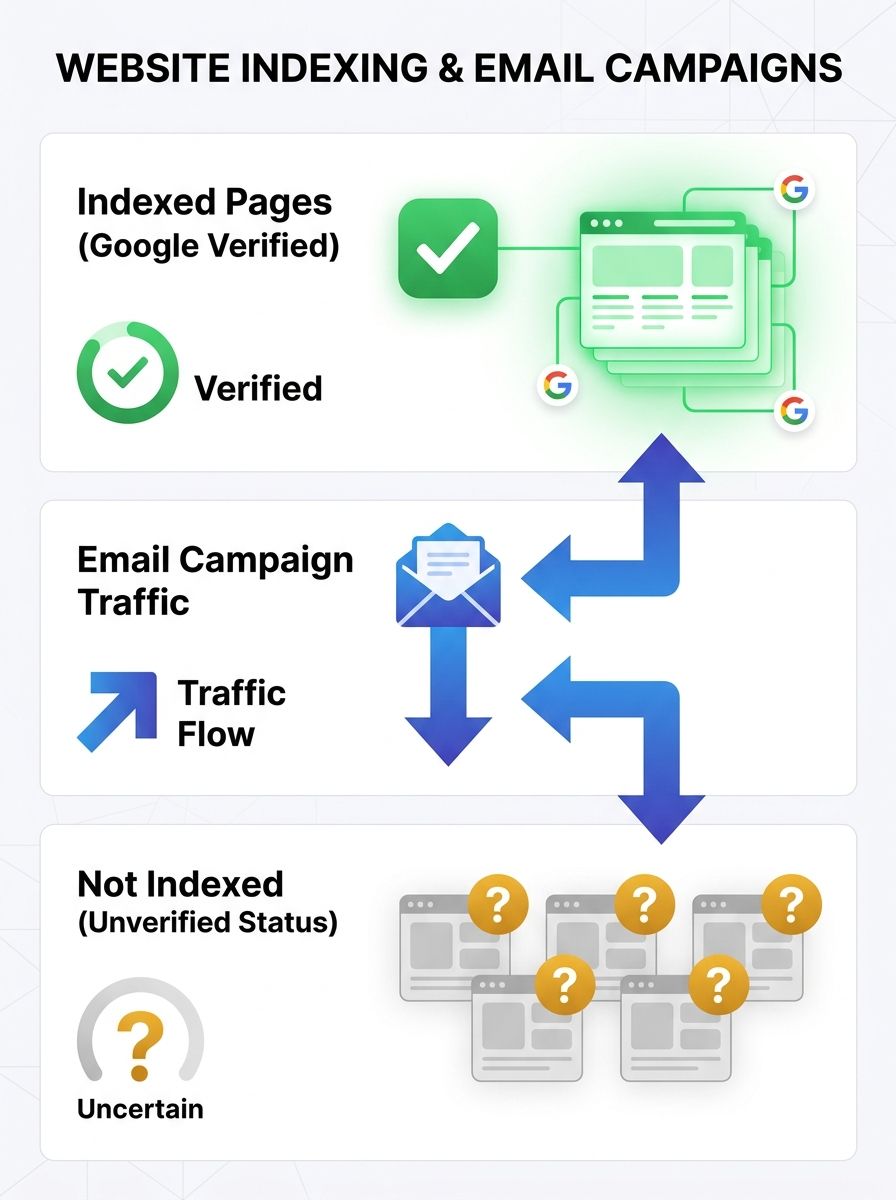
The Page Your Email Links To Might Not Even Be Indexed
Here's the practical scenario that makes this architectural debate relevant to anyone running email campaigns. You build a landing page for a product launch, write a supporting blog post, and send both URLs out to your list. The email performs well. Open rates are solid, click-throughs hit your benchmarks. But three weeks later, the blog post still isn't showing up in Google's index. The landing page is indexed but ranks on page six for its target query. Your email drove a spike of traffic that decayed within 48 hours, and neither page generates meaningful organic visits afterward.
This happens constantly on sites where XML sitemap crawl efficiency is poor. When crawl budget is mismanaged, important pages go unindexed, new content faces delays in ranking, and Googlebot wastes its visits on duplicate or thin pages instead of the content you actually want discovered. The fix isn't writing more content. It's making sure Google can find and prioritize the pages your campaigns depend on. Sites that segment sitemaps by content type and keep only canonical, indexable URLs in the file have pushed index rates toward 98%, which means the pages your emails drive subscribers to actually exist in Google's index when organic searchers go looking for the same topic a week later.
But crawl efficiency alone doesn't explain why some email-linked pages rank well and others languish. A page can be indexed perfectly and still earn zero organic traffic if Google doesn't view your site as authoritative on the surrounding topic. That's where the topic cluster architecture SEO question takes over from the sitemap conversation entirely.
What Sitemaps Actually Control (and Where They Stop)
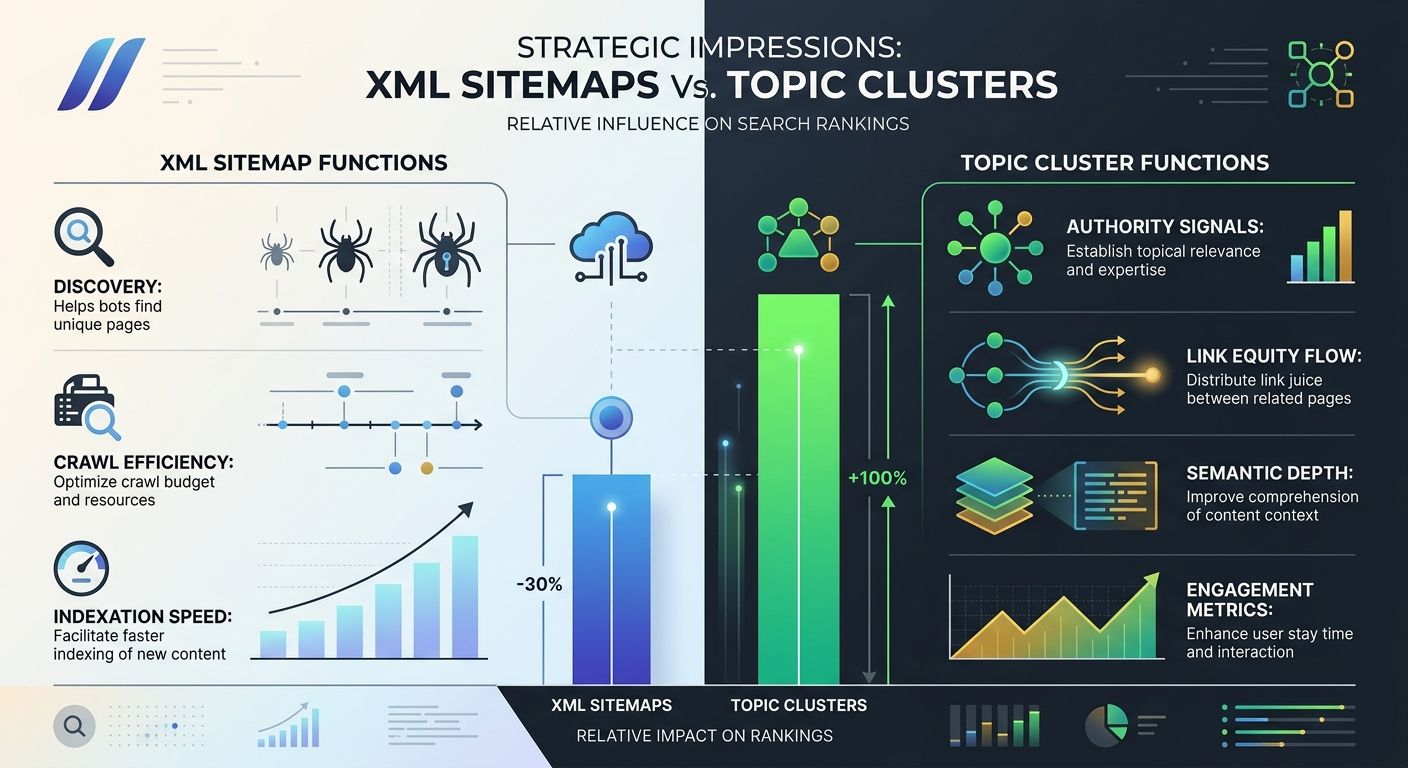
XML sitemaps serve a discovery function. Think of your sitemap as a table of contents handed directly to Google and Bing, helping bots find new content without guessing where it lives on your site. For sites with tens of thousands of URLs, parameterized navigation, or deep page hierarchies, sitemaps prevent critical content from becoming invisible to crawlers. One e-commerce consultant described cleaning up a store's sitemap after discovering Google couldn't determine which URL versions to trust. Rankings recovered only after standardizing everything to absolute, canonical URLs.
What sitemaps don't do is pass link equity or signal topical authority. A page listed in your sitemap but orphaned from your internal linking structure will get indexed, but Google has little reason to rank it well. The analogy I've seen SEO engineers use captures this accurately: the sitemap gets the bot to the door, but internal links show it around the house. If a page has no internal links pointing to it, Google treats it as isolated content with minimal contextual importance, regardless of what your sitemap says.
For email marketers, this has a direct operational implication. When you create campaign-specific landing pages or content pieces and only distribute them through email, those pages often end up as orphans in your site architecture. They exist in the sitemap. They might even get crawled. But without connections to your broader content structure, they won't accumulate the content hub hierarchy ranking signals Google needs to rank them competitively. Your email campaign generates a burst of direct traffic, and when that burst fades, the page effectively disappears from your acquisition funnel. When your technical SEO checks pass but organic performance still underperforms, this architectural disconnect is often the culprit.
The practical value of optimizing XML sitemap crawl efficiency shows up most clearly on large sites. Google's own guidance, as analyzed by the Wix SEO team, acknowledges that most small, clean sites won't face crawl budget problems. Googlebot handles them fine. The inflection point comes when you're stacking tens of thousands of URLs with faceted navigation and parameterized pages. If you're running a large-scale email operation driving traffic to thousands of product or content pages, sitemap hygiene becomes a genuine performance lever. For most content-driven sites sending weekly newsletters to a few thousand subscribers, it's a baseline configuration that should be set up correctly and then largely left alone.
Topic Clusters as the Infrastructure for Email Content Programs
The architecture that actually moves the needle on organic rankings is the topic cluster, and it happens to map remarkably well onto how effective email content programs are structured. A pillar page covers a broad topic at length, typically running 2,000 to 8,000 words. Cluster pages explore specific subtopics in depth and link back to the pillar. The pillar links out to each cluster page. This interconnected structure, as Search Engine Land's guide on topic clusters explains, signals to search engines that your site is an authority on the subject, strengthening site structure topical authority in ways that individual disconnected blog posts never achieve.
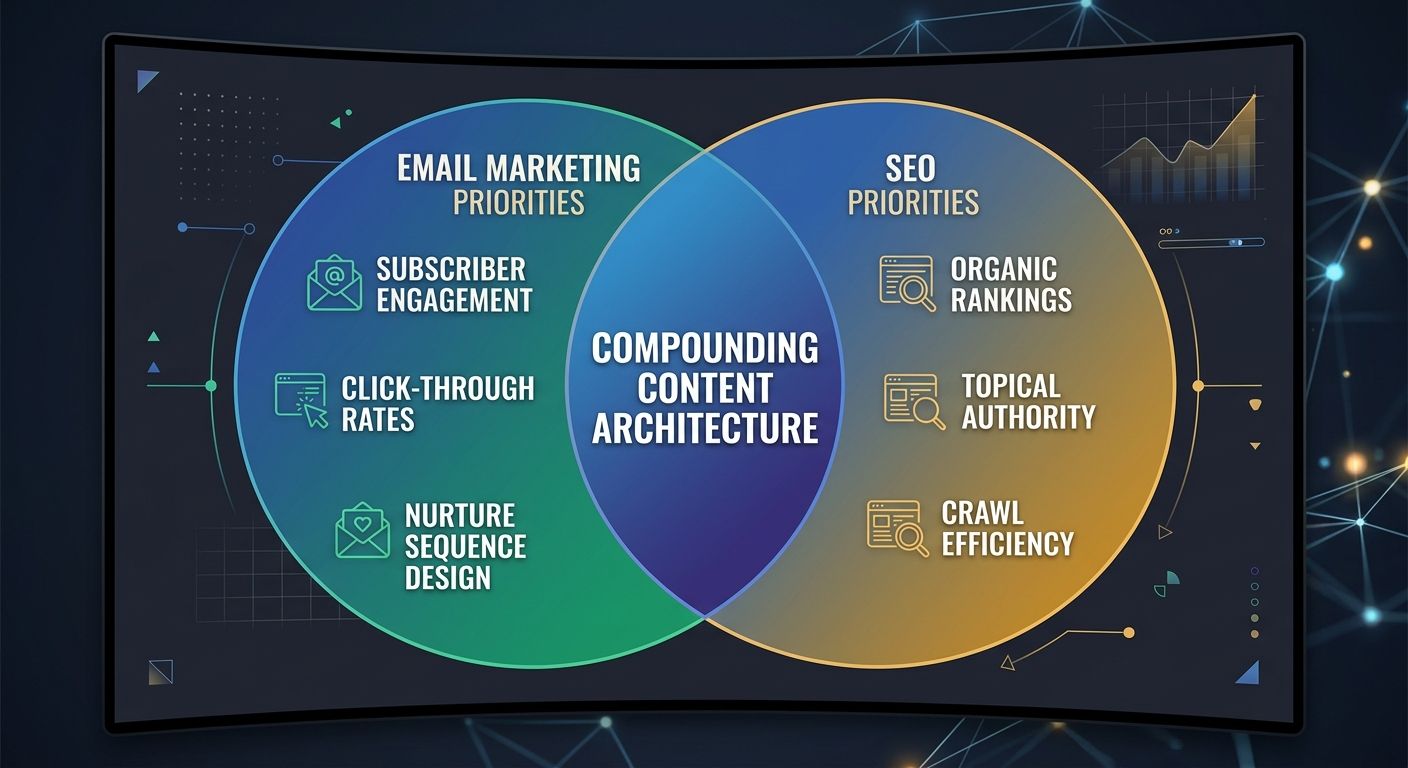
The overlap with email strategy becomes obvious when you look at how content marketing teams actually plan nurture sequences. A well-designed drip campaign already follows a cluster-like pattern: an introductory email covers the broad topic (your pillar), and subsequent sends go deeper into related subtopics (your cluster pages). The difference is whether those emails link to pages that are architecturally connected on your site or to scattered, unrelated URLs. When the pages themselves form a cluster with strategic internal link architecture, every email send drives traffic to a page that reinforces the authority of the entire cluster. Subscribers who click through and then explore related cluster pages generate the engagement signals (longer sessions, lower bounce rates, multi-page visits) that Google's systems treat as positive ranking indicators.
I've seen this compounding effect play out clearly in B2B SaaS email programs. A company sends a weekly newsletter linking to a new blog post. If that post exists as an island on the site with no cluster connections, it gets its traffic spike from the email and then flatlines. But if the post is part of a topic cluster with strong internal linking and clear topical authority signals, the email-driven traffic kickstarts engagement, Google picks up the architectural signals from the cluster, and the page begins generating organic traffic that compounds over weeks and months. The email campaign becomes a catalyst for organic growth rather than its own isolated channel.
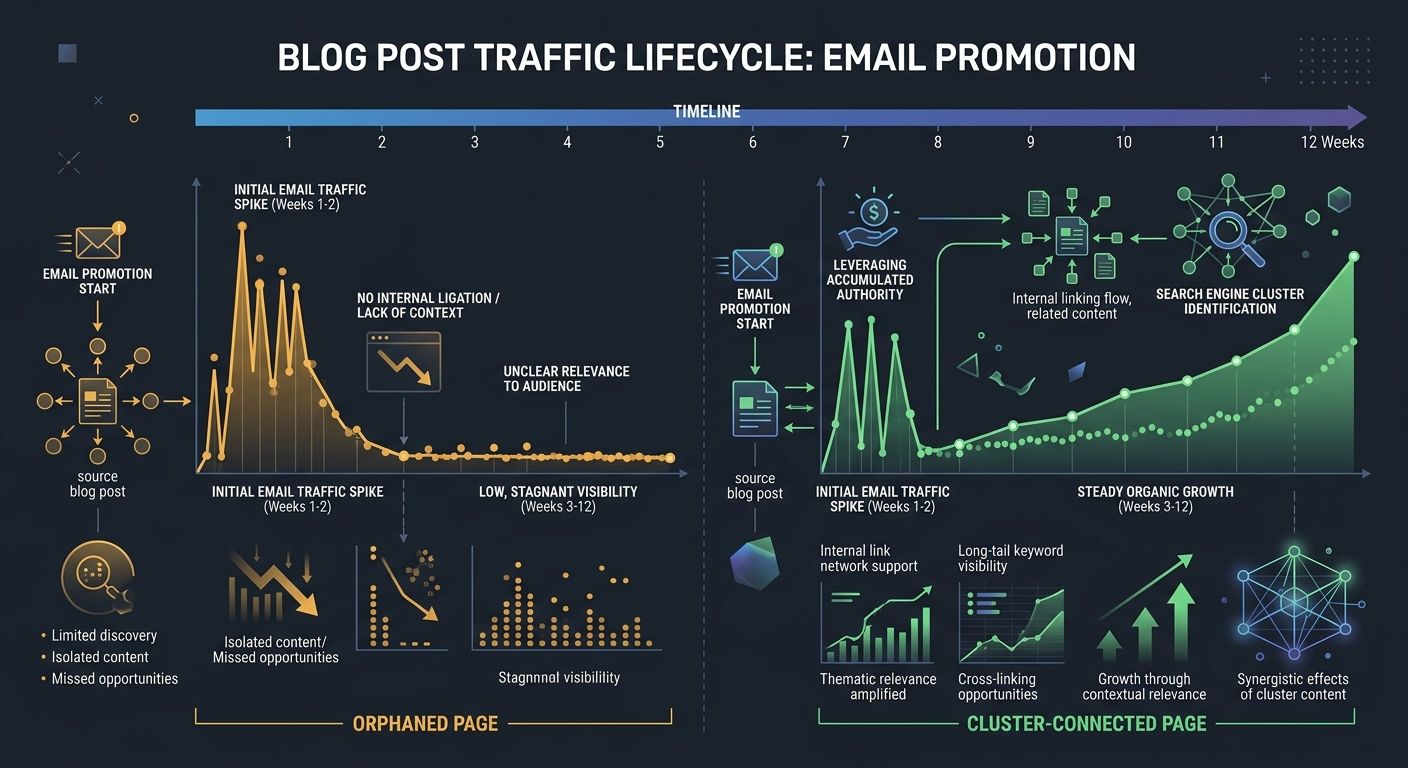
Google's March 2026 core update reinforced this dynamic by rewarding content authenticity and depth over volume. Sites with well-organized clusters that demonstrate genuine expertise outperform those publishing high volumes of shallow, disconnected content. For email marketers, this means the architecture of your content matters as much as the content itself. You can write excellent individual pieces and promote them through well-crafted email campaigns, but if your site architecture doesn't support how Google crawls and evaluates those pages, the organic tail never materializes.
Gary Illyes from Google has recommended hierarchical site structures specifically because they give Google the ability to treat different sections of a site differently, including how frequently they get crawled. A /resources/ directory organized around topic clusters sends clearer signals than a flat blog archive where every post sits at the same structural level. This architectural clarity benefits both crawl efficiency and topical authority simultaneously. Email marketers who coordinate with their SEO and development teams to ensure campaign content lives within well-structured clusters will capture more long-term value from every piece of content they produce and distribute. If your team struggles with that cross-functional coordination, the challenge of building integrated planning systems that actually scale is worth solving before you invest further in content production.
Where These Two Signals Leave Email Marketers Without Clear Answers
The honest answer to "which signal matters more" is that topic cluster architecture carries far more weight for rankings, while XML sitemaps serve as a necessary but insufficient prerequisite for getting content into the index. For email marketers, this means your time and strategic attention should overwhelmingly go toward building interconnected content structures that compound the value of every send. Sitemap configuration is a one-time technical setup that needs periodic maintenance, not an ongoing strategic priority.
But this framing leaves some genuinely unresolved questions. The measurement problem is significant: most marketing teams track email performance and organic performance in separate dashboards with separate attribution models, which makes it extremely difficult to quantify how much an email campaign contributed to a cluster page's organic ranking trajectory. We've explored why analytics dashboards often misrepresent actual performance on this site before, and the gap between what your tools show you and what's actually happening with email-to-organic compounding remains one of the widest measurement blind spots in digital marketing.
There's also the organizational reality. Email teams and SEO teams rarely share planning workflows, content calendars, or architectural guidelines. The email team creates content designed to drive clicks from subscribers. The SEO team creates content designed to rank. When those are different pages targeting different goals with different URL structures, neither team fully benefits from the other's work. Building topic clusters that serve both email engagement and organic authority requires a level of cross-functional alignment that most organizations haven't achieved yet, and the technical infrastructure to measure the interaction between channels at sufficient resolution doesn't exist for most marketing stacks.
And the AI search question adds another dimension of uncertainty. As Google's AI Overviews and competing AI answer engines increasingly pull from authoritative, well-structured content to generate responses, the sites with clear topic cluster architecture are more likely to be cited as sources. Email campaigns driving traffic to those pages may accelerate this citation effect by generating engagement signals. But we don't yet have reliable data on whether email-driven traffic meaningfully influences AI citation selection, or how to measure that interaction at the resolution marketers need. What we can say with confidence is that well-architected content serves both channels better than scattered pages, and that the structural investment in topic clusters pays dividends across every distribution channel your content touches, email included. The question of precisely how much each signal contributes at each stage of the compounding cycle remains open, and anyone offering exact ratios is extrapolating well beyond what current data supports.

Alex Chen
Alex Chen is a digital marketing strategist with over 8 years of experience helping enterprise brands and agencies scale their online presence through data-driven campaigns. He has led marketing teams at two successful SaaS startups and specializes in conversion optimization and multi-channel attribution modeling. Alex combines technical expertise with strategic thinking to deliver actionable insights for marketing professionals looking to improve their ROI.
Explore more topics