
HubSpot Marketing Hub Deployments Show Widespread Attribution Configuration Gap, Pedowitz Group Audit Finds
The Pedowitz Group reported June 15 that multi-touch revenue attribution remains misconfigured in most HubSpot Marketing Hub Enterprise deployments the firm has audited, with organizations running the platform for 12 to 24 months unable to answer which marketing programs influenced quarterly pipelin

HubSpot Marketing Hub Deployments Show Widespread Attribution Configuration Gap, Pedowitz Group Audit Finds
The Pedowitz Group reported June 15 that multi-touch revenue attribution remains misconfigured in most HubSpot Marketing Hub Enterprise deployments the firm has audited, with organizations running the platform for 12 to 24 months unable to answer which marketing programs influenced quarterly pipeline, according to implementation analysis published by the consulting firm.
The finding comes from configuration audits TPG conducted across more than 100 B2B marketing organizations using HubSpot Marketing Hub. Jeff Pedowitz, the firm's founder, documented the most common deployment failure: companies purchase HubSpot Marketing Hub Enterprise, run marketing programs for 12 to 24 months, and remain unable to report which campaigns or channels contributed to closed revenue during that period.
The Configuration Gap TPG Identified
Multi-touch revenue attribution in HubSpot requires Marketing Hub Professional or Enterprise tier subscriptions. Professional tier includes only first-touch and last-touch attribution models, according to the analysis. Enterprise tier adds four additional models: U-shaped, W-shaped, linear, time-decay, and full-path attribution.
The revenue attribution reports TPG references require Enterprise tier access. Organizations running Professional tier can access basic source attribution but cannot build deal-level multi-touch attribution reports that show how multiple marketing interactions across the buyer journey contributed to pipeline creation.
TPG's audit identified a structural reporting prerequisite that causes attribution failure: contacts must be associated to deals inside HubSpot's CRM for attribution reports to function. Deals with no associated contacts will not appear in revenue attribution reports regardless of tier or configuration, the analysis noted.
The firm recommended organizations run a deal-to-contact association audit before attempting to build attribution reports, identifying orphaned deals as the most common data-quality blocker in attribution rollouts.
Attribution Model Selection Patterns
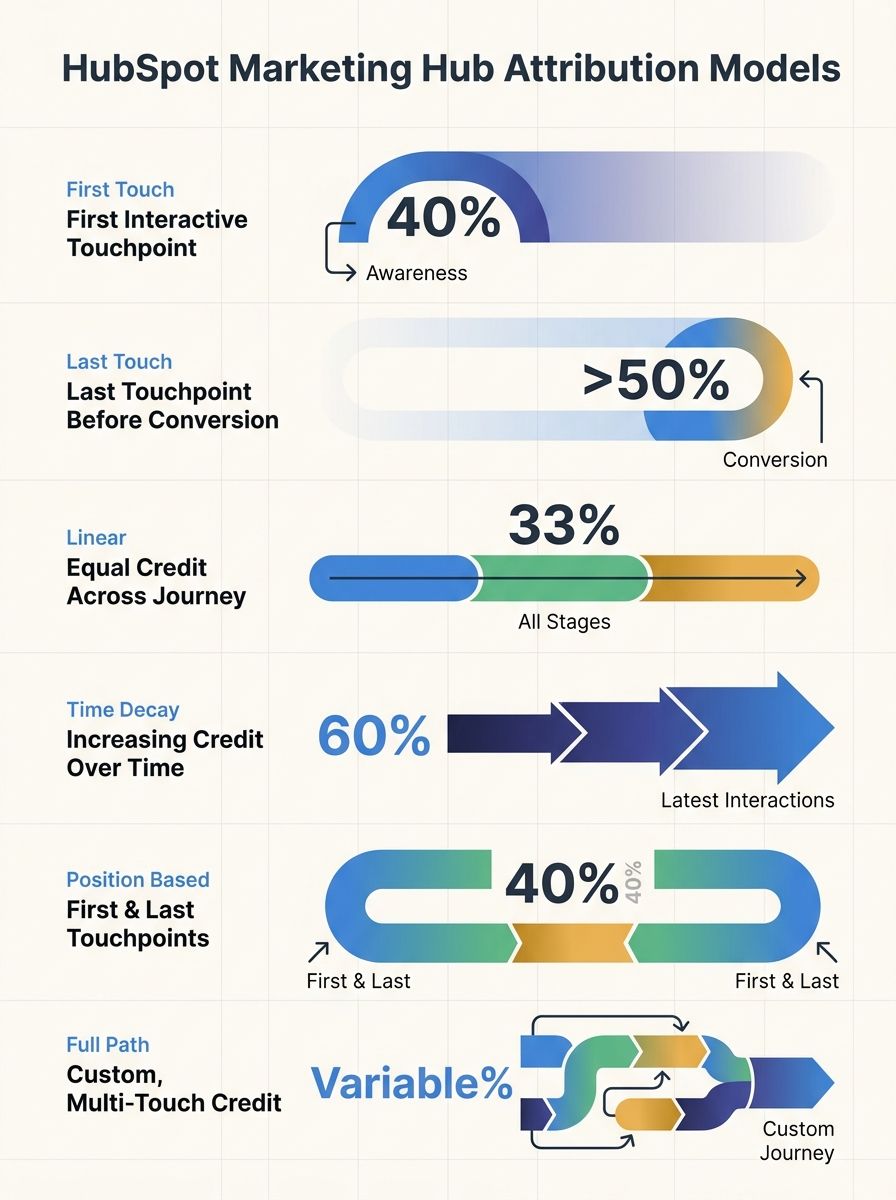
HubSpot offers six attribution models, each distributing revenue credit differently across marketing touchpoints. The model choice determines which programs appear to drive pipeline in executive reports, TPG's analysis showed.
First-touch attribution assigns 100% of revenue credit to the initial marketing interaction. Last-touch attribution assigns 100% of credit to the final interaction before deal creation or close. Linear attribution distributes credit equally across all touchpoints with no stage weighting.
U-shaped attribution allocates 40% credit to the first touch, 40% to the lead-creation touch, and 20% distributed across middle touches, according to the configuration guide. W-shaped attribution assigns 30% each to first touch, lead-creation touch, and deal-creation touch, with 10% distributed across remaining interactions. Full-path attribution gives 22.5% each to first touch, lead creation, deal creation, and closed-won touch, distributing 10% across other touchpoints.
TPG recommended W-shaped attribution as the default starting point for mid-market B2B organizations. "It rewards programs that create leads and programs that push deals to creation without ignoring the closing stage," the analysis stated. The firm advised running all six models in parallel and comparing output before committing to a primary model for board-level reporting.
The recommendation aligns with broader B2B attribution analysis showing last-click models systematically undervalue top-of-funnel and middle-of-funnel program contribution.
UTM Parameter Requirements
UTM parameters stored on form submissions provide the data layer for paid and owned media attribution, TPG's guide noted. Without consistent UTM tagging conventions, HubSpot attribution reports cannot identify the source of web-driven contacts.
The firm outlined a five-parameter UTM architecture required for attribution functionality: utm_source identifying the platform or channel, utm_medium identifying media type, utm_campaign carrying the campaign name, utm_content for creative variant tracking, and utm_term for paid search keywords.
UTM parameter values are case-sensitive in HubSpot, the analysis warned. "linkedin and LinkedIn are different source values and will appear as separate rows in your source reports," the guide stated, recommending lowercase-only conventions to prevent source fragmentation in attribution reports.
Organizations that launch paid campaigns without pre-defined UTM conventions encounter attribution blind spots that cannot be retroactively corrected, according to the analysis. Contacts acquired before UTM standardization retain their original source values, creating permanent data-quality gaps in historical attribution reports.
Marketing Implications
The configuration gap TPG identified reflects a broader disconnect between marketing platform capabilities and operational deployment. Organizations purchase enterprise-tier marketing automation with advanced attribution features, then operate those platforms in basic configurations that provide no visibility into multi-touch program influence.
The 12-to-24-month deployment window before attribution configuration suggests most marketing teams prioritize email automation and lead scoring over revenue reporting during initial HubSpot rollouts. That sequencing prevents data-driven budget allocation for the first two years of platform use, when historical attribution data could inform program mix decisions.
Marketing teams evaluating HubSpot tiers face a capability cliff between Professional and Enterprise that extends beyond attribution models. The Professional-to-Enterprise tier gap may justify the cost differential for organizations that require channel-level ROI reporting, but only if attribution setup occurs during initial deployment rather than as a deferred configuration project.

Alex Chen
Alex Chen is a digital marketing strategist with over 8 years of experience helping enterprise brands and agencies scale their online presence through data-driven campaigns. He has led marketing teams at two successful SaaS startups and specializes in conversion optimization and multi-channel attribution modeling. Alex combines technical expertise with strategic thinking to deliver actionable insights for marketing professionals looking to improve their ROI.
Related Articles

B2B Marketing Programs Systematically Undervalue Outbound Channels in Last-Click Attribution Models, Analysis Finds
Marketing analysis published June 13, 2026, by Fypion Marketing identifies a structural reporting failure in B2B demand generation: last-click attribution assigns conversion credit to bottom-of-funnel branded searches and direct visits while erasing the cold emails, content interactions, and retarge

Startup Content Attribution Framework Ties Editorial Output to Pipeline Value in Four-Step Tracking System
A comprehensive framework for tracking content performance from traffic through closed revenue appeared June 6, 2026, addressing startup founders' struggle to justify editorial budgets in cash-constrained environments, according to a guide published by Mean CEO. The methodology connects web analytic

Email Marketing Teams Abandon Open Rates as Primary KPI Following Privacy-Driven Metric Collapse
B2B email marketing teams are replacing open rate tracking with conversion-focused metrics including click-to-open rate, revenue attribution, and deliverability health indicators, according to a June 17 analysis published by MarketBoats. Open rates jumped from 28% to 55% following Apple's Mail Priva
Explore more topics