
Startup Content Attribution Framework Ties Editorial Output to Pipeline Value in Four-Step Tracking System
A comprehensive framework for tracking content performance from traffic through closed revenue appeared June 6, 2026, addressing startup founders' struggle to justify editorial budgets in cash-constrained environments, according to a guide published by Mean CEO. The methodology connects web analytic

Startup Content Attribution Framework Ties Editorial Output to Pipeline Value in Four-Step Tracking System
A comprehensive framework for tracking content performance from traffic through closed revenue appeared June 6, 2026, addressing startup founders' struggle to justify editorial budgets in cash-constrained environments, according to a guide published by Mean CEO. The methodology connects web analytics to CRM pipeline data through first-touch, last-touch, and assisted conversion models, then calculates return by comparing deal value against total content costs including production, distribution, tools, and founder time.
The guide, written by Violetta Bonenkamp, a bootstrapping founder in Europe who has built companies across deeptech, education, and startup tooling, argues that pageview-focused measurement leaves most commercial impact invisible because content influences buyers across multiple touchpoints before conversion.
Why Traditional Metrics Miss Commercial Impact
Content operates across longer time windows than paid advertising, creating measurement gaps in startups that rely on single-session conversion tracking. "Vanity numbers can feel comforting, but comfort is expensive, and startups rarely die from lack of impressions. They die from weak cash discipline and fuzzy cause-and-effect," Bonenkamp wrote in the June 6 guide.
The framework references recent Marketing Week reporting on marketing risk metrics, which argued that teams should evaluate predictability and downside risk alongside headline return figures. Bonenkamp applied that logic to content specifically, noting that founders need return calculations plus confidence intervals, payback timing, contribution by channel, and variance between expected and actual commercial outcomes.
Distribution weakness breaks attribution from the start, the guide states. Teams that publish content, post once on social channels, then declare failure miss the amplification layer that determines whether ROI measurement captures real performance or simply measures under-distribution. This connects to broader content distribution strategy that treats promotion as part of production, not a separate phase.
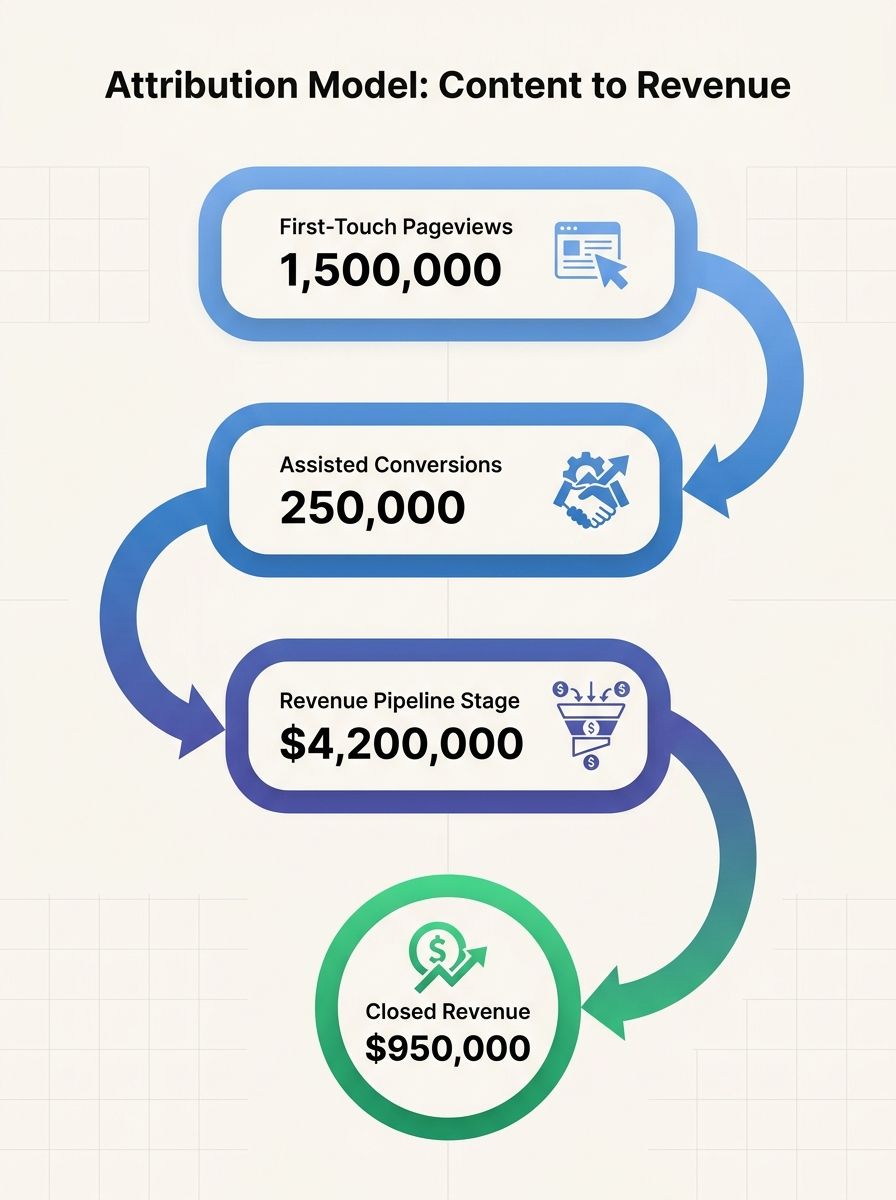
The Four-Component Attribution System
The published methodology breaks content measurement into four connected layers. First, teams audit existing content assets and group them by funnel role—awareness, consideration, decision, retention. Second, teams fix naming conventions and tracking parameters so analytics platforms can identify which assets touched each visitor. Third, teams connect web analytics to CRM stages, matching content touches to lead status, opportunity creation, and closed deals. Fourth, teams review which specific content pieces supported actual pipeline movement.
"If you cannot attribute content to commercial outcomes, you do not have a content engine. You have a publishing hobby," Bonenkamp wrote, summarizing the core premise.
The guide provides a content return formula: divide total attributed deal value by total content costs. Costs must include writing, editing, design, video production, analytics tools, distribution spend, and founder time allocated to content review and strategy. Startups that exclude founder time systematically overstate return because executive attention carries high opportunity cost.
Incrementality also matters. The framework instructs teams to compare conversion rates for visitors who engaged content against those who converted through other paths. If content-engaged visitors convert at 8% and direct-navigation visitors convert at 7%, the incremental lift is 1 percentage point—content's true contribution to conversion improvement.
Stage-Specific Models for Seed Through Series A
Attribution complexity should scale with startup stage and data infrastructure maturity. Seed-stage teams with fewer than 50 deals per quarter should use three simple views: first-touch attribution (which content started the relationship), last-touch attribution (which content closed it), and assisted conversions (which content appeared anywhere in between). That combination shows content's role at journey entry, journey exit, and journey middle without requiring weighted models that demand larger sample sizes to produce stable coefficients.
Series A and later-stage startups can add position-based weighting, which assigns 40% credit to first touch, 40% to last touch, and distributes the remaining 20% across middle touches. Custom models can weight touches by pipeline stage, assigning higher credit to content consumed during qualified opportunity stages than content consumed during anonymous browsing.
The guide cautions against premature sophistication. "Teams keep funding content they personally like, not content that sells," Bonenkamp noted, identifying founder bias as a measurement blocker. Building complex attribution before the team accepts data-driven budget decisions wastes analytics resources on reports nobody uses.
Payback time provides another startup-specific metric. Calculate months from content publication to first attributed conversion, then months from first conversion to payback of total content cost through margin on attributed deals. Content with 18-month payback timelines may not fit runway-constrained seed businesses even if long-term ROI looks strong. This extends data governance practices that force teams to define which metrics actually drive resource allocation.
The Takeaway
The June 6 framework gives marketing managers and content strategists a practical path to connect editorial work to revenue outcomes without requiring enterprise marketing automation platforms or data science teams. By anchoring attribution in first-touch, last-touch, and assisted views, then tying each model to CRM pipeline stages, startups can prove content value in the language finance and exec teams understand: pipeline created, deals influenced, customer acquisition cost reduced.
For digital agency professionals advising early-stage clients, the stage-specific guidance solves a persistent problem—seed companies that adopt attribution complexity designed for Series B scale, then abandon measurement entirely when weighted models produce unstable results on small sample sizes. The framework's explicit instruction to match model sophistication to deal volume and data maturity prevents that failure mode.
The emphasis on total cost accounting, including founder time and distribution spend, also addresses a blind spot in many content ROI calculations. Teams that exclude those inputs report inflated returns, then face budget scrutiny when leadership compares content performance to paid channels that account for all operational costs. Startups that implement the full four-step system gain defensible ROI numbers that survive finance review and board-level strategy discussions.

Alex Chen
Alex Chen is a digital marketing strategist with over 8 years of experience helping enterprise brands and agencies scale their online presence through data-driven campaigns. He has led marketing teams at two successful SaaS startups and specializes in conversion optimization and multi-channel attribution modeling. Alex combines technical expertise with strategic thinking to deliver actionable insights for marketing professionals looking to improve their ROI.
Related Articles

B2B Marketing Programs Systematically Undervalue Outbound Channels in Last-Click Attribution Models, Analysis Finds
Marketing analysis published June 13, 2026, by Fypion Marketing identifies a structural reporting failure in B2B demand generation: last-click attribution assigns conversion credit to bottom-of-funnel branded searches and direct visits while erasing the cold emails, content interactions, and retarge

From Blue Links to Business Outcomes: Rebuilding Your SEO Strategy Around First-Party Data in 2026
Businesses using first-party data for marketing measurement saw a 2.9x increase in revenue lift compared to those relying on third-party tracking, per Google's aggregate advertiser data. That gap keeps widening as cookie deprecation accelerates.

Organizations With Documented Content Strategies Report Nearly Double the Effectiveness Rate, CMI Data Shows
Content marketing programs built around documented strategies report 71% effectiveness rates compared to 38% among organizations without formal plans, according to Content Marketing Institute research cited in an analysis published June 14, 2026, by Dumbest Generation. The 33-percentage-point gap re
Explore more topics