
The SEO Benchmarking Cadence: Why Weekly Tracking, Monthly Reviews, and Quarterly Pivots Beat Static Annual Audits
Google's March 2026 core update reshuffled 79.5% of top-three search positions in under two weeks. Paid search teams scrambled to adjust bids while SEO teams running annual audit cycles had no framework to diagnose what happened, let alone respond.

The SEO Benchmarking Cadence: Why Weekly Tracking, Monthly Reviews, and Quarterly Pivots Beat Static Annual Audits
Google's March 2026 core update reshuffled 79.5% of top-three search positions in under two weeks. Paid search teams scrambled to adjust bids while SEO teams running annual audit cycles had no framework to diagnose what happened, let alone respond. A three-tier SEO benchmarking cadence gives both organic and paid teams the signal speed they need to protect revenue.
The Annual Audit Model and Where It Broke
For most of the 2010s, annual SEO audits were sufficient. Sites changed slowly, Google's algorithm updated a handful of times per year, and the gap between audits rarely cost teams more than a few percentage points of traffic.
Industry guidance still reflects this for small operations. Sites with 10-50 pages that rarely change can get by with an annual audit, according to Nav43's technical SEO frequency guide. An annual deep dive remains generally recommended as a baseline, even for sites running more frequent lightweight checks, per SEO Locale's audit frequency analysis. These recommendations hold true for static brochure sites. They fall apart everywhere else.
The conditions that made annual cycles viable have eroded. Google shipped multiple core updates in 2025 and 2026, each one capable of rearranging the first page overnight. The March 2026 core update alone displaced nearly 80% of top-three results, and Google's May 2026 search redesign cut publisher click-through traffic by 70% to 89% as AI-generated answers absorbed queries that previously sent users to websites. An audit conducted in January would be strategically irrelevant by April.
The breakdown accelerated for teams managing both organic and paid channels. When SEO traffic cratered mid-quarter, PPC teams operating from an annual plan had no mechanism to shift budget toward the keywords that organic had lost. The annual cadence created information gaps that cost real ad dollars, often thousands per week on keywords where organic visibility had already recovered but paid campaigns kept running.
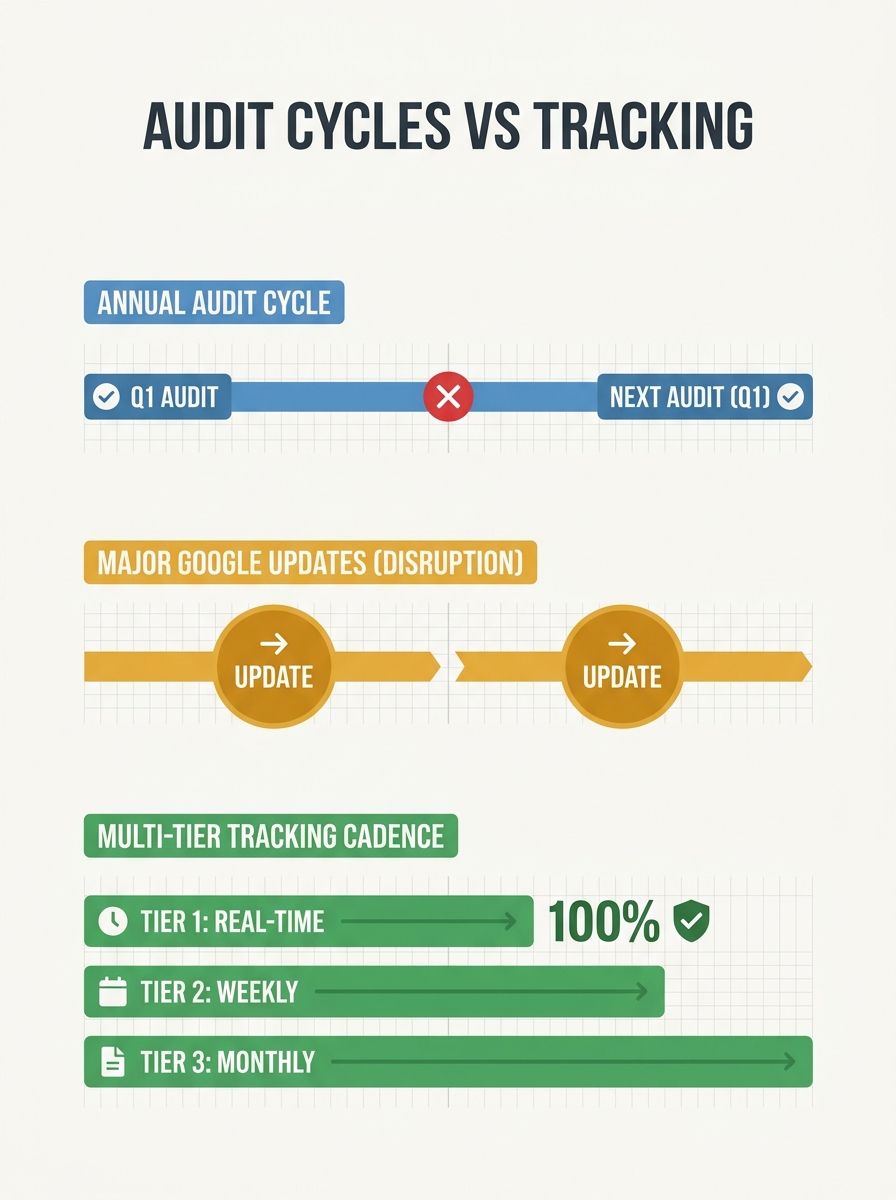
Weekly SEO Tracking Metrics Become the Early Warning Layer
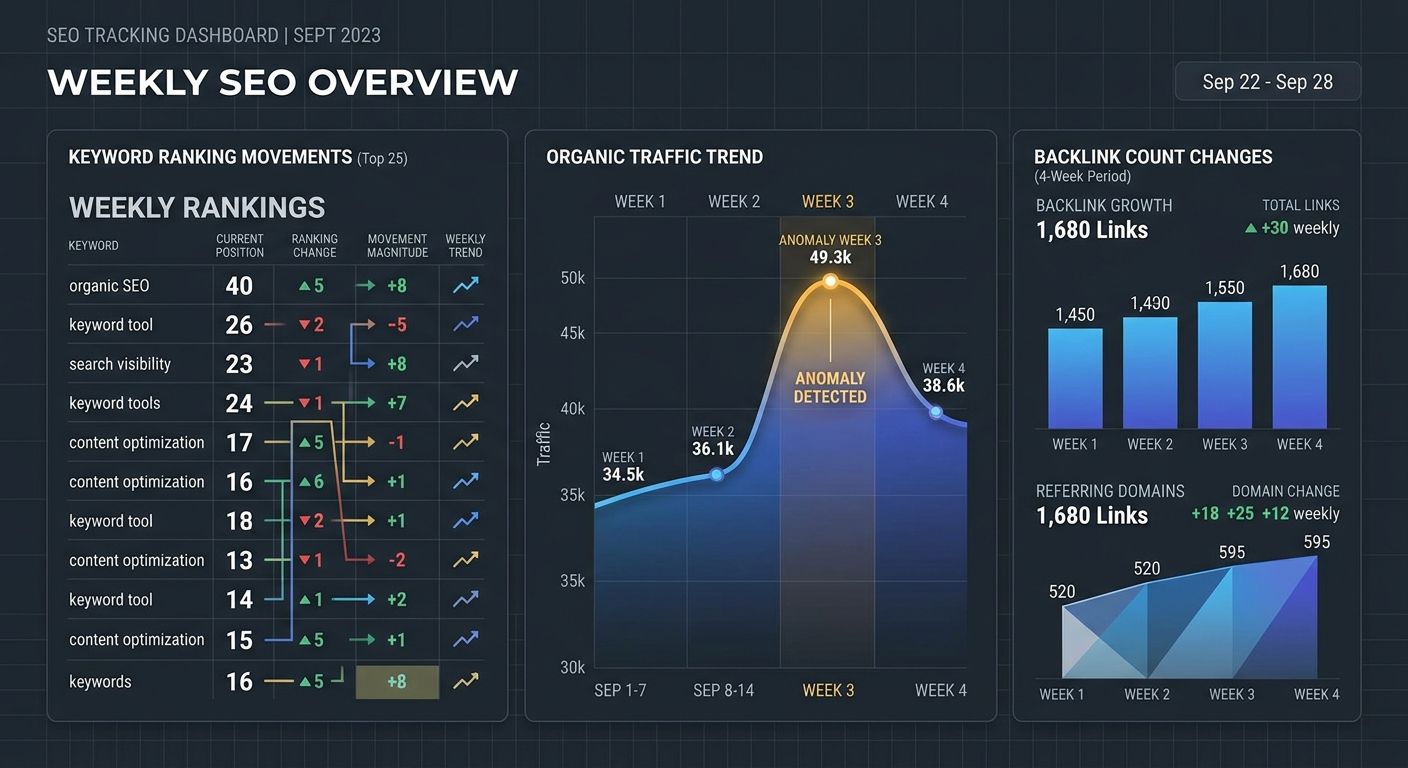
The first tier to emerge from the wreckage of annual planning was weekly tracking. The logic was straightforward: if Google can change your rankings in a day, you need visibility into those changes within a week.
Weekly SEO tracking metrics don't need to be complicated. The focus belongs on signals that actually move fast enough to warrant weekly attention: organic traffic, search impressions, and keyword ranking shifts, as Dyad Marketing's tracking framework recommends. DashThis's 2026 SEO tracking guide reinforces this, advising teams to monitor keyword rankings, organic traffic trends, and sudden performance drops weekly to catch technical issues or algorithm impacts before they compound.
I started building weekly dashboards for enterprise clients around 2022, and the metrics that proved their worth break into three buckets:
Ranking movement: Track your target keyword set (typically 50-200 priority terms) for position changes of 3+ spots. Smaller fluctuations are noise.
Traffic anomalies: A 15%+ week-over-week drop in organic sessions to any page cluster warrants immediate investigation and, if confirmed, a corresponding paid search response within 48 hours.
Backlink changes: Weekly monitoring prevents link decay from going unnoticed. When a high-authority site removes your link, outreach within the same week can often restore it. Spam link spikes targeting your domain also surface at this cadence, giving you time to disavow before the next crawl cycle.
For PPC teams, these weekly SEO signals are operational gold. A ranking drop on a high-converting keyword cluster means paid search needs to increase bids or activate paused campaigns for those terms within days. Conversely, when organic rankings climb into positions 1-3, you can pull back paid spend on those queries and redistribute budget toward terms where organic still can't compete. One e-commerce client saved $4,200 per month in redundant paid clicks by syncing weekly SEO tracking metrics with their Google Ads bid adjustments.
The cadence matters for prioritizing technical fixes too. An indexation error caught on Monday and fixed by Wednesday loses you 3 days of traffic. The same error caught in a quarterly audit loses you up to 90.
The Monthly SEO Performance Review Takes Shape
Weekly tracking catches fires. Monthly reviews reveal the patterns hiding underneath them.
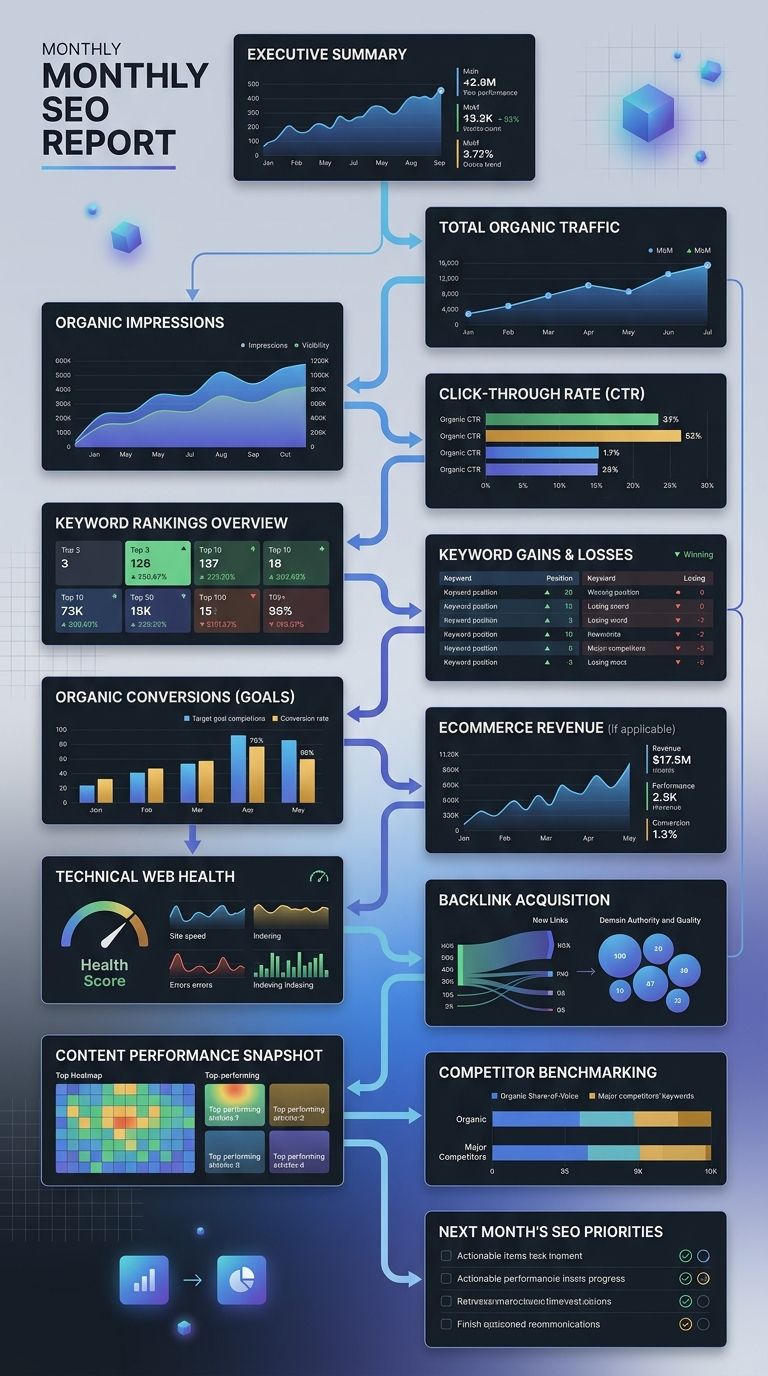
A proper monthly SEO performance review pulls together the signals that need 30 days of data to become meaningful: conversion rate trends, content performance by page type, technical health scores, and competitive positioning shifts. A 2026 SEO performance tracking guide from Futuristic Marketing Services defines 12 core metrics every programme should track and maps the right cadence for each. Many of those 12 require monthly windows to show actionable trends rather than statistical noise.
The monthly report structure that's worked best across my clients follows a specific sequence. UpperCut SEO's reporting guide recommends including crawl errors, page speed scores, mobile usability, and indexation status because these factors directly affect both rankings and Quality Score in paid campaigns. A monthly SEO report template published by Sadek Ur Rahman breaks this into 13 pages covering: executive summary, traffic performance with charts, rankings and keyword analysis, conversions and business impact, technical SEO health, backlink profile, content performance, competitor insights, work completed, and next month's priorities.
That 13-page structure sounds heavy, but the critical insight is the business impact section. When monthly data connects organic traffic to actual conversion numbers and pipeline value, the report becomes a tool for budget conversations with paid media teams. If organic drove 340 marketing-qualified leads in March but only 280 in April while PPC held steady at 190, the budget allocation conversation changes. Your content attribution framework should feed directly into these monthly reviews so that both channels report against shared revenue metrics rather than siloed vanity numbers.
Only 33% of mobile sites currently pass Google's tightened LCP threshold of 2.0 seconds, a technical metric that monthly performance reviews should catch before it drags down both organic rankings and landing page Quality Score in your paid campaigns.
For medium-sized sites, the research supports quarterly deep audits combined with monthly monitoring. Audit frequency guidance recommends monthly checks plus quarterly deep dives for large e-commerce operations, while medium sites should run quarterly full audits at minimum. The monthly layer fills the gap between those deeper dives by keeping the technical foundation visible to everyone who depends on search traffic, organic and paid alike.
The Quarterly Pivot Becomes Standard Practice
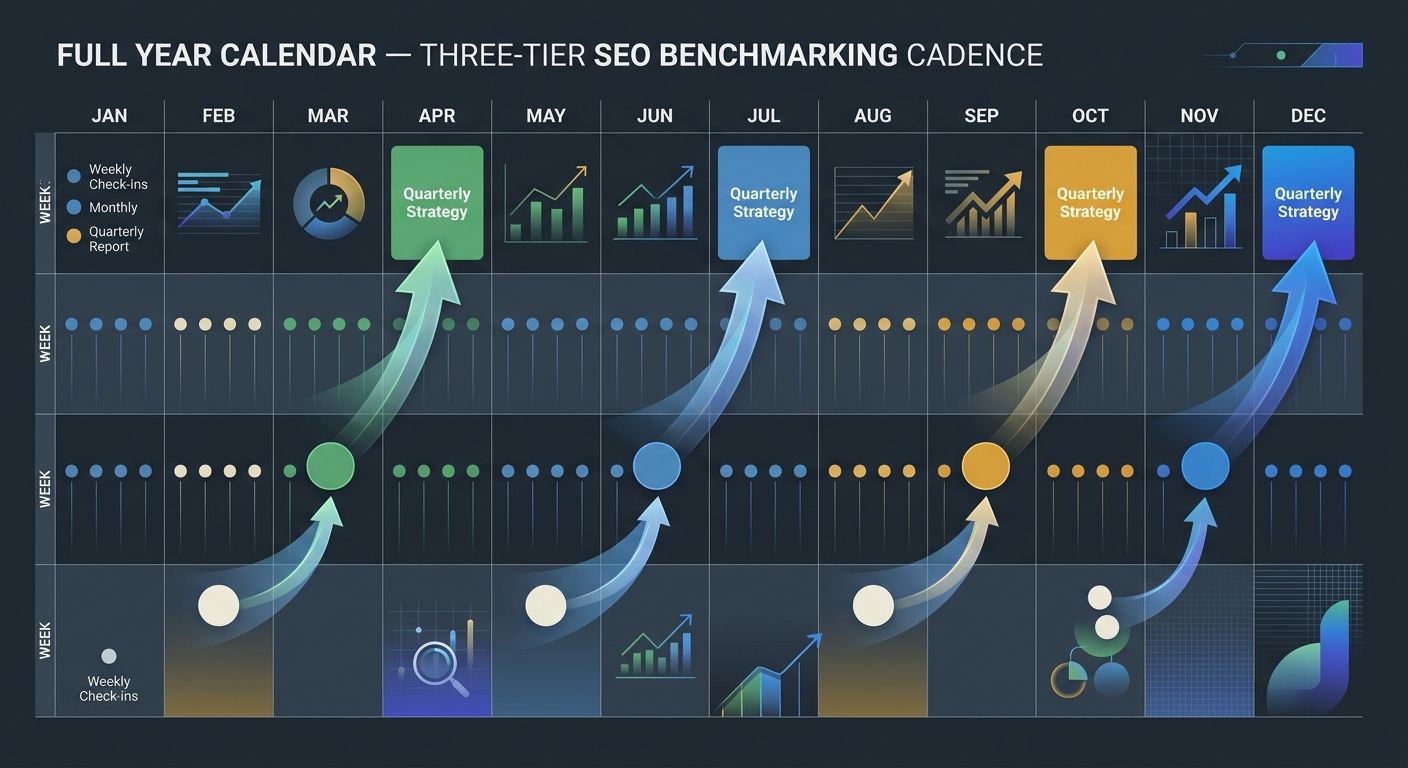
Why do quarterly cycles outperform longer planning horizons? Because 90 days matches the natural rhythm of search engine changes. Hashmeta's enterprise framework describes quarterly SEO roadmapping as a methodology that divides annual optimization initiatives into 90-day execution cycles, designed to be responsive where 12-month plans are rigid. Core updates, new SERP features, and competitive shifts tend to produce measurable effects within 60-90 days, giving you enough data to distinguish signal from noise and enough runway to execute meaningful strategy changes.
A quarterly SEO strategy review addresses a fundamentally different set of decisions than weekly or monthly work:
Competitive set reassessment: Are the same domains competing for your priority terms, or have new entrants appeared? One B2B client discovered a venture-funded competitor entering their primary keyword cluster in Q2 2025, which triggered a complete reallocation of both content production and paid search budget for Q3.
Content pillar evaluation: Which topic clusters drove traffic growth versus stagnation? Where does your content strategy documentation need revision?
Channel budget reallocation: Silverback Strategies' quarterly planning framework tracks traffic by page type, rankings by topic cluster, and assisted conversions to define success metrics before each quarter launches, enabling proactive optimization rather than reactive scrambling. This is the meeting where SEO and PPC leadership should sit in the same room.
Tactical abandonment: Effective pivots require honest assessment of what's not working and willingness to abandon ineffective tactics despite sunk costs. Disciplined focus on activities producing measurable momentum within quarterly timeframes beats commitment to tactics that promised long-term theoretical gains but haven't materialized after 90 days of measurement.
I worked with an e-commerce client through 2025 that illustrates the quarterly pivot's value. Their Q1 strategy leaned heavily on category page optimization. By the Q1 review, monthly data showed those pages gaining rankings but losing conversion rate, a classic search intent mismatch. The Q2 pivot shifted resources to comparison content targeting mid-funnel queries, and paid search simultaneously reduced spend on branded category terms where organic now held positions 1-3. The combined channel savings funded a content expansion that drove Q3 pipeline value up 22%.
Mid-quarter checkpoints matter too. Setting a review at the 45-day mark lets you course-correct without waiting for the full 90-day cycle. Small firms averaging an overall SERP position of 20 and medium firms around position 12 both benefit from this mid-quarter check because the gap between their current standing and page-one visibility often requires iterative adjustment rather than single-shot optimization. Organic traffic for small professional services practices typically ranges from 1,200 to 6,500 monthly sessions, with average lead-page conversion rates hovering around 1.1%, numbers that shift meaningfully within a single quarter when both channels are actively managed.
How the Three Tiers Connect Across Teams
The operational challenge isn't understanding why a three-tier cadence works. The challenge is getting separate teams to act on the same data at different time horizons.
In organizations where SEO and paid media sit in different departments, weekly SEO tracking metrics rarely reach the PPC team within the same week. Monthly SEO performance reviews get formatted as PDFs and emailed to stakeholders who read them 10 days later. Quarterly strategy reviews happen in separate conference rooms for organic and paid.
The fix is a shared dashboard that both teams access at every tier. Weekly: both teams see keyword ranking shifts and coordinate coverage within 48 hours. Monthly: both teams review the same traffic-to-conversion data and align their reporting against first-party business outcomes rather than channel-siloed metrics. Quarterly: the strategy review happens jointly, with budget allocation decisions made from a unified view of search landscape performance across organic and paid.
When you're operating at 1,200-6,500 monthly organic sessions and running paid campaigns alongside them, every percentage point of conversion rate improvement matters. The fastest path to improvement is catching problems at the weekly layer, diagnosing them at the monthly layer, and solving the underlying strategic issues at the quarterly layer. Each tier creates the context that makes the next tier's decisions sharper.
The State of Play
The shift from annual audits to a structured SEO benchmarking cadence has become standard practice for any team managing search visibility across organic and paid channels. Weekly tracking catches problems while they're still cheap to fix. Monthly reviews reveal patterns that inform both SEO and PPC tactics. Quarterly pivots keep the overall strategy aligned with a search landscape that changes faster than any annual plan can accommodate.
Teams that built repeatable workflows around these three rhythms before Google's turbulent 2025-2026 update cycle entered the volatility with the operational muscle to adapt. Organizations still running annual audits as their primary diagnostic tool are working with instrumentation that updates once a year in an environment that shifts every week. The gap between those two operating models shows up directly in wasted ad spend, missed ranking recoveries, and quarterly budget conversations that happen with 90-day-old data instead of current intelligence.

Sarah Chen
SEO strategist and web analytics expert with over 10 years of experience helping businesses improve their organic search visibility. Sarah covers keyword tracking, site audits, and data-driven growth strategies.
Related Articles

The SEO Benchmarking Cadence Audit: How to Stop Tracking Vanity Metrics and Start Making Data-Driven Ranking Decisions
The benchmarking cadence audit replaces static annual metric reviews with a three-frequency system — weekly pulse checks, monthly trend analysis, quarterly strategic pivots — where each layer filters SEO KPIs through conversion impact.

The SEO Workflow Breakdown: Building a Repeatable System That Scales With Your Team
Switching from ad-hoc SEO execution to a structured workflow system reduced time-to-publish from over two weeks to three to five days per content asset, while cutting brief creation time from two to three hours down to 30 minutes. These gains compound across every piece of content a team produces.

From Blue Links to Business Outcomes: Rebuilding Your SEO Strategy Around First-Party Data in 2026
Businesses using first-party data for marketing measurement saw a 2.9x increase in revenue lift compared to those relying on third-party tracking, per Google's aggregate advertiser data. That gap keeps widening as cookie deprecation accelerates.
Explore more topics