
The Long-Tail Comparison Content Strategy: How to Rank in Niches Where 'Obvious' Comparisons Don't Work
The standard "Tool A vs. Tool B" comparison page template breaks in specialized markets where head-to-head brand queries generate fewer than 10 monthly searches. Niche industries need a different comparison architecture.

The Long-Tail Comparison Content Strategy: How to Rank in Niches Where 'Obvious' Comparisons Don't Work
The standard "Tool A vs. Tool B" comparison page template breaks in specialized markets where head-to-head brand queries generate fewer than 10 monthly searches. Niche industries need a different comparison architecture. The mechanism underneath it operates through three distinct frames: situational constraints, role-specific workflows, and outcome-based criteria that I call the Three-Frame Comparison Model.
Why Head-to-Head Comparisons Fail in Specialized Markets
The "vs." comparison format works when both brands have enough consumer awareness to generate search volume. Salesforce vs. HubSpot generates thousands of monthly queries because both brands are household names in CRM. But niche markets lack this awareness asymmetry. Buyers in specialty manufacturing, vertical SaaS, or professional services rarely type "[Brand A] vs. [Brand B]" because they often don't know Brand B exists yet.
Niche businesses derive up to 70% of their organic traffic from long-tail terms, according to AFFiNCO's 2026 strategy analysis. That 70% figure tells you where comparison content needs to live: in the long tail, structured around the specific constraints and workflows your buyers already think in. When you run a search intent audit on your existing comparison pages, you'll often find they rank for queries your audience isn't asking and miss the ones they are.
The failure pattern is consistent across industries. A B2B compliance software company builds 12 "vs." pages targeting competitor brand names. Each page generates 0-15 organic visits per month. Meanwhile, uncontested queries like "SOC 2 audit tool for startups under 50 employees" or "HIPAA compliance software with EHR integration" sit wide open with zero competition and high purchase intent.
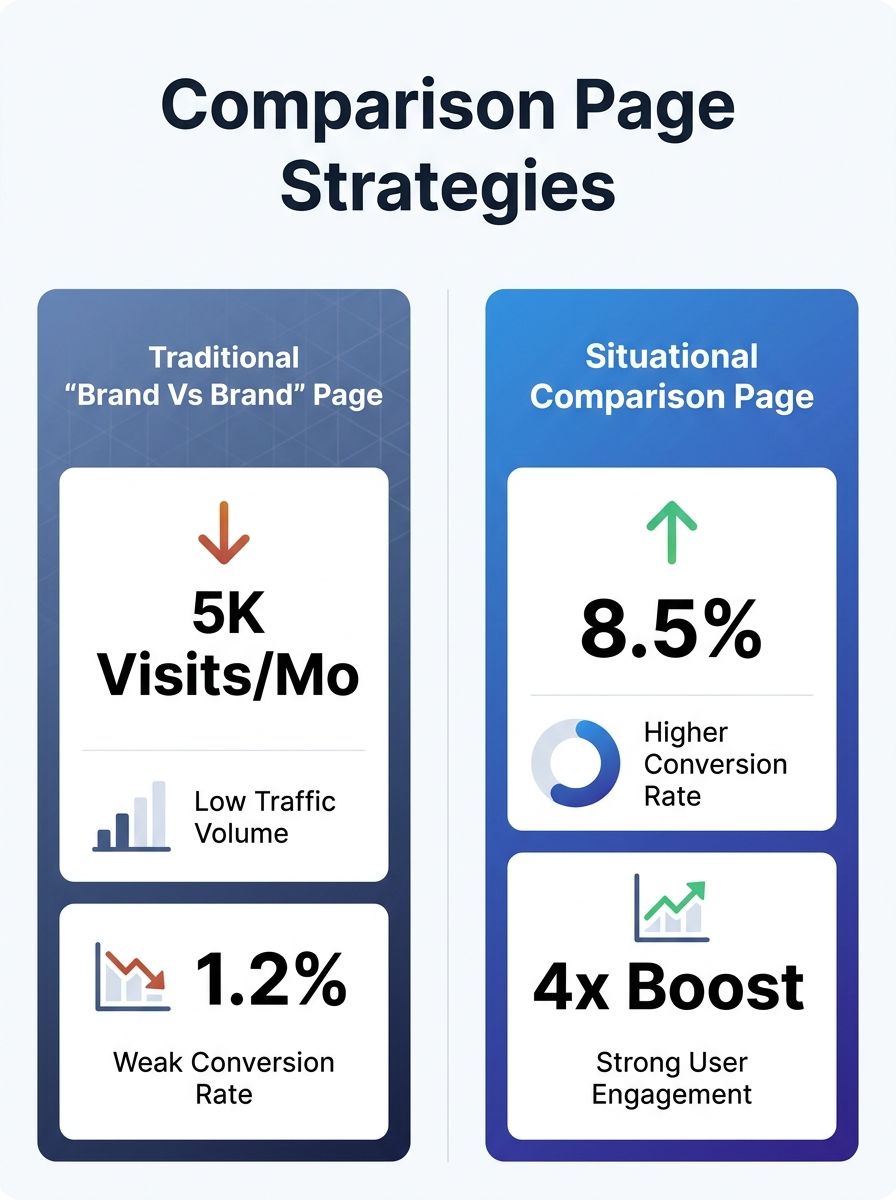
The Three Comparison Frames Niche Buyers Actually Use
Why does the "vs." model miss so much niche search behavior? Because it maps to only one of three ways specialized buyers compare options. The Three-Frame Comparison Model captures all three.
Frame 1: Situational Constraints. These queries describe the buyer's specific situation rather than naming brands. Examples include "best project management tool for construction crews with no office" or "CRM for real estate teams under 10 agents." B2B companies using long-tail strategies built around these situational frames see 55% higher lead quality scores compared to campaigns targeting generic head terms. The constraint itself becomes the keyword cluster anchor.
Frame 2: Role-Specific Workflows. Different roles within the same organization evaluate the same product against different criteria. A CFO searching for accounting software cares about audit trail depth and compliance reporting. An accounts payable clerk cares about invoice matching speed and batch processing. Each role generates a distinct set of long-tail comparison queries. Pipedrive, the sales pipeline software company, demonstrates this well. As documented in Semrush's niche-driven SEO analysis, Pipedrive ranks for "confirmation email template" because it maps content to the daily workflows of sales professionals, not to broad "CRM comparison" queries.
Frame 3: Outcome-Based Criteria. These queries compare approaches to achieving a specific result rather than comparing products directly. "Reduce invoice processing time from 5 days to 1 day" or "automate SOC 2 evidence collection without hiring" describe desired outcomes. Content that compares methods, configurations, or product categories against these outcomes captures buyers who haven't narrowed their consideration set to specific brands yet.
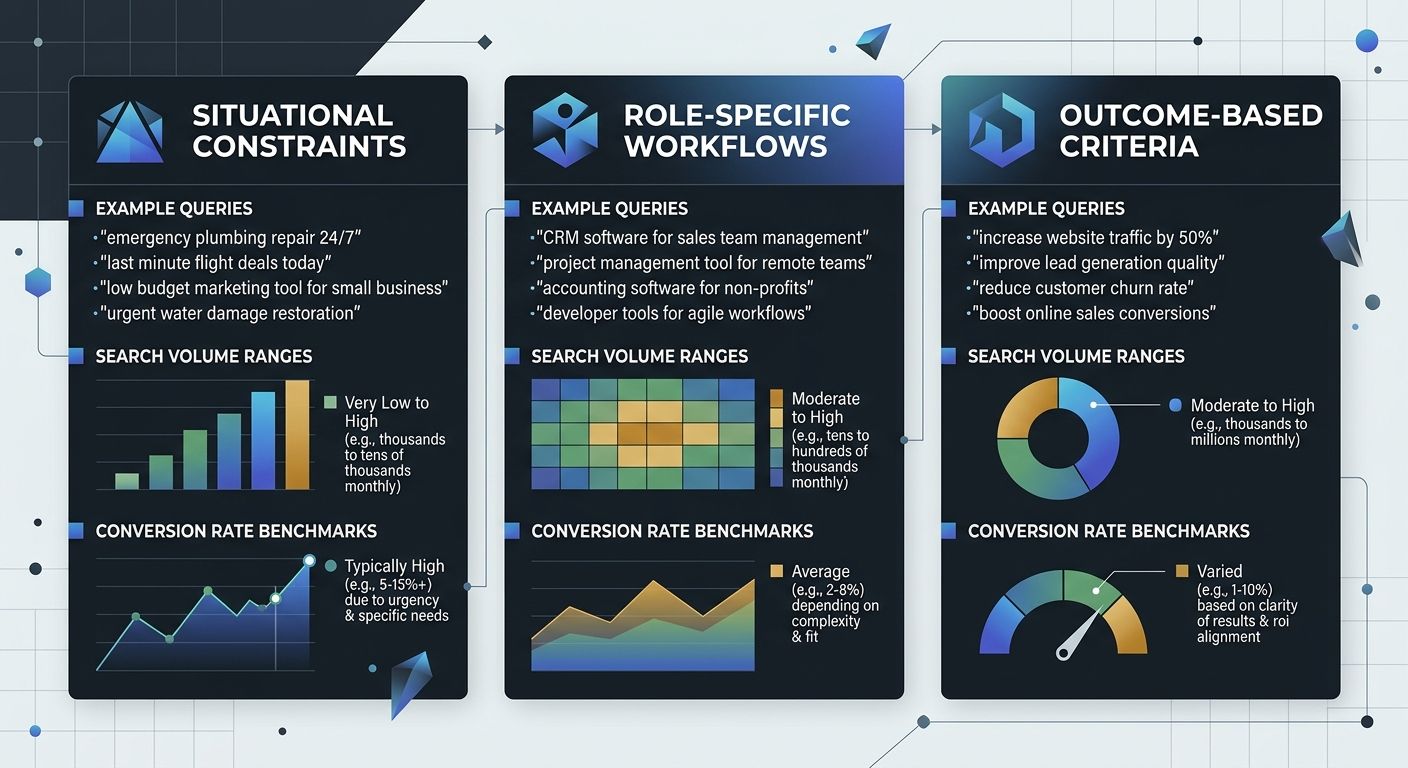
Each frame produces queries with different volume profiles. Situational constraint queries tend to cluster in the 20-90 monthly search range. Role-specific queries often fall between 10-50. Outcome-based queries can reach 100-300 when they describe common pain points. All three convert at rates significantly higher than broad head terms, with long-tail comparison traffic converting at 2.5 to 5 times the rate of generic keyword traffic and driving 2.5x higher time-on-page.
Mining the Queries Your Competitors Overlook
The discovery process for niche comparison queries requires a different toolset than standard keyword research. Semrush's Organic Rankings report lets you enter a competitor's domain and filter for low-volume, low-difficulty keywords to surface their long-tail footprint. But the real value comes from combining that competitive data with three additional sources.
Customer support tickets and sales call transcripts contain the exact language your buyers use when comparing options. A compliance software company I worked with extracted 47 unique comparison query patterns from 6 months of sales call transcripts. Phrases like "does your tool handle multi-entity reporting for holding companies" and "how does this compare to doing SOC 2 manually with spreadsheets" mapped directly to search queries with zero competition.
Forum and community mining in niche-specific spaces (industry Slack groups, vertical Reddit communities, LinkedIn groups) reveals comparison questions that keyword tools can't detect because the volume is too low for their databases. We've covered finding uncontested niches through competitive gap analysis before, and the same principle applies here: the queries with the fewest competing pages often have the highest conversion rates.
AI-driven intent mapping uses LLMs to generate 75-100 realistic, natural-language search queries grouped by customer journey stage. You feed the LLM your product description, your buyer personas, and your three comparison frames, then filter the output against actual search data to identify queries with confirmed volume and no existing comparison content.
Clustering Into Publishable Content Units
Raw query lists don't produce effective comparison content. The clustering step organizes individual queries into low-competition keyword clusters that can each support a single article with enough depth to rank. Organizations with documented content strategies report nearly double the effectiveness rate of those without, and clustering is where that documentation matters most.
The clustering mechanism works through semantic proximity. Queries that share 2 or more constraint variables belong in the same cluster. "Best EHR for small dermatology practices" and "EHR software for solo dermatologists with telehealth" share the specialty (dermatology), practice size (small/solo), and a feature need. They belong in one article, not two.
Cluster Type | Example Anchor Query | Typical Cluster Size | Avg. Monthly Volume Per Query | Competition Level |
|---|---|---|---|---|
Situational Constraint | "CRM for nonprofit fundraising teams under 20 staff" | 8-15 queries | 20-70 | Very low (KD 0-10) |
Role-Specific Workflow | "accounting software for fractional CFOs managing 5+ clients" | 5-10 queries | 10-40 | Very low (KD 0-8) |
Outcome-Based | "reduce employee onboarding from 2 weeks to 3 days" | 10-20 queries | 30-150 | Low (KD 5-20) |
Traditional "vs." | "Salesforce vs. HubSpot" | 3-5 queries | 1,000-10,000 | High (KD 40-70) |
The table makes the tradeoff visible. Traditional "vs." clusters carry high volume but high competition. Niche comparison clusters carry 1/50th the volume per query but near-zero competition, and the aggregate volume across 15-20 published clusters often exceeds what a single "vs." page would capture.
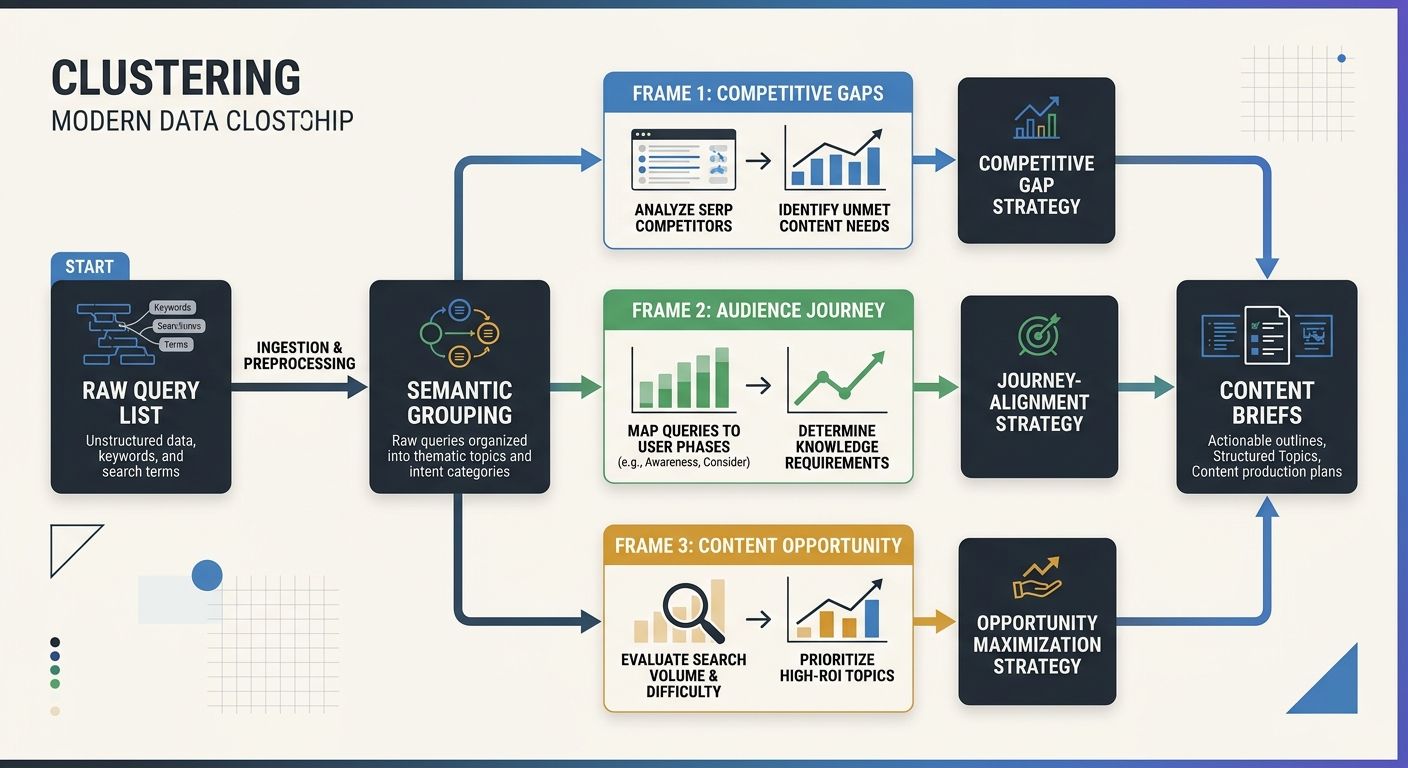
The internal linking structure between these clusters matters for topical authority. Each cluster page should link to related cluster pages within the same comparison frame and cross-link to pages in adjacent frames. This is the same architectural thinking behind building topic authority for AI search engines, where interconnected, specific pages signal deeper expertise than a single broad comparison hub.
Matching Templates to Comparison Type
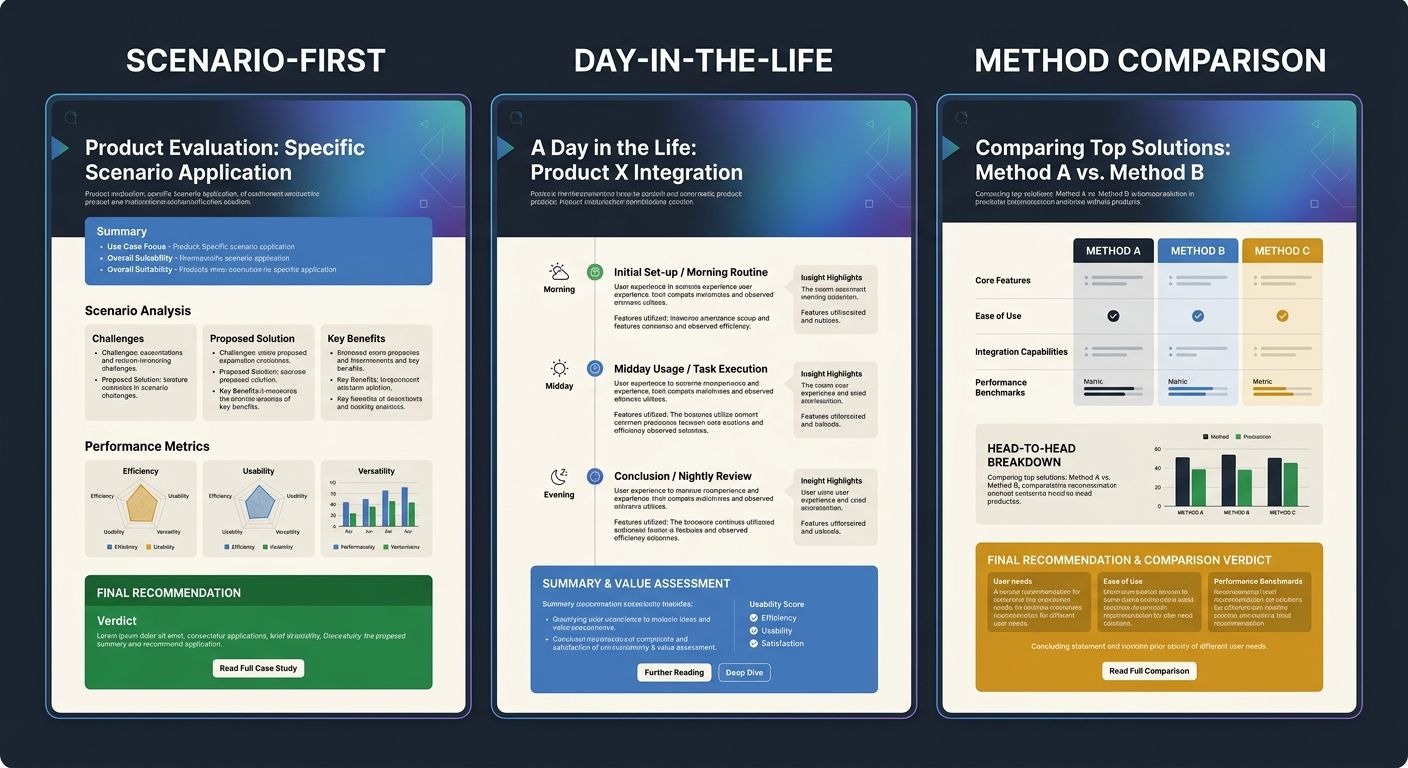
Each comparison frame works best with a different article structure. Using the wrong comparison article template for the query type is one of the most common reasons niche comparison content underperforms despite targeting the right keywords.
Situational constraint articles perform best with a "scenario-first" template. Open with a description of the exact situation (team size, industry, budget range, technical environment), then evaluate 3-5 options against criteria specific to that scenario. The page should include a "who this is for" section near the top, as recommended in FHSEOHub's niche-driven SEO framework, which found that adding explicit audience sections to published pages improved both rankings and lead quality.
Role-specific workflow articles work best with a "day-in-the-life" template. Walk through the specific tasks the role performs, then show how each option handles those tasks differently. A comparison of project management tools for construction site managers should describe the site manager's actual workflow (morning safety check, crew scheduling, material ordering, daily reporting) and map features against those steps.
Outcome-based articles need a "method comparison" template. Compare 3-4 approaches to achieving the stated outcome (manual process, partial automation, full automation, outsourcing), then evaluate specific tools within each approach category. These articles tend to be longer (1,500-2,500 words) because they're covering methodology, not just features.
Local long-tail searches within these comparison frames convert at 3x the rate of generic local searches, which makes geographic constraint a powerful additional variable to layer onto any of the three frames.
Where the Three-Frame Model Breaks Down
The model fails when applied to markets with genuine brand awareness parity. Consumer electronics, mainstream SaaS with $50M+ marketing budgets, and widely-known consumer brands generate enough "vs." search volume that the traditional head-to-head format still captures the most traffic. Running a niche comparison content strategy against Slack vs. Microsoft Teams wastes resources that should go toward the established comparison format.
It also struggles in markets where the buying process is entirely offline or relationship-driven. If 90% of purchasing decisions in your niche happen through trade show conversations and existing vendor relationships, the search volume for any comparison frame will be too thin to justify content investment. The model assumes buyers search before they buy.
Timing creates another limitation. The Three-Frame Comparison Model produces results over 4-8 months as individual cluster pages accumulate authority. Teams expecting traffic within 30 days will be disappointed. The mechanism works through compound coverage: each page ranks for its specific cluster, passes authority to adjacent pages through internal links, and gradually builds the topical depth that search engines (and AI answer engines) recognize as expertise.
And a final constraint worth naming: this approach demands genuine product knowledge. You can't write a credible comparison of "EHR software for solo dermatologists with telehealth" without understanding dermatology practice workflows. Generic content teams producing comparison articles from feature lists will produce pages that rank but don't convert, because the niche audience detects the lack of specificity in the first three paragraphs. Long-tail comparison SEO works precisely because the content requires expertise that most competitors won't invest in producing.

Alex Chen
Alex Chen is a digital marketing strategist with over 8 years of experience helping enterprise brands and agencies scale their online presence through data-driven campaigns. He has led marketing teams at two successful SaaS startups and specializes in conversion optimization and multi-channel attribution modeling. Alex combines technical expertise with strategic thinking to deliver actionable insights for marketing professionals looking to improve their ROI.
Related Articles

Long-Tail Comparison SEO: Finding Uncontested Niches Before Your Competitors Do
Long-tail comparison keywords — queries containing "vs," "for [specific audience]," or "alternative to" — sit in the lowest competition bands of search while attracting decision-stage buyers.

The Search Intent Mismatch Audit: Why Your Content Ranks but Doesn't Convert
Pages that rank on page one but convert below 1% don't have a CRO problem. They have a content classification problem, where the page answers the wrong type of question for the person searching.

The Benchmarking Blindspot: Why Your Analytics Comparison Strategy Is Missing Critical Industry Context
GA4 benchmarking groups your site into one of 15 industry categories and compares engagement rate, sessions, and bounce rate against anonymized peers within that bucket.
Explore more topics