
Email Marketing Teams Abandon Open Rates as Primary KPI Following Privacy-Driven Metric Collapse
B2B email marketing teams are replacing open rate tracking with conversion-focused metrics including click-to-open rate, revenue attribution, and deliverability health indicators, according to a June 17 analysis published by MarketBoats. Open rates jumped from 28% to 55% following Apple's Mail Priva

Email Marketing Teams Abandon Open Rates as Primary KPI Following Privacy-Driven Metric Collapse
B2B email marketing teams are replacing open rate tracking with conversion-focused metrics including click-to-open rate, revenue attribution, and deliverability health indicators, according to a June 17 analysis published by MarketBoats. Open rates jumped from 28% to 55% following Apple's Mail Privacy Protection rollout, rendering the metric unreliable for measuring campaign performance, Beehiiv research cited in the analysis shows.
The metric shift addresses a structural blind spot in email performance measurement. Open rates monitor whether an image pixel loaded when a recipient's email client rendered the message, but the metric fails to capture whether the recipient read the content, took action, or contributed to pipeline value. HubSpot's 2025 benchmark analysis found average email open rates reached 38.58% while click-to-open rates averaged 4.62%, revealing a 34-percentage-point gap between apparent exposure and demonstrated engagement.
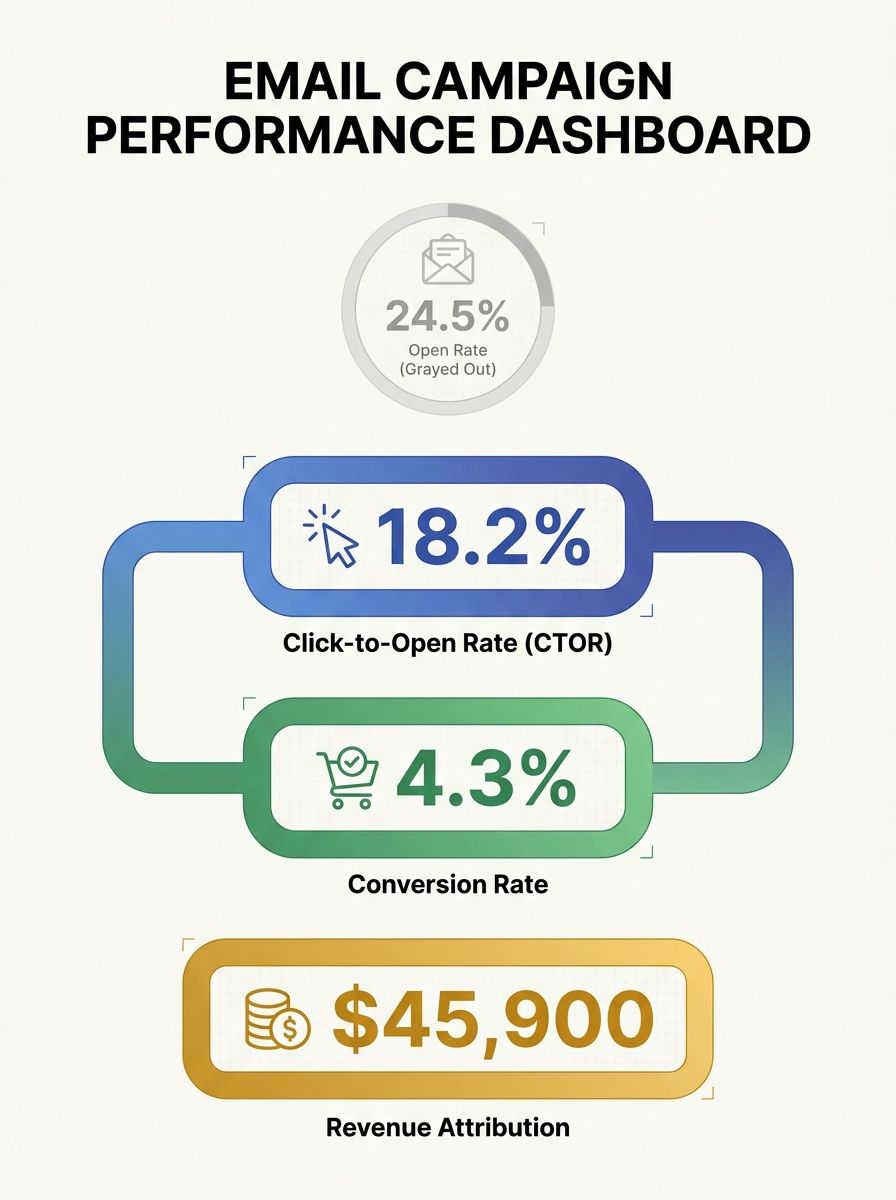
Marketing departments tracking only open rates cannot distinguish between emails that generated curiosity and emails that drove commercial decisions, the MarketBoats analysis notes. Organizations optimizing for inbox visibility rather than downstream outcomes waste resources on metrics Apple's Mail Privacy Protection has rendered commercially meaningless.
Privacy-Driven Measurement Collapse
Apple's Mail Privacy Protection feature, rolled out in 2021 and now widely adopted, prefetches email content and triggers tracking pixels regardless of whether recipients view messages. The automated loading process inflated open rates across B2B email platforms, with Beehiiv documenting the 28% to 55% spike after MPP deployment.
The inflation masked declining engagement quality. Email marketers celebrating improved open rates often overlooked flat or declining click-through rates, conversion rates, and attributed pipeline contribution. Teams running campaigns optimized for subject-line performance continued investing in top-of-funnel tactics while downstream metrics deteriorated.
Privacy updates from Google and other email providers introduced similar prefetch behavior, compounding the measurement problem. Open rates now reflect automated system behavior rather than human engagement, rendering year-over-year comparisons and A/B test results statistically invalid for opens.
Engagement Metrics That Track Commercial Intent
Click-to-open rate measures the percentage of email recipients who clicked a link after opening the message, indicating content relevance and intent. The metric isolates engaged readers from those whose email clients merely loaded pixels. HubSpot's 4.62% average CTOR establishes a baseline for B2B campaigns, though performance varies by industry, list quality, and content type.
Conversion rate extends measurement to defined downstream actions including demo bookings, asset downloads, and trial signups. Unlike CTOR, which tracks interest signals, conversion rate connects email performance directly to pipeline activity. Organizations monitoring conversion rates can calculate cost-per-acquisition at the campaign level and allocate budget toward messages that drive commercial outcomes.
Most B2B platforms lack native conversion tracking beyond link clicks, requiring integration between email systems and customer relationship management software. The technical lift explains why many teams default to open-rate dashboards despite the metric's limitations, according to the MarketBoats analysis. Attribution infrastructure that connects email touchpoints to closed revenue requires custom implementation in most marketing automation platforms.
Revenue Attribution and Pipeline Tracking
Email revenue attribution assigns commercial credit to messages that influenced purchase decisions. Last-touch attribution models credit the final email before conversion, while multi-touch models distribute value across the entire sequence. Both approaches require CRM integration and defined conversion events, making setup complexity higher than engagement tracking.
Organizations running attribution frameworks that tie content to pipeline value can isolate which email types—nurture sequences, product announcements, event invitations—generate the highest return. The visibility allows marketing leaders to defend budget allocation with revenue data rather than engagement proxies.
The analysis recommends defining conversion events before campaign launch, ensuring trackability from day one. Teams that retrofit attribution after campaigns conclude face incomplete data and manual reconciliation across systems. Pre-campaign event definition also forces alignment on what constitutes success, preventing dashboard drift toward vanity metrics.
Deliverability Health Indicators
Bounce rate, spam complaint rate, and unsubscribe rate determine whether future emails reach recipient inboxes. Internet service providers use sender reputation scores—calculated from deliverability metrics—to filter messages. A campaign generating high engagement but also high bounce rates damages long-term inbox placement, the analysis notes.
Rising unsubscribe rates signal relevance problems rather than creative failures. Contacts who unsubscribe remove themselves from nurture sequences, while contacts who ignore messages without unsubscribing suppress sender reputation scores without providing feedback. Clean list management through active unsubscribe monitoring produces better long-term deliverability than retention tactics that keep disengaged contacts on distribution lists.
Spam complaint rates below 0.1% maintain most ISP thresholds for inbox placement. Rates above 0.3% trigger filtering and sender reputation penalties that reduce future campaign reach. Organizations lacking spam complaint monitoring operate blind to reputation damage until inbox placement rates collapse.
Dashboard Framework for B2B Teams
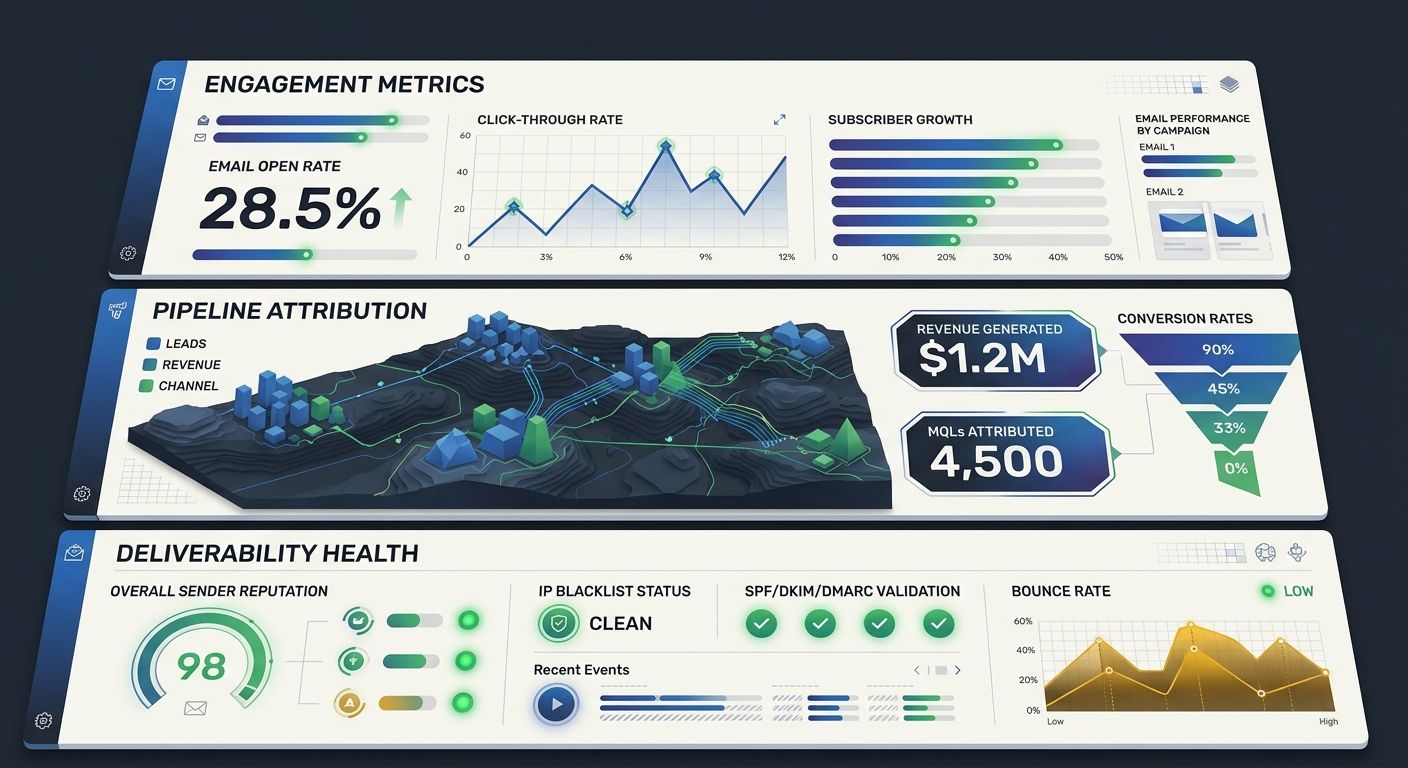
The recommended three-layer dashboard architecture separates engagement signals, pipeline impact, and sender health. The engagement layer tracks click-to-open rate and response rate as relevance indicators. The pipeline layer monitors email-attributed pipeline contribution and conversion rate. The health layer combines bounce rate, inbox placement rate, and spam complaint trends.
The framework shifts measurement from decorative to actionable by connecting visible metrics to commercial outcomes. Teams reviewing health and engagement metrics together surface issues that single-metric dashboards miss—rising CTOR paired with declining inbox placement, for example, indicates sender reputation decay despite content effectiveness.
Integration between email platforms and CRM systems enables the pipeline layer, creating technical dependencies that many B2B organizations have not implemented. B2B marketing attribution models that undervalue email touchpoints compound the tracking gap by assigning disproportionate credit to last-click channels, reducing incentive to build email-specific attribution infrastructure.
Marketing Implications
The shift from open rates to outcome metrics requires infrastructure investment before measurement improvement. Marketing operations teams must integrate email platforms with CRM systems, define conversion events at the campaign planning stage, and build dashboards that surface pipeline contribution alongside engagement proxies. Organizations still optimizing for open rates in mid-2026 operate on metrics Apple rendered unreliable five years ago.
The measurement gap creates competitive advantage for teams that complete the transition early. Email marketers tracking attributed revenue can calculate true ROI at the campaign and message level, enabling budget reallocation toward high-performing sequences. Those stuck on open-rate dashboards continue investing in subject-line optimization while ignoring conversion rate collapse, pipeline contribution decline, and deliverability degradation that compound over quarterly cycles.
Privacy-driven metric inflation will accelerate as additional email providers adopt prefetch behavior. The gap between organizations measuring conversion outcomes and those monitoring exposure metrics widens with each privacy update, making early adoption of revenue-connected measurement a durable strategic advantage in B2B email marketing.

Alex Chen
Alex Chen is a digital marketing strategist with over 8 years of experience helping enterprise brands and agencies scale their online presence through data-driven campaigns. He has led marketing teams at two successful SaaS startups and specializes in conversion optimization and multi-channel attribution modeling. Alex combines technical expertise with strategic thinking to deliver actionable insights for marketing professionals looking to improve their ROI.
Related Articles

Email Open Rates No Longer Reliable Performance Metric Due to Apple Privacy Protection, Digital Marketing Veteran Says
Digital marketing consultant Hank Hoffmeier published email marketing benchmarks for small businesses on August 1, 2026, warning that Apple's Mail Privacy Protection has rendered open rates unreliable and recommending click-to-open rates as the primary performance metric, according to More In Media.

B2B Marketing Programs Systematically Undervalue Outbound Channels in Last-Click Attribution Models, Analysis Finds
Marketing analysis published June 13, 2026, by Fypion Marketing identifies a structural reporting failure in B2B demand generation: last-click attribution assigns conversion credit to bottom-of-funnel branded searches and direct visits while erasing the cold emails, content interactions, and retarge

The Search Intent Mismatch Audit: Finding Hidden Revenue Loss in Your Top-Ranking Pages
Ranking #1 on Google for a keyword tells you nothing about whether that page will convert your email subscribers. Email marketers instinctively link to their highest-performing organic pages in campaigns, treating search visibility as a proxy for conversion readiness.
Explore more topics