
Instagram Restricts Recommendation Eligibility for Aggregator Accounts Across All Content Formats
Instagram restricted recommendation eligibility for aggregator accounts across all content formats on April 30, 2026, completing a policy shift that began with Reels and now extends to photos and carousels, according to Coruzant's algorithmic analysis.

Instagram Restricts Recommendation Eligibility for Aggregator Accounts Across All Content Formats
Instagram restricted recommendation eligibility for aggregator accounts across all content formats on April 30, 2026, completing a policy shift that began with Reels and now extends to photos and carousels, according to Coruzant's algorithmic analysis. Accounts that primarily repost content they did not create lose Explore placement and suggested-post distribution while retaining reach to existing followers.
The timing coincides with escalating commercial stakes: US social media creator revenue will grow 16.2% to $20.6 billion in 2026, according to eMarketer data cited in the analysis. Distribution rules that control access to that revenue pool changed twice in twelve months, rendering most guidance written before 2025 obsolete. Instagram's January 2025 disclosure of which signals actually determine ranking ended years of reverse-engineering attempts, while the April originality extension punishes repost-heavy accounts that dominated growth strategies for the past decade.
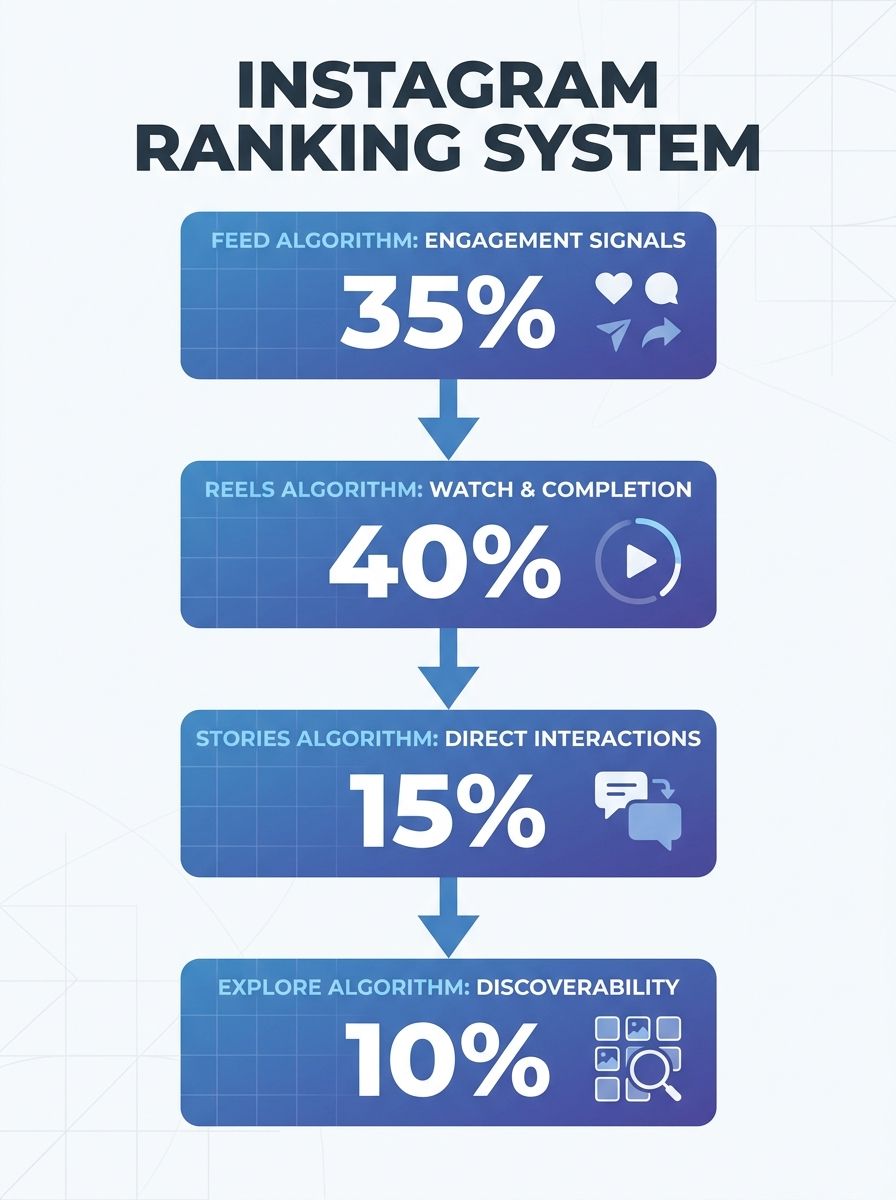
Four Separate Ranking Systems Run in Parallel
Instagram operates distinct ranking models for Feed, Reels, Stories, and Explore rather than a single unified algorithm. Stories prioritize accounts users already follow, Explore delivers almost entirely recommended content from unfollowed accounts, Reels functions as the primary discovery engine, and Feed mixes connected and unconnected content. The same post produces completely different reach outcomes depending on which surface carries it, the analysis noted. A Reel with strong follower engagement but weak share behavior performs well in Feed distribution but fails to gain Explore placement. Diagnosing reach problems requires identifying which specific surface stopped delivering rather than attributing failure to "the algorithm" as a monolith.
The architecture mirrors TikTok's recommendation logic and reflects how every major platform has converged on separating familiar-content surfaces from discovery surfaces. Practitioners troubleshooting distribution should ask which surface underperformed before adjusting content strategy.
Three Named Signals Drive Distribution Decisions
Instagram head Adam Mosseri stated in January 2025 that three signals matter most for ranking: watch time, likes per reach, and sends per reach. Mosseri added a critical distinction—likes carry more weight for connected content (distribution to followers), while sends carry more weight for unconnected content (recommendation to strangers who do not follow the account). The split explains the most common growth frustration: posts that earn follower likes achieve respectable reach among existing audiences but never break out to new viewers because they failed to generate the send signal required for scaled recommendation.
"Watch time gets the audition. Sends get the scale," the analysis summarized. Comments, follower count, and posting time were notably absent from Mosseri's named signals. Recency influences ordering within surfaces an account already has access to but does not determine whether a post reaches new audiences.
Sends per reach is not displayed as a labeled metric in Instagram's interface. Practitioners must calculate it manually by dividing sends by reach and multiplying by 100 from individual post insights. Tracking that ratio reveals performance on the signal most accounts ignore.
Hashtag Cap and Persistent Myth Corrections
Instagram capped hashtags at five per post in December 2025, and Mosseri stated plainly that hashtags do not improve reach. Hashtags serve topical signaling for search functionality rather than distribution use. The correction matters because nearly every guide written before 2025 recommends maximizing hashtag use as a reach tactic.
Purchased engagement similarly backfires because every named signal operates as a ratio. Likes per reach, sends per reach, and watch time relative to length all measure engagement quality rather than raw volume. Purchased likes from accounts that do not watch, share, or return spike one numerator while denominators continue growing, depressing the ratios Instagram actually evaluates. The platform assesses accounts at the account level rather than judging each post in isolation, meaning suppressed performance history carries forward into subsequent posts.
Originality Rule Reset Discovery Access in April
The April 30, 2026 extension applies a restriction that previously covered only Reels to photos and carousels. Accounts that primarily post content they did not create are no longer recommended to people who do not follow them. Existing followers still see posts—the restriction affects recommendation eligibility, not distribution to connected audiences. What disappears is Explore placement, Reels tab distribution, and suggested posts.
Mosseri clarified that aggregators retain eligibility if they meaningfully transform reposted content. Adding watermarks does not qualify as transformation. Narration, on-screen commentary, original graphics, and substantive editing meet the standard. The policy targets accounts built entirely on republishing others' work without additive value.
The change aligns with broader platform incentives to surface original creators in recommendation surfaces, particularly as AI systems increasingly recommend brands based on third-party mentions rather than direct content signals.
Why This Matters Now
Instagram's dual disclosure of ranking signals and originality enforcement in twelve months removes the guesswork that shaped creator strategy for years. Marketers managing brand accounts or creator partnerships now have explicit confirmation that sends per reach—not follower count, not hashtag volume, not posting cadence—determines whether content breaks out of existing audiences into discovery surfaces. The April originality rule closes the repost loophole that let aggregator accounts scale without production costs.
The $20.6 billion creator economy figure underscores why distribution mechanics matter commercially. Brands allocating influencer budgets or building owned creator programs need to evaluate partners on their send-per-reach performance rather than vanity follower counts. Accounts that generate genuine shares access recommendation; accounts that purchase engagement or rely on reposted content do not.
For digital marketing teams tracking social performance, the shift from "maximize hashtags and post at optimal times" to "optimize for sends and watch time on original content" represents a fundamental rewrite of Instagram growth playbooks written before 2025. The platform told practitioners what it values. Strategy adjustments that ignore the stated signals will continue optimizing for factors Instagram no longer prioritizes.

Alex Chen
Alex Chen is a digital marketing strategist with over 8 years of experience helping enterprise brands and agencies scale their online presence through data-driven campaigns. He has led marketing teams at two successful SaaS startups and specializes in conversion optimization and multi-channel attribution modeling. Alex combines technical expertise with strategic thinking to deliver actionable insights for marketing professionals looking to improve their ROI.
Related Articles

Instagram Tests Drag-to-Refresh Algorithm Controls and Conversational Feed Tuning
Instagram Chief Adam Mosseri announced June 28 that the platform is testing four new algorithm control features, including drag-down access to topic preferences and conversational prompts for feed refinement, according to Social Media Today. The experiments expand the app's "Your Algorithm" control
Self-Promotional Listicles Feed Competitor Recommendations in Google AI Overviews, June 2026 Research Shows
Self-promotional comparison pages that rank brands in a category are now feeding competitor recommendations inside Google's AI Overviews, according to research published in June 2026 by Lily Ray analyzing 100 B2B software queries across three months. Cited brands lose the recommendation 69% of the t

AI Systems Recommend Brands Based on Third-Party Mentions, Not Direct SEO Signals, Agency Founder Says
Kris Jones, founder of LSEO and former CEO of Pepper Jam, stated that AI search systems recommend brands based on third-party mentions and brand signals rather than direct optimization efforts, according to a Search Engine Journal podcast published August 3, 2026.
Explore more topics