
Marketing Consultant Publishes Three-Question Email Platform Framework with 2026 Pricing Benchmarks
A marketing consultant published a decision framework for email platform selection on August 29, 2026 showing businesses frequently overspend by selecting feature-rich platforms for workflows they never use, according to analysis from Lilach Bullock.
Marketing Consultant Publishes Three-Question Email Platform Framework with 2026 Pricing Benchmarks
A marketing consultant published a decision framework for email platform selection on August 29, 2026 showing businesses frequently overspend by selecting feature-rich platforms for workflows they never use, according to analysis from Lilach Bullock. The framework narrows platform choice through three questions addressing list size, business model, and weekly time investment rather than feature comparison matrices.
The analysis targets decision paralysis among marketing managers who spend weeks comparing platforms while competitors launch campaigns. "Clients spend six weeks comparing Mailchimp, ActiveCampaign, Klaviyo, Kit and Brevo in a spreadsheet," Bullock wrote, adding that delayed decisions cost more than wrong choices.
The Three-Question Decision Model
The framework eliminates broad comparison charts in favor of three qualifying questions. First, current list size and growth velocity determine pricing tier sustainability—platforms appearing inexpensive below 1,000 subscribers can cost three times more than competitors at 20,000 contacts, the analysis notes.
Second, business model dictates required features. Ecommerce operations need abandoned cart automation and revenue tracking, service businesses require lead nurture sequences and booking integrations, while content creators typically need clean newsletters and basic tagging, according to the framework. "Buying an ecommerce-first platform for a service business (or the reverse) is the single most common expensive mistake," Bullock stated.
Third, realistic weekly time commitment determines automation value. The framework advises against paying for complex workflow builders users won't configure.
2026 Platform Pricing Comparison
The analysis compiled current pricing across six platforms based on observed client spending rather than marketing page claims. Mailchimp offers free service up to 500 contacts, then costs £13 to £20 monthly at 500 contacts on the Standard plan, climbing past £300 monthly at 10,000 contacts with full automation enabled.
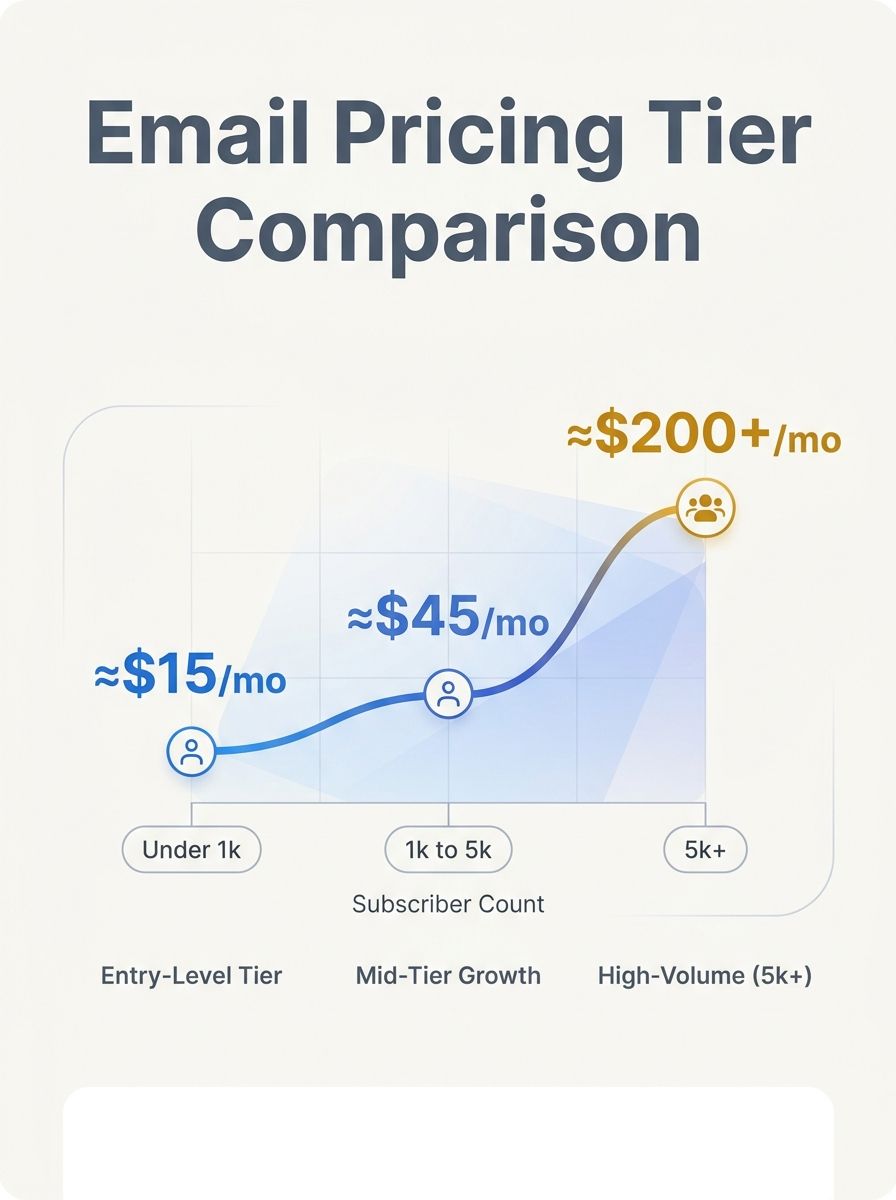
Kit maintains free access up to 10,000 subscribers with limited automation, then charges approximately £25 monthly for the Creator plan at that volume. ActiveCampaign starts near £12 to £15 monthly for 500 contacts on the Lite plan, but core automation and CRM features require the Plus plan at £45 to £60 monthly, the data shows.
Klaviyo provides free service up to 250 contacts before scaling cost by both list size and email volume, a pricing structure that becomes expensive past 10,000 contacts for high-frequency senders. Brevo employs volume-based pricing on emails sent per month rather than list size, costing roughly £20 to £30 monthly for moderate sending volume.
Case Study Shows £492 Annual Savings
Bullock detailed a coaching business client with 6,000 subscribers paying £70 monthly for ActiveCampaign automation the client never configured. The business sent one manual newsletter weekly with a single welcome email sequence.
Migration to Kit reduced monthly cost to £29 while maintaining identical sending patterns and performance metrics. "Open rates didn't move. Revenue didn't move. The only thing that changed was £492 a year staying in her account," Bullock wrote, characterizing the situation as tool-job mismatch rather than platform failure.
The analysis cautioned that platform switching rarely addresses underlying content quality issues, noting clients who changed platforms three times hoping new dashboards would improve flat open rates when the actual problem was email relevance. This observation aligns with broader concerns about email open rates as performance metrics following Apple's privacy protection rollout.
The Takeaway
The framework shifts platform selection from feature comparison to operational reality assessment—a practical correction to vendor-driven evaluation methods that emphasize capability over utilization. For marketing managers, the three-question model provides immediate decision structure while the 2026 pricing benchmarks establish cost expectations across growth trajectories. The £492 annual savings case demonstrates quantifiable impact when matching platform complexity to actual workflow needs, particularly for service businesses and content operations that don't require ecommerce-specific automation. The underlying message—that software doesn't compensate for weak content strategy—reinforces the need to address list engagement and email quality before considering platform migration as a performance solution.

Sarah Chen
SEO strategist and web analytics expert with over 10 years of experience helping businesses improve their organic search visibility. Sarah covers keyword tracking, site audits, and data-driven growth strategies.
Related Articles

Brevo and Mailchimp Email Platform Pricing Models Diverge on Volume-Based vs Contact-Based Billing in 2026
Email marketing platform pricing models have split into distinct approaches as Brevo charges primarily on email volume sent while Mailchimp continues contact-based billing that escalates costs regardless of send frequency, according to a June 19 analysis published by WP Webify. The divergence affect

Email Marketing Teams Abandon Open Rates as Primary KPI Following Privacy-Driven Metric Collapse
B2B email marketing teams are replacing open rate tracking with conversion-focused metrics including click-to-open rate, revenue attribution, and deliverability health indicators, according to a June 17 analysis published by MarketBoats. Open rates jumped from 28% to 55% following Apple's Mail Priva
The SEO Tool Stack Audit: Why You're Paying for Overlapping Features and How to Consolidate
Every SEO team subscribing to both Ahrefs and SEMrush pays for rank tracking, backlink analysis, and site auditing twice. The duplicate data adds no analytical edge.
Explore more topics