
The Link Equity Flow Audit: Mapping How Authority Moves Through Your Site Architecture
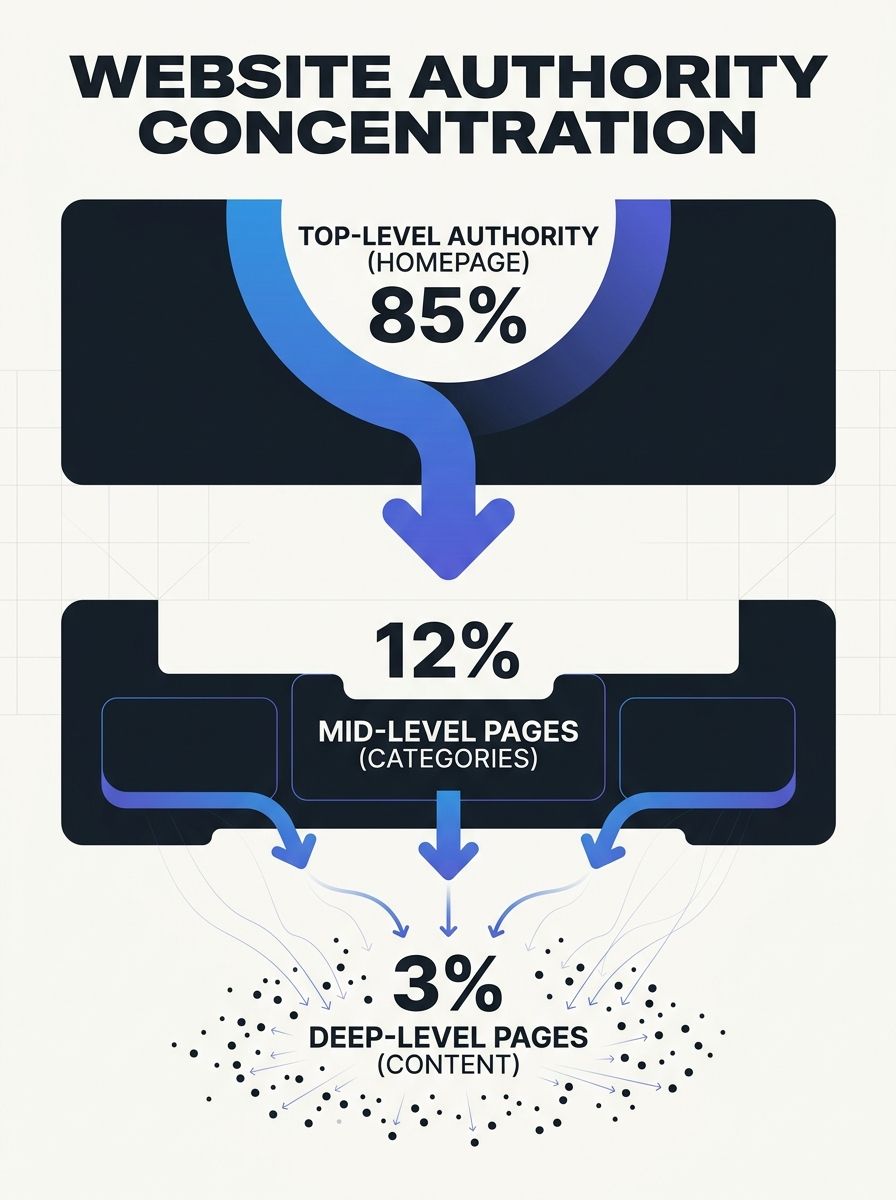
The top 10% of pages on a typical enterprise site absorb more than 80% of all internal links, according to Digital Strategy Force's 2026 audit data, leaving the remaining pages starved of the authority they need to rank.

The Link Equity Flow Audit: Mapping How Authority Moves Through Your Site Architecture
The top 10% of pages on a typical enterprise site absorb more than 80% of all internal links, according to Digital Strategy Force's 2026 audit data, leaving the remaining pages starved of the authority they need to rank. A link equity flow audit maps exactly where this imbalance occurs, pinpoints orphaned content, and shows you how to redirect ranking power toward pages that actually drive revenue.
Why Authority Pools in the Wrong Places
Internal links perform three functions simultaneously: they distribute ranking authority, define semantic relationships between topics, and create the crawl paths that both search engines and AI models use to discover content. A site with 500 pages and a weak internal linking strategy functions as 500 isolated documents. Strategic linking transforms that same site into an interconnected graph that Google and AI search platforms can traverse as a unified authority source.
The structural problem is predictable. Homepages and blog indexes collect the majority of both external backlinks and internal links. Category pages receive moderate attention. And the pages that often matter most to revenue (product pages, comparison guides, high-intent landing content) sit three, four, or five clicks deep with minimal internal support.
Digital Strategy Force stated this directly in their February 2026 audit guide: "Your internal linking architecture is the single most honest expression of what your website actually values. If your highest-value pages are buried four clicks deep and receive no internal links, you're telling search engines they don't matter."
This makes the site hierarchy audit the starting point for any serious SEO improvement, because it addresses ranking signals, crawl efficiency, and AI visibility in a single pass.
The Four-Layer Diagnostic Framework
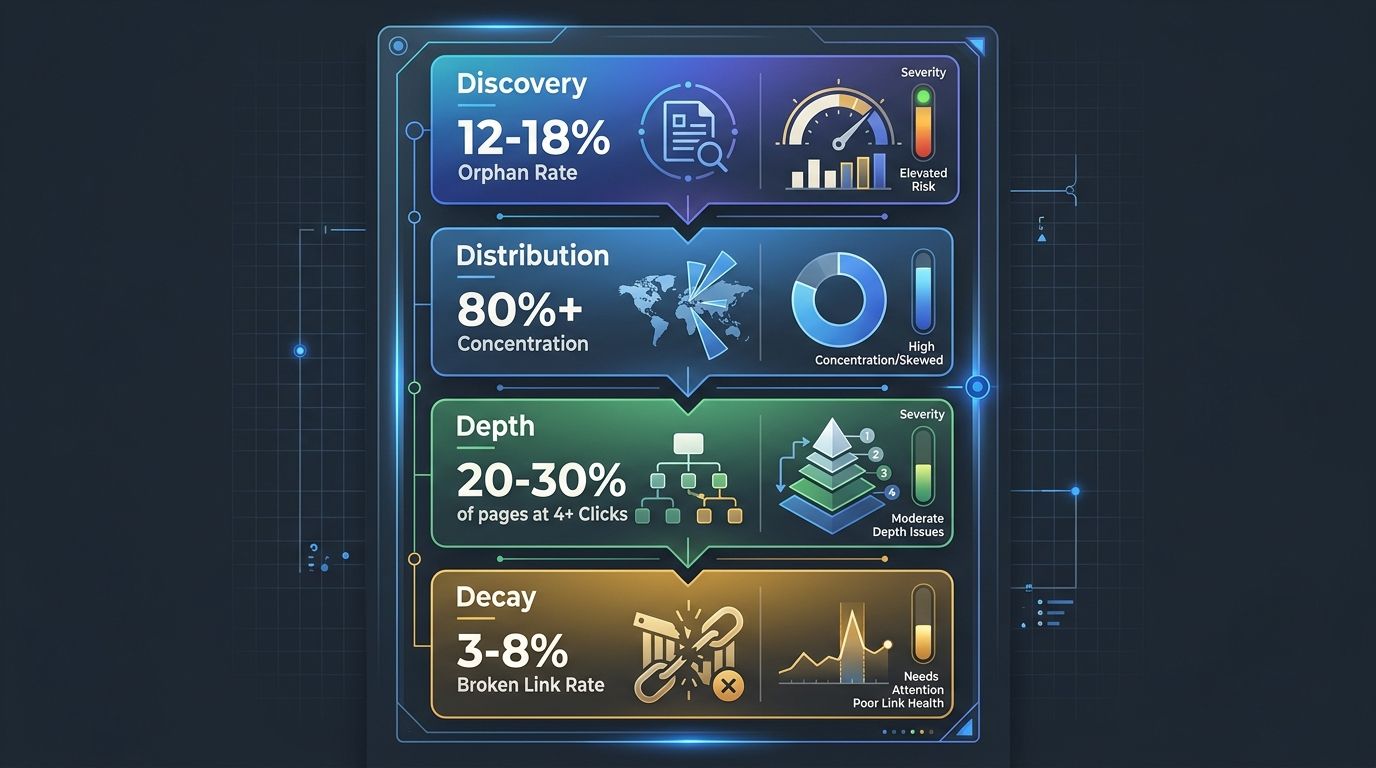
Digital Strategy Force introduced the DSF Link Equity Flow Map, a four-layer diagnostic that structures the entire link equity distribution audit. Each layer targets a different failure mode.
Discovery identifies every internal link on the site and flags orphan pages. Audit data shows 12% to 18% of pages on enterprise sites receive zero inbound internal links. These pages are invisible to crawlers regardless of content quality, making them a P0 (critical) fix.
Distribution measures where equity concentrates. The 80%+ concentration in the top 10% of pages is consistent across industries. Incremys warns auditors to "look for extremes: pages covered in links, risking dilution and poor UX, versus under-linked pages." Both ends of the spectrum hurt performance.
Depth tracks click distance from the homepage. TEAM Lewis's 2026 site structure guide recommends keeping all important pages within 3 clicks of the homepage, yet DSF audits find 20% to 30% of key pages sit at 4+ clicks deep. Every additional click level reduces the equity that reaches a page and harms crawl budget optimization, because Googlebot allocates fewer resources to pages it discovers late in a crawl session.
Decay catches broken internal links (404 errors) and redirect chains. Between 3% and 8% of internal links on audited sites point to dead URLs. Each broken link represents an active leak where authority disappears rather than flowing to its target.
If you've already explored how poor site structure undermines internal linking, the DSF diagnostic framework gives you the measurement layer to quantify those problems with specific numbers.
The Remediation Sequence That Moves Rankings
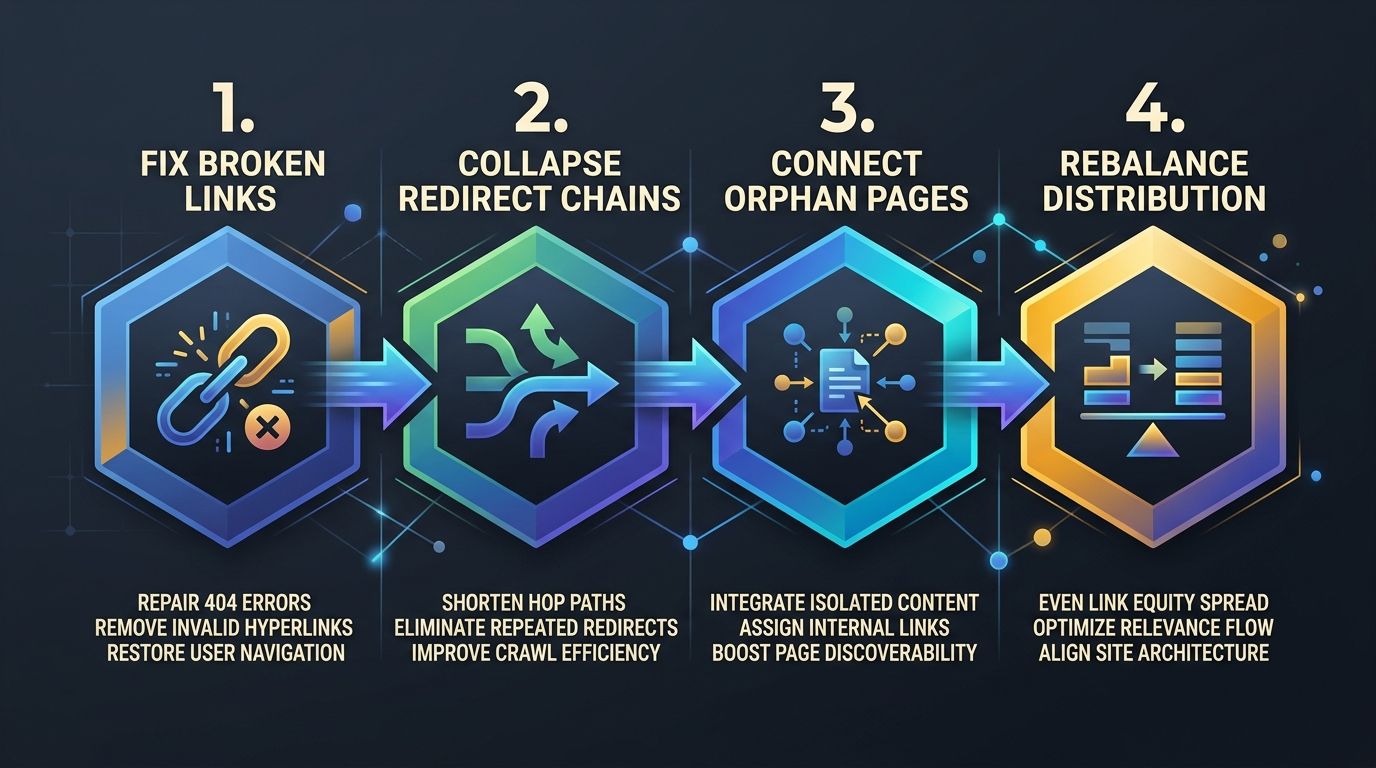
Fixing link equity problems in the wrong order wastes effort. The sequence matters because some issues block the benefits of later fixes.
Start with broken internal links. A 404 error passes zero equity, so every downstream optimization you make is less effective while active leaks exist. Crawl your site with Screaming Frog or Sitebulb, export all 404 responses, and either restore the target URL or update the link to point to the correct destination.
Collapse redirect chains next. Multi-hop 301 redirects dissipate equity at each step. If Page A links to Page B, which 301s to Page C, which 301s to Page D, the authority arriving at Page D is a fraction of what Page A originally passed. If you've dealt with preserving link equity during a domain migration, the principle is identical for internal redirect chains that accumulate over years of site changes.
Connect orphan pages third. Any page receiving zero internal links needs at least 2 to 3 contextual links from topically related content. A single contextual link from a high-traffic blog post to an underperforming product page can improve that page's rankings within weeks, producing results equivalent to months of external link building.
Rebalance distribution last. Identify your high-authority "reservoir" pages (typically top blog posts, resource pages, or hub pages with strong backlink profiles) and add 3 to 5 strategic links from each to underlinked priority pages. This rebalancing step is where the 32.3% increase in link equity flow to target pages comes from in DSF's audit data.
Hub-and-Spoke Architecture Fixes Distribution at Scale
Individual link fixes address symptoms. The hub-and-spoke model fixes the structural cause. Each topic cluster gets a hub page (pillar content) that accumulates internal links and backlinks, then passes equity outward to spoke pages covering supporting subtopics, product pages, and long-tail content.
AlmCorp's April 2026 enterprise SEO framework identifies a common flaw: the homepage and blog absorb most internal authority while high-intent commercial pages remain underlinked. This happens because editorial teams link freely between blog posts but rarely connect blog content to product or service pages. The topical authority flow becomes one-directional when it should be bidirectional.
Floyi's architecture documentation recommends clustering content into MT (main topic), ST2, ST3, and ST4 layers that map directly to URL structure. When architecture, content hierarchy, and navigation follow the same logic, equity distribution becomes predictable and measurable. For a practical example, Link Whisper documented a gardening site audit where topic clusters covering composting, pest control, and lawn care lacked internal cohesion. After the audit identified gaps between related posts and implemented strategic connecting links, the site saw measurable topical authority improvements across all three clusters.
TrySight AI's January 2026 survey found that 42% of SEO specialists now weight internal links equally with backlinks, up significantly from prior years where external links dominated strategy discussions. The shift reflects growing understanding that earned external authority produces limited ROI when internal architecture fails to distribute it to the pages that need it most.
Crawl Budget Implications for Large Sites
Every internal linking fix also affects how efficiently search engines crawl your site. Googlebot allocates a finite crawl budget to each domain, and the pages it discovers first through internal link paths receive priority. For enterprise sites with 10,000+ URLs, this is where crawl budget optimization directly connects to revenue.
Mailchimp's crawl budget guide recommends removing irrelevant or outdated pages and optimizing internal linking to guide crawlers toward high-priority pages like new product launches, key landing pages, or updated blog content. The r/SEO community has validated this through practical testing: optimizing your internal linking structure and handling URL parameters properly ensures that important pages remain accessible within a few clicks of the homepage.
If you're investigating why Google understands your pages but won't rank them, the crawl budget connection is often the missing diagnostic layer. Pages that get crawled infrequently receive slower indexing of updates, which means even well-optimized content sits stale in Google's index while competitors get re-crawled weekly.
Measuring the Audit's Impact
Track five metrics before and after your site hierarchy audit to quantify results:
Metric | Tool | Baseline Benchmark | Post-Audit Target |
|---|---|---|---|
Inlink count per priority page | Screaming Frog / Sitebulb | Flag pages with fewer than 3 | 5 to 10 contextual inlinks |
Average click depth | Screaming Frog | Flag pages at 4+ clicks | All priority pages within 3 clicks |
Orphan page percentage | Sitebulb / Ahrefs | 12% to 18% of total pages | Below 2% of total pages |
Organic sessions on target pages | GA4 | Pre-audit baseline | 25% uplift within 6 months |
Broken internal link rate | Screaming Frog | 3% to 8% of all links | Below 0.5% of all links |
Overlay backlink data from Ahrefs or SEMrush to identify pages with strong external authority but weak internal support. These are your highest-ROI opportunities, because the external authority already exists but your architecture prevents it from flowing to connected pages.
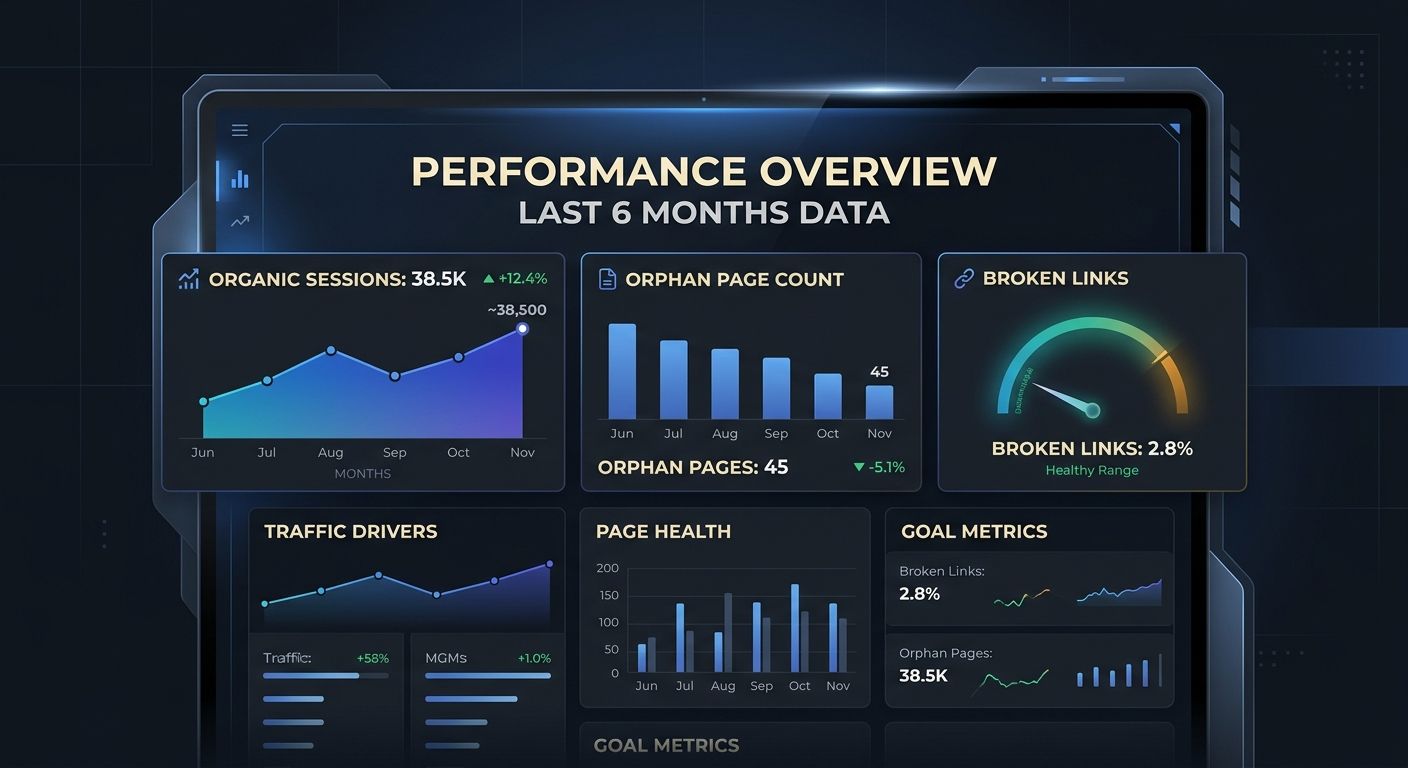
Automate weekly crawls and build dashboards that alert you when orphan page counts creep back up or broken link percentages rise above 1%. Link decay is continuous. A one-time audit without ongoing monitoring loses value within 3 to 6 months as new content gets published, URLs change, and redirect chains accumulate. I've found that connecting this monitoring to your broader analytics tag audit process catches data integrity issues before they distort your link equity measurements.
What Still Isn't Settled
The SEO community hasn't reached consensus on several link equity questions that matter for how you fine-tune your audit. How much equity does a nofollow internal link actually pass? Google's public statements say none, but ranking experiments from independent SEOs consistently show indirect effects. Does anchor text diversity within internal links matter as much as it does for backlinks, or does exact-match internal anchor text carry zero penalty risk?
And as AI search platforms like ChatGPT and Perplexity increasingly use site structure to determine citation-worthiness, will the weighting of internal links shift further relative to backlinks beyond the 42% equal-weight figure from TrySight AI's survey? The velocity of change in AI search behavior suggests the answer is yes, but the data to quantify the shift doesn't exist yet.
These open questions shouldn't delay your audit. The four-layer framework, the remediation sequence, and the hub-and-spoke architecture model all produce measurable gains with the data available today. The 32.3% equity flow improvement and 25% organic traffic uplift that audits produce come from fixing known structural problems, not from resolving theoretical debates. Run the audit, measure the five metrics above, and refine your approach as the answers to these questions emerge over the next 12 to 18 months.

Alex Chen
Alex Chen is a digital marketing strategist with over 8 years of experience helping enterprise brands and agencies scale their online presence through data-driven campaigns. He has led marketing teams at two successful SaaS startups and specializes in conversion optimization and multi-channel attribution modeling. Alex combines technical expertise with strategic thinking to deliver actionable insights for marketing professionals looking to improve their ROI.
Related Articles

Site Architecture for SEO: How to Structure Your Website for Maximum Rankings
PageRank flows downhill through your site's link graph, losing equity at every click away from the homepage.

The Content Architecture Data Trap: How Poor Site Structure Silently Kills Your Internal Linking Strategy
Link equity flows top-down through a site hierarchy, with the homepage holding the most authority and each subsequent level receiving progressively less. ClickRank.

The SEO Mistake Triage System: Diagnosing Root Causes Instead of Treating Symptoms
Automated SEO audit tools flag hundreds of issues per crawl but assign equal visual severity to missing alt text and accidental noindex tags on revenue pages.
Explore more topics