
The Content Architecture Data Trap: How Poor Site Structure Silently Kills Your Internal Linking Strategy
Link equity flows top-down through a site hierarchy, with the homepage holding the most authority and each subsequent level receiving progressively less. ClickRank.

The Content Architecture Data Trap: How Poor Site Structure Silently Kills Your Internal Linking Strategy
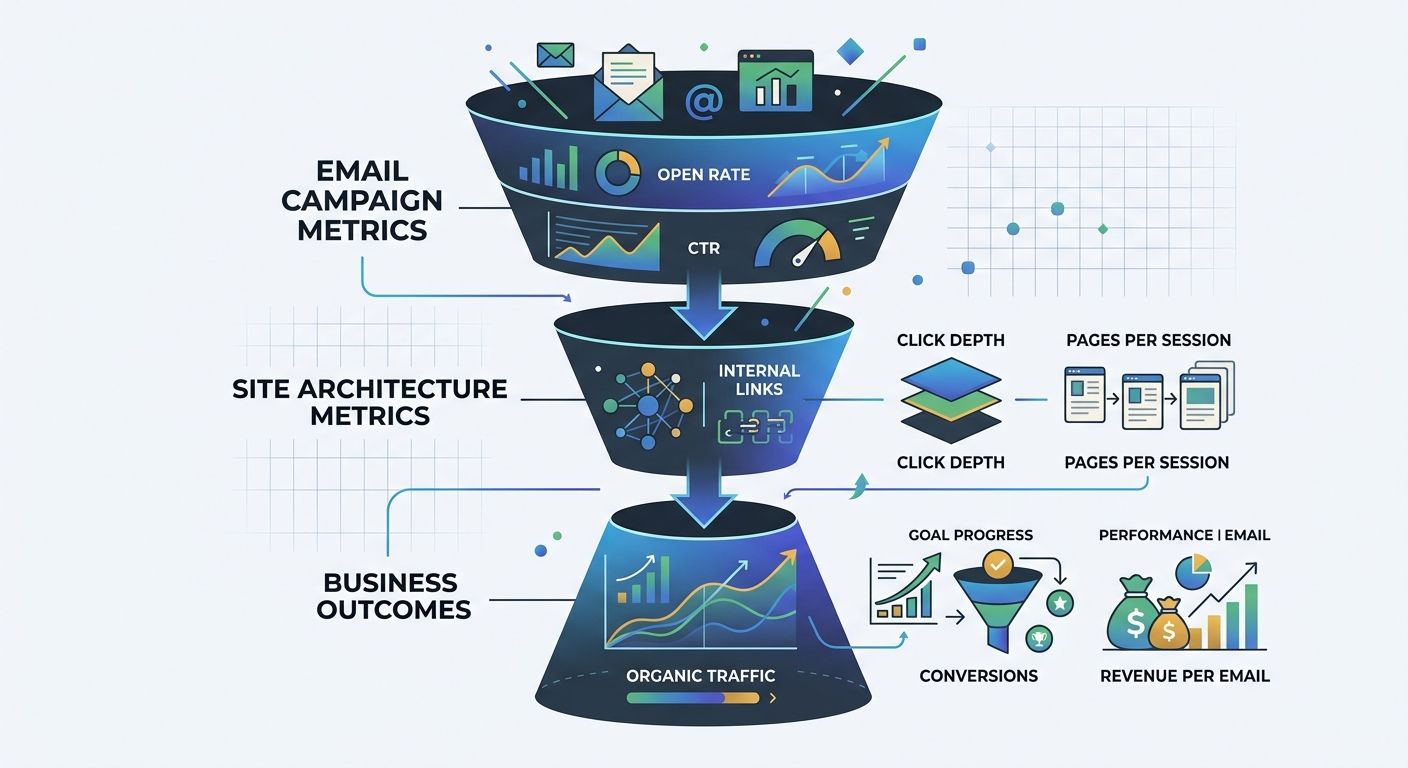
Link equity flows top-down through a site hierarchy, with the homepage holding the most authority and each subsequent level receiving progressively less. ClickRank.ai's 2026 guide to link equity flow confirms this pattern, describing how a hierarchical structure creates a clear path from broad category pages to specific content. For email marketers, this has a consequence that rarely shows up in campaign dashboards: every landing page, blog post, and resource hub your nurture sequences point subscribers toward either benefits from that equity flow or sits completely outside it. When your site's content structure SEO degrades over time, the pages absorbing your email traffic become structurally isolated from the rest of your domain's authority. Your campaigns still generate clicks. Those clicks stop compounding into organic visibility, deeper engagement, or anything resembling long-term return.
I've watched this pattern unfold across multiple enterprise email programs, and it follows a remarkably consistent timeline.
The Baseline: When Architecture Still Matched the Content
Every site starts in a state of relative structural coherence. The homepage links to five or six category pages. Each category page links to a handful of supporting articles or product pages. Blog posts reference each other contextually. The internal linking strategy functions because there's so little content that the connections are obvious, almost automatic.
At this stage, email marketing and site architecture exist in harmony without anyone actively managing the relationship. Your welcome sequence links to a getting-started guide that lives two clicks from the homepage. Your weekly newsletter promotes a blog post that's properly nested under a topic cluster. The topic cluster architecture signals authority to Google because the hierarchy is shallow and every page has a clear parent.
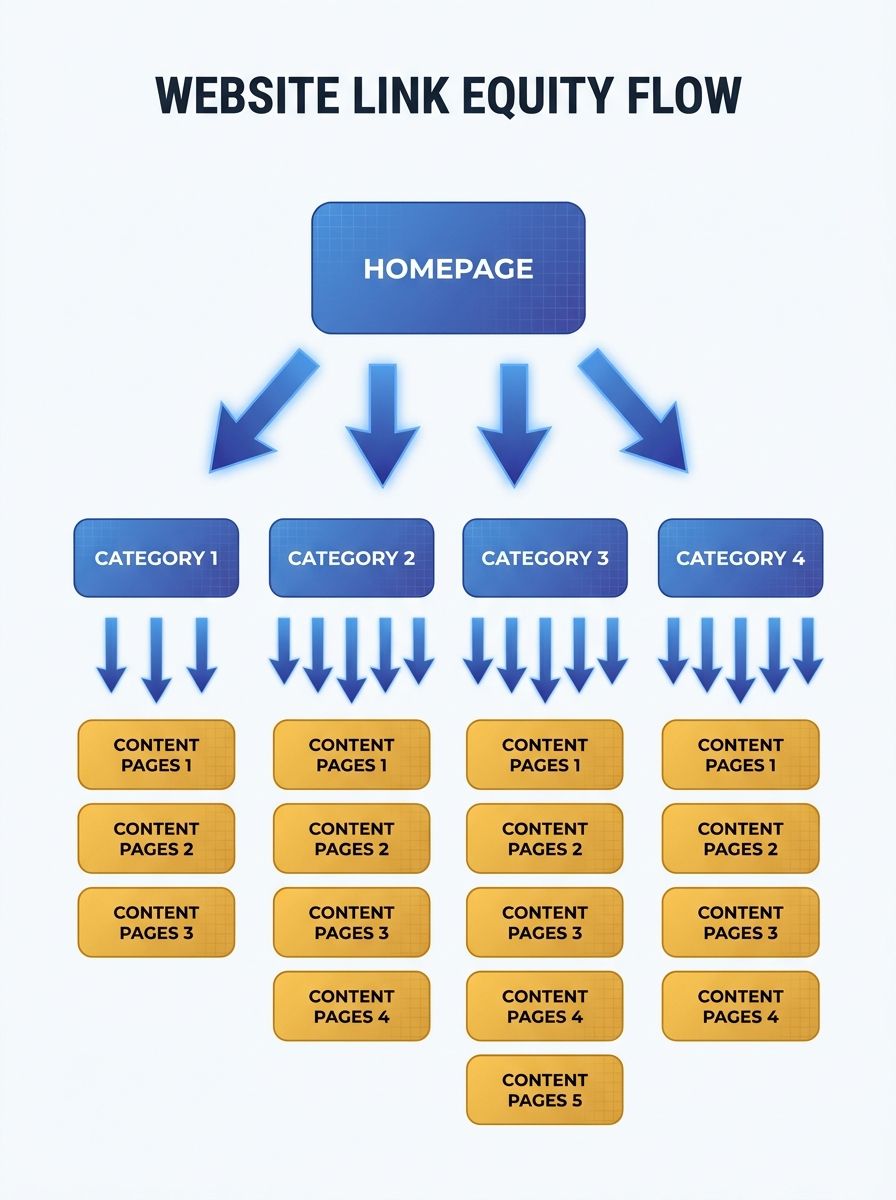
Pages buried deep within a site's structure tend to receive less link equity, as BetterLinks' research on link equity distribution documents. But at this early phase, nothing is buried. The architecture is flat by default, and email traffic lands on pages that Google already crawls frequently and ranks accordingly.
Content Scaling Without Structural Planning
The problems begin when the content operation scales faster than the architecture can accommodate. This is the phase where marketing teams publish 8-15 blog posts per month, create dedicated landing pages for each email campaign, spin up resource hubs for different audience segments, and add gated content behind forms. Each piece of content gets written, published, linked from an email, and then structurally forgotten.
Within six to twelve months of aggressive publishing, three things happen simultaneously:
New pages get created without being linked from existing content. The editorial calendar prioritizes production volume, and retroactive linking falls off the workflow entirely.
Email-specific landing pages sit outside the main navigation hierarchy. They're accessible via direct URL from campaigns, but no category page, no sidebar, no breadcrumb trail connects them to the rest of the site.
Older content that previously formed the structural backbone stops receiving updates. Pillar pages that once linked to every relevant subtopic now link to 30% of them because nobody adds the new posts.
The site hierarchy crawlability degrades incrementally. No single week looks alarming. But the cumulative effect is a site whose published page count has tripled while its actual interconnected structure covers maybe half of what exists.
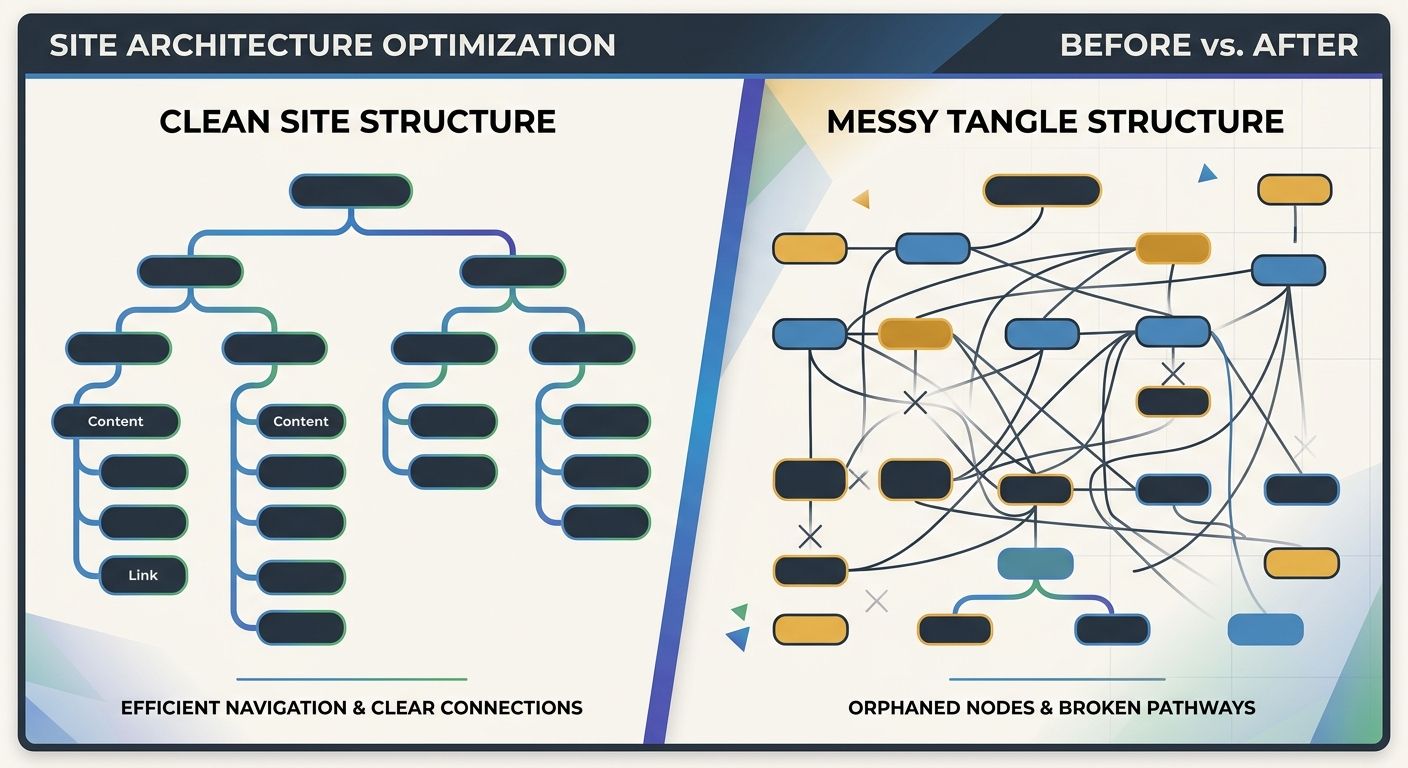
Ahrefs published a pointed critique of rigid silo structures, arguing that isolating content into strict silos and prohibiting cross-topic internal linking is counterproductive. The irony is that most sites suffering from this architecture trap haven't intentionally siloed anything. They've accidentally created silos through neglect, where entire clusters of email landing pages and campaign-specific content exist in their own disconnected pocket of the domain.
When Email Landing Pages Became Orphans
Here's where the problem becomes specifically painful for email marketers. I've run content architecture audits on sites where 40-60% of the URLs receiving the most email-driven traffic were orphaned pages. Zero internal links pointing to them from anywhere on the site. The only way a human or a crawler could reach them was by typing the URL directly or clicking a link in an email.
For the email marketer, this creates two compounding problems:
Problem one: no organic discovery. Your best-performing email content generates zero organic search traffic because search engines can't find it through your internal link graph. Yoast's internal linking guide states this plainly: a clear internal linking strategy provides crawlers with a map of your website, enabling them to prioritize your most valuable pages. Pages that aren't on the map don't get prioritized.
Problem two: no engagement depth. Subscribers who click through from your email land on a page with no contextual links to related content. There's nowhere to go. Pages per session drops below 1.3, time on site compresses, and the conversion path you designed in your email sequence breaks because the on-site experience doesn't continue the narrative.
Both problems feed a metric that email marketers track religiously: revenue per email. When your landing pages are architectural orphans, revenue per email declines even as deliverability, open rates, and click-through rates hold steady. The leak is invisible from inside the email platform.
The Audit That Exposes the Structural Damage
The turning point in every case I've worked on comes when someone finally runs a crawl-based audit and maps the actual link graph against the pages receiving email traffic. The gap is always wider than anyone expected.
A typical audit reveals patterns like these:
The top 20 pages by email-driven sessions have an average of 1.2 internal links pointing to them, compared to 8-12 for organically performing pages at the same level of the hierarchy
Campaign landing pages created for specific email sequences have a click depth of 5+ from the homepage, meaning crawlers deprioritize them
Blog posts promoted in newsletters link outward to other content in only 35% of cases, because the editorial team treats email-promoted content as self-contained
If you've been tracking why Google understands your pages but won't rank them, this is often the structural root cause. The content is crawlable in a technical sense. Google has seen it. But the site's internal link architecture doesn't signal that these pages matter, so they sit in a ranking limbo where they're indexed but invisible.
Rebuilding the Bridge Between Email Content and Site Architecture
The fix follows a specific sequence, and it requires email marketing and SEO teams to actually coordinate, which is rarer than it should be.
Step 1: Map every URL your email program has linked to in the past 12 months
Export your email platform's click data. Pull every unique destination URL. This becomes your audit scope. On most mid-market sites, this surfaces 50-200 unique URLs that have received meaningful email traffic.
Step 2: Score each URL's structural integration
For each URL, document: how many internal links point to it, what its click depth is from the homepage, whether it appears in any navigation or breadcrumb trail, and whether it links out to other relevant content on the site. Any page with fewer than 3 internal inbound links and a click depth greater than 3 is structurally underserved.
Step 3: Build contextual internal links from high-authority pages
This is where link equity distribution actually gets fixed. Identify your highest-authority pages using your crawl tool's internal PageRank or equivalent metric. Add contextual, editorially relevant links from those pages to your orphaned email landing pages. The anchor text should describe the destination naturally, matching how you'd reference that content in conversation.
Step 4: Add outbound internal links from email landing pages
Your email landing pages need to link forward into the site, not serve as dead ends. Add 3-5 contextual internal links from each landing page to related content. This serves both the user who arrived via email and wants to explore further, and the crawler that needs link paths to follow.
Step 5: Create a recurring sync between editorial and email calendars
Every new email campaign that creates or promotes a URL should trigger a structural checklist: Is this page linked from at least one category or pillar page? Does it contain outbound internal links? Is it reachable within three clicks from the homepage? Without this process, you're building new orphans every campaign cycle.
The approach is similar to what we've outlined for diagnosing site architecture problems at the topic cluster level, applied specifically to the pages your email program depends on.
What the Data Looks Like After the Fix
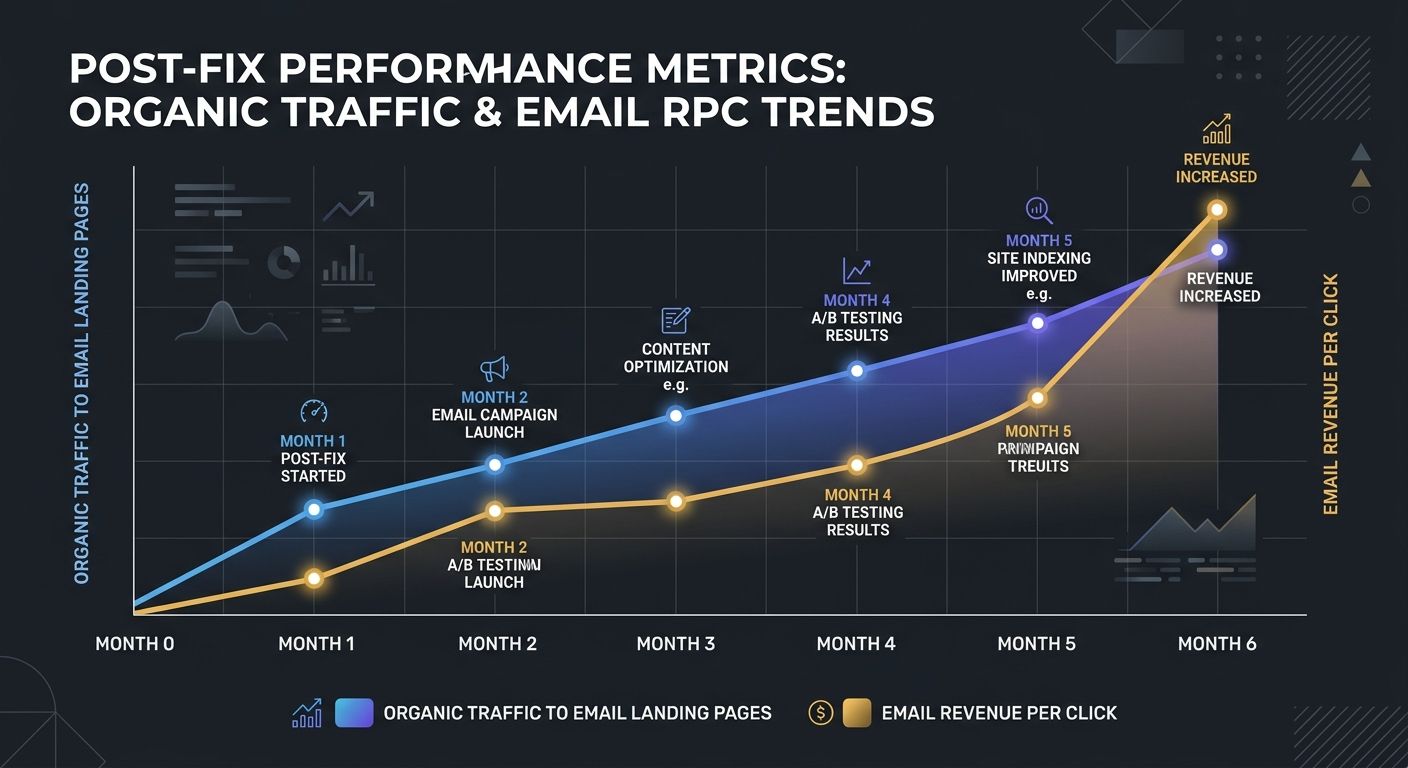
Across the enterprise programs where I've seen this structural repair executed properly, the numbers follow a consistent pattern. Within 60-90 days of rebuilding the internal link architecture around email-promoted content, organic traffic to those previously orphaned pages increases by 30-80%. Pages per session for email-tagged traffic climbs above 2.0. And the pages that email campaigns drive traffic to begin ranking organically for related queries, which means the email investment generates compounding returns instead of one-time clicks.
The revenue math shifts in a fundamental way. An email promoting a resource page that also ranks organically for 15-20 long-tail queries generates value long after the campaign sends. An email promoting an orphaned page generates value for exactly 48 hours and then nothing.
The structural work takes a one-time investment of 15-25 hours for a mid-market site, followed by perhaps 2-3 hours per month of maintenance through the editorial-email sync process. Compared to the thousands of dollars most teams spend optimizing subject lines and send times, the ROI on fixing the architecture underneath is disproportionately large.
Email marketers have spent years perfecting what happens before the click. The open. The subject line. The CTA button color. The send time optimization. All of that work funnels toward a single moment: someone clicks and arrives on your site. What happens after that click depends entirely on whether your content architecture supports the visit or abandons it. The teams that treat site structure as an email marketing problem, and not solely an SEO problem, are the ones whose campaign performance actually compounds over time.

Alex Chen
Alex Chen is a digital marketing strategist with over 8 years of experience helping enterprise brands and agencies scale their online presence through data-driven campaigns. He has led marketing teams at two successful SaaS startups and specializes in conversion optimization and multi-channel attribution modeling. Alex combines technical expertise with strategic thinking to deliver actionable insights for marketing professionals looking to improve their ROI.
Related Articles

The Search Intent Mismatch Audit: Finding Hidden Revenue Loss in Your Top-Ranking Pages
Ranking #1 on Google for a keyword tells you nothing about whether that page will convert your email subscribers. Email marketers instinctively link to their highest-performing organic pages in campaigns, treating search visibility as a proxy for conversion readiness.

The Link Equity Flow Audit: Mapping How Authority Moves Through Your Site Architecture
The top 10% of pages on a typical enterprise site absorb more than 80% of all internal links, according to Digital Strategy Force's 2026 audit data, leaving the remaining pages starved of the authority they need to rank.

The SEO Planning Breakdown: Why Your Strategy Fails at Scale (And How Enterprise Teams Fix It)
Enterprise SEO planning fails at scale because channel teams—email marketing, paid media, product—generate landing pages, redirect chains, and content independently, compounding technical debt faster than any SEO team can remediate.
Explore more topics