
The Domain Migration SEO Audit Checklist: Preserving Rankings While Consolidating Brand Authority
The 301 redirect strategy that protects your organic rankings during a domain migration will break your paid search campaigns in ways no SEO checklist warns you about.

The Domain Migration SEO Audit Your Paid Campaigns Can't Survive Without
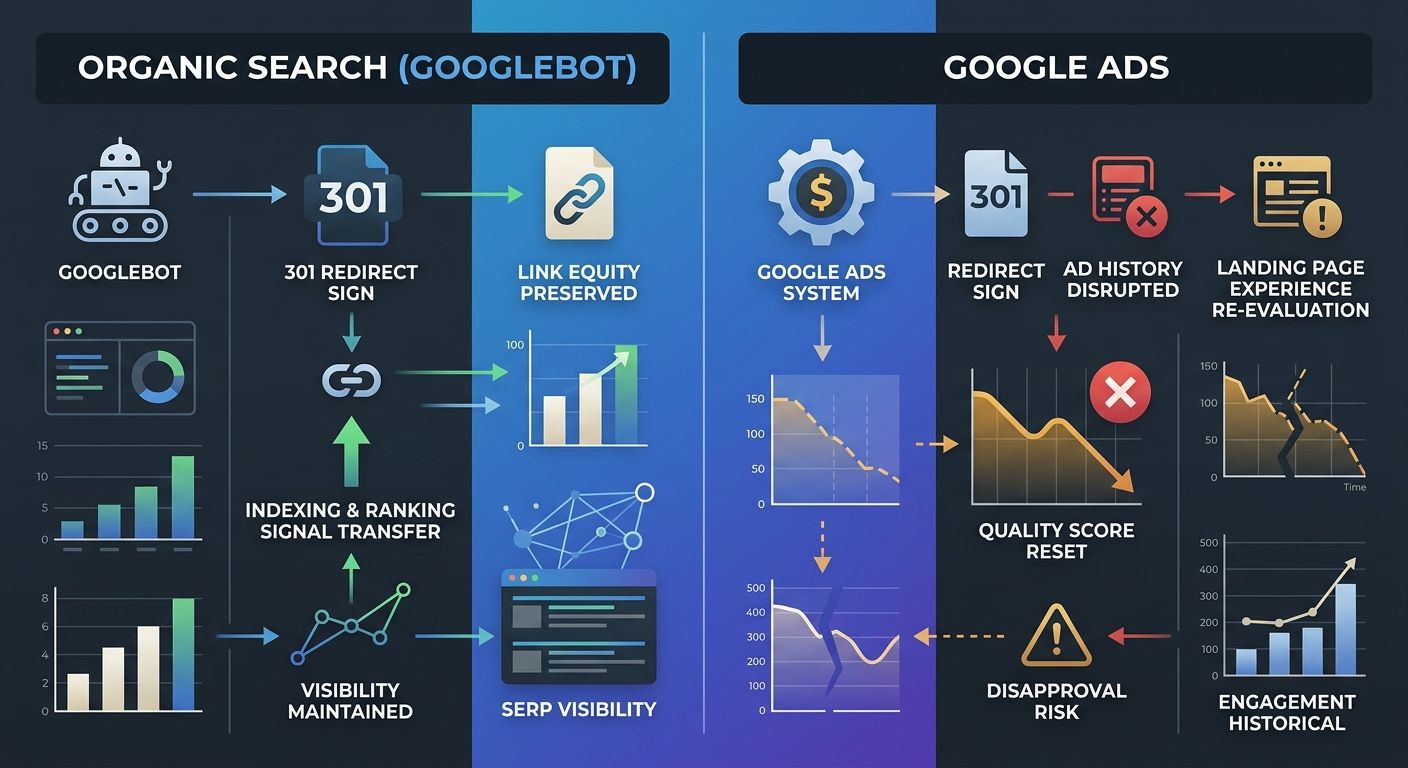
The 301 redirect strategy that protects your organic rankings during a domain migration will break your paid search campaigns in ways no SEO checklist warns you about. Redirects preserve link equity for crawlers, but Google Ads treats every redirected landing page as a new URL with no Quality Score history. Your CPCs spike the same week your organic traffic disappears.
The 523-Day Recovery Window and What It Costs in Ad Spend
According to Outpace SEO's analysis of 892 domain migrations, the average site takes 523 days to regain its original organic traffic levels. Worse, 17% of migrated domains never recover their traffic, even after 1,000 days of monitoring. Those numbers represent an organic channel operating at partial capacity for nearly 18 months.
The arithmetic is uncomfortable. If your organic channel drives $200,000 in monthly revenue and migration drops it by 40%—a figure consistent with the "silent decay" pattern Outpace SEO documented, where long-tail keyword performance erodes gradually even when head terms appear stable—you're looking at $80,000 per month in lost organic revenue. Over 523 days, that's roughly $1.4 million in organic value your paid campaigns need to replace, or your business absorbs the loss.
The TransferWise-to-Wise.com migration illustrates both the risk and the recovery ceiling. Organic traffic fell from 32 million to 12.9 million monthly visits immediately after the domain switch. A rigorous recovery effort eventually grew that number to 205 million monthly visits, but the dip period still required paid media to cover critical revenue-generating queries. Companies without Wise's budget and SEO sophistication face that same dip with far fewer resources to compensate.
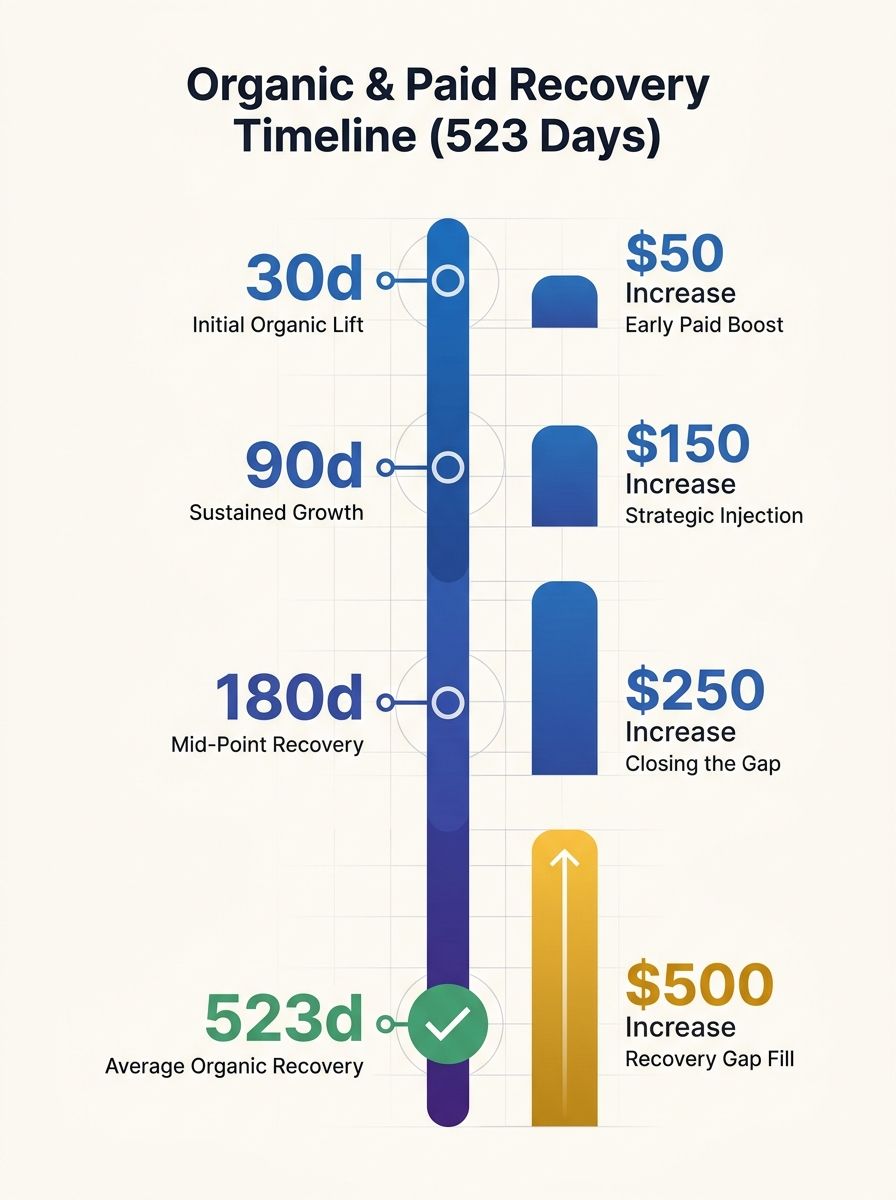
The pre-migration technical SEO audit needs a paid media budget projection baked into it. Before any redirect goes live, your team should model three scenarios: optimistic recovery (90 days), average recovery (523 days), and non-recovery. Each scenario should include the incremental paid spend required to maintain revenue targets. I've seen organizations treat domain migration SEO as a technical project with a fixed cost, only to discover the real expense shows up in their Google Ads account over the following year.
This paid media exposure also interacts with your site structure and internal linking strategy. Pages that relied on internal link equity from a well-organized hierarchy lose that structural advantage during migration if the architecture isn't rebuilt carefully on the new domain—extending the recovery window and extending the period your paid budget has to compensate.
Why Your 301 Redirect Strategy Breaks Paid Differently Than Organic
301 redirects exist to tell search engines that a page has permanently moved. For organic search, they work as advertised: Semrush's website migration checklist confirms that running a technical SEO audit on your staging site catches harmful errors before they reach production, and properly implemented 301 redirects preserve SEO equity from old URLs to new equivalents.
But Google Ads doesn't process redirects the same way. When a user clicks your ad and hits a 301 redirect before reaching the destination, three things happen simultaneously:
Landing page experience score resets. Google Ads evaluates landing page quality independently from organic crawling. A new domain means a new evaluation, and your Quality Score's landing page component drops to "average" or "below average" until Google re-crawls enough data to reassess.
Ad disapprovals trigger. If your redirect chain adds latency or if the final destination doesn't match the display URL in your ad, Google's policy bots flag the ad. During a migration with thousands of URLs changing, disapprovals can cascade across entire campaigns before your team notices.
Redirect chains compound the damage. Organic crawlers tolerate two or three redirect hops with moderate equity loss. Google Ads penalizes redirect chains more aggressively in Quality Score calculations. A chain of old-URL → intermediate-URL → new-URL degrades your ad rank enough to increase CPCs by 15-30% on competitive terms.
Migration Element | Organic Impact | Paid Search Impact | Conversion Tracking Impact |
|---|---|---|---|
301 redirect (single hop) | ~90-99% equity preserved | Quality Score resets to baseline | Pixel fires on new URL if tag is present |
Redirect chain (2+ hops) | Moderate equity dilution | CPC increase of 15-30% | Pixel may fail to fire entirely |
URL parameter changes | Canonical tags resolve duplication | Custom parameters in tracking templates break | UTM and GCLID attribution fractures |
Domain name change | Gradual reindexing over weeks | Immediate display URL mismatch in active ads | All domain-bound cookies and audiences lost |
SSL/protocol change | Minor ranking signal adjustment | Certificate mismatch triggers ad disapprovals | Secure/non-secure pixel conflicts |
Marcel Digital's migration checklist emphasizes conducting an SEO audit to confirm all pages, content, links, tags, and mobile elements are accounted for before and after migration. That advice is sound for organic, but the same audit needs a parallel track: every active Google Ads campaign, every landing page URL in your ad groups, every sitelink extension, and every tracking template must be mapped to new-domain equivalents and updated before the redirects go live—not after.
The Silent Death of Conversion Data During Migration
The third piece of evidence is the one that costs organizations the most money per dollar of awareness: conversion tracking infrastructure is domain-bound, and migration kills it silently.
Google Ads conversion pixels, Meta's CAPI server-side events, LinkedIn Insight Tags, and first-party cookies all reference your domain. When the domain changes, several things break at once. First-party cookies set on the old domain don't transfer. Remarketing audiences built over months or years—your most valuable paid audiences, the ones with 3-5x higher conversion rates than cold traffic—vanish. Server-side tracking configurations that reference the old domain's endpoints stop sending data.
The damage is silent because your ads keep running. Clicks still register. Spend continues. But your conversion column shows zero or near-zero, and your automated bidding strategies (Target CPA, Target ROAS, Maximize Conversions) interpret the missing conversion data as a signal that the campaigns have stopped working. Within 48-72 hours, Smart Bidding algorithms start making destructive bid adjustments based on incomplete data.
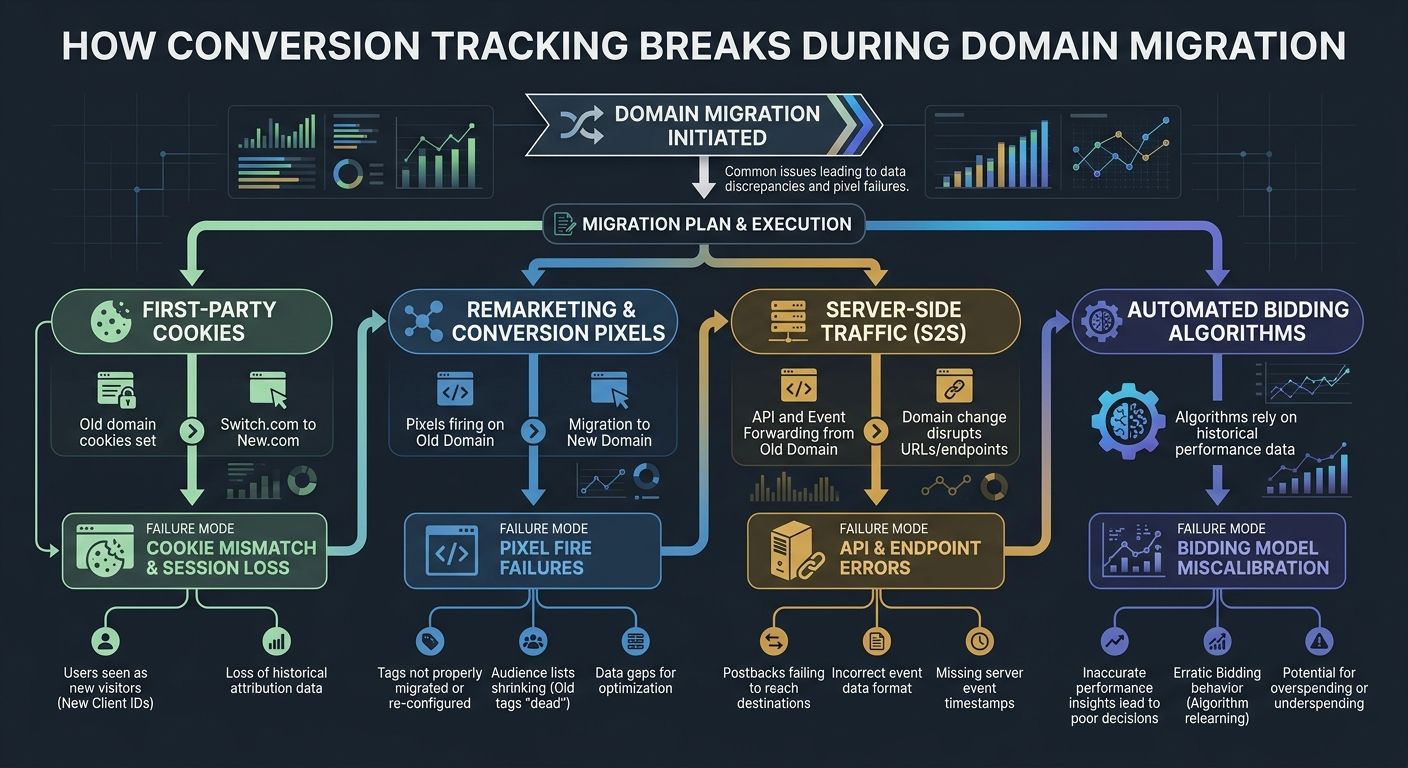
I've worked with organizations that lost 2-3 weeks of conversion data during migration because nobody validated that the tracking tags were firing on the new domain. By the time they noticed, their Smart Bidding models had deoptimized so thoroughly that recovery took another 4-6 weeks of manual CPC bidding and learning-period resets.
If you've already done the work of auditing your analytics tags for silent data loss, apply that same discipline to every paid media pixel. Pre-migration, create a spreadsheet mapping every tracking tag to its domain dependency. On launch day, validate each one with real test conversions before scaling ad spend back to normal levels.
The SERP landscape analysis migration teams run to identify at-risk organic keywords should also inform paid media defense. If your SERP landscape analysis shows that your top 50 revenue-driving keywords are likely to drop during recovery, those exact keywords need paid coverage—and that paid coverage needs functional conversion tracking from day one to justify the spend.
For schema and structured data preservation, the same principle applies: updating your Organization and Website schema on the new domain reinforces entity recognition for both organic and paid. Google's entity understanding influences ad quality assessments, and inconsistent brand signals between your organic presence and your ad landing pages create friction in quality evaluations.
Where This Leaves the Standard Migration Checklist
The conventional domain migration SEO audit covers redirects, sitemaps, robots.txt, canonical tags, and Search Console verification. Every step in that checklist is necessary. None of it is wrong.
But the checklist is incomplete in a way that's expensive to discover after launch. Post-migration ranking recovery depends on organic signals that take 523 days to rebuild on average. During that window, paid media is your revenue bridge. And if your paid infrastructure broke on the same day your organic traffic dropped, you've cut both lifelines simultaneously.
The fix is structural, not complex. Add four elements to your existing pre-migration technical SEO audit: a paid landing page URL map with redirect validation, a conversion tracking tag inventory with domain dependencies, a remarketing audience export and rebuild plan, and a 90-day paid budget model that accounts for Quality Score resets and CPC inflation.
A crawlability audit catches the organic issues. The paid media parallel catches the budget hemorrhage. Run both before the first redirect goes live, and the 523-day recovery window becomes a managed cost rather than an uncontrolled one.
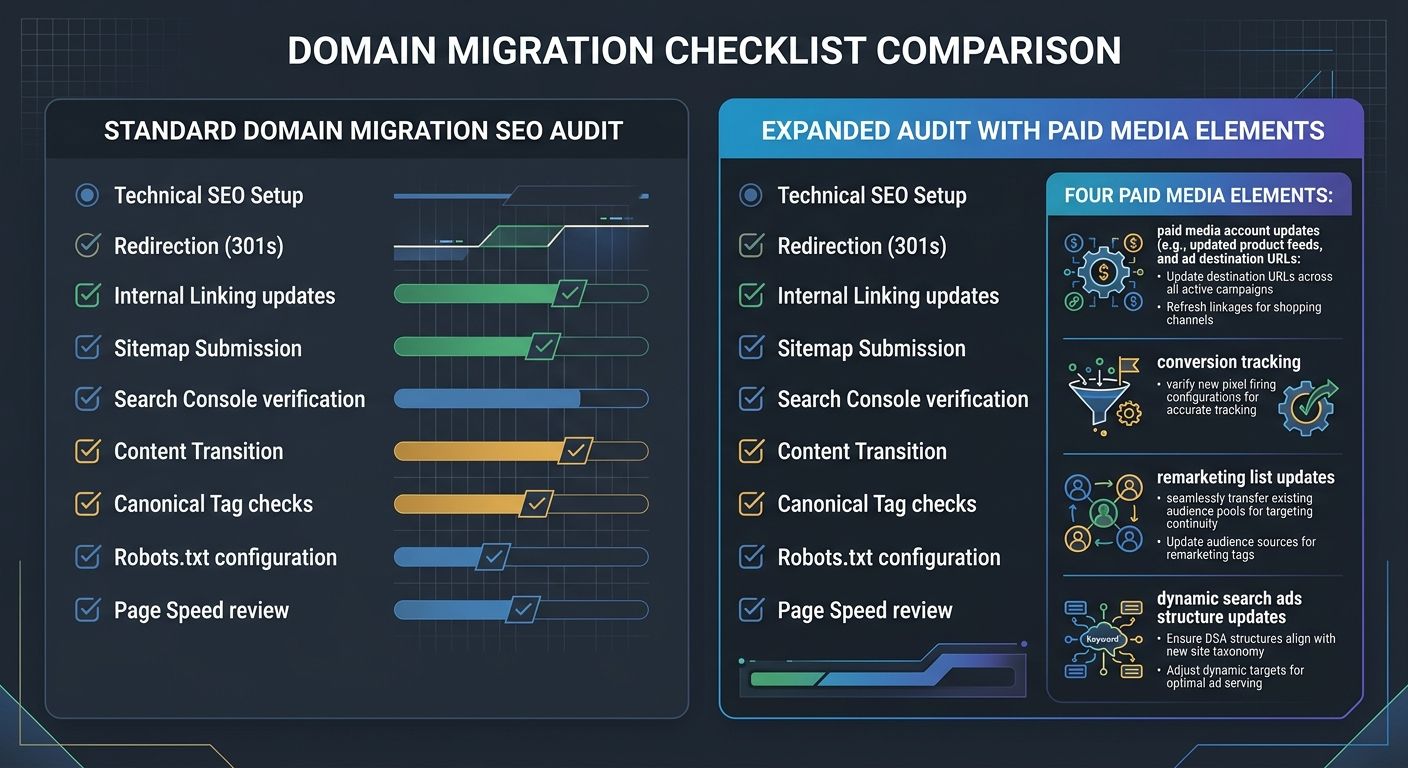
The organizations that migrate domains successfully in 2026 don't treat SEO and paid media as separate workstreams that happen to share a URL. They audit both systems against the same redirect map, validate both tracking layers on the staging environment, and model the financial exposure across both channels before committing to a launch date. The checklist already exists for organic. The paid media layer is four line items. Skipping them is how a $50,000 migration project generates $500,000 in downstream paid media waste.

Sarah Chen
SEO strategist and web analytics expert with over 10 years of experience helping businesses improve their organic search visibility. Sarah covers keyword tracking, site audits, and data-driven growth strategies.
Related Articles
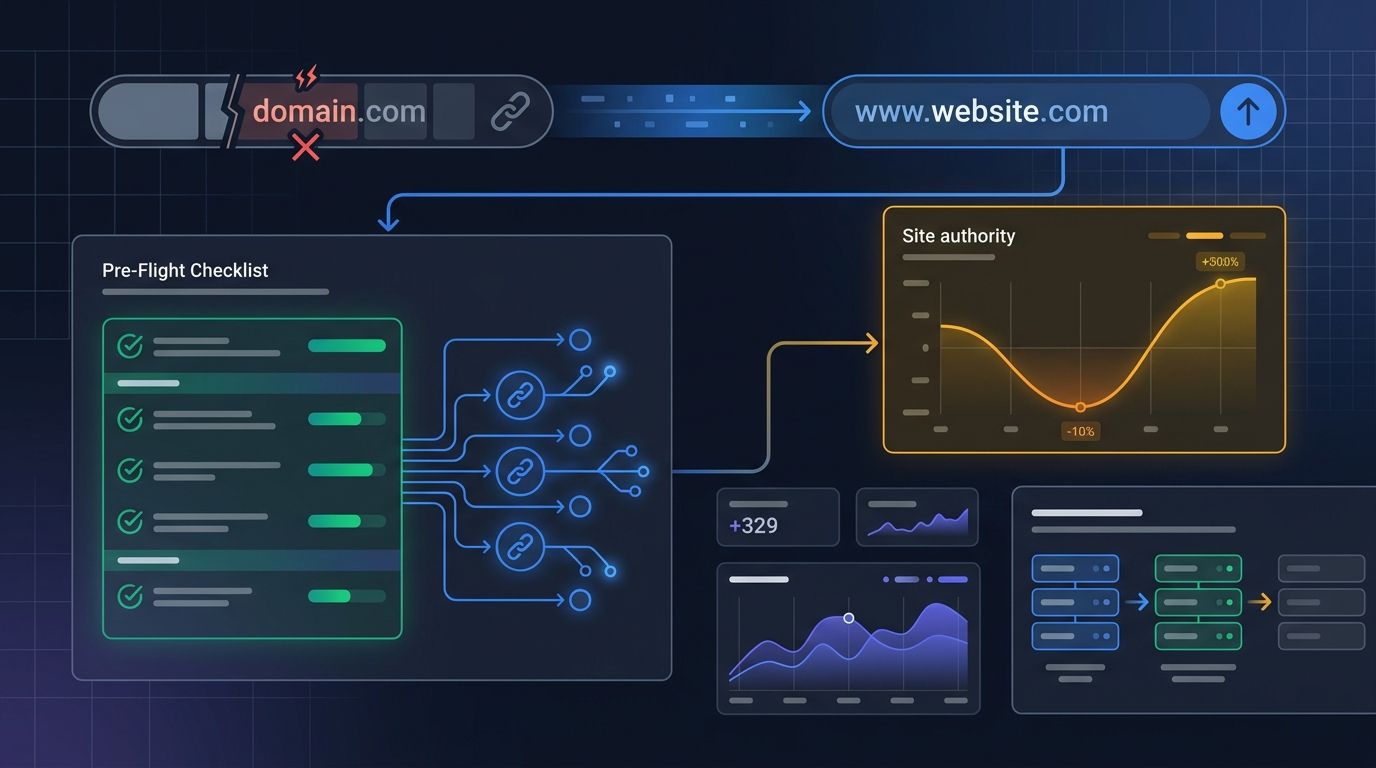
The Domain Migration SEO Playbook: Pre-Flight Checklist, Execution, and Post-Migration Recovery Timeline
Google's Change of Address tool forwards ranking signals for a hard 180-day window during domain-level moves, and 1:1 server-side 301 redirects pass full link equity to destination URLs. The mechanism that preserves SEO authority during migration is well-documented.

The Domain Migration SEO Playbook: Step-by-Step 301 Redirect Strategy to Preserve Rankings and Authority
A properly executed 301 redirect maps every old URL to its exact new equivalent, passing 90–99% of accumulated link equity to the destination page.

Website Migration Guide Establishes Expected 5% to 12% Organic Traffic Dip as Benchmark for Clean Redirects
Website migrations executed with complete URL mapping and tested 301 redirects should expect a temporary 5% to 12% organic traffic decline, while migrations without systematic redirect planning risk traffic crashes exceeding 40%, according to an SEO migration framework published by GadgetsFarms on A
Explore more topics