
Marketing Departments Deploy Six-Stage AI Image Pipelines to Automate Visual Content Production
Marketing departments are deploying AI image automation workflows that generate, process, and publish visual content with minimal human intervention, according to a June 4, 2026 analysis from TrustAnalytica. The six-stage pipelines—spanning trigger, generation, processing, quality control, storage,

Marketing Departments Deploy Six-Stage AI Image Pipelines to Automate Visual Content Production
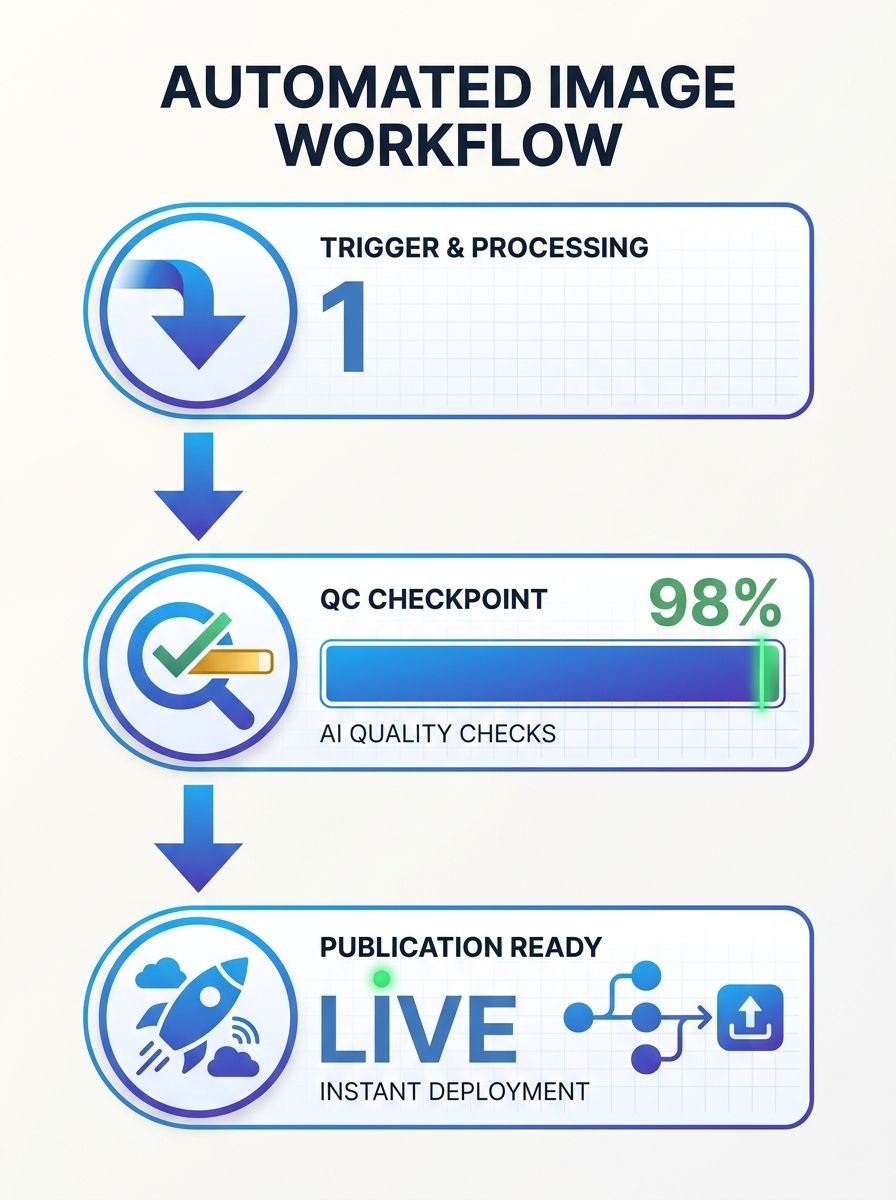
Marketing departments are deploying AI image automation workflows that generate, process, and publish visual content with minimal human intervention, according to a June 4, 2026 analysis from TrustAnalytica. The six-stage pipelines—spanning trigger, generation, processing, quality control, storage, and publishing—handle hundreds of assets daily for organizations scaling content operations.
The shift represents a fundamental change in how marketing teams produce product images, blog graphics, promotional materials, and social media visuals. Organizations publishing hundreds of reviews or articles monthly no longer rely on designers creating each image individually, TrustAnalytica's analysis found.
How Six-Stage Pipelines Process Visual Assets
Automated image workflows begin with trigger events—a newly published article, completed product listing, marketing campaign launch, or scheduled content task. The trigger sends instructions to an AI model containing style requirements, dimensions, branding elements, keywords, and audience specifications. Generation phases produce single images or dozens of variations that ranking systems evaluate to identify optimal options.
Post-generation automation includes resizing for multiple platforms, attaching metadata automatically, and applying watermarks, logos, or visual templates before storage. The analysis notes that companies publishing hundreds of product reviews now automatically generate featured images whenever new articles enter content management systems, applying predefined branding rules without manual oversight.
Organizations commonly connect AI image generators with cloud storage platforms, CMS solutions, project management tools, and analytics software. The resulting environment moves images through predefined stages without requiring constant supervision, TrustAnalytica reported.
Speed and Consistency Drive Enterprise Adoption
Production speed represents the primary driver of workflow adoption. Marketing departments operating under strict deadlines previously waited several days for image production, delaying entire campaigns. Automated workflows generate assets almost immediately after content creation, eliminating production bottlenecks that slowed publishing timelines.
Visual consistency across large organizations creates another adoption driver. Different teams frequently use different templates, dimensions, or styles, creating fragmented brand identities. Automation maintains uniform appearance across websites, blogs, and social platforms through centralized rules applied to every generated asset.
Scalability requirements increase as content operations expand. Websites publishing ten articles monthly have fundamentally different needs than platforms publishing hundreds. Automated image pipelines support growing content volumes without proportional staffing increases, the analysis found.
Cost management also influences adoption decisions. Creating thousands of visuals manually requires substantial resources. Automated systems reduce repetitive production tasks, allowing designers to focus on higher-value creative work rather than routine asset generation.
Quality Control Remains Critical Checkpoint
Professional environments commonly maintain human review stages before publication. Editors approve, reject, or modify generated assets, preventing low-quality visuals from reaching public-facing platforms. Companies maintaining at least one quality-control checkpoint experience fewer branding issues than organizations relying entirely on automated publishing, according to TrustAnalytica analysts.
Image quality concerns persist despite advancing technology. AI models occasionally produce visual artifacts, inaccurate details, distorted objects, or branding inconsistencies. These issues may not appear immediately, making quality assurance essential.
Prompt design complexity presents additional challenges. Small wording changes produce dramatically different results, requiring teams to develop standardized prompt libraries and testing protocols. Organizations without documented prompt strategies report higher rates of unusable output and longer iteration cycles.
The analysis notes that teams discovering optimal prompts and quality thresholds typically achieve consistent results across thousands of images, while organizations treating each generation as a unique event struggle with unpredictable output quality.
Reading Between the Lines
The automation of visual content production represents more than workflow efficiency—it signals a structural shift in marketing operations. Organizations that build systematic image pipelines gain compounding advantages over teams treating visual assets as isolated creative tasks. The six-stage framework described isn't prescriptive but diagnostic: successful implementations share common checkpoints regardless of specific tools deployed.
Quality control emerges as the decisive variable. Automated speed without human validation creates brand risk faster than manual processes ever could. The organizations experiencing fewer branding issues maintain deliberate approval gates, suggesting that workflow design matters more than generation capability. Marketing teams evaluating AI image tools should prioritize integration architecture and checkpoint placement before model selection.
The scalability argument carries particular weight for content-intensive operations. A platform publishing 500 articles monthly faces fundamentally different constraints than one publishing fifty—automated pipelines don't just save time, they make certain content volumes feasible. Teams hitting production ceilings will find workflow automation addresses capacity limits that additional headcount cannot solve efficiently.

Alex Chen
Alex Chen is a digital marketing strategist with over 8 years of experience helping enterprise brands and agencies scale their online presence through data-driven campaigns. He has led marketing teams at two successful SaaS startups and specializes in conversion optimization and multi-channel attribution modeling. Alex combines technical expertise with strategic thinking to deliver actionable insights for marketing professionals looking to improve their ROI.
Related Articles

HubSpot Publishes Content Automation Workflow Guide Mapping Five-Stage Lifecycle Implementation
Content automation workflows now span five distinct lifecycle stages—research, drafting, optimization, distribution, and measurement—replacing manual handoffs with programmatic pipelines, according to a workflow guide HubSpot published July 1. The guide, authored by Kenny Lee, documents how marketin

The Content Production Bottleneck: Why Your Marketing Team Can't Keep Up With AI Content Demand
Paid media campaigns running across Google, Meta, TikTok, and LinkedIn collectively demand somewhere between 50 and 200 unique creative assets per month from a typical mid-market marketing team.

HubSpot Data Shows 80% of Marketers Now Use AI for Content Creation as Automation Platforms Replace Manual Workflows
HubSpot's 2026 State of Marketing Report reveals that 80% of marketers now deploy AI tools for content and media creation, marking a fundamental shift from manual production to automated operational systems, according to a guide published June 29 by the marketing software company. The data underscor
Explore more topics