
The Post-Migration Traffic Recovery Audit: Diagnosing Ranking Loss After Domain Consolidation
Three distinct audit approaches compete for priority after a domain consolidation tanks organic traffic. Picking the wrong one first extends recovery timelines that already average 523 days for poorly diagnosed migrations, according to aggregated industry data on post-migration SEO recovery.

The Post-Migration Traffic Recovery Audit: Diagnosing Ranking Loss After Domain Consolidation
Three distinct audit approaches compete for priority after a domain consolidation tanks organic traffic. Picking the wrong one first extends recovery timelines that already average 523 days for poorly diagnosed migrations, according to aggregated industry data on post-migration SEO recovery. The right sequence depends on where your link equity actually broke.
The instinct after a migration-related traffic drop is to audit everything simultaneously. That instinct wastes time. Over 60% of post-migration traffic losses trace back to technical or structural issues that fall neatly into one of three diagnostic categories, and each category has a different recovery curve. Traffic drops caught within the first 4 weeks recover in 4 to 8 weeks with targeted fixes, while drops left undiagnosed until the 6-to-8-week mark compound into problems that take 3 to 12 months to unwind.
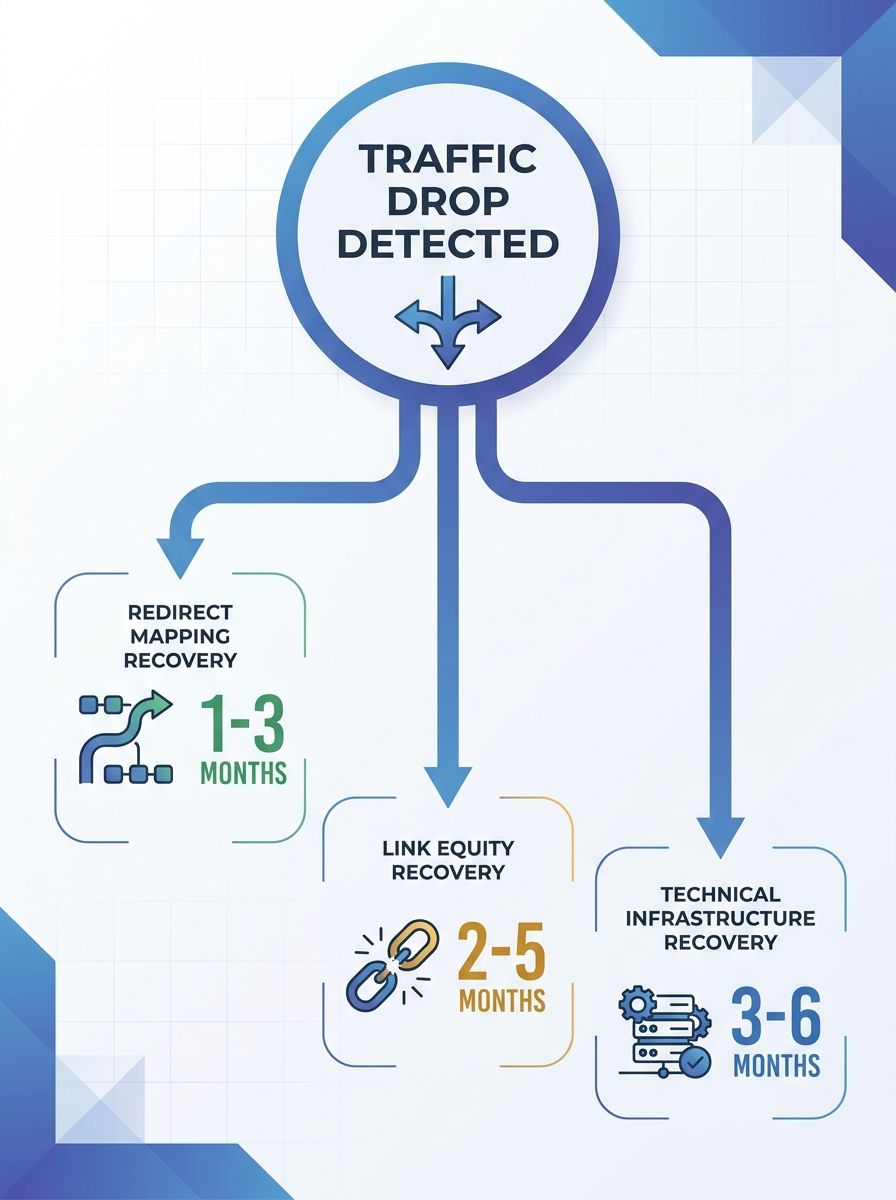
The table below summarizes what each audit approach targets, its typical time investment, and the recovery window you can expect.
Audit Approach | Primary Focus | Time to Execute | Recovery Window | Best For |
|---|---|---|---|---|
Redirect Mapping | 301 chains, loops, soft 404s, mapping accuracy | 1–2 weeks | 4–8 weeks | Sites where 70%+ of traffic loss hits redirected URLs |
Link Equity Recovery | Backlink reclamation, authority flow, referring domain preservation | 2–4 weeks | 2–4 months | Sites that lost 30%+ of referring domains post-migration |
Technical Infrastructure | Crawlability, indexation, canonicals, robots directives | 1–3 weeks | 2–4 weeks for directive fixes; 8–12 weeks for index recovery | Sites where Search Console shows coverage errors spiking |
The Redirect Mapping Audit
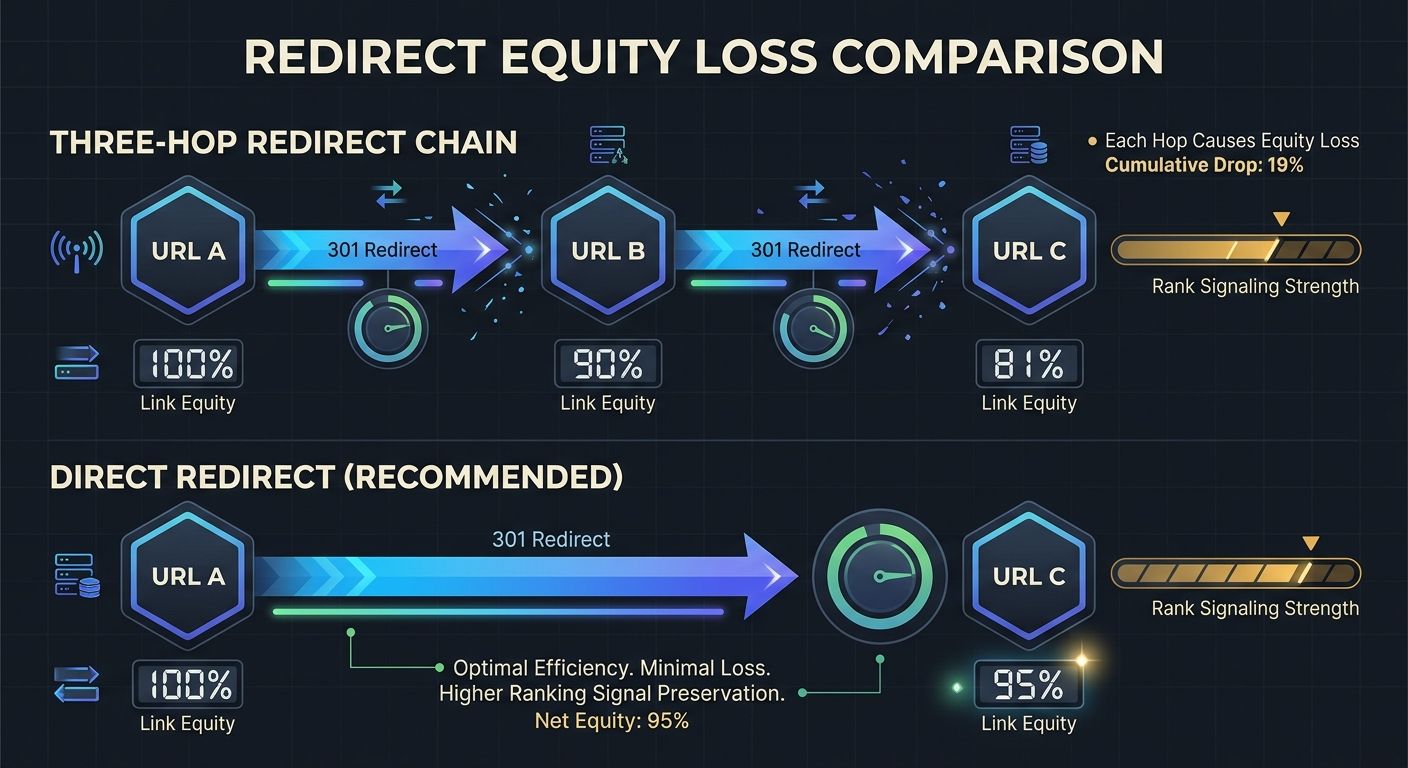
Redirect mapping failures account for the largest share of immediate post-migration ranking loss because they sever the link equity pipeline between old URLs and new destinations. A properly implemented 301 redirect passes 90–99% of accumulated link equity to the destination page, but that transfer rate assumes direct one-to-one mapping. Redirect chains, where URL A points to URL B which then points to URL C, dilute that equity with each additional hop. Sites with 70% of redirects misconfigured or returning 404 errors can lose 63% of organic traffic overnight.
The audit itself follows a specific sequence. First, crawl every URL from your pre-migration sitemap and check the HTTP response code. You're looking for three failure types: chains (more than one redirect hop), loops (URLs that redirect back to themselves or to each other), and soft 404s where old pages redirect to irrelevant destinations like the homepage. As Semrush's redirect documentation advises, the solution is straightforward: "update all 301 redirects to point directly to the final destination URL."
If you've already built your 301 redirect strategy during the migration planning phase, this audit validates that the implementation matched the plan. If you skipped that step, you're building the redirect map retroactively, which means pulling your old sitemap from the Wayback Machine or a pre-migration crawl export and mapping each URL manually.
The timeline pressure matters here. The 14-to-30-day re-crawling period after migration is your window to get redirects right before Google fully reassigns rankings. Redirect fixes deployed within 11 days of identifying the problem recover the fastest. Beyond that window, you're competing against Google's re-evaluation of your domain's authority, which adds months to recovery.
The Link Equity Recovery Audit
When the redirect mapping checks out clean but traffic still hasn't recovered, the problem usually lives in lost backlink authority. Domain consolidation often merges 2, 3, or even 10+ properties into a single domain. Every inbound link pointing to those retired domains needs a working redirect path, and many external sites will have linked to deep pages that your redirect map doesn't cover. According to Skyfield Digital's research on post-acquisition traffic recovery, the fix requires you to "remove the unintended directives, request re-indexing, and watch the coverage report for recovery over the next 2 to 4 weeks."
This audit starts in your backlink analysis tool. Export the full referring domain list for every legacy domain you consolidated. Compare that against what's currently resolving. Any backlink returning a 404 or looping redirect represents lost authority. For enterprise-scale migrations, some organizations benefit from built-in redirect management in enterprise CMS platforms that simplify bulk changes and maintenance across thousands of URLs.
Understanding how authority moves through your site architecture is critical here. A single high-authority page that previously ranked well on an old domain might have carried 40% of that domain's total link equity. If the redirect for that one page breaks, the downstream effect cascades across every internal page it linked to.
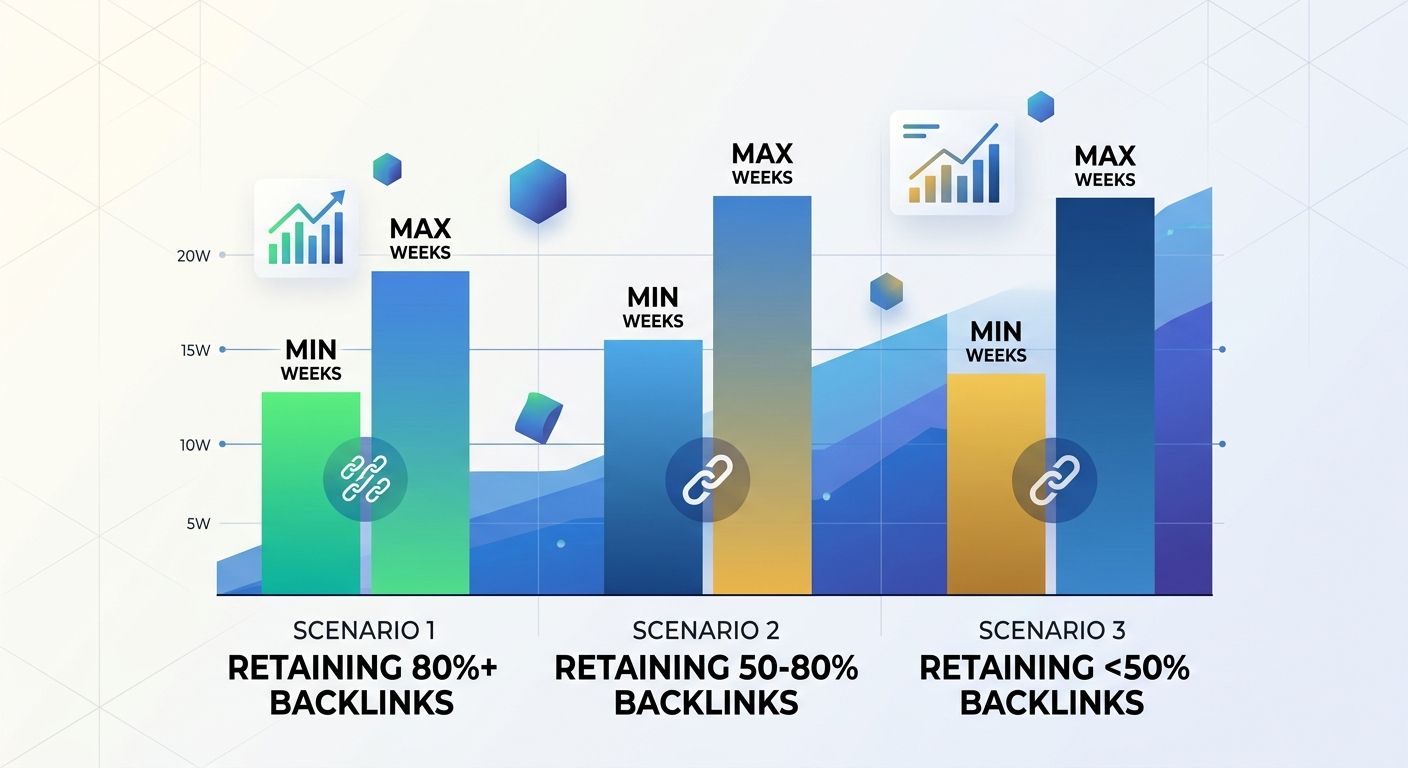
Recovery through backlink reclamation takes longer than redirect fixes. The 2-to-4-month window reflects the time needed to identify broken backlinks, reach out to linking sites for URL updates where feasible, and wait for Google to re-crawl and re-evaluate your authority profile. Sites that lost more than 30% of their pre-migration referring domains should expect closer to the 4-month end of that range, while sites that preserved 80%+ of their backlink profile through clean redirects see faster recovery.
For teams managing this process, Krawl's migration recovery framework recommends that you "report weekly during the first 2 months: percentage change, affected sections, fixes deployed, and expected recovery range." That cadence keeps stakeholders calibrated and prevents the panic-driven decisions that make things worse.
The Technical Infrastructure Audit
The third approach targets problems that exist independently of redirects and backlinks. Domain consolidation frequently introduces crawlability and indexation failures that block Google from accessing your content entirely. Search Engine Journal's analysis of migration failures found that migrations can cause websites to lose their metadata in the process, stripping title tags, meta descriptions, and canonical directives from pages that previously ranked well.
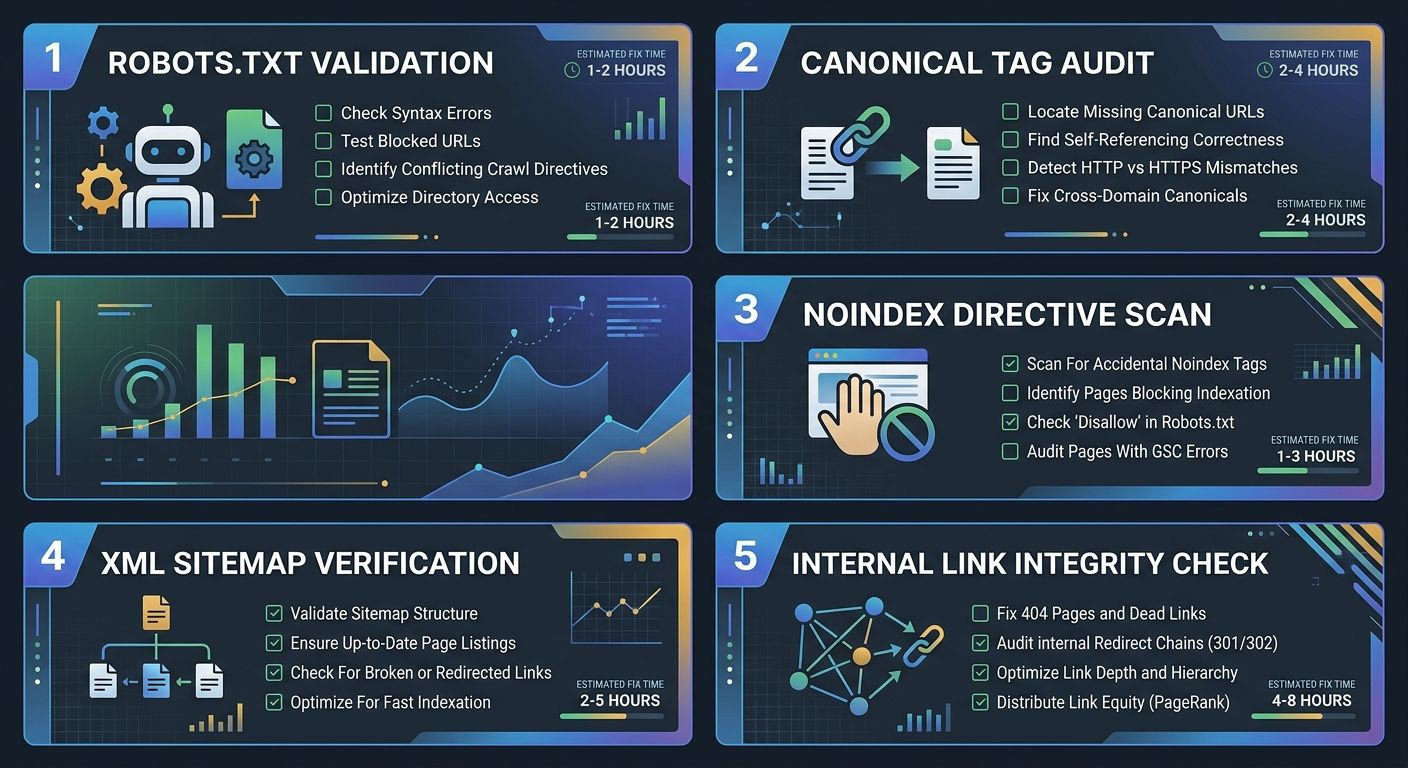
The checklist for this audit covers five specific areas: robots.txt directives that accidentally block crawlers, canonical tags pointing to old (now-dead) URLs, noindex directives left on staging pages that went live, missing or malformed XML sitemaps, and broken internal links that create orphan pages. Sites experiencing these problems show a distinctive pattern in Search Console: impressions dropping alongside clicks, indicating that Google has removed pages from the index rather than simply ranking them lower.
If your consolidated site has structural issues in its architecture, the migration might have exposed pre-existing weaknesses rather than creating new ones. Pages that were borderline crawlable before the migration often fall below the threshold when the domain changes. This is especially common when consolidating sites built on different CMS platforms, where template differences create conflicting canonical signals.
The recovery timeline for technical fixes is the shortest of the three approaches. Removing unintended noindex directives or fixing robots.txt errors triggers re-indexing within 2 to 4 weeks. But this speed comes with a caveat: if the technical problems stayed undetected for 6 to 8 weeks, rankings that were lost have partially reassigned to competitors, and winning them back requires competing for those positions fresh. The fastest recovery path, as one organic traffic diagnostics guide emphasizes, is to "identify the correct cause before taking any action" and check the relationship between impressions and clicks in Search Console.
Teams dealing with indexation issues alongside broader visibility challenges in AI search platforms face compounded recovery timelines. A page that drops from Google's index doesn't get cited by generative AI systems either, so the organic traffic loss extends beyond traditional search. Sites not optimized for Core Web Vitals are 48% more likely to drop in rankings after a migration, adding another diagnostic layer to the technical audit.
How To Choose Between These Three
The diagnostic starting point depends on one data point: what Search Console shows in the first week after you notice the drop.
If impressions stay stable but clicks drop, your pages are still indexed and visible. The problem is ranking position, which points to a redirect mapping audit. Link equity isn't reaching the right pages, and Google is showing your content lower in results. Start with the redirect mapping audit and budget 4 to 8 weeks for recovery.
If impressions and clicks both drop proportionally, pages are leaving the index entirely. That's a technical infrastructure problem. Crawlability or indexation directives are blocking Google. Start with the technical audit, fix the blocking issues, and expect 2 to 4 weeks for re-indexing plus another 4 to 8 weeks for ranking recovery.
If impressions drop gradually over 4 to 8 weeks rather than falling off a cliff, you're watching authority erosion. Backlinks are 404-ing, referring domains aren't resolving, and your domain's authority score is declining. Start with the link equity recovery audit and plan for 2 to 4 months of reclamation work.
In practice, most domain consolidations that lose more than 50% of traffic have problems in at least two of these three categories. Run the redirect mapping audit first because it's the fastest to execute and has the shortest recovery window. Then move to technical infrastructure. Save the link equity recovery audit for last because it requires the redirects to be clean before backlink reclamation efforts produce results. Following the structured approach in a domain migration audit checklist helps ensure nothing falls through the cracks across all three stages. The 45-day mark after migration is your inflection point: sites that have diagnosed and begun fixing across all three categories by day 45 recover measurably faster than those still trying to identify root causes at that stage.

Alex Chen
Alex Chen is a digital marketing strategist with over 8 years of experience helping enterprise brands and agencies scale their online presence through data-driven campaigns. He has led marketing teams at two successful SaaS startups and specializes in conversion optimization and multi-channel attribution modeling. Alex combines technical expertise with strategic thinking to deliver actionable insights for marketing professionals looking to improve their ROI.
Related Articles
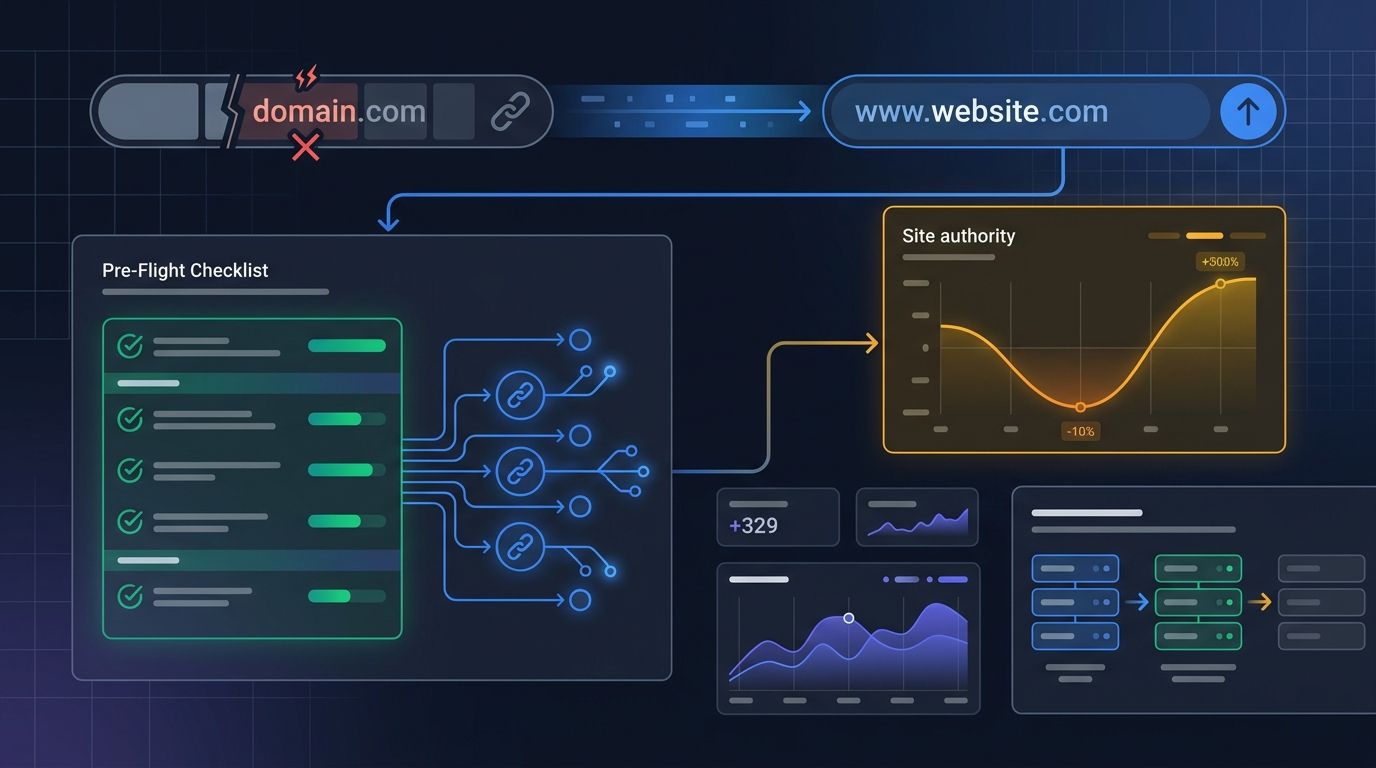
The Domain Migration SEO Playbook: Pre-Flight Checklist, Execution, and Post-Migration Recovery Timeline
Google's Change of Address tool forwards ranking signals for a hard 180-day window during domain-level moves, and 1:1 server-side 301 redirects pass full link equity to destination URLs. The mechanism that preserves SEO authority during migration is well-documented.
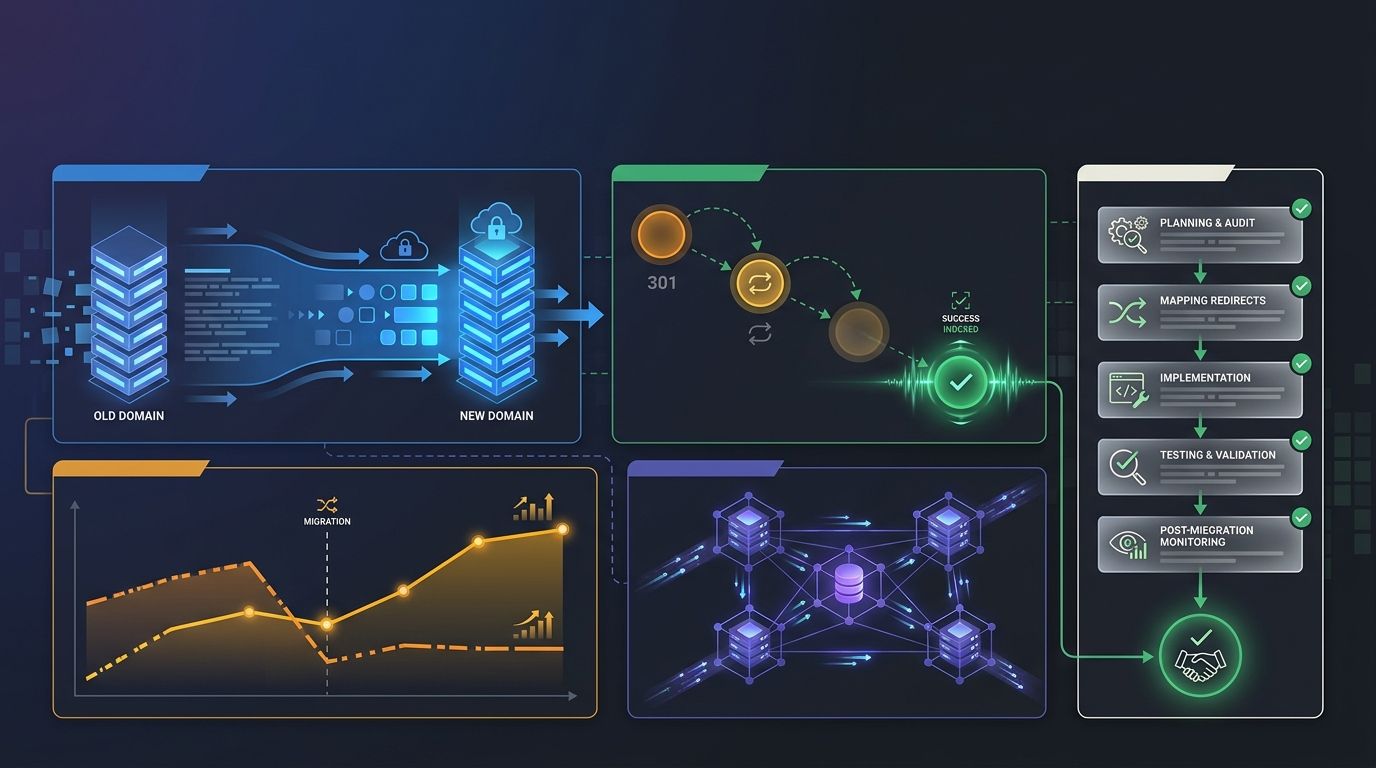
The Domain Migration SEO Playbook: Step-by-Step 301 Redirect Strategy to Preserve Rankings and Authority
A properly executed 301 redirect maps every old URL to its exact new equivalent, passing 90–99% of accumulated link equity to the destination page.

Website Migration Guide Establishes Expected 5% to 12% Organic Traffic Dip as Benchmark for Clean Redirects
Website migrations executed with complete URL mapping and tested 301 redirects should expect a temporary 5% to 12% organic traffic decline, while migrations without systematic redirect planning risk traffic crashes exceeding 40%, according to an SEO migration framework published by GadgetsFarms on A
Explore more topics