
The Corporate Silo Problem in AI Search: How to Align Teams for Visibility in 2026
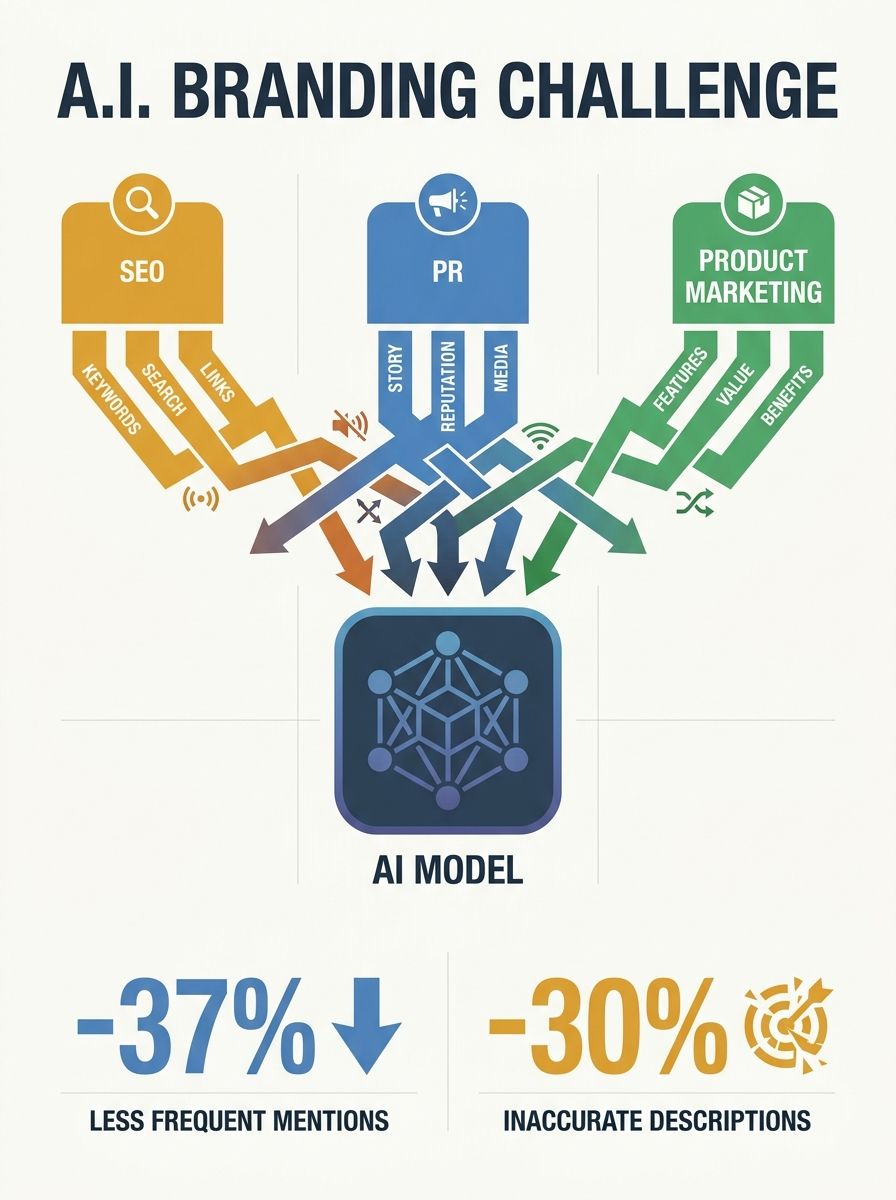
Internal departmental silos cause 37% of brands to appear less frequently than competitors in AI-generated answers, and 30% to be described inaccurately.
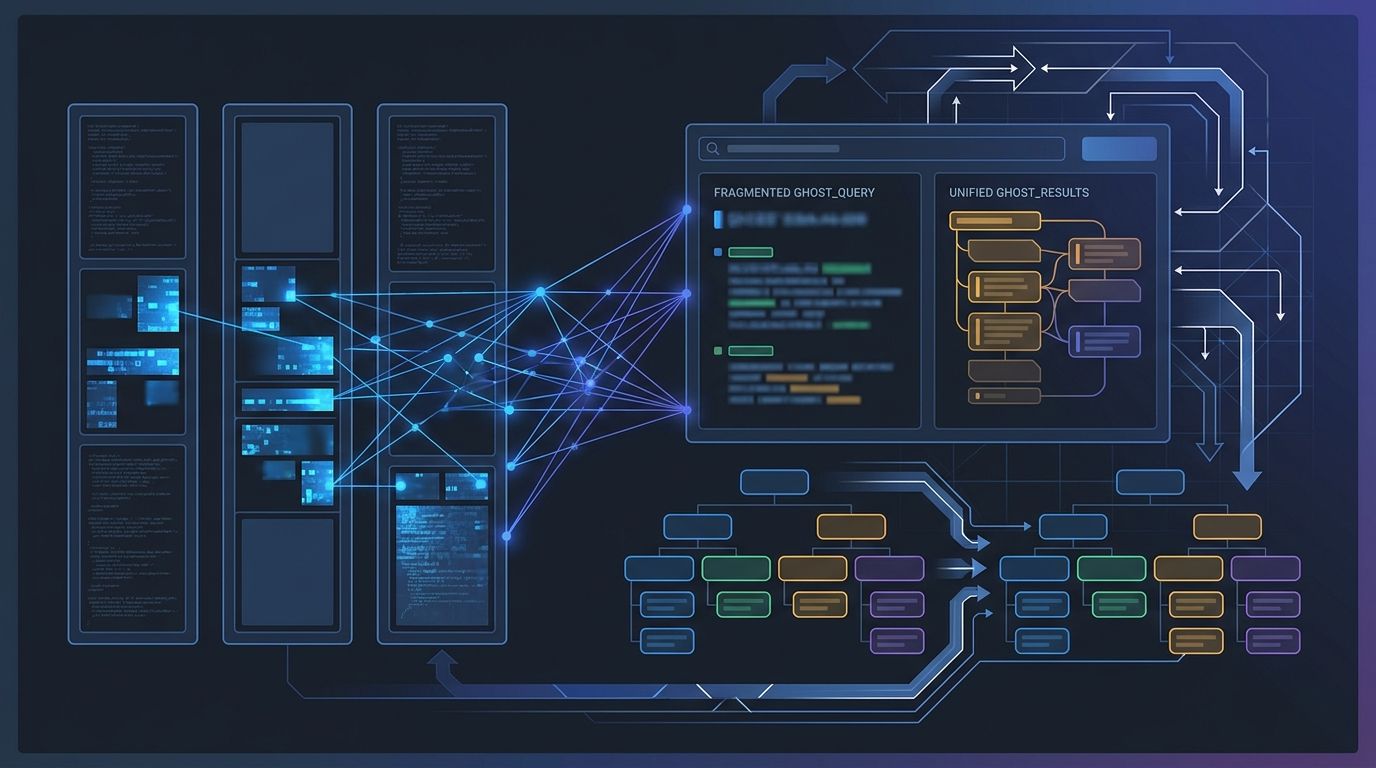
The Corporate Silo Problem in AI Search: How Semrush's Study Exposed the Teams Failing at Visibility
Internal departmental silos cause 37% of brands to appear less frequently than competitors in AI-generated answers, and 30% to be described inaccurately. Those numbers come from Semrush's April 2026 marketer survey, reported by Business Insider on June 3, which found only 22% of US marketing teams run a fully integrated AI search strategy.
The Survey That Quantified the Silo Tax
Semrush's April 2026 study surveyed US marketers about how their organizations manage AI search visibility across departments. The findings paint a clear picture: 78% of marketing teams operate without a unified generative engine optimization strategy. Each team publishes its own version of brand messaging. SEO writes content targeting traditional keywords. PR pitches journalists with a separate narrative. Product marketing ships landing pages with a third framing. And AI answer engines ingest all three.
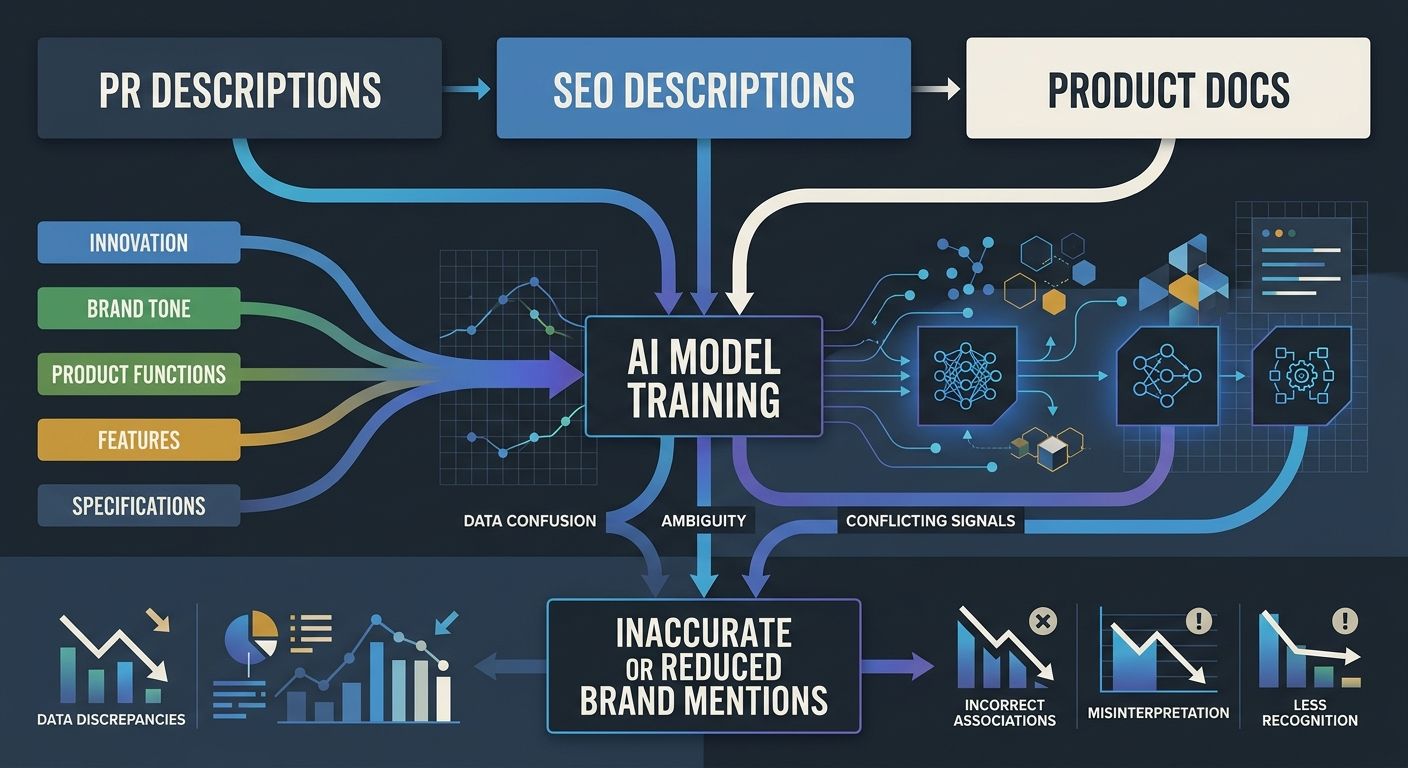
The result is predictable. When ChatGPT, Gemini, or Perplexity encounter conflicting information about your brand across multiple sources, they either average the contradictions into something bland or pick the version that appears most frequently on authoritative domains. If your PR team's pitch deck says you serve "mid-market SaaS companies" and your SEO team's blog says "enterprise software teams," the AI model has no mechanism to reconcile those claims. It guesses. And 30% of the time, per Semrush's data, it guesses wrong.
This is the AI search visibility silos problem reduced to its simplest form: your departments are competing with each other for the AI's attention, and the AI is confused.
The timing of this study matters. Google's May 2026 search redesign cut publisher traffic by 70% to 89% as AI answers replaced traditional click-through results. The stakes for getting AI citation right have never been higher. A Forbes council post published June 1, 2026 reinforced the urgency: "The fundamental dynamic of how consumers discover, evaluate and choose brands has been altered," the author wrote, noting that CMOs claim their teams know how to win in AI search but few can produce proof.
How Conflicting Narratives Reach the AI Models
Understanding why silos damage AI visibility requires understanding how large language models build their knowledge. Unlike Google's traditional index, which ranks individual pages, AI answer engines synthesize information across dozens of sources into a single response. When your brand appears inconsistently across those sources, the model assigns lower confidence to all of your claims.
Consider the path a brand mention takes. Your PR team lands a guest post on a trade publication describing your company as "an AI-powered analytics platform." Your SEO team publishes a comparison page calling the product "a business intelligence dashboard." Your product team's documentation refers to "a data visualization tool." Each of these descriptions lives on a different domain with different authority signals. The AI model, when asked about your company, encounters three competing entity descriptions. It either picks one (creating inaccuracy for 30% of brands, per Semrush) or reduces your mention frequency because the conflicting signals lower your citation confidence score.
As GreenBananaSEO documented in their AEO case studies, "AI engines extract and cite answer-formatted content significantly more often than traditional article structures." The format matters, but consistency across sources matters more. An organization running a unified AEO and SEO approach will outperform a siloed team with better individual content every time.
Cross-team SEO alignment in 2026 means something different than it did two years ago. It's no longer about making sure everyone uses the same target keyword list. It's about ensuring every team, across every channel, describes the brand, its products, and its differentiators with the same core entity attributes. Same terminology. Same category labels. Same competitive positioning.
The 22% Who Built a Cross-Functional Cadence
The minority of organizations that reported a fully integrated AI search strategy in Semrush's survey share a common structural feature: regular cross-functional meetings with shared metrics.
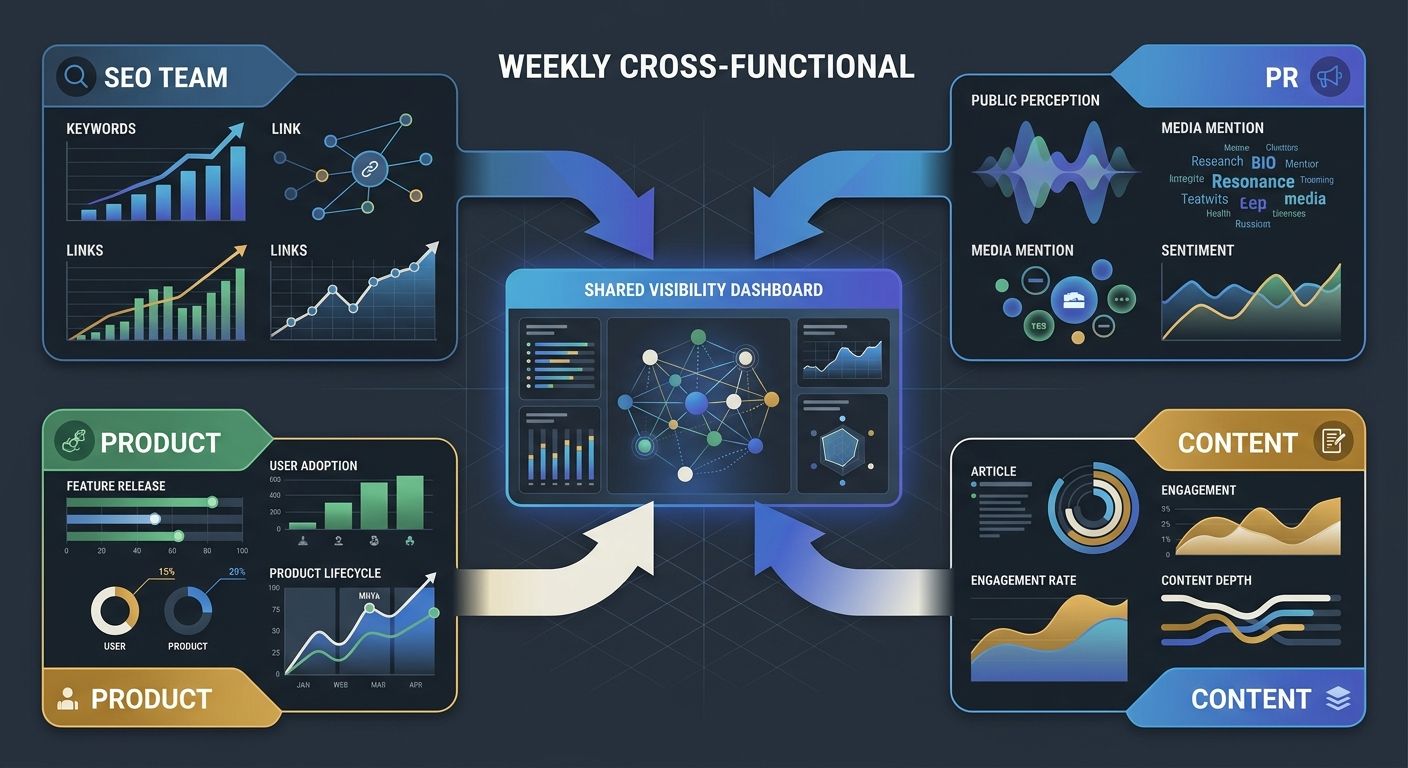
Evolv Agency, which has documented its approach to fixing visibility gaps created by departmental silos, described the pattern directly: "By establishing weekly cross-functional sessions with a shared visibility framework, we aligned their teams around common objectives," the agency reported. The key word there is "framework." These sessions don't work as status updates where each team reports independently. They work when every team shares a single dashboard tracking how the brand appears across AI answer engines.
What does this look like in practice? The SEO team monitors which queries trigger AI-generated answers that mention the brand. The PR team tracks which publications and brand mentions AI models cite most frequently. The content team ensures new assets use the exact entity descriptions the SEO and PR teams have validated. Product marketing aligns landing page copy with the same terminology. One shared truth document governs all output.
This approach to internal marketing coordination has a strong parallel in the Descript case. Search Engine Land profiled how the 200-person company competes with a $160 billion competitor in AI search. The answer: tight alignment between brand, content, and SEO teams, with every piece of content reinforcing the same brand positioning and entity attributes that AI models use to build their knowledge graphs.
The Wix Studio AI Search Lab's guidance on breaking down silos reinforces this cadence: "Celebrate collective wins, but also analyze failures constructively so every campaign improves the relationship between your team," rather than assigning blame to one department when visibility drops. This cultural shift matters as much as the tactical one. If PR gets blamed when AI answers misrepresent the brand, PR stops engaging with the cross-functional process. The silo rebuilds itself.
Organizations building a PR-to-citation pipeline see the fastest improvements here, because PR placements on authoritative domains carry disproportionate weight in AI model training data. But those placements only help if the brand description in the PR placement matches what the SEO team has optimized for.
GA4's New AI Channel and the Measurement Blind Spot
One reason silos persisted so long in AI search is that nobody could measure the damage. Traditional analytics didn't separate AI-referred traffic from organic search traffic. Teams couldn't prove that inconsistent brand messaging caused lower AI citation rates because they couldn't track AI citations at all.
That changed on May 13, 2026, when GA4 introduced a native "AI Assistant" channel grouping. This channel tracks traffic arriving from ChatGPT, Gemini, Claude, and other AI answer engines as a distinct source. Around the same time, Google Search Console launched a dedicated view for generative AI visibility, showing which queries trigger AI-generated answers that cite your content.
These measurement tools matter for internal marketing coordination because they give every team shared data. Before May 2026, the SEO team tracked organic rankings, the PR team tracked media mentions, and the content team tracked engagement metrics. Nobody owned AI visibility. Now, every team can see how their work contributes to (or detracts from) the brand's presence in AI answers. If you haven't yet run a full AI visibility audit across ChatGPT and Gemini, the new GA4 channel grouping gives you the measurement infrastructure to do it properly.
The CIO.com 2026 State of the CIO survey found that CIOs are now building organizational structures and KPIs specifically designed to measure AI ROI. That organizational pressure is reaching marketing departments. When the C-suite starts asking for AI search visibility metrics, the siloed team that can't produce them loses budget to the integrated team that can.
The Org-Chart Lesson Semrush's Data Can't Fix Alone
Semrush's study documents the problem with precision: 78% fragmentation, 37% reduced mentions, 30% inaccuracy. But data doesn't restructure organizations. The 22% who got this right didn't just read a report and change their behavior. They changed their meeting cadence, their shared dashboards, their approval workflows, and their definition of what "search visibility" means in a post-AI-answer world.
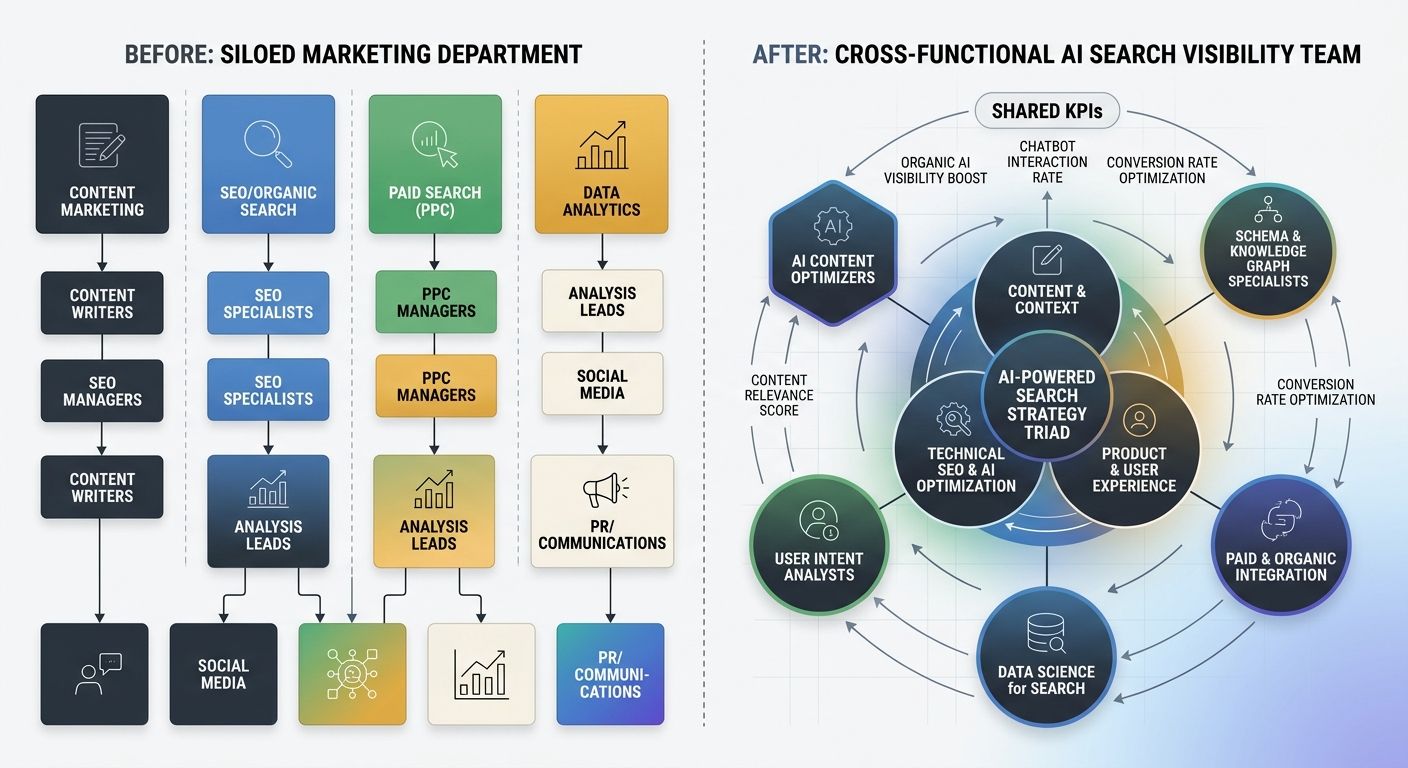
The companies still running generative engine optimization strategy out of the SEO team alone will keep falling behind. So will those treating AI answer engine optimization as a separate discipline run by a separate team. As LLMrefs documented in their 2026 GEO guide, generative engine optimization "builds on SEO fundamentals, but adds specific techniques for improving search visibility in AI-generated content." Those additional techniques span PR, product documentation, schema markup, and brand messaging. No single team owns all of those outputs.
The most telling number in Semrush's entire study isn't the 22% integration rate or the 37% mention reduction. It's the 30% inaccuracy rate. When AI answer engines describe your brand incorrectly to potential customers, every team pays the price. Sales gets confused prospects. Support gets frustrated users. Marketing gets lower conversion rates. The damage radiates outward from a problem that originates in the gaps between org-chart boxes. And until those boxes share a single truth document, a single measurement dashboard, and a single weekly conversation about how the brand appears in AI answers, the AI will keep getting it wrong. Fixing the content architecture that feeds your internal linking is part of the solution, but only if every team agrees on what that architecture should say about the brand in the first place.

Sarah Chen
SEO strategist and web analytics expert with over 10 years of experience helping businesses improve their organic search visibility. Sarah covers keyword tracking, site audits, and data-driven growth strategies.
Related Articles
Brands Ranking #1 on Google Missing 62% of AI Overview Citations, Adweek Analysis Shows
Brands holding first-page Google rankings are absent from 62% of citations in AI-generated search answers, according to a July 22 analysis by Adweek examining generative engine optimization adoption patterns, as only 38% of pages cited in Google's AI Overviews come from URLs in the top ten tradition

AEO Integration Without Cannibalizing Traditional SEO: Building Your Unified Search Strategy for 2026
Google's AI Overviews killed click-through rates by 61% on queries where they appear, according to Dataslayer's 2026 analysis.

The AI Visibility Audit: Why 76% of Brands Disappear From ChatGPT and Gemini Recommendations
The SearchScore AI Visibility Study, released June 1, 2026, analyzed 254 websites across ChatGPT, Gemini, and other generative AI search platforms and found that 76.4% of brands scored below 40% in AI visibility. Only 7.
Explore more topics