
Choosing Between Organic Growth and Fast Results: Your SEO vs. SEM Decision Tree
A client once showed me their marketing dashboard with a proud grin. They were spending $14,000 a month on Google Ads and generating what looked like solid lead volume.
Choosing Between Organic Growth and Fast Results: Your SEO vs. SEM Decision Tree
A client once showed me their marketing dashboard with a proud grin. They were spending $14,000 a month on Google Ads and generating what looked like solid lead volume. Then we dug into the actual cost-per-acquisition numbers, compared them against the three blog posts that had been quietly ranking on page one for eight months, and the math got uncomfortable fast. Those three organic pages were driving 40% of their qualified leads at effectively zero marginal cost. The paid campaigns? They were acquiring the same type of customer at 3x the price. That's when the real conversation about SEO vs SEM strategy started.
I'm not here to tell you one channel is universally better than the other. That would be lazy advice. What I can give you is a decision framework built from years of watching companies burn money on the wrong channel at the wrong time, and a few who got the balance exactly right.
The Fundamental Difference Most People Get Wrong
People treat SEO and SEM as two versions of the same thing. They're not. They're fundamentally different economic models.
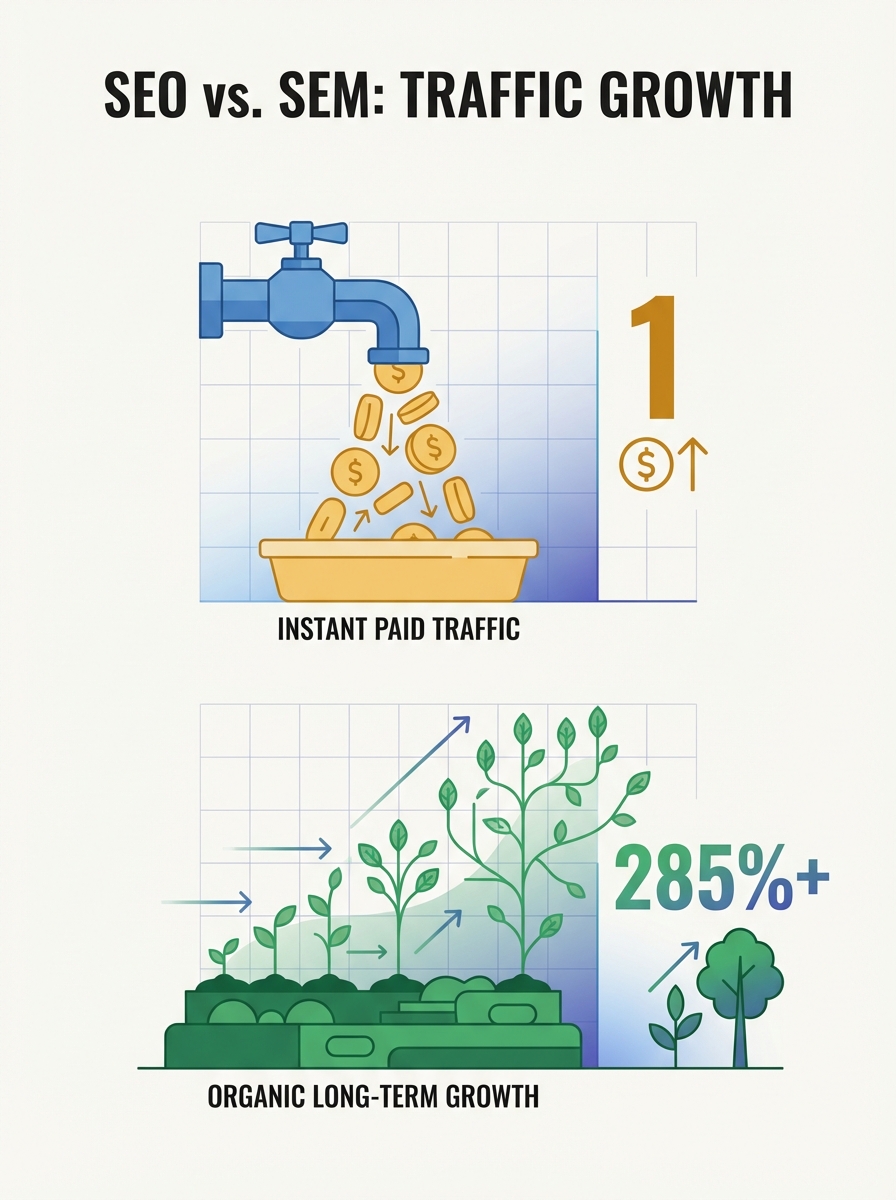
SEM is a faucet. You turn it on, traffic flows. You turn it off, it stops. Every click costs money, and that cost tends to rise over time as competition increases. According to Essential Marketer's analysis of search marketing economics, SEM delivers immediate visibility but requires continuous investment to maintain results.
SEO is a garden. You plant seeds, tend them, wait, and eventually you're harvesting traffic that shows up whether you're actively spending or not. The catch? You can't skip the growing season.
The organic vs paid search ROI comparison only makes sense when you factor in time horizon. Over 90 days, SEM almost always wins. Over 18 months, SEO almost always wins. The question is which timeline matters more for your specific business situation right now.
The Decision Tree: Five Questions That Determine Your Path
I've boiled this down to five questions. Answer them honestly, and your search marketing timeline becomes clear.
Question 1: How Quickly Do You Need Revenue?
If your answer is "yesterday," SEM is your starting point. Paid search can deliver visibility within hours of campaign launch, depending on your account setup and bid strategy. Product launches, seasonal promotions, event-driven businesses, and startups validating product-market fit all need that speed.
If your timeline is measured in quarters rather than weeks, SEO deserves the bulk of your attention. As Brian Dean noted from his experience building Backlinko, targeting long-tail keywords and implementing best practices can produce results within a few months, though meaningful rankings often take six months or longer to materialize.
Here's the honest truth: most businesses need both, just in different proportions at different stages.
Question 2: What's Your Current Domain Authority?
This matters more than people realize. If you're launching a brand new site with zero domain authority, SEO alone will leave you invisible for months. Your content might be brilliant, but Google doesn't know you yet.
Early-stage companies with no domain authority should consider allocating 70-80% of their budget to paid search while organic builds momentum. That's not a permanent ratio. It's a starting position.
If you've been around for years, have solid backlinks, and already rank for some terms, the math flips. You should be investing 60-70% into SEO and using SEM to fill specific gaps.
Question 3: Are You in a High-CPC Market?
Some industries have pay-per-click costs that make SEM brutal at scale. Legal, insurance, SaaS, and finance keywords regularly hit $15-50+ per click. In these markets, the long-term vs short-term search growth calculation tilts heavily toward SEO, because the compounding value of ranking organically for expensive keywords is enormous.
Run the numbers. If your average CPC is $8 and you need 1,000 clicks a month to hit your targets, that's $96,000 a year in ad spend. A solid SEO program targeting those same terms might cost $40,000-60,000 annually and continue delivering traffic even if you pause investment.
But if your CPCs are low and your conversion rates on paid are strong, SEM can be perfectly sustainable as a primary channel.
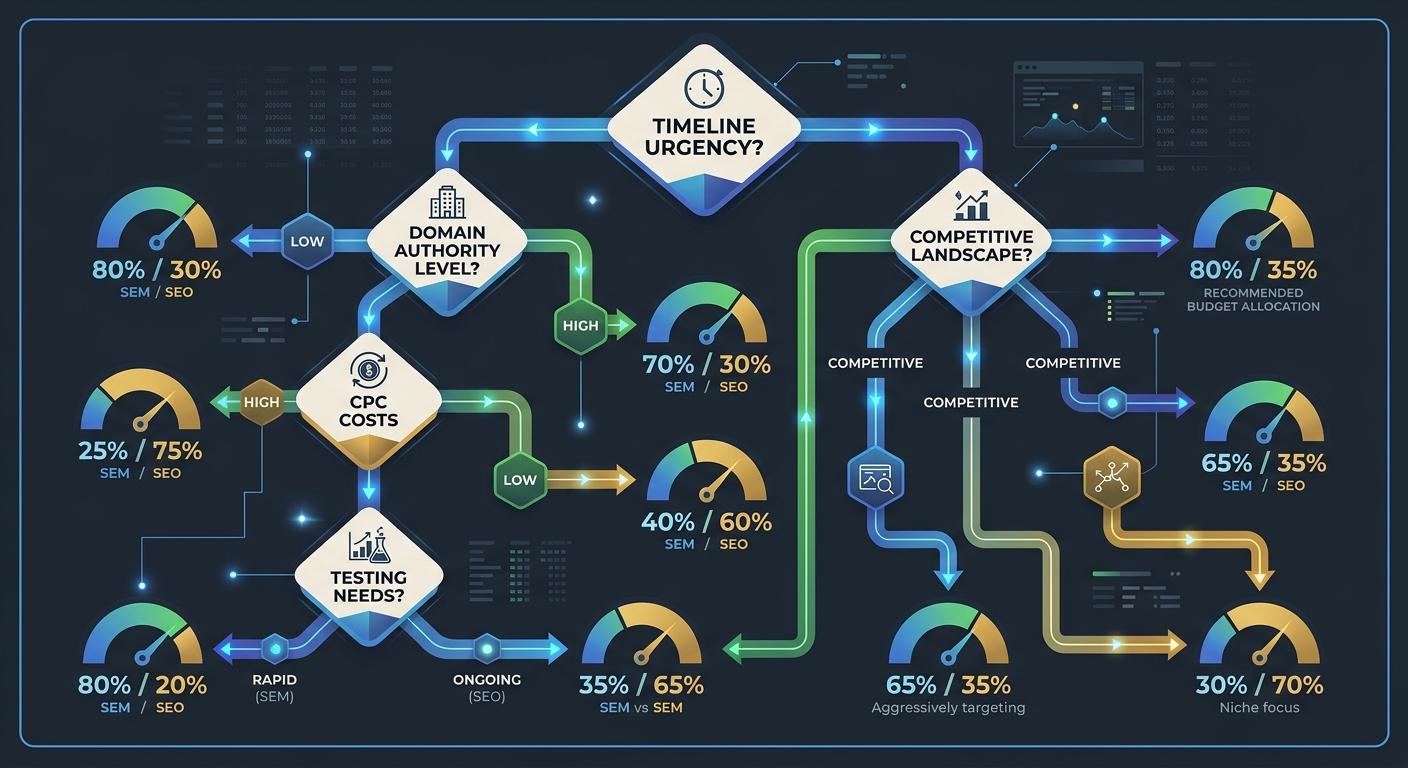
Question 4: How Much Do You Need to Test?
This is where SEM has an underrated advantage. Paid search is a learning machine.
You can test 50 keyword variations in two weeks with SEM. You can A/B test landing pages, offers, and messaging in real time with real data. Then you take those learnings and build your SEO content strategy around what actually converts.
I've seen this play out repeatedly: a team runs paid campaigns, identifies the 10-15 keywords that drive the most qualified traffic, and then builds out an organic content plan targeting those exact terms. The paid data de-risks the SEO investment.
So if you're entering a new market or launching a new product line, SEM-first gives you intelligence that makes your SEO work smarter. This approach pairs naturally with building a content marketing strategy that's grounded in real conversion data rather than guesswork.
Question 5: How Volatile Is Your Competitive Landscape?
The March 2026 core update reminded everyone that organic rankings aren't guaranteed. If you've been following how AI bot traffic and GEO are reshaping competitive rankings, you know the ground keeps shifting. AI Overviews now appear in over 13% of search queries, and zero-click searches account for roughly 27% of all queries.
SEM acts as a hedge. When an algorithm update tanks your organic traffic, paid campaigns keep the lights on while you recover. Companies that rely 100% on either channel are taking on unnecessary risk.
The Budget Allocation Framework
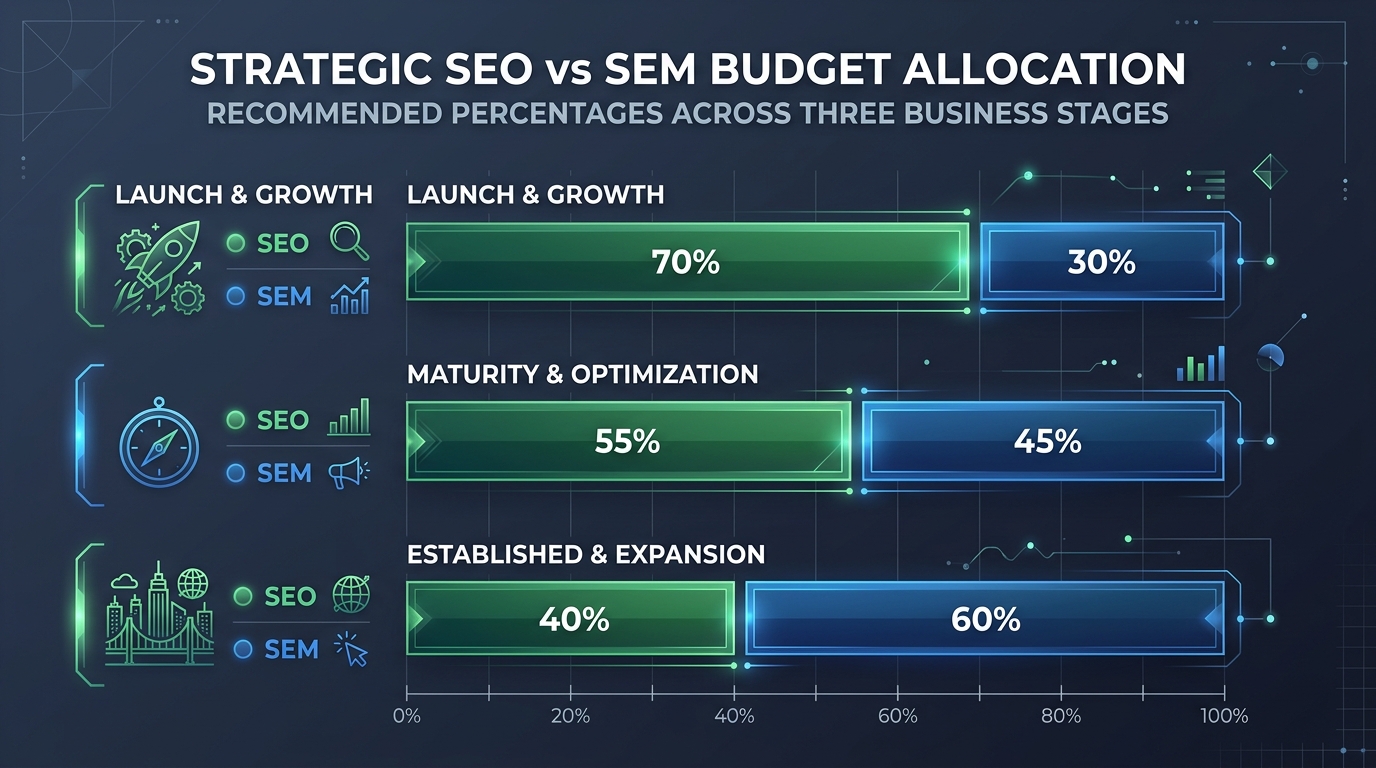
Here's the budget allocation SEO PPC framework I actually use with clients. It's based on business maturity and current organic position.
Stage 1: New Business / New Domain (0-12 months)
SEM: 70%
SEO: 30%
Goal: Generate immediate traffic and leads while building domain authority
Stage 2: Establishing Authority (12-24 months)
SEM: 50%
SEO: 50%
Goal: Organic traffic starts compounding; paid spend focuses on high-intent keywords
Stage 3: Mature Organic Presence (24+ months)
SEM: 30%
SEO: 70%
Goal: Organic carries the load; SEM targets competitive gaps and seasonal pushes
These aren't rigid rules. They're starting points. Your actual split depends on your answers to the five questions above.
Where Most Companies Get This Wrong
The biggest mistake I see is treating the SEO vs SEM decision as permanent. Companies pick a lane and stay in it for years without re-evaluating.
Your search strategy should shift as your business evolves. A startup that was 80% SEM should be gradually shifting budget toward organic as their content starts ranking. An established brand that's been coasting on organic should spin up paid campaigns when entering new product categories.
The second biggest mistake is not connecting the data between channels. Your paid search data should inform your SEO keyword strategy. Your organic ranking data should help you reduce wasted SEM spend on terms you're already winning. If your analytics setup is giving you questionable numbers, diagnosing issues in your GA4 implementation should be step one before making any allocation decisions.
And the third mistake? Ignoring how search itself is changing. The rise of AI-generated search results means your content needs to be structured for both traditional rankings and AI recommendations. We covered how SEO strategy needs to evolve for AI-driven search in detail, and this applies equally to how you think about paid versus organic visibility.
The Hybrid Approach in Practice
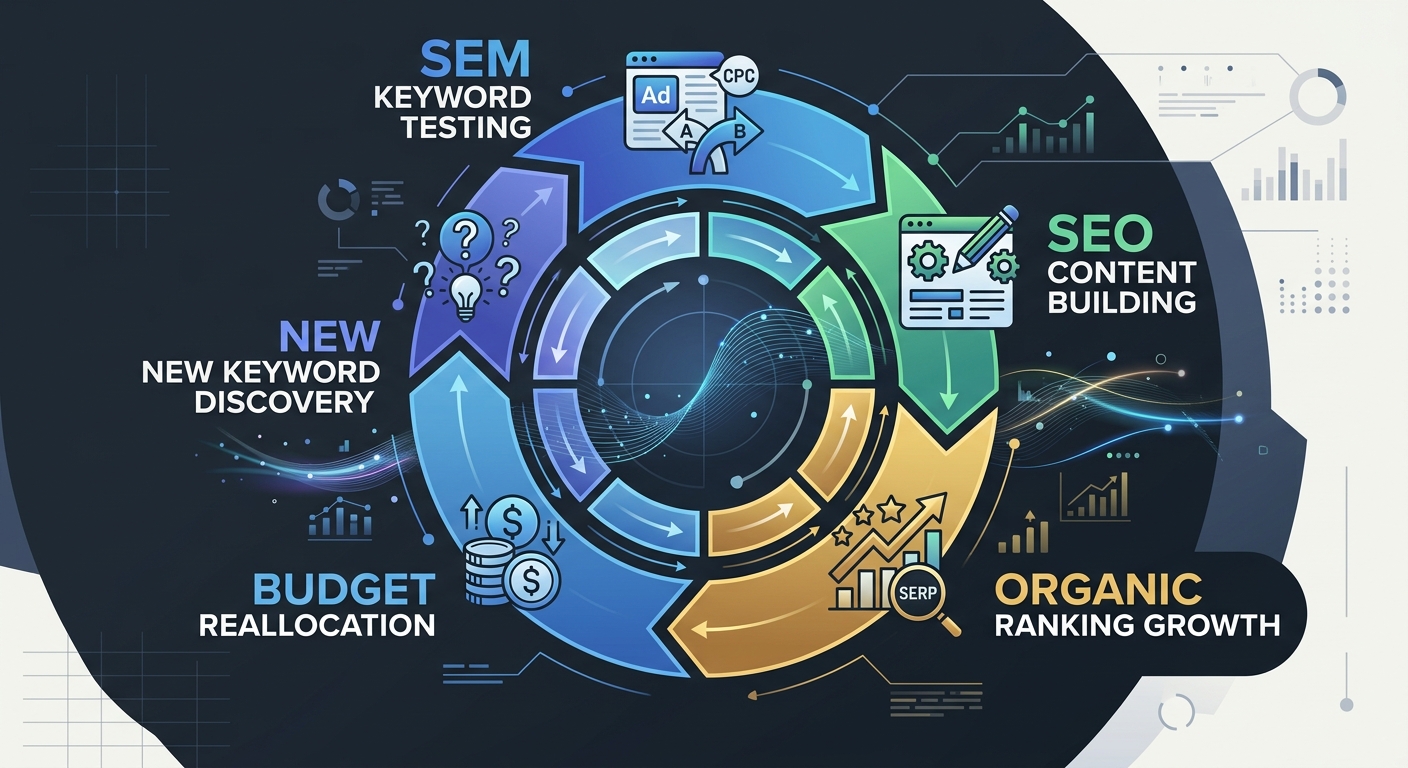
Here's what a well-integrated SEO vs SEM strategy looks like in practice:
Run SEM campaigns targeting your core keyword set
Track which keywords convert, not just which ones get clicks
Build SEO content around your top 10-15 converting terms
As organic rankings climb for those terms, reduce paid bids on them
Reinvest that freed-up SEM budget into new keyword discovery
Repeat
This creates a flywheel. SEM scouts ahead, SEO consolidates the territory, and freed-up paid budget gets redeployed to the next opportunity.
The companies that do this well see something interesting happen around month 12-18: their blended cost per acquisition drops significantly because organic traffic is shouldering more of the conversion load while paid campaigns focus only on the highest-value opportunities.
What to Actually Do This Week
Stop debating SEO versus SEM in the abstract. Instead, do this:
Pull your current paid search data and identify your top 20 converting keywords by revenue, not by click volume
Check how many of those 20 keywords you rank organically for on page one
For every keyword where you're paying for clicks but also ranking in the top 5 organically, test reducing your bid and measure the impact on total traffic
For every high-converting keyword where you have zero organic presence, start a content plan targeting it
Set a calendar reminder to revisit your allocation ratio quarterly
The right answer to "SEO or SEM?" is almost never one or the other. It's knowing which lever to pull, how hard, and when to shift your weight. Your competitors are figuring this out. The question is whether you'll get there first.

Sarah Chen
SEO strategist and web analytics expert with over 10 years of experience helping businesses improve their organic search visibility. Sarah covers keyword tracking, site audits, and data-driven growth strategies.
Frequently Asked Questions
- Should I use SEO or SEM for immediate results?
- SEM is your best option for immediate results, delivering visibility within hours of campaign launch. SEO typically takes six months or longer to produce meaningful rankings, making it better suited for businesses with longer timelines measured in quarters rather than weeks.
- What's the right budget split between SEO and SEM?
- The allocation depends on your business stage. New businesses should allocate 70% SEM and 30% SEO, shifting to 50/50 at 12-24 months, then 30% SEM and 70% SEO after 24+ months as organic authority builds.
- How much does SEM cost compared to SEO long-term?
- SEM requires continuous monthly investment with costs rising over time due to competition, while SEO is an upfront investment that continues delivering traffic without ongoing spending. In high-CPC industries like legal and finance, an annual SEM budget of $96,000 might cost $8-50+ per click, whereas an equivalent SEO program could cost $40,000-60,000 annually with lasting results.
- How can I use paid search data to improve my SEO strategy?
- Run SEM campaigns to identify your top 10-15 converting keywords, then build your SEO content strategy around those proven keywords. This approach uses real conversion data to de-risk your SEO investment rather than relying on guesswork.
- What should I do if I have zero domain authority?
- New brands with zero domain authority should allocate 70-80% of their budget to paid search while building organic momentum. As your domain authority grows and organic content starts ranking, you can gradually shift more budget toward SEO.
- How often should I adjust my SEO vs SEM strategy?
- Your search strategy should shift as your business evolves, and you should revisit your allocation ratio quarterly. Treating the SEO versus SEM decision as permanent is a common mistake—budget should move from paid to organic as your content starts ranking and authority builds.
- Can I reduce paid search spending on keywords I already rank for organically?
- Yes. Identify high-converting keywords where you rank in the top 5 organically, test reducing your paid bids on those terms, and measure the impact on total traffic. This frees up budget to reinvest in discovering new keyword opportunities.
Explore more topics