
Building a Hybrid SEO Strategy: When to Optimize for Google vs. Alternative Search Engines
Forty-seven percent of our client's DuckDuckGo traffic converted at a higher rate than their Google organic traffic. I stared at the report for a solid minute before I believed it.
Building a Hybrid SEO Strategy: When to Optimize for Google vs. Alternative Search Engines
Forty-seven percent of our client's DuckDuckGo traffic converted at a higher rate than their Google organic traffic. I stared at the report for a solid minute before I believed it. The volume was tiny compared to Google, sure, but the users arriving from Bing and DuckDuckGo were deeper in the funnel, less distracted by AI Overviews, and more likely to click through to a product page. That single finding changed how I think about search engine diversification, and it should change how you think about it too.
Google's AI Overviews now reach 2 billion monthly users, and organic click-through rates have dropped 18-64% on queries where those overviews appear. Meanwhile, alternative search engines are quietly growing their user bases among privacy-conscious consumers, enterprise users, and people who are simply tired of wading through sponsored results. The default assumption that Google captures your entire addressable search audience no longer holds.
The question isn't whether you should care about engines beyond Google. It's how much time and budget to allocate to each one without spreading yourself too thin.
The Real Differences Between Google and Bing Ranking Factors
People assume optimizing for Google automatically covers Bing. It doesn't. Understanding the Bing vs Google ranking factors gap is the first step toward a genuine multi-engine approach.
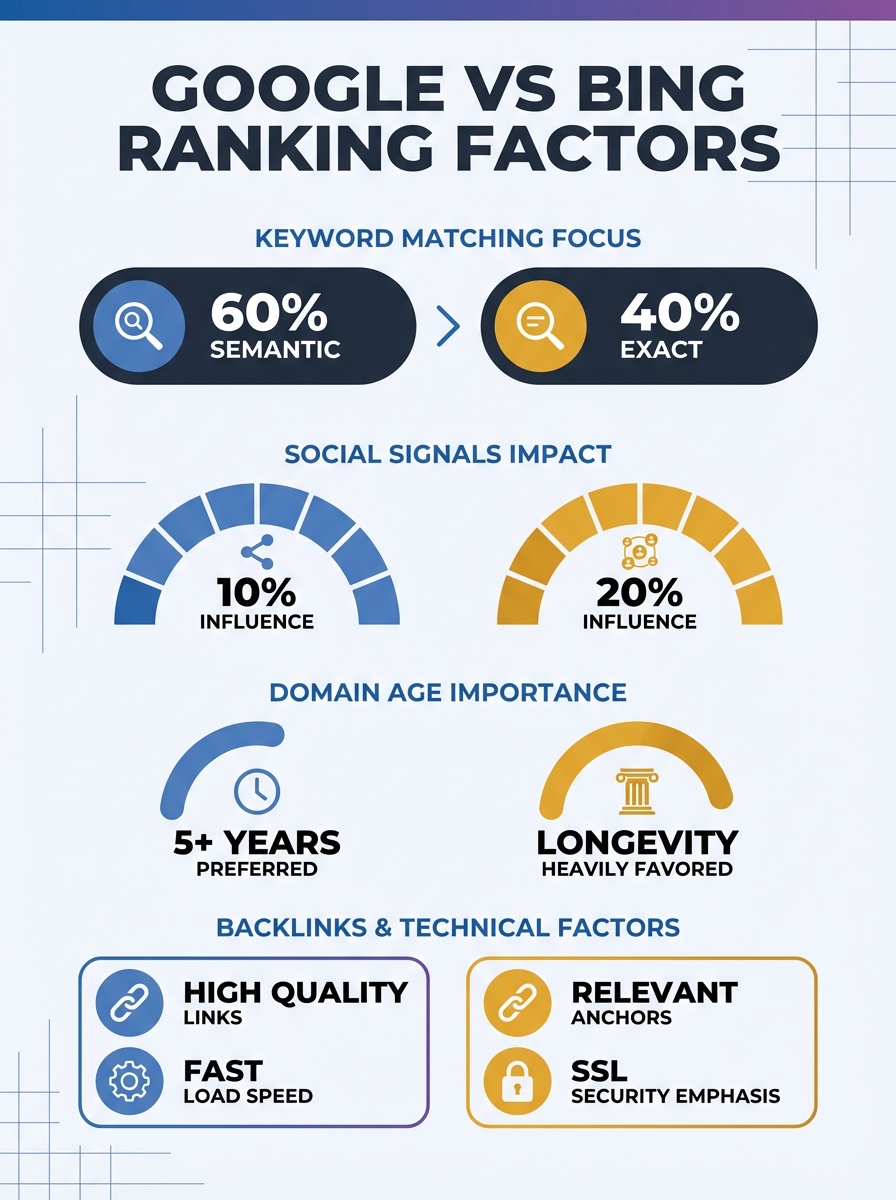
Google's algorithm leans heavily on semantic understanding, entity relationships, and user behavior signals. Bing, by comparison, still places more weight on exact-match keywords, domain age, and social signals. Yes, social signals. Bing has publicly stated that social media activity influences how they evaluate page authority. Google has spent years downplaying that connection.
Here's where it gets practical. Bing rewards pages that use their target keyword in the page title, H1, and early body copy more directly than Google does. Google is better at understanding synonyms and related concepts, so you can write more naturally and still rank. With Bing, being explicit about your primary keyword matters more.

Domain authority carries weight on both engines, but Bing's interpretation favors older, established domains more than Google's does. If you're running a newer site, you'll likely see Bing rankings lag behind Google rankings for the same content. That's normal. It also means your Bing strategy might need to lean harder on building citations and directory listings early on.
And backlinks? Both engines care about them, but Bing appears to value the raw quantity of linking domains slightly more, while Google focuses more on the quality and topical relevance of those links. If you're tracking your keyword rankings across engines, you'll notice these differences show up as real position gaps on identical queries.
DuckDuckGo SEO Optimization: The Bing Connection Most People Miss
Here's the thing about DuckDuckGo SEO optimization that simplifies your life considerably: DuckDuckGo pulls its results primarily from Bing's index. This means that if you're optimizing for Bing, you're simultaneously optimizing for DuckDuckGo. Two engines for the effort of one.
But there's a nuance. DuckDuckGo also pulls from over 400 other sources, including its own web crawler (DuckDuckBot), Apple Maps for local results, and Wikipedia for instant answers. As SiteLint's optimization guide points out, you can use Bing Webmaster Tools to track your site's performance on DuckDuckGo, including rankings, organic traffic, and CTR.
The privacy angle matters here too. DuckDuckGo doesn't personalize results. Every user searching the same query sees the same results. That's fundamentally different from Google, where your ranking position can vary wildly based on location, search history, and device. For SEO practitioners, this means DuckDuckGo results are more predictable and more stable once you earn a position.
DuckDuckGo also features "bang" searches, where users can search directly within specific platforms. As WPBeginner explains, users can type commands like "!zillow Orlando, FL" to search within Zillow directly from DuckDuckGo's search bar. If your brand operates on vertical platforms like Zillow, Yelp, or Amazon, establishing a strong presence there feeds into DuckDuckGo's ecosystem in ways that pure Google optimization doesn't.
Building Your Multi-Engine Search Strategy
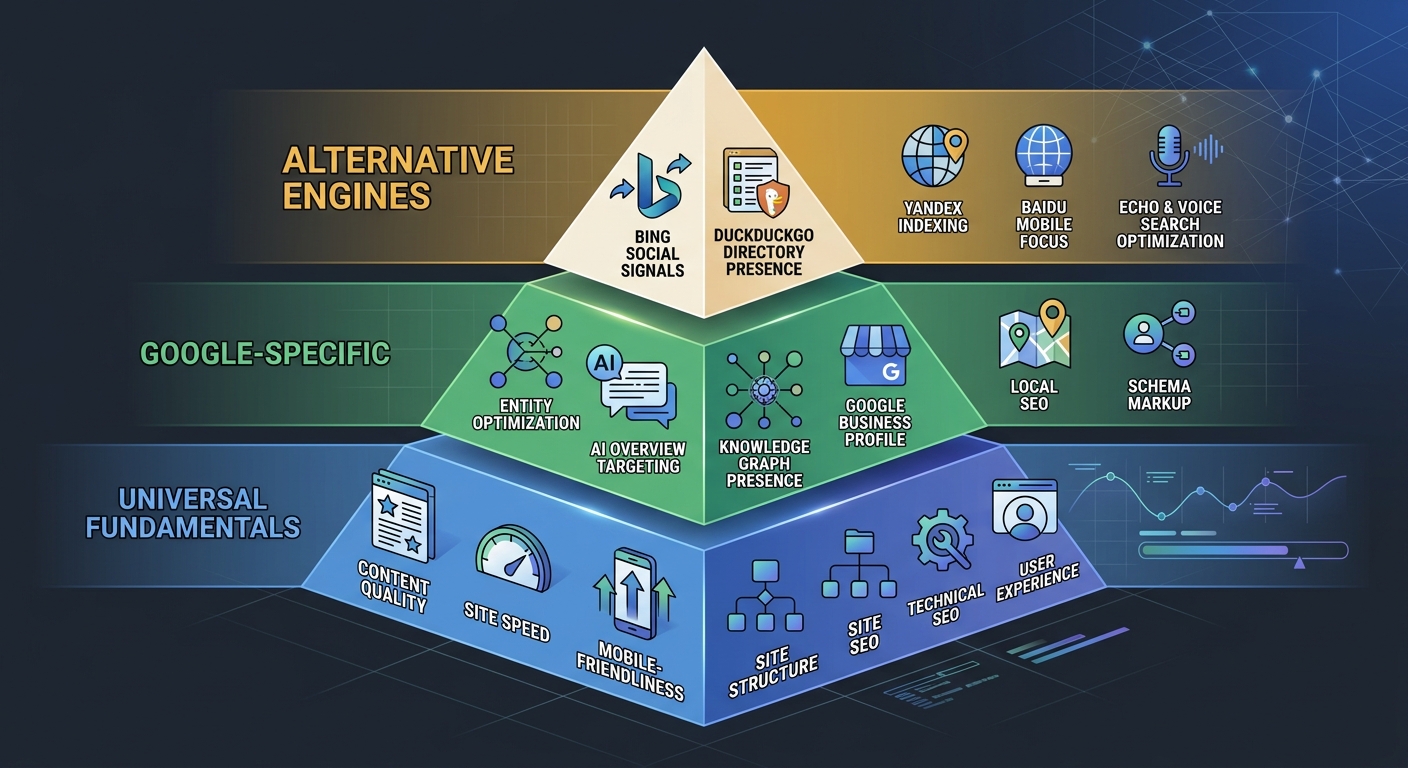
A multi-engine search strategy doesn't mean doing entirely different things for each search engine. About 80% of good SEO practice is universal: quality content, fast page loads, logical site structure, and relevant backlinks. The remaining 20% is where engine-specific tactics make the difference.
Here's the framework I use with clients:
Start with Google-first fundamentals. Google's own SEO starter guide remains the best baseline for technical optimization. Get your crawling, indexing, structured data, and Core Web Vitals right. This foundation serves every engine.
Layer in Bing-specific signals. Submit to Bing Webmaster Tools, verify your social profiles, and ensure your primary keywords appear explicitly in titles and H1 tags.
Audit your presence on vertical platforms. YouTube, Reddit, and niche directories feed into alternative engines' result sets. Build profiles where your audience actually searches.
Monitor performance separately. Don't blend all organic traffic into one bucket. If your analytics implementation isn't properly segmented, you'll never know which engine sends your most valuable visitors.
The biggest mistake I see teams make is treating alternative search engine optimization as an afterthought they'll "get to eventually." By the time they look at it, they've left months of qualified traffic on the table. Even a 3-5% traffic share from Bing and DuckDuckGo can represent meaningful revenue, especially in B2B verticals where the audience skews toward privacy-focused enterprise users.
When Google Optimization Alone Isn't Enough
There are specific scenarios where investing more heavily in alternative engines pays off disproportionately.
Privacy-sensitive industries. Healthcare, legal, finance, and cybersecurity audiences over-index on DuckDuckGo usage. If your target customer cares about data privacy, they're more likely to use a search engine that doesn't track them.
Windows-heavy enterprise environments. Bing is the default search engine in Microsoft Edge, which ships with every Windows installation. In corporate environments where IT departments don't change defaults, Bing captures a surprising share of search activity. I've seen B2B SaaS companies where Bing drives 12-15% of organic traffic simply because their buyers work in locked-down corporate browsers.
Content competing against AI Overviews. When Google's AI Overviews eat your click-through rates on high-value queries, alternative engines become your pressure valve. The same query on Bing or DuckDuckGo often presents traditional blue links without an AI summary consuming the top half of the screen. Understanding how AI and GEO are reshaping competitive rankings helps you identify which queries are worth fighting for on Google and which ones you should pursue elsewhere.
Local businesses. Bing Places and Apple Maps (which feeds into DuckDuckGo's local results) have less competition than Google Business Profile. Claiming and optimizing those listings can land you in top local positions faster. If you're already tracking local keyword performance, extend that monitoring to Bing's local pack.
The YouTube and Reddit Factor
Search behavior is fragmenting beyond traditional engines entirely. YouTube is the second-largest search engine globally, and as Backlinko's strategy guide notes, people search differently there than on Google. Reddit has become an increasingly important source for both users and AI systems that cite discussion threads.
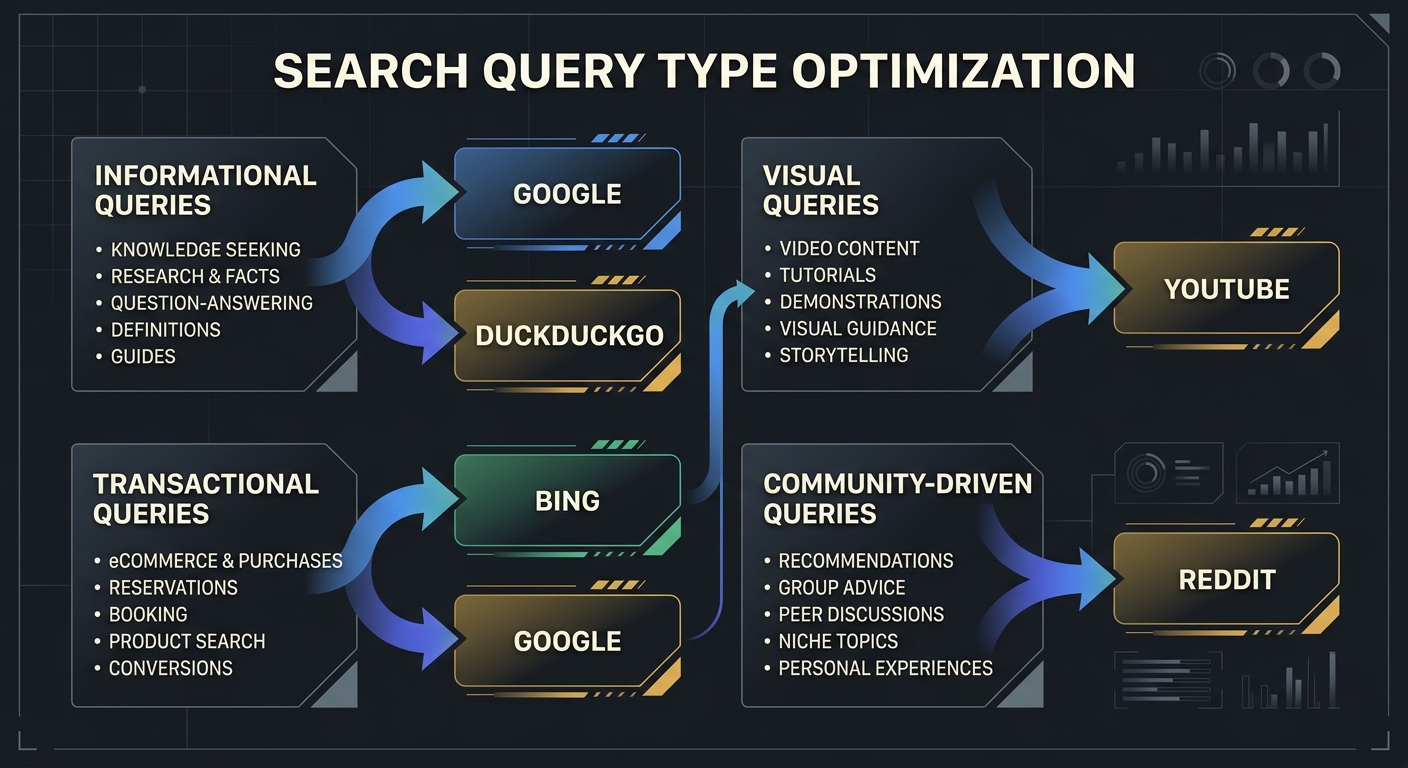
Your content strategy needs to account for this. A blog post that ranks well on Google might not address the same intent as a YouTube search or a Reddit thread. Consider how your topics map across platforms:
Informational queries with visual components → YouTube optimization
Community-driven, opinion-seeking queries → Reddit presence
Transactional and navigational queries → Google and Bing
Privacy-conscious informational queries → DuckDuckGo
This isn't about being everywhere for the sake of it. It's about matching your content format to the platform where your specific audience is searching. Thinking through how your content strategy maps to different channels prevents you from creating generic content that performs mediocrely everywhere instead of excelling somewhere specific.
Practical Allocation: Where to Spend Your Time
I'm not going to pretend there's a universal formula. But after running multi-engine strategies for dozens of sites, here's the allocation that works for most businesses:
70% of effort on Google. It still dominates market share and feeds AI citation systems. Your Google strategy should be the core.
15% on Bing/DuckDuckGo. Most of this is automated once you've set up Bing Webmaster Tools and adjusted your on-page keyword approach. It's low-effort, high-return.
15% on platform-specific optimization. YouTube descriptions, Reddit engagement, directory listings. These feed back into alternative engine results and build the kind of brand authority that helps everywhere.
As Method + Metric's analysis puts it, "Neglecting to build an SEO strategy for alternative search engines, regardless of their market share, can lead to missed revenue." But they also caution against running afoul of Google's preferences in the process. The good news is that nothing about optimizing for Bing or DuckDuckGo conflicts with Google best practices. You're adding layers, not changing direction.
Measuring What Actually Matters
The final piece is measurement. You need to track performance by engine, not just in aggregate. Set up separate segments in your analytics platform to see how Bing, DuckDuckGo, and Google traffic differ in engagement, conversion rate, and revenue.
When I started doing this for clients, the patterns were eye-opening. DuckDuckGo users spent 23% more time on page. Bing users had a 15% higher form completion rate. Google sent 10x the volume but at lower average engagement. These numbers will vary for your business, but you won't know your numbers until you look.
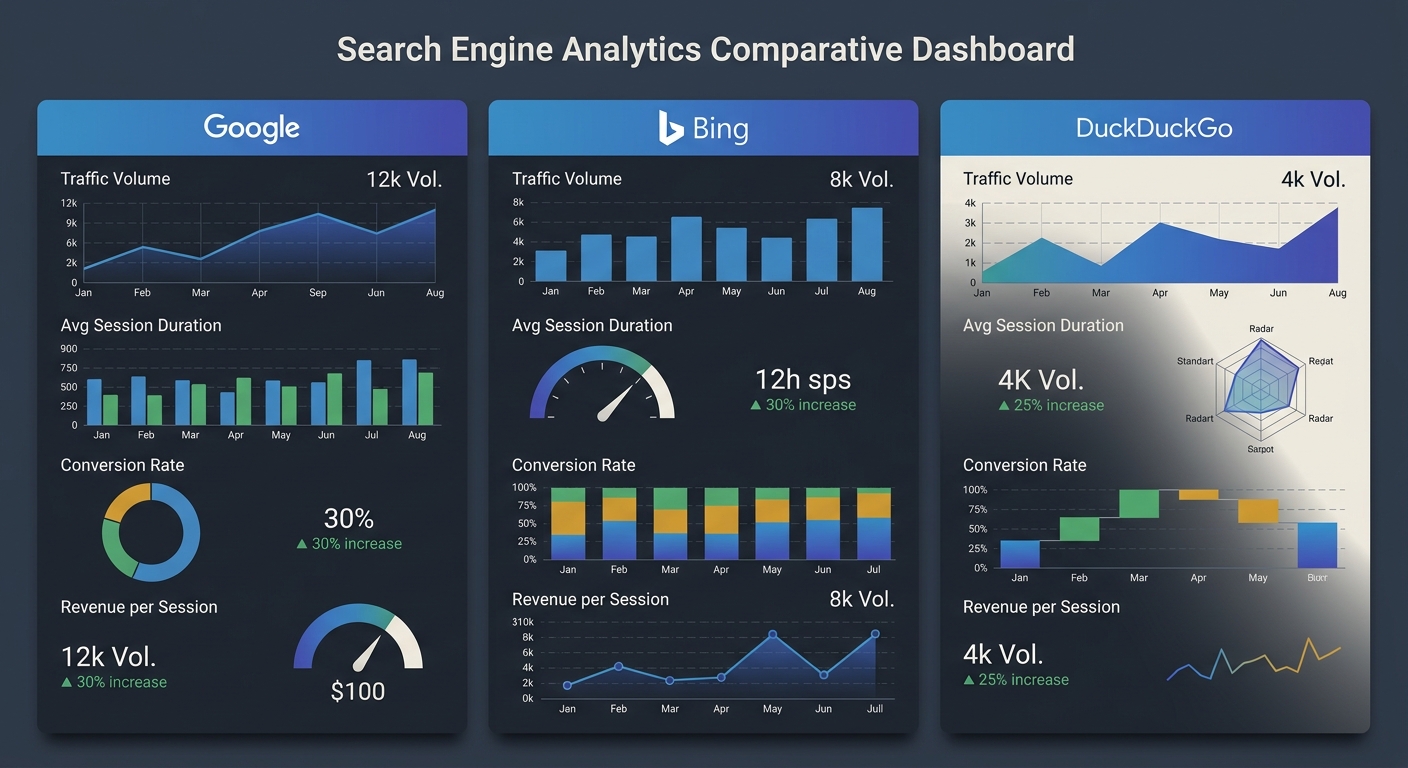
Cross-reference your traffic data with your conversion rate optimization efforts to identify which engines send the most commercially valuable visitors, not just the most visitors.
Where Multi-Engine SEO Delivers Real ROI
Open Bing Webmaster Tools. Submit your sitemap. Verify your site. Then pull your analytics and create engine-specific traffic segments. Those two actions take less than an hour and immediately give you visibility into a channel you've probably been ignoring. From there, audit your top 20 landing pages for explicit keyword placement in titles and H1s, which helps Bing more than Google. That's your search engine diversification strategy, started and measurable, before lunch.
The era of optimizing for a single search engine is over. Not because Google is dying, but because your most valuable customers might be arriving from somewhere you're not watching.

Sarah Chen
SEO strategist and web analytics expert with over 10 years of experience helping businesses improve their organic search visibility. Sarah covers keyword tracking, site audits, and data-driven growth strategies.
Frequently Asked Questions
- What are the main differences between Google and Bing ranking factors?
- Google's algorithm emphasizes semantic understanding and entity relationships, while Bing places more weight on exact-match keywords, domain age, and social signals. Bing rewards pages that use target keywords explicitly in titles, H1 tags, and early body copy more directly than Google does, and favors older, established domains more heavily than Google.
- Why does DuckDuckGo optimization matter if I'm already optimizing for Bing?
- DuckDuckGo pulls its results primarily from Bing's index, so optimizing for Bing simultaneously optimizes for DuckDuckGo. However, DuckDuckGo also pulls from over 400 other sources including its own crawler and features unique "bang" searches that let users search within specific platforms directly.
- How much has Google's organic click-through rate declined due to AI Overviews?
- Google's organic click-through rates have dropped 18-64% on queries where AI Overviews appear, which now reach 2 billion monthly users. This makes alternative search engines like Bing and DuckDuckGo increasingly valuable since they often present traditional blue links without AI summaries consuming the top of the page.
- What is the recommended time and budget allocation across search engines?
- The recommended allocation is 70% of effort on Google, 15% on Bing/DuckDuckGo, and 15% on platform-specific optimization like YouTube and Reddit. Most Bing and DuckDuckGo optimization is low-effort and high-return once you've set up Bing Webmaster Tools and adjusted on-page keyword placement.
- Which industries benefit most from optimizing for alternative search engines?
- Privacy-sensitive industries like healthcare, legal, finance, and cybersecurity benefit most from alternative search engines since their audiences over-index on DuckDuckGo usage. Windows-heavy enterprise environments also see disproportionate value from Bing optimization since it's the default in Microsoft Edge, with B2B SaaS companies sometimes seeing 12-15% of organic traffic from Bing.
- Should I create separate pages for different search engines?
- No, you should not create separate or duplicate pages targeting different search engines, as every engine penalizes thin or duplicate content. Your Bing-specific adjustments should happen within the same pages that target Google, primarily through on-page keyword placement and structured data refinements.
- What's the first action to take for multi-engine SEO?
- Submit your site to Bing Webmaster Tools, verify your site, and upload your sitemap—this single action takes about five minutes and costs nothing while improving your visibility on both Bing and DuckDuckGo simultaneously. Then set up analytics segments to track performance by search engine separately.
- How does DuckDuckGo's lack of personalization affect SEO strategy?
- Since DuckDuckGo doesn't personalize results based on location, search history, or device, every user searching the same query sees identical results. This makes DuckDuckGo rankings more predictable and stable once you earn a position, unlike Google where rankings can vary significantly by user.
Explore more topics