
From Subscription Bloat to API-First SEO: Building a Unified Tool Stack Without Breaking Your Budget
I counted 11 active SEO subscriptions on our company credit card. Eleven. Three of them pulled ranking data from the same source. Two offered nearly identical backlink databases. One hadn't been logged into since someone on the team "needed it for a quick audit" eight months prior.
From Subscription Bloat to API-First SEO: Building a Unified Tool Stack Without Breaking Your Budget
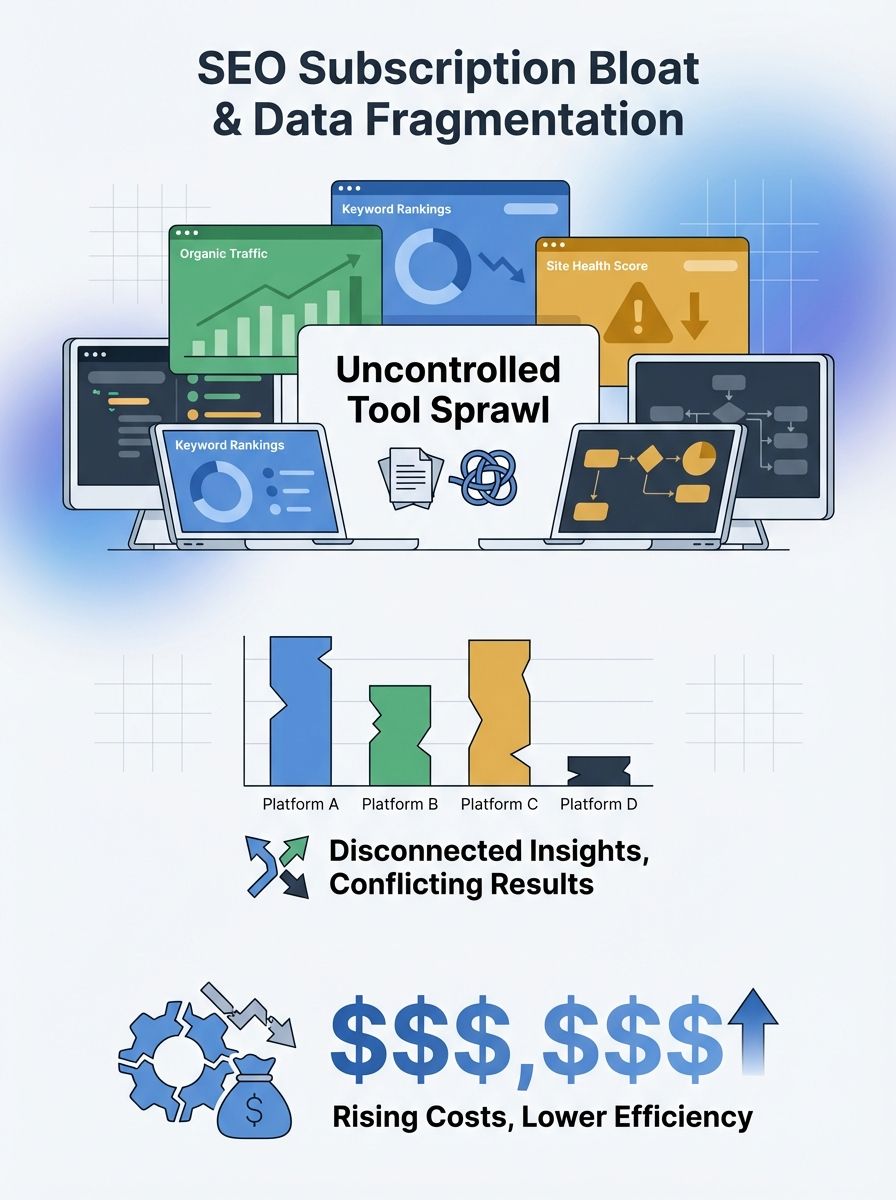
I counted 11 active SEO subscriptions on our company credit card. Eleven. Three of them pulled ranking data from the same source. Two offered nearly identical backlink databases. One hadn't been logged into since someone on the team "needed it for a quick audit" eight months prior. Total monthly spend: $2,847 for a six-person marketing team. That number made me angry enough to rip the whole thing out and start over. What replaced it costs $640 a month and does more.
This is the story of how we got there, and a practical framework you can steal to do the same.
The Subscription Tax Nobody Talks About
Every SEO tool starts the same way. Someone on the team hits a wall, Googles a solution, signs up for a free trial, and then the card goes on file. Multiply that by three years of team turnover and shifting priorities, and you've got a Frankenstein stack where nobody can explain why you're paying for all of it.
The financial waste is obvious. But the hidden cost is worse: fragmented data. When your rank tracking lives in one tool, your backlink analysis in another, and your technical audits in a third, you spend absurd amounts of time reconciling numbers that never quite agree. Research shows that agencies using more than five SEO tools without integration waste an average of 18 hours per month on redundant reporting and data reconciliation. That's over two full working days, gone.
And it's not just time. When your analytics dashboards pull from conflicting sources, you make decisions based on whichever number feels right rather than whichever number is right. I've watched teams argue for 30 minutes about whether organic traffic went up or down, because two tools showed opposite trends for the same period.
SEO tool consolidation isn't about being cheap. It's about building a stack where the data actually agrees with itself.
What "API-First" Actually Means (And Doesn't Mean)
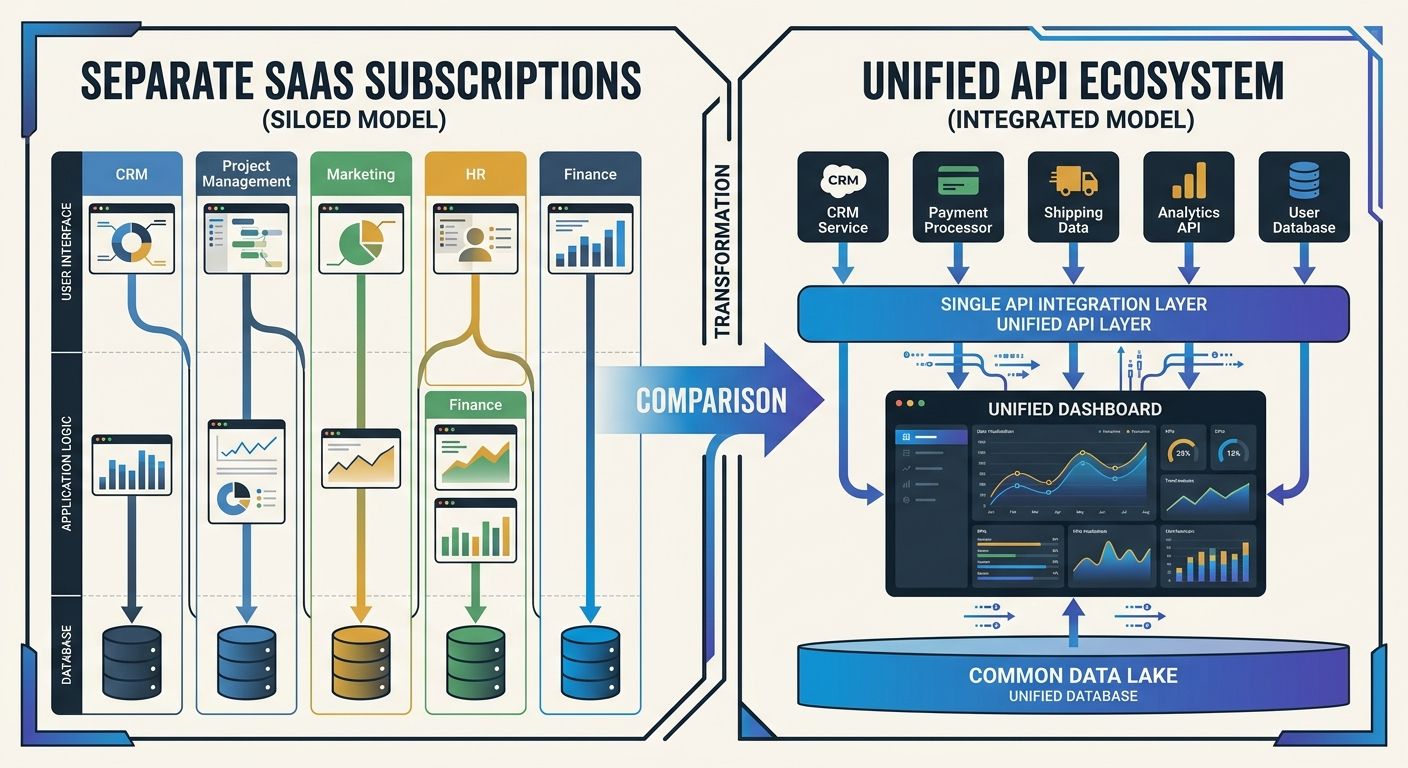
The term gets thrown around loosely, so let me be specific. An API-first SEO approach means you're consuming raw data through programmatic interfaces and assembling your own workflows, instead of paying for someone else's UI wrapped around that same data.
Here's what most people miss: the big-name SEO platforms are themselves built on top of data providers. They license crawl data, SERP results, and backlink indexes, then package it with a nice interface and charge you a premium. When you go API-first, you're cutting out the middleman and buying closer to the source.
This doesn't mean you need a team of engineers. It means you need one person comfortable with basic scripting or a low-code automation tool, and a clear understanding of what data you actually need versus what a sales page convinced you that you need.
The real mental shift is moving from "which tool should I subscribe to?" to "what data do I need, and what's the cheapest reliable way to get it?"
The Audit That Starts Everything
Before you consolidate anything, you need an honest inventory. Here's the framework I used:
List every tool with an active subscription, the monthly cost, and the last login date for each team member
Tag each tool with its primary function: rank tracking, backlink analysis, technical audit, content optimization, SERP monitoring, or reporting
Identify overlaps where two or more tools serve the same primary function
For each function, determine how often you actually use it: daily, weekly, monthly, or "when someone remembers"
Calculate cost-per-actual-use by dividing monthly spend by the number of times the tool was meaningfully used that month
When I ran this audit on our stack, the results were embarrassing. We were paying $179/month for a technical audit tool we ran quarterly. That's $44.75 per crawl for something an API call could handle for under $5. Our rank tracking was split across two platforms because one "had better local data," except nobody had validated that claim in over a year.
The pattern I keep seeing when I talk to other teams is the same: 40-60% of tool spend goes to overlapping functionality or tools used less than once a month. That's your budget for building something better.
Building the Unified Stack: A Practical Architecture
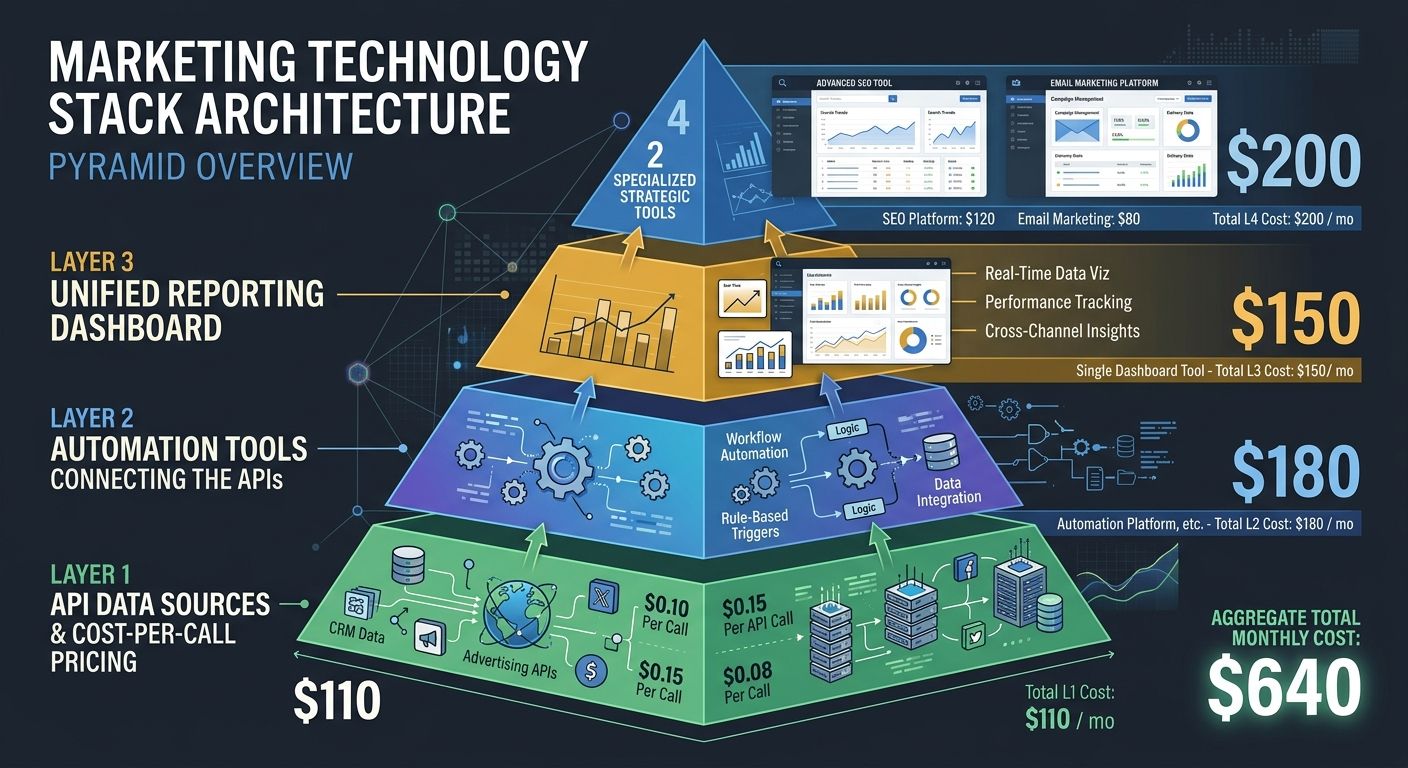
Here's the stack architecture that replaced our 11 subscriptions. I'm not saying this is the only way, but it's battle-tested across our own work and three client implementations.
Layer 1: Core Data via API
The foundation is a consumption-based SEO data provider. We chose DataForSEO after testing three alternatives. The key difference from subscription tools: you pay per API call, not per month. If you need 10,000 SERP checks this month and 500 next month, your bill reflects that. According to NextGrowth.ai's review of the platform, shifting from subscription to consumption-based pricing is the single biggest lever in reducing tool spend.
The DataForSEO implementation covered four core needs for us: rank tracking, SERP feature monitoring, backlink checking, and on-page technical audits. Their API stack provides endpoints for each of these, and the pay-as-you-go model meant we could scale individual functions independently.
Layer 2: Automation and Orchestration
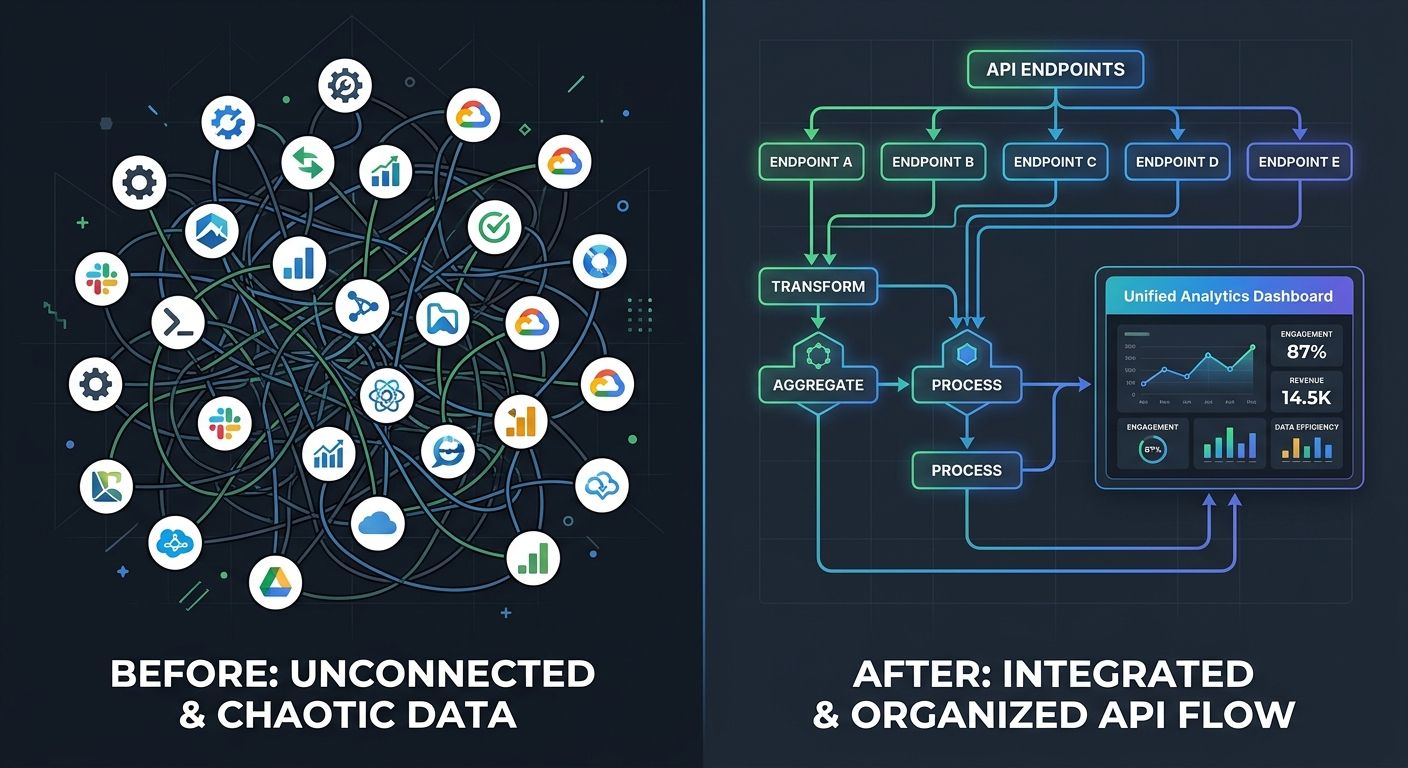
Raw API access is useless without workflows. We use n8n (self-hosted, open source) to stitch everything together. A typical workflow: every Monday at 6 AM, pull ranking data for our priority keywords, merge it with Google Search Console click data from the past 7 days, flag any keyword that dropped more than 3 positions, and push an alert to Slack with the affected URLs.
Building this took about six hours. It replaced a manual process that took someone 90 minutes every Monday morning, plus an Ahrefs subscription we were using primarily for rank tracking.
Layer 3: Reporting Dashboard
All data flows into a single Looker Studio dashboard. One source of truth. No more "my tool says something different" debates. If you want to understand why your current data might be misleading you, separating traffic metrics from conversion outcomes in this dashboard is critical.
Layer 4: Specialized Tools (Sparingly)
Some things are genuinely hard to replicate with APIs alone. We kept Screaming Frog for deep technical crawls and Clearscope for content optimization. That's it. Two subscriptions, each serving a function nothing else in our stack covers.
The Numbers: Before and After
Here's our actual spend comparison:
Before (11 subscriptions):
Ahrefs: $249/mo
Semrush: $229/mo
SE Ranking: $89/mo
Moz Pro: $99/mo
Screaming Frog: $259/yr ($22/mo)
AccuRanker: $129/mo
Clearscope: $170/mo
Surfer SEO: $99/mo
Sitebulb: $35/mo
BrightLocal: $79/mo
SpyFu: $79/mo
Total: $2,847/mo
After (API-first + 2 subscriptions):
DataForSEO (consumption-based): ~$350/mo
Screaming Frog: $22/mo
Clearscope: $170/mo
n8n (self-hosted): $18/mo (server costs)
Looker Studio: Free
Google Search Console: Free
GA4: Free
Total: ~$640/mo
That's a 78% reduction. And our data is more reliable now because it flows through a single pipeline instead of being manually compared across platforms.
Some caveats: the upfront investment was about 40 hours of development time to build the automation workflows. If you're comparing rank tracking tools as standalone products, the UI experience in Ahrefs or Semrush is genuinely better than what you'll build yourself. You're trading polish for control and cost savings.
Where Most Teams Get This Wrong
I've seen three common failure modes in marketing tech stack optimization projects:
Trying to replace everything at once. Don't. Start with the function where you have the most overlap (usually rank tracking), build the API replacement, validate it for 30 days against your existing tool, then cancel the subscription. One function at a time.
Underestimating the maintenance burden. APIs change. Endpoints get deprecated. Your automation will break at some point. Budget 2-3 hours per month for maintenance. If nobody on your team can debug a broken API call, this approach isn't for you yet.
Ignoring data compliance. As Robert Goldenowl's analysis of SEO API providers points out, if you plan to resell data or integrate it into client-facing tools, you need to ensure the provider's terms allow it and that they maintain high data integrity standards. Read the terms of service before building a client-facing product on top of someone else's data.
The teams that succeed treat this as an engineering project, not a shopping exercise. You're building infrastructure, not just swapping one vendor for another.
When Consolidation Goes Beyond Tools
The API-first mindset naturally extends to content strategy. Google consolidated six microsites for Google Retail into one hub, which doubled their CTA click-through rates and increased organic traffic by 64%. The same principle applies to your tool stack: fewer, better-connected pieces outperform a sprawl of disconnected ones.
This is also why understanding how evolving search patterns affect your strategy matters when choosing your stack. If AI answer engines are reshaping where your traffic comes from, your tools need to track those new surfaces. An API-first approach lets you add a new data source in hours, not months of waiting for your SaaS vendor to build a new feature.
Your Move: The 30-Day Plan
Week 1: Run the audit framework from above. Get the real numbers. Share them with your team or manager. The sticker shock does the selling for you.
Week 2: Pick your most redundant function (again, usually rank tracking) and set up a parallel API-based workflow. Run both systems simultaneously.
Week 3: Compare outputs daily. When the API data matches or exceeds the subscription tool's accuracy, you've got your proof of concept.
Week 4: Cancel the first subscription. Document the process. Move to the next function.
The whole point of API-first SEO tools isn't technical purity for its own sake. It's about spending less money on better data, reclaiming the hours you lose to manual reconciliation, and building a stack that adapts to your needs instead of forcing you into someone else's product roadmap. Eleven tools felt like progress at the time. Two subscriptions and an API turned out to be the actual answer.

Sarah Chen
SEO strategist and web analytics expert with over 10 years of experience helping businesses improve their organic search visibility. Sarah covers keyword tracking, site audits, and data-driven growth strategies.
Explore more topics