
AI Search Tools Supplement Rather Than Replace Google, Similarweb Traffic Data Shows
Ninety-five percent of ChatGPT's 494 million users also actively use Google, according to Similarweb data tracking audience overlap between March and May 2026, showing AI search tools have not replaced traditional search engines but instead added a supplementary layer to existing search behavior, ac

AI Search Tools Supplement Rather Than Replace Google, Similarweb Traffic Data Shows
Ninety-five percent of ChatGPT's 494 million users also actively use Google, according to Similarweb data tracking audience overlap between March and May 2026, showing AI search tools have not replaced traditional search engines but instead added a supplementary layer to existing search behavior, according to analysis published by Search Engine Journal.
The findings appear in Similarweb's 38-page "2026 Generative AI Landscape: The Evolution of AI Search" report, which Rand Fishkin, co-founder and CEO of SparkToro, highlighted on LinkedIn July 24 as data that challenges both AI adoption enthusiasts and skeptics simultaneously. Traditional search platforms maintain a five-to-one volume advantage over AI chatbots despite year-over-year growth in the latter category.
Search Volume Gap Persists Despite AI Growth
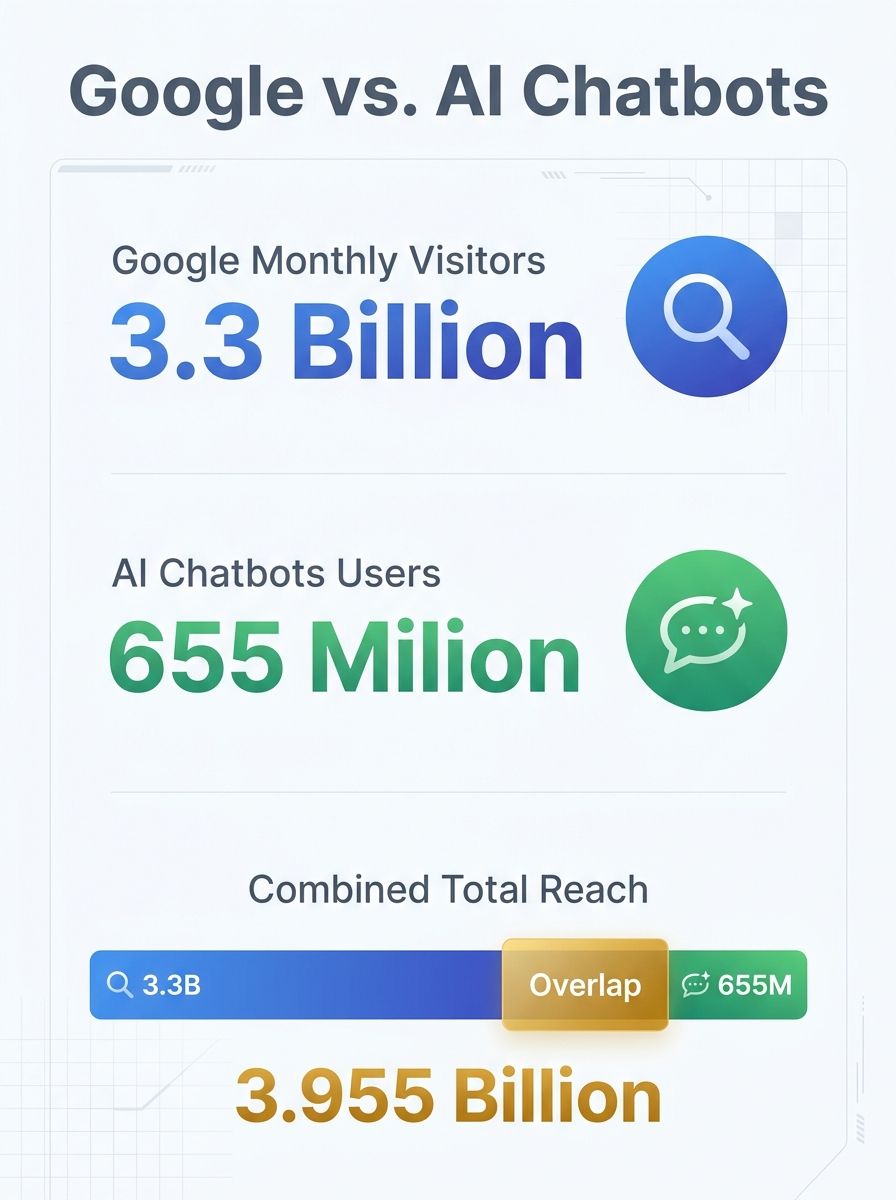
Traditional search engines drew 3.3 billion average monthly unique visitors worldwide through May 2026, while AI chatbots collectively attracted 655 million users despite growing 57% year over year, the Similarweb data shows. The 461 million users who maintain active accounts on both ChatGPT and Google represent behavior additive to existing search habits rather than substitution.
Only 6.8% of ChatGPT answers in the United States included a link to an external source as of May 2026, according to the report. That figure represents a fivefold increase from approximately 1% one year earlier, yet means 93 of every 100 AI-generated responses still direct users to no external destination. Ethan Smith of Graphite noted in the report that users are applying longer, conversational prompt formats to traditional Google searches as average query length climbs steadily since AI Mode launched.
AI Platform Adoption Shows Mainstream Momentum
Generative AI platforms recorded 9.5 billion average monthly web visits between June 2025 and May 2026, up 70% year over year, while app downloads worldwide climbed to 2.7 billion, up 134%, the Similarweb report found. Half of all generative AI users are now 35 or older, compared to 61% under age 34 two years earlier.
"Growth concentrated in younger demographics can fade with trends; growth spreading into older generations is often what durable, mainstream adoption looks like," said Michael Horrocks of Miro in the report. Meta AI's publicly disclosed monthly active users increased from 384 million in September 2024 to 1.2 billion by March 2026, more than tripling in 18 months by embedding AI functionality inside Instagram, Facebook, WhatsApp, and Messenger rather than operating as a standalone destination.
ChatGPT ad penetration in the United States jumped from 14% of desktop chat sessions in May 2026 to 26% one month later, the data shows. The rapid advertising adoption rate signals commercial viability despite citation and referral traffic patterns that differ sharply from traditional search behavior.
Citation Patterns Reveal Homepage-Deep Page Disconnect
Sixty-five percent of URLs that ChatGPT cites in responses sit two or three folder levels deep in site architecture, according to analysis by Aleyda Solis of Orainti included in the Similarweb report. Yet 58.8% of referral traffic that AI platforms send back to websites lands on the homepage rather than the cited page itself, creating a disconnect between content that earns citations and pages that receive actual visitor traffic.
The gap between cited pages and clicked destinations requires separate tracking for citation rate versus referral conversion, Solis noted. Brands holding first-page Google rankings face similar visibility challenges in AI-generated answers, where traditional ranking signals don't guarantee inclusion in chatbot responses. Citation folder depth and homepage landing behavior function as independent metrics that conflate when reported as a single "AI visibility" score.
Fishkin compared the measurement challenge to 20th-century advertising, where billboard and radio advertisers proved campaign effectiveness by tracking downstream store visits rather than counting ad impressions. The mechanism delivering traffic has changed from search result clicks to AI referrals, but the discipline of measuring conversion behavior rather than surface-level visibility metrics remains constant.
The Takeaway
The data settles a binary argument—AI search versus traditional search—by showing it was the wrong question. Marketing teams treating AI visibility and traditional SEO as competing budget allocations are missing behavior that layers both channels simultaneously. Ninety-five percent audience overlap means the same users who type conversational prompts into ChatGPT also conduct standard Google searches, often for the same research intent, with citation patterns and click-through paths that follow entirely different rules.
The 65%-versus-59% folder-depth mismatch presents the immediate strategic shift: content earning AI citations lives in the site architecture layers doing evidentiary work, while the pages actually receiving referral traffic sit at the homepage or top navigation level. Building a unified SEO strategy across traditional and AI search channels requires separate KPIs for citation rate (does AI trust your content as a source) and referral conversion (what happens when humans click through from that citation). Agencies conflating those two metrics in a single dashboard miss both problems—content not cited, and cited content not converting—at the same time.
The 6.8% external link rate in ChatGPT answers, up from 1% a year ago, represents the actual surface area for optimization work today. That's the fraction of AI responses where content teams can influence which URLs appear, where they send traffic, and whether the landing experience converts visitors who arrived expecting a conversational answer rather than a traditional search result page.

Sarah Chen
SEO strategist and web analytics expert with over 10 years of experience helping businesses improve their organic search visibility. Sarah covers keyword tracking, site audits, and data-driven growth strategies.
Related Articles
Brands Ranking #1 on Google Missing 62% of AI Overview Citations, Adweek Analysis Shows
Brands holding first-page Google rankings are absent from 62% of citations in AI-generated search answers, according to a July 22 analysis by Adweek examining generative engine optimization adoption patterns, as only 38% of pages cited in Google's AI Overviews come from URLs in the top ten tradition

Seventy-Three Percent of Marketers Now Prioritize AI-Generated Answer Optimization as Google Query Volume Reaches Record High
Seventy-three percent of marketers now prioritize content designed to appear in AI-generated search answers, according to a July 21 analysis by SEO Essex citing 2026 Interactive Advertising Bureau data, as Google search query volume reaches an all-time high despite declining click-through rates on t
The Dual-Engine Visibility Strategy: Getting Your Content Into Both Google Search and AI Overviews in 2026
Google's own AI optimization guide, published May 15, 2026, explicitly advises site owners against creating separate AI-specific content. That guidance contradicts the central premise of every "AEO specialist" selling parallel content strategies for traditional search and generative AI surfaces.
Explore more topics