
From Organic to GEO: Building a Unified SEO Strategy Across Google, AI Engines, and Local Search in 2026
Citation rates for top-10 organic results inside Google's AI Overviews dropped from 76% in mid-2025 to between 17% and 54% in 2026.
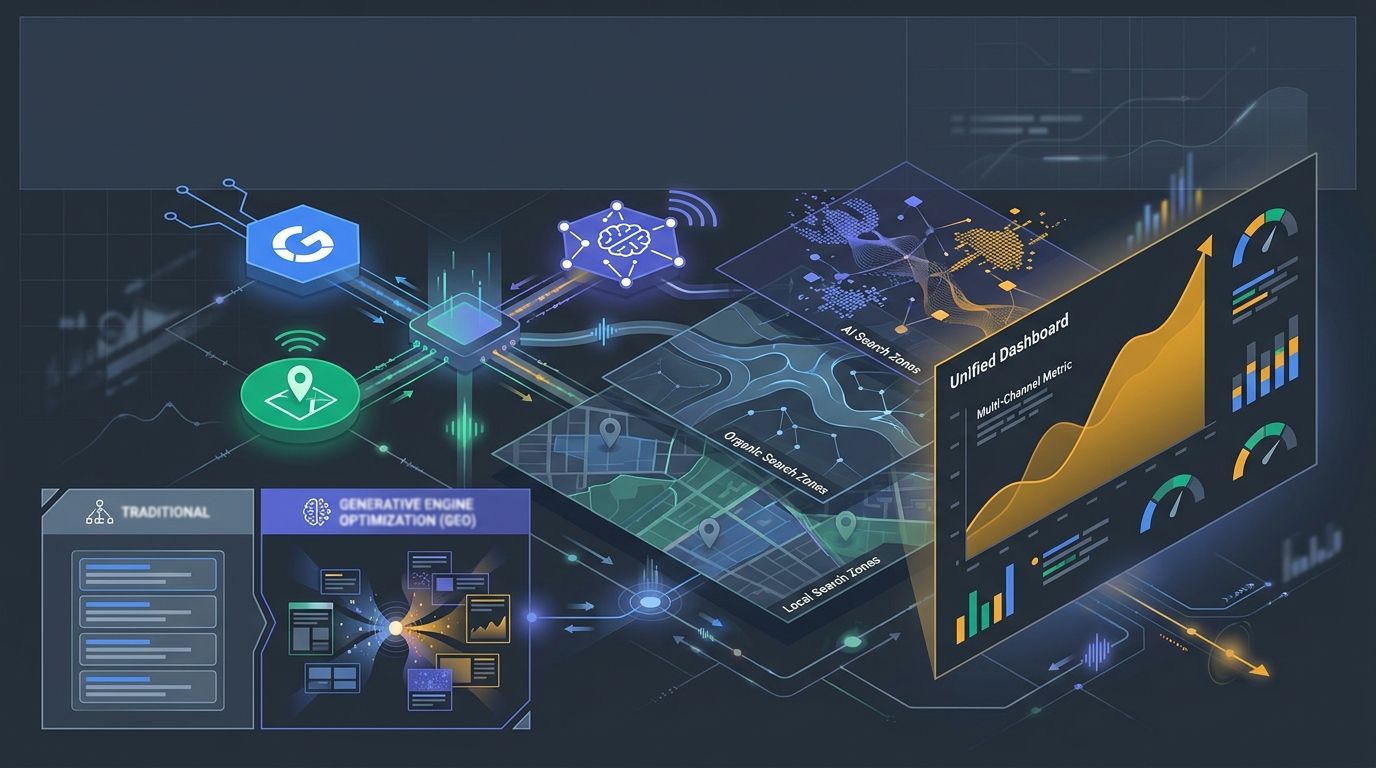
From Organic to GEO: Building a Unified SEO Strategy Across Google, AI Engines, and Local Search
Citation rates for top-10 organic results inside Google's AI Overviews dropped from 76% in mid-2025 to between 17% and 54% in 2026. A unified SEO framework spanning traditional search, AI answer engines, and local listings now determines whether organic traffic converts or evaporates at the point of discovery.
The Citation Math That Broke Siloed SEO
Why does a page ranking #1 organically still lose traffic? Because AI Overviews, ChatGPT, Perplexity, and Gemini pull citations from a wider and less predictable pool of sources. Reddit threads, niche community sites, and pages with rich structured data are capturing citation share that previously belonged to top-10 blue-link results exclusively. According to analysis from Evergreen Media, websites with strong brand signals across multiple platforms show greater resilience to Google's algorithmic shifts, including the March and May 2026 core updates.
The conversion impact is direct. When a B2B buyer asks ChatGPT to recommend CRM software and your product doesn't appear in the response, you've lost the lead before they ever open Google. As G2's June 2026 review of AEO optimization tools documents, answer engine optimization software now helps brands "monitor, analyze, and improve their visibility in AI-powered search engines, LLMs, and AI chatbots." That software category barely existed eighteen months ago.
A GEO strategy in 2026 requires tracking where your content gets cited across surfaces, not where it ranks on a single SERP.
Google's Own Guidance Calls AEO and GEO "Still SEO"
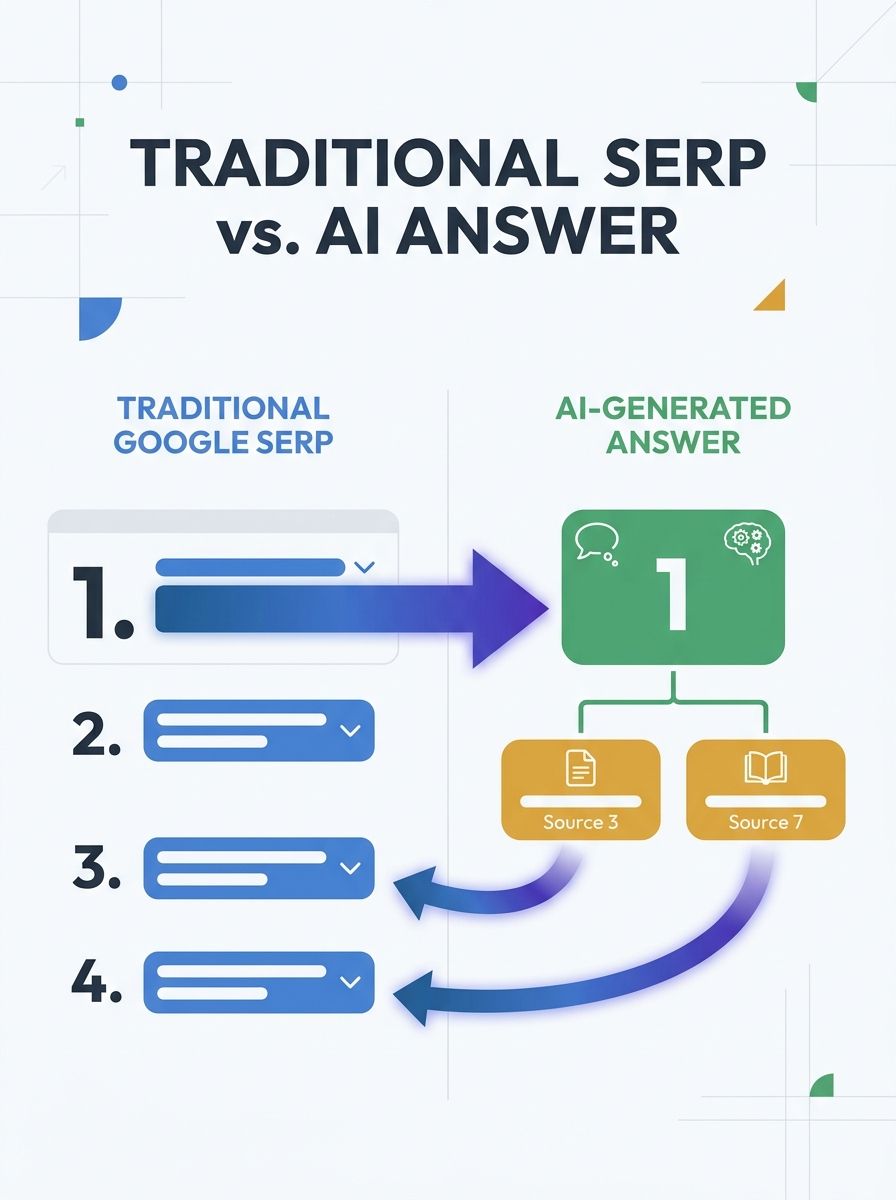
Google's May 2026 Search Central documentation addresses AEO optimization and GEO head-on. The official guide defines AEO as "answer engine optimization" and GEO as "generative engine optimization," describing both as "terms you may see used to describe work specifically focused on improving visibility in AI search experiences." Google's position is unambiguous: these disciplines extend existing SEO practice rather than replacing it.
This matters for conversion optimization because you don't need three separate content strategies. The sites winning through the March and May 2026 core updates share specific traits: genuine expertise, original content, solid technical performance, and real, earned authority, according to analysis from Aik Designs. Those same traits drive AI citation rates and local search prominence.
Search Engine Land's 2026 analysis argues the industry needs to "kill the channel silo and let the SEO team act as the strategic quarterback for brand authority." Teams still treating organic, AI, and local as separate reporting lines fragment their authority signals and, consequently, their conversion funnels. The organizational walls I've written about before around how technical SEO work gets lost between teams apply with equal force here.
The Three-Surface Visibility Model
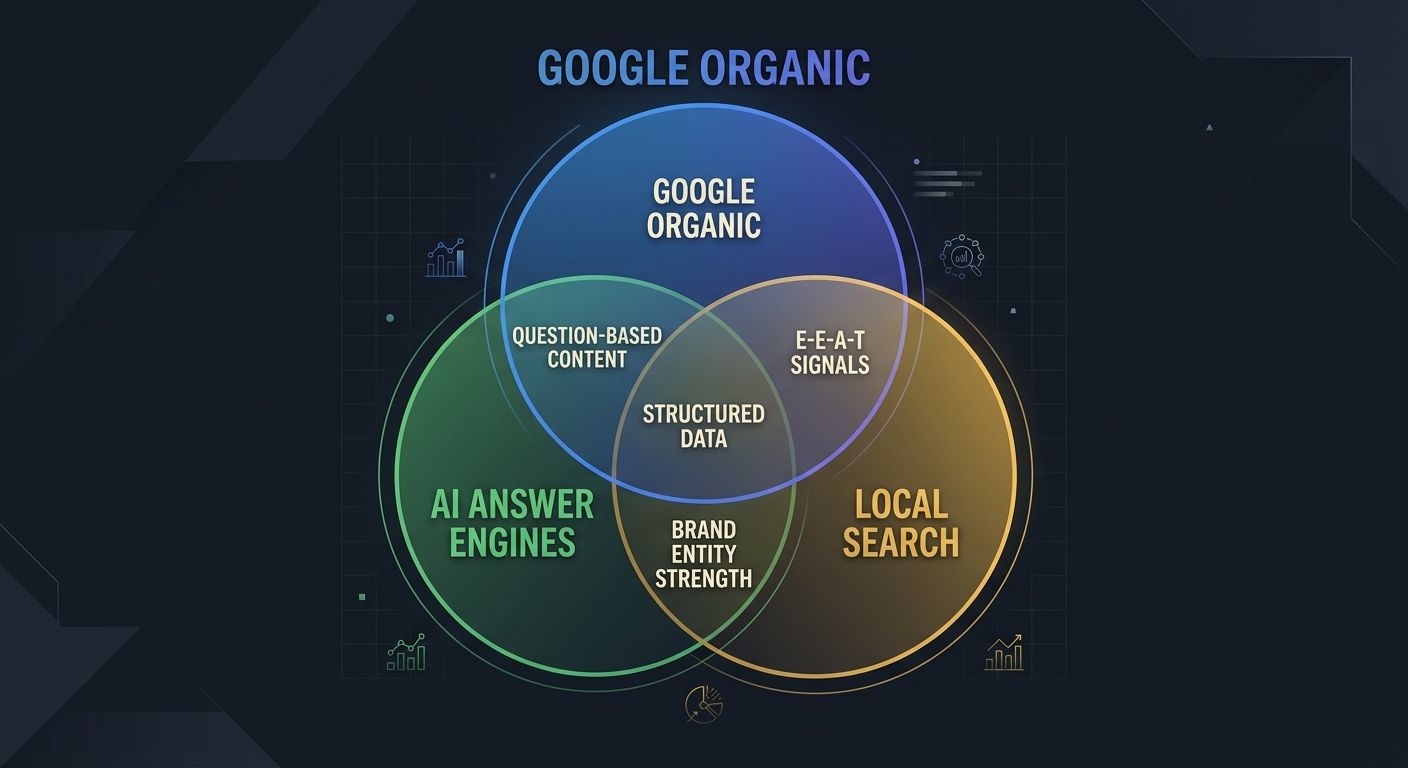
A unified SEO framework needs to account for how each surface discovers, evaluates, and presents your content differently. I've been using what I call the Three-Surface Visibility Model with enterprise clients to audit and prioritize optimization work across Google organic, AI answer engines, and local search simultaneously.
Surface | Discovery Mechanism | Key Ranking Signal | Primary Conversion Action | Optimization Priority |
|---|---|---|---|---|
Google Organic | Googlebot crawl + index | E-E-A-T, backlinks, technical health | Click-through to site | Page speed, internal linking, content depth |
AI Answer Engines | LLM training data + real-time retrieval | Citation authority, statistical density, expert quotations | Brand mention in AI response | 200–300 word content chunks, FAQ schema, source attribution |
Local Search | Google Business Profile + local signals | Proximity, reviews, NAP consistency | Phone call, direction request, booking | Review management, local schema, GBP completeness |
Princeton and Georgia Tech research shows that targeted content optimization can increase visibility in generative AI responses by up to 40%. The three modifications with the highest measured impact are adding direct quotations from named experts (+42.6% citation lift), including specific statistics with sources (+32.8%), and citing authoritative references (+27.7%). These are the same practices that strengthen E-E-A-T signals for traditional Google rankings and build the trust that drives local conversions.
The model works because optimization overlap between the three surfaces is larger than most teams assume. Adding expert quotes and statistics to a service page improves its AI search visibility, its organic ranking potential, and its conversion rate for local visitors who land on it. One investment, three returns.
Content Architecture for Multi-Channel Ranking
Research from ALM Corp's 2026 AI search analysis found that content mirroring natural question language outperforms keyword-dense phrasing in generative responses. Phrases like "what is the best way to," "how do I," and "which option works for" trigger higher citation rates than traditional keyword targeting.
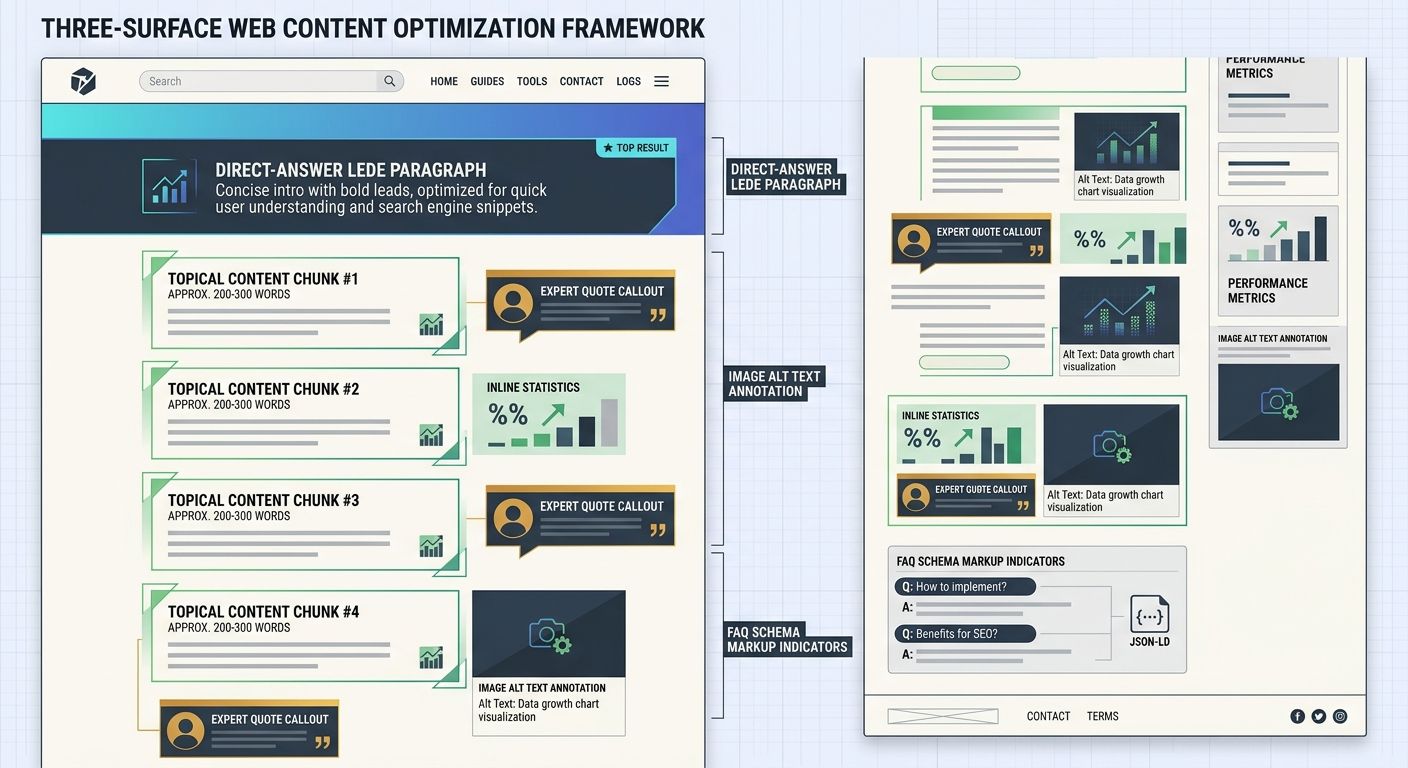
Structure each page around 200–300 word topical chunks with clear H2 headers. Each chunk should open with a direct answer to the question implied by its heading. This architecture serves three purposes simultaneously: Google's crawlers parse the semantic structure efficiently, LLMs extract self-contained answer blocks for citation, and local searchers scanning on mobile find answers without scrolling through dense paragraphs.
If your current site architecture is built around crawl priority for Googlebot alone, you're missing the structural signals that AI answer engines need. FAQPage schema remains functional for LLM retrieval even after Google removed FAQ rich snippets in June 2026, according to HubSpot's local SEO documentation. Keep implementing it.
Multimodal accessibility also matters. Pages that include images with descriptive alt text and videos with transcripts perform measurably better in AI-generated responses than text-only pages, per ALM Corp's analysis. The same visual content that earns AI citations increases on-page engagement and reduces bounce rates, creating a compounding effect on conversion.
Brand Entity Signals as the Conversion Multiplier
Gartner's forecast that 25% of organic search traffic will shift to AI surfaces by the end of 2026 puts brand entity recognition at the center of every conversion strategy. AI engines select sources based on entity signals: verified identities, consistent NAP data, schema markup connecting your organization to its people, and presence across authoritative platforms.
E-E-A-T has evolved into what practitioners are calling E³: Expertise, Experience, and Entity. Entity-based indexing cross-references verified identities and schema to assign credibility scores that determine whether your content gets cited or passed over. With Google's AI Mode crossing 1 billion monthly active users, these entity signals now influence a massive portion of search behavior.
The conversion path works in sequence: a buyer encounters your brand in a ChatGPT response, validates it through a Google search, checks local reviews on your Google Business Profile, then converts. Each touchpoint either reinforces or undermines the entity signals that surface you. A multi-channel visibility audit catches gaps in this chain before they cost you leads.
Digital PR, community presence, and multi-platform footprints create the entity signals AI agents reference when selecting sources. And if you haven't explored why AI chatbot visibility operates independently of Google rankings, that gap deserves attention. Brand investment is a direct SEO and conversion priority, not a separate line item.
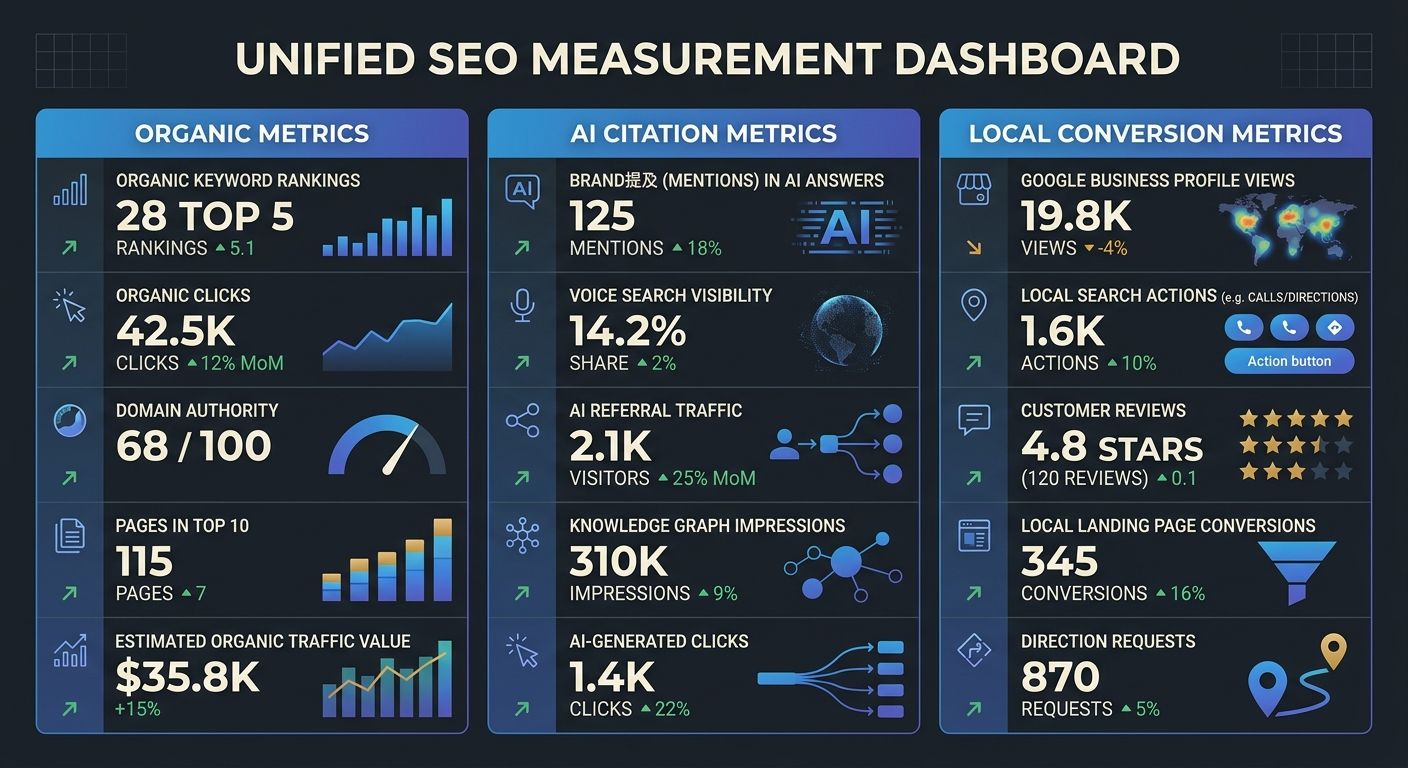
Measuring Across All Three Surfaces
Traditional rank tracking captures roughly one-third of the visibility picture. If your benchmarking cadence is based solely on organic keyword positions, you're ignoring AI citation frequency and local pack performance entirely.
A unified measurement approach tracks three categories:
Organic surface metrics: keyword positions, click-through rates, pages indexed, Core Web Vitals scores. These remain foundational. Sites with solid technical performance continue winning through algorithm updates, and organic still accounts for the majority of search-driven conversions in most verticals.
AI surface metrics: citation frequency across ChatGPT, Gemini, Perplexity, and AI Overviews; brand mention sentiment; answer accuracy for branded queries. The AEO tools reviewed on G2 now track these across platforms, with most offering weekly monitoring cadences and competitive benchmarking.
Local surface metrics: Google Business Profile impressions, direction requests, phone calls, review velocity, local pack position for target queries. These are the closest to direct conversion signals and the easiest to tie to revenue.
SEO compounds over time and works alongside paid, email, and social channels across the full customer journey. The GEO strategy 2026 demands extends this compounding principle to AI and local surfaces, where each citation builds on the last.
What The Data Doesn't Tell Us
The case for unified optimization is strong, but significant gaps remain. Citation tracking across AI engines is still imprecise. ChatGPT and Perplexity don't expose their source-selection algorithms the way Google's ranking factors have been studied and reverse-engineered over two decades. The 17–54% citation range for top-10 organic results is wide enough to suggest that AI citation patterns vary significantly by query type, vertical, and content format.
Attribution between surfaces also remains murky. When a customer discovers your brand through an AI chatbot, validates you through organic search, and converts through your local listing, which surface gets credit? Current analytics tools aren't built for three-surface attribution, and the organizations doing the most interesting work here are building custom tracking layers on top of existing platforms.
The Gartner 25% traffic-shift projection, while directionally useful, covers an average across industries. B2B software and healthcare will see sharper shifts. Local services and e-commerce may see far less. Your own data matters more than industry benchmarks. If you haven't audited where AI chatbots send research traffic in your specific vertical, that gap is worth closing before investing heavily in GEO-specific tooling.
What the numbers do confirm is that the walls between organic, AI, and local search are dissolving faster than most teams can restructure around. The conversion opportunities will concentrate with organizations that treat all three surfaces as a single system, measure across them consistently, and build the entity authority that every surface rewards.
Sarah Chen
SEO strategist and web analytics expert with over 10 years of experience helping businesses improve their organic search visibility. Sarah covers keyword tracking, site audits, and data-driven growth strategies.
Related Articles
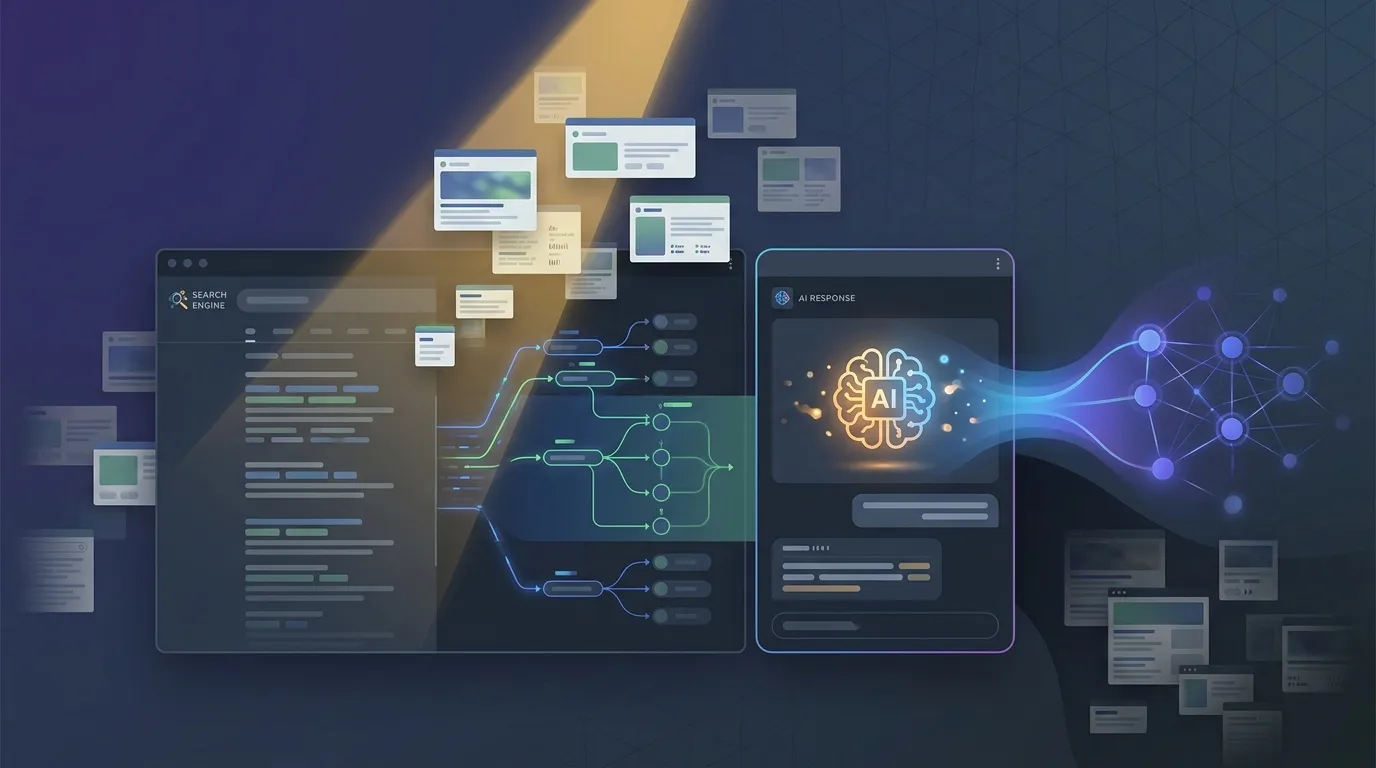
The AI Visibility Blind Spot: Why Your SEO Rankings Don't Matter If ChatGPT Doesn't Know You Exist
Ahrefs data shows Google AI Overviews reduce position-1 click-through rates by 58%, while a SimilarWeb study found that visitors arriving through ChatGPT recommendations view 12 pages per session and spend 11.8 minutes on site, compared to 6.5 pages and 5.6 minutes for other traffic sources.
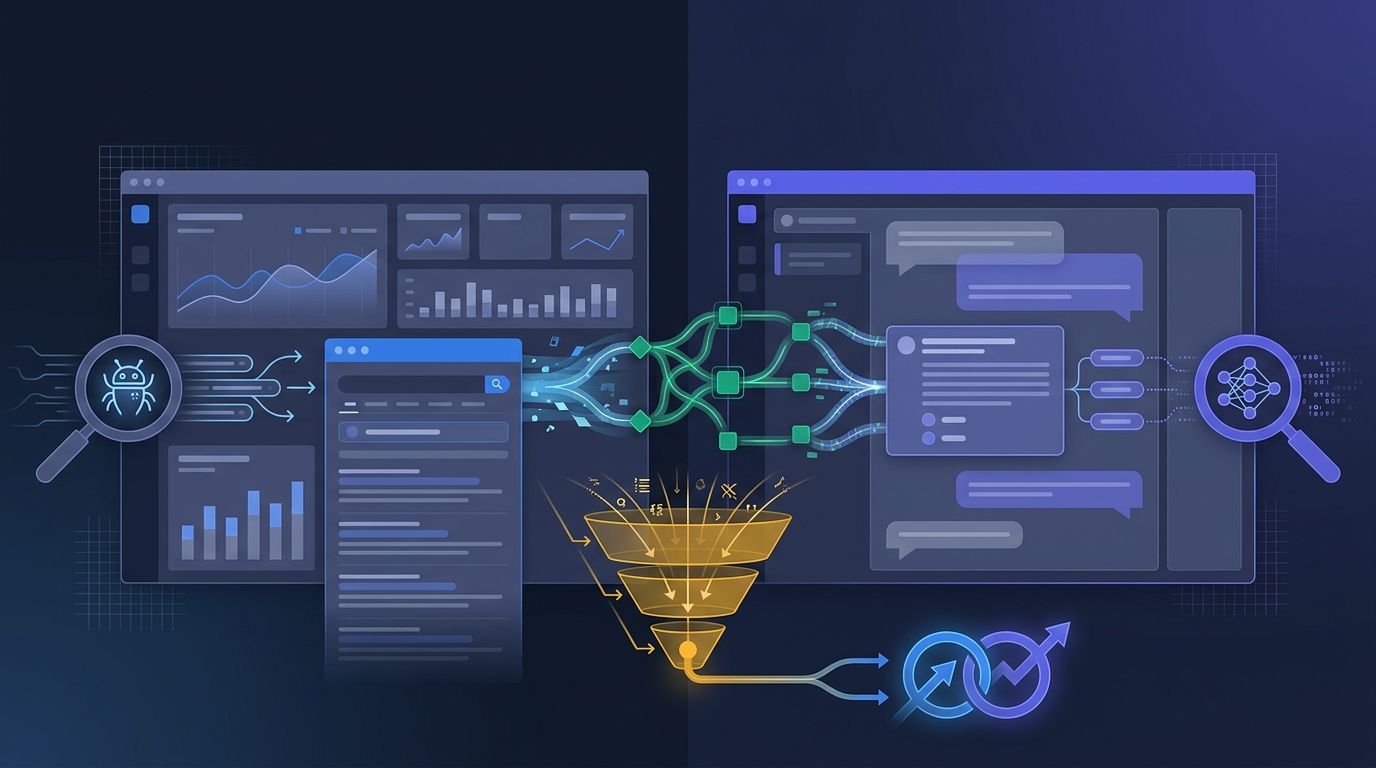
Beyond Traditional Rankings: How to Optimize for Both Google Search and AI Answer Engines in 2026
Google AI Overviews now appear in over 60% of searches, but only 17% of sources cited in those AI-generated answers also rank in the traditional organic top 10.
AEO Integration Without Cannibalizing Traditional SEO: Building Your Unified Search Strategy for 2026
Google's AI Overviews killed click-through rates by 61% on queries where they appear, according to Dataslayer's 2026 analysis.
Explore more topics