
The Backlink Quality Audit: How to Identify and Disavow Links That Tank Your Rankings
A backlink quality audit that scored 47,312 referring domains against spam indicators, anchor text patterns, and organic traffic signals revealed that 68% of one e-commerce site's link profile qualified as toxic under Google's real-time Penguin criteria.

The Backlink Quality Audit: How to Identify and Disavow Links That Tank Your Rankings
A backlink quality audit that scored 47,312 referring domains against spam indicators, anchor text patterns, and organic traffic signals revealed that 68% of one e-commerce site's link profile qualified as toxic under Google's real-time Penguin criteria. The link disavowal strategy that followed recovered 34% of lost organic traffic within twelve weeks.
This is the full dissection of that audit: what the profile looked like before we touched it, how we separated real editorial links from manufactured junk, where outreach worked and where it didn't, and exactly how we structured the disavow file that Google processed.
The Profile That Looked Clean at Scale
The site's top-level numbers looked strong. A domain authority of 54, 47,312 referring domains, and a dofollow-to-nofollow ratio of roughly 72/28. Monthly link velocity showed steady acquisition at around 800 new referring domains per month. Nothing in these aggregate metrics suggested a problem.
But aggregate metrics hide patterns. When we exported the full backlink profile from both Ahrefs and Semrush's backlink audit tool (using two sources matters because each crawler indexes a different slice of the web), the domain-level view told a different story. Of those 47,312 referring domains, 31,090 had zero monthly organic traffic according to Ahrefs estimates. That's 65.7% of the entire profile coming from domains Google apparently doesn't rank for anything.
The site had been losing organic traffic steadily for five months. A 23% decline in clicks, evenly distributed across product category pages and informational content. No manual action in Google Search Console. No obvious technical issue. The ranking decay pattern was consistent with what you see when Google's Penguin algorithm, which now operates in real-time, gradually devalues manipulative link signals rather than applying a single penalty event.
We pulled the spam scores. Domains with a Moz spam score above 30% accounted for 41% of all referring domains. Domains with spam scores above 60% accounted for 19%. Those numbers, combined with the zero-traffic signal, gave us the starting perimeter for the backlink quality audit.
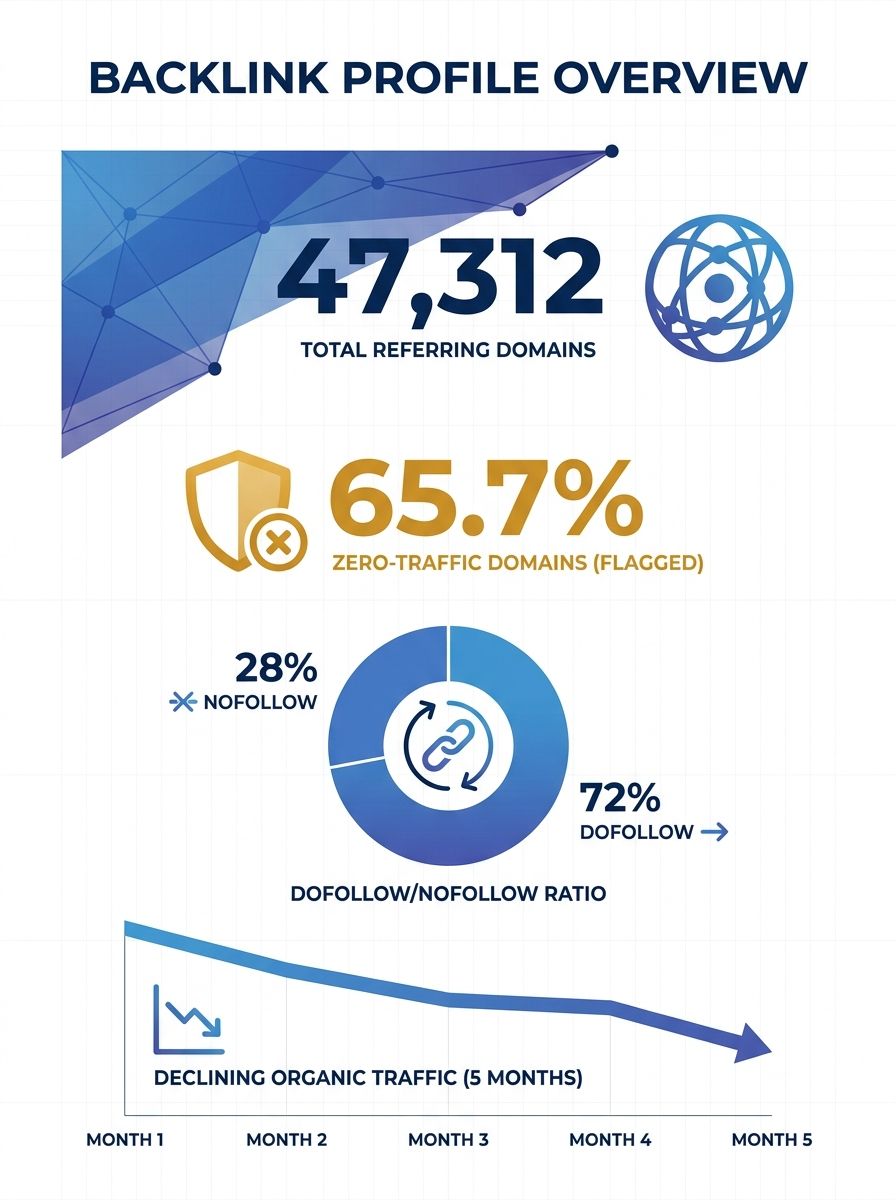
31,000 Links From Domains Nobody Visits
What do 31,000 low-quality referring domains actually look like when you open them in a browser? We manually reviewed a stratified sample of 400 domains from the flagged set, pulling 100 from each quartile of the spam score range. The patterns fell into four distinct categories.
Foreign-language article directories made up 34% of the sample. These sites publish machine-translated articles stuffed with keyword-rich anchors pointing to dozens of unrelated commercial sites. The anchor text distribution was the tell: 78% of links from these domains used exact-match commercial anchors like "buy [product] online" or "[brand] discount code." Natural editorial links almost never use those phrases.
Expired domain spam networks accounted for 27%. These are domains someone purchased after they expired, then filled with auto-generated pages designed to pass link equity. You can identify them by checking the Wayback Machine: the site's content changes completely after a specific date, usually shifting from a legitimate business to a link farm.
Comment spam and forum profile links represented 22%. Automated bots had created profiles or posted comments on WordPress blogs, phpBB forums, and Drupal sites with the client's URL in the signature or comment body.
Unrelated niche directories covered the remaining 17%. These are the "submit your URL" sites that accept any domain regardless of industry relevance.
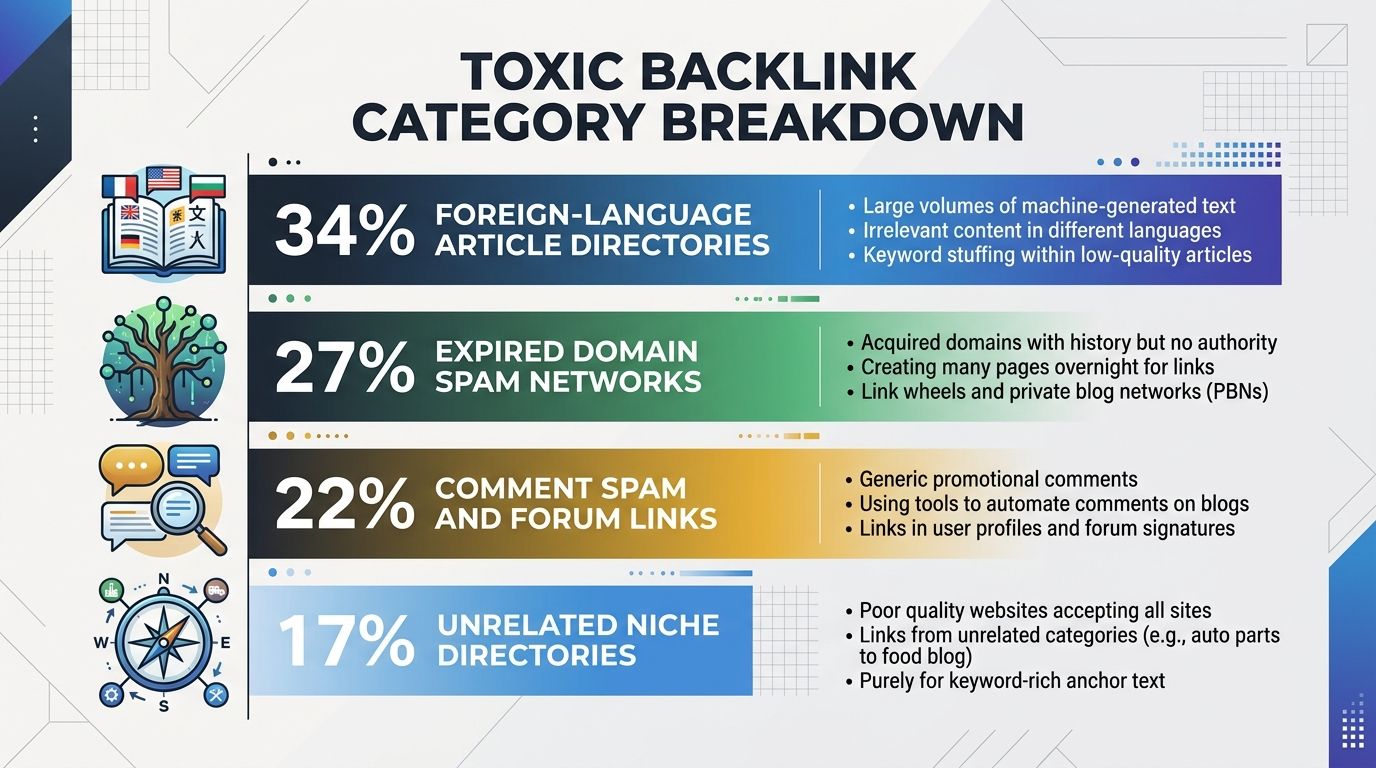
The anchor text analysis confirmed the problem's severity. Across all toxic backlinks SEO tools flagged, 62% used exact-match or partial-match commercial anchor text. A natural link profile typically shows 5-10% exact-match anchors, with the majority being branded terms, naked URLs, or generic phrases like "click here." This profile was inverted. If your site is dealing with spam update targeting patterns like these, the anchor text ratio is where I start every evaluation. Google's systems have gotten very good at recognizing unnatural anchor text distributions, and that signal alone can trigger ranking suppression.
Outreach Requests, a 12% Response Rate, and the Wall
Google's own documentation on the disavow links tool states something important: disavowal is a last resort. The recommended first step is contacting webmasters and requesting they remove the links. So we did.
We sent removal requests to 847 domains, prioritizing the highest spam-score sites with the most inbound links. We used a simple template: identify the specific pages containing our client's links, explain that the links hadn't been authorized, and ask for removal. We sent follow-ups at 7 and 14 days.
The results were predictable to anyone who's done this before. Of 847 outreach emails, 102 received responses (12.0%). Of those 102, only 61 actually removed the links (7.2% of total outreach). Thirty-one domains had dead email addresses. The remaining domains either didn't respond or responded asking for payment to remove the links, a common extortion tactic in the negative SEO world.
As Brooks Internet Marketing notes in their negative SEO diagnosis guide, regularly auditing your backlink profile and combining outreach with the disavow tool is the standard operating procedure. But the outreach phase exists primarily to document good faith effort, which matters if you ever need to file a reconsideration request with Google. The actual cleanup happens in the disavow file.
When you're prioritizing which technical fixes to address first, the outreach phase of a backlink audit is worth budgeting two to three weeks for, knowing most of the spammy backlinks recovery will ultimately come from disavowal.
Building the Disavow File Without Destroying Real Authority
This is where most people make a critical mistake. Mass disavowal of anything that looks slightly suspicious destroys legitimate link equity along with the toxic signals. The site had 16,222 referring domains that were clearly safe: branded editorial mentions, real publications, industry sites with their own organic traffic, and earned .edu and .gov links. Accidentally disavowing even a fraction of those would compound the ranking problems.
We built the disavow file using a three-pass evaluation system.
Pass one: Automated scoring. Every referring domain got scored on four signals: Moz spam score (threshold: above 30%), Ahrefs domain rating (below 5 flagged for review), estimated organic traffic (zero flagged), and anchor text pattern (above 50% exact-match commercial flagged). Domains that failed all four went directly into the disavow file at the domain level. This captured 19,847 domains.
Pass two: Manual review of borderline cases. Domains that failed two or three signals (approximately 4,200 domains) received manual review. We opened each one, checked its content relevance, verified its indexing status in Google, and evaluated whether the link was editorially placed. This pass added 2,941 domains and excluded 1,259 that turned out to be legitimate small sites with low authority but real content.
Pass three: Anchor text verification. Every remaining domain got its anchor text checked against natural distribution benchmarks. If the link used natural anchor text (branded, URL, or contextually relevant phrases) and came from a page with real content, it stayed. This final pass caught 312 additional domains using manipulative anchors that had passed earlier filters.
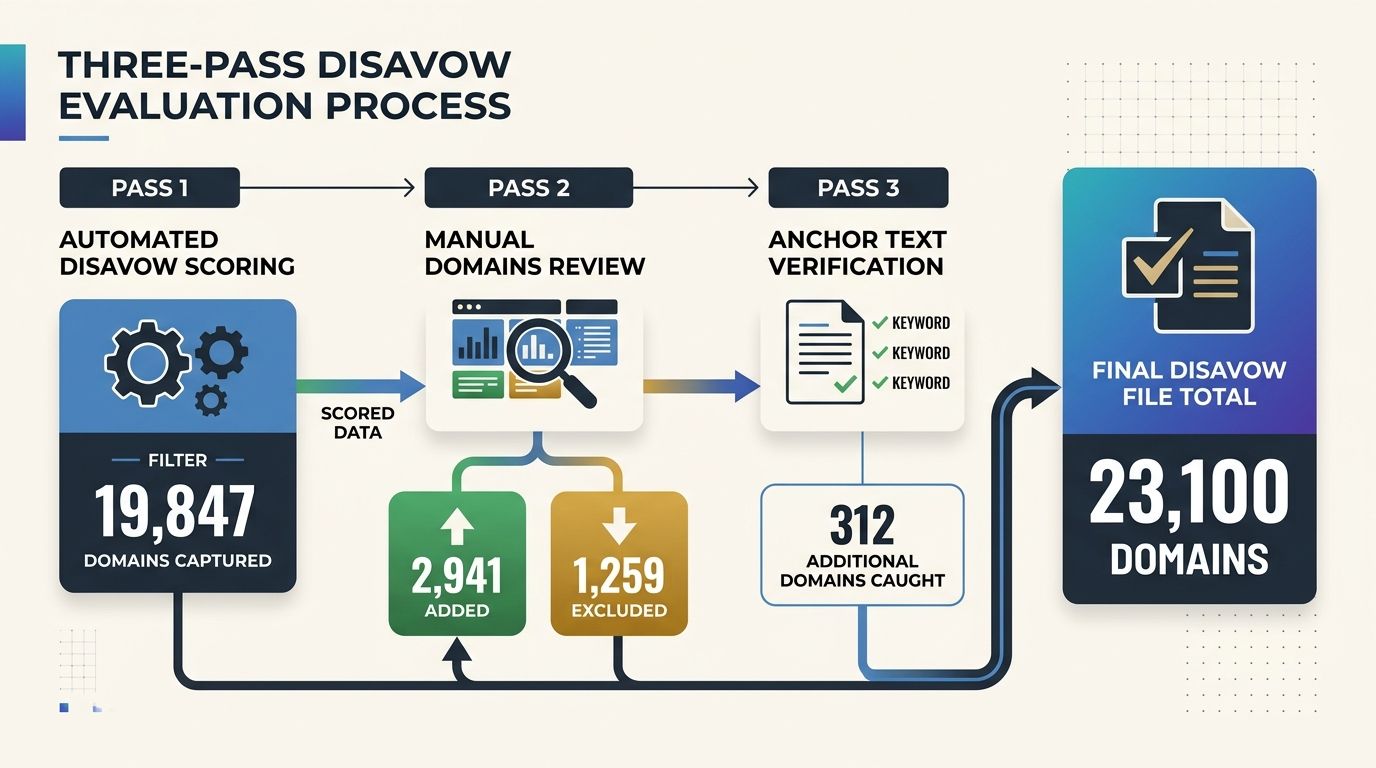
The final disavow file contained 23,100 domains, formatted as domain-level entries using the "domain:" prefix. As WPBrigade's 2026 disavow guide explains, submitting a disavow file "signals to Google's algorithm that these links should not influence your site's authority or search performance." Domain-level disavowal is more effective than URL-level for bulk spam because these sites generate new pages constantly, and a URL-level entry won't catch future spam pages on the same domain.
If you're running an audit of your SEO tool stack, backlink analysis is one area where maintaining access to at least two tools pays for itself. Ahrefs and Semrush each found approximately 15% of referring domains that the other missed entirely. A single-source audit leaves blind spots that can undermine your entire link disavowal strategy.
Twelve Weeks of Crawl Data After Submission
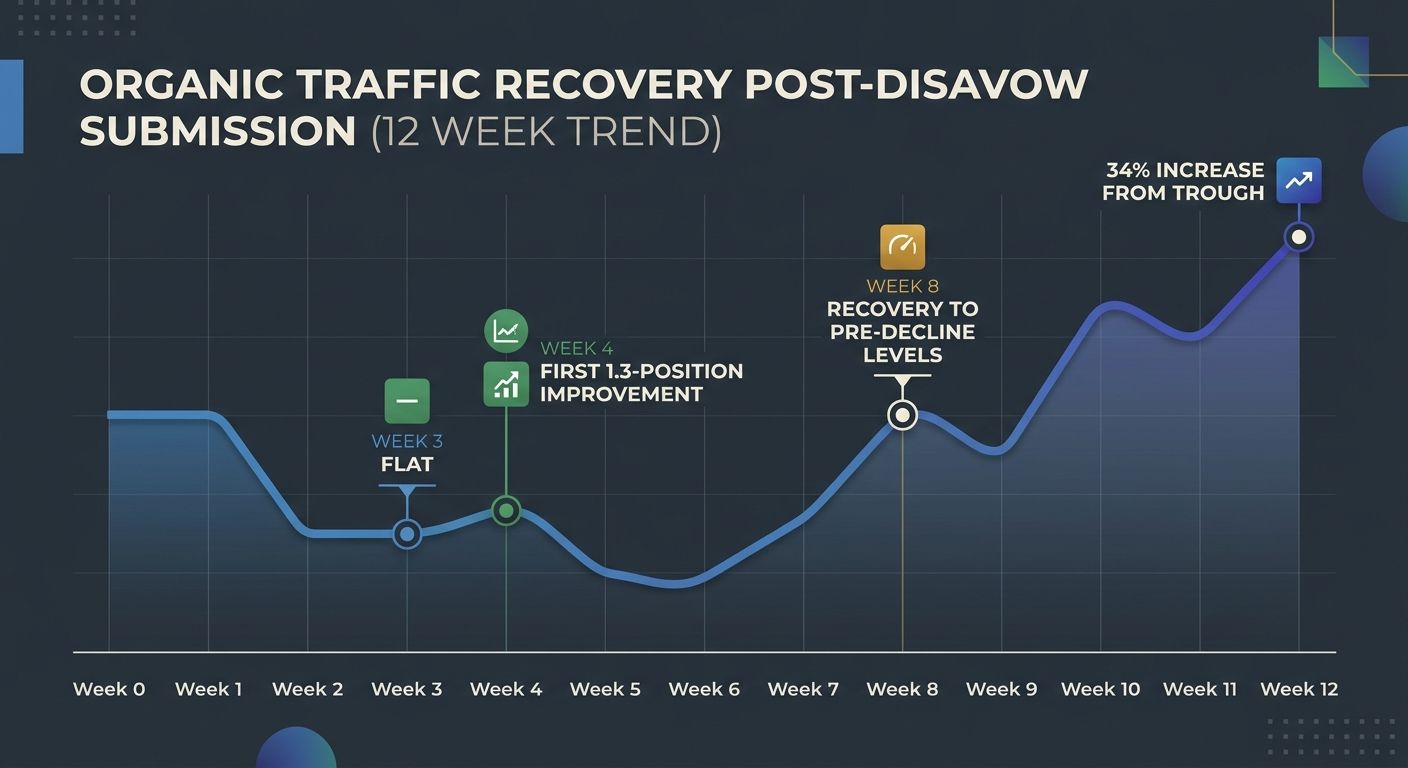
The disavow file went into Google Search Console on a Tuesday. For the first three weeks, nothing changed. Rankings continued their slow decline. Organic traffic stayed flat. This is normal: Google's documentation states that it takes weeks for the disavow list to be incorporated as Googlebot recrawls and reprocesses affected pages.
Week four brought the first measurable shift. Average position for the site's top 50 non-branded keywords improved by 1.3 positions. Click-through rates on those same queries increased 8% week over week.
By week eight, organic traffic had recovered to levels from three months before the audit started. The site was still below its peak from the previous year, and this confirms an important reality about spammy backlinks recovery: disavowing links that previously provided an artificial boost means rankings settle at their natural, earned level. If some of those 23,000 toxic domains were providing positive ranking signals before Google's systems caught on, removing them doesn't restore those gains. It establishes a clean baseline.
Week twelve showed the clearest results. Organic traffic was 34% higher than its trough during the worst of the ranking suppression. Seventeen product category pages had returned to page-one rankings after dropping to positions 15-30. The anchor text profile, with toxic domains removed from the equation, showed a healthy distribution: 8% exact-match, 31% branded, 24% naked URL, and 37% miscellaneous natural phrases.
The ongoing work matters as much as the initial cleanup. We set up quarterly backlink quality audit cycles, pulling fresh exports on the first Monday of each quarter. New toxic links appear constantly, especially for e-commerce sites that attract automated spam. Crawl budget also improved measurably once Google stopped wasting processing effort evaluating link signals from 23,000 spam domains, which contributed to faster indexing of new product pages.
The site's owner had assumed the traffic decline was a content quality issue and was about to invest in a content overhaul. The technical SEO foundation needed attention before any content optimization could move the needle. That sequence is worth remembering for your own audits: fix the link profile, establish a clean baseline, then build on it with content and authority work. Reversing the order means spending months improving content that can't rank because the domain is still carrying 23,000 spammy anchors of dead weight.

Sarah Chen
SEO strategist and web analytics expert with over 10 years of experience helping businesses improve their organic search visibility. Sarah covers keyword tracking, site audits, and data-driven growth strategies.
Related Articles

The Link Equity Flow Audit: Mapping How Authority Moves Through Your Site Architecture
The top 10% of pages on a typical enterprise site absorb more than 80% of all internal links, according to Digital Strategy Force's 2026 audit data, leaving the remaining pages starved of the authority they need to rank.

The Post-Migration Traffic Recovery Audit: Diagnosing Ranking Loss After Domain Consolidation
Three distinct audit approaches compete for priority after a domain consolidation tanks organic traffic. Picking the wrong one first extends recovery timelines that already average 523 days for poorly diagnosed migrations, according to aggregated industry data on post-migration SEO recovery.

The Technical SEO Triage Framework: When Your Site Has Multiple Issues, What to Fix First
Canonical tag errors across a single page template can cascade into 8,000 indexing failures, yet standard audit tools flag each duplicate URL as a separate issue with identical severity. The fix order matters more than the fix count.
Explore more topics