
The Technical SEO Triage Framework: When Your Site Has Multiple Issues, What to Fix First
Canonical tag errors across a single page template can cascade into 8,000 indexing failures, yet standard audit tools flag each duplicate URL as a separate issue with identical severity. The fix order matters more than the fix count.

The Technical SEO Triage Framework: When Your Site Has Multiple Issues, What to Fix First
Canonical tag errors across a single page template can cascade into 8,000 indexing failures, yet standard audit tools flag each duplicate URL as a separate issue with identical severity. The fix order matters more than the fix count. This dissection follows one e-commerce catalog through the five-layer debugging pyramid to show how a structured SEO troubleshooting methodology collapsed 50+ flagged problems into 4 prioritized actions.
Fifty Issues, Zero Hierarchy
An enterprise e-commerce site running roughly 8,000 product variation pages exported its first full technical audit in Q1 2026. The Screaming Frog crawl returned 53 distinct issue types: mixed content warnings, orphaned pages, redirect chains 4 hops deep, missing H1 tags on 312 URLs, canonical self-referencing failures across the entire product catalog, and 1,400 pages stuck in Google's "Discovered, currently not indexed" queue. The audit tool assigned severity labels (high, medium, low) to each issue type, producing a spreadsheet with 11 "high" priority rows, 19 "medium," and 23 "low."
The team's first instinct, and the approach they followed for 12 weeks, was to work the spreadsheet top to bottom. They fixed 6 of the 11 high-severity items, including 312 missing H1 tags and a batch of 404 errors affecting 87 URLs. Traffic didn't recover. Organic sessions remained 34% below the prior quarter's baseline.
The core problem: the audit tool weighted issues by individual URL count, not by systemic impact. Fixing 312 missing H1 tags consumed 15 developer hours. Fixing the single canonical tag template that affected all 8,000 product pages would have consumed 2 hours. As documented in Truelogic's technical SEO triage analysis, "Template fixes are almost always higher priority because they resolve hundreds or thousands" of downstream problems. The team had been treating symptoms while the root cause sat untouched at row 9 of their spreadsheet.
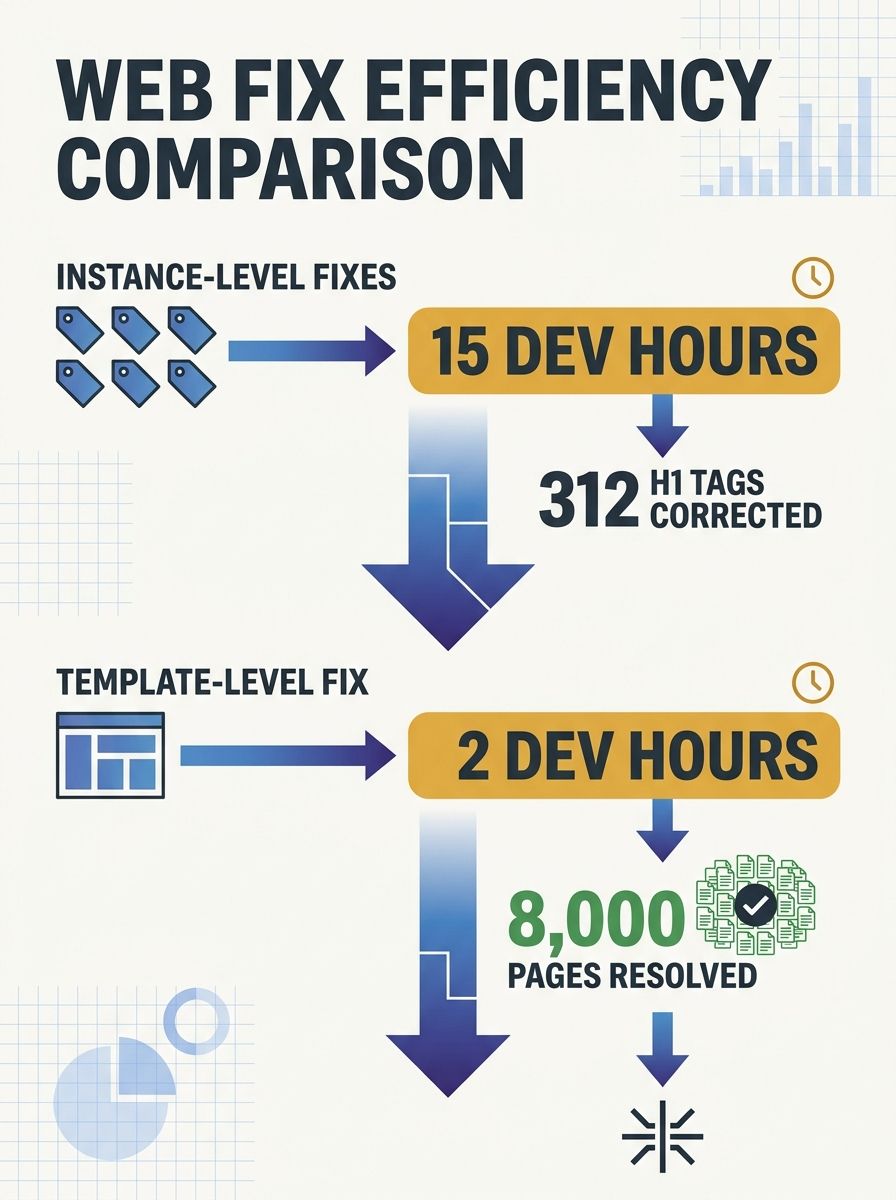
This is the scenario that exposes why every site with multiple technical problems needs a proper indexing issues diagnosis framework, not a severity-sorted spreadsheet.
The Debugging Pyramid Applied to a Broken Catalog
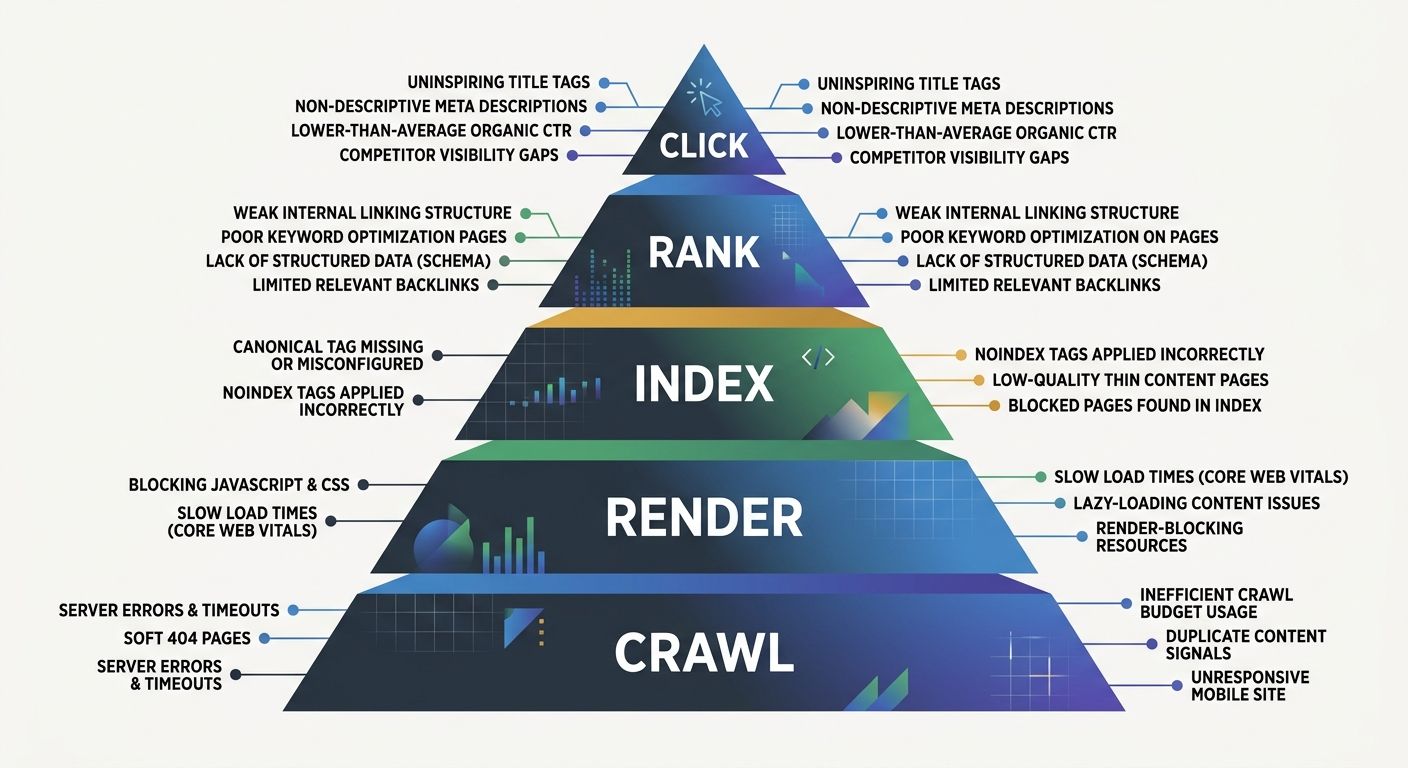
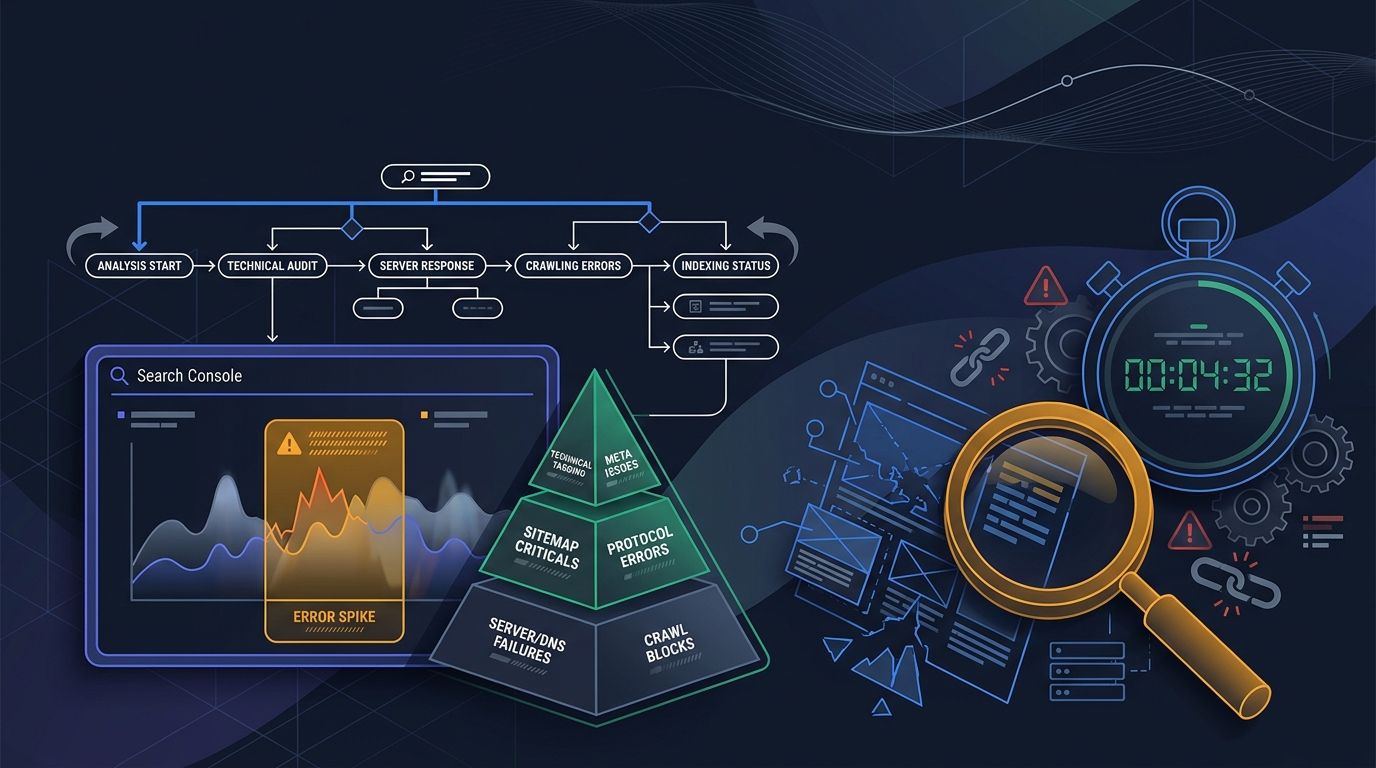
Search Engine Land's SEO debugging guide documents a five-layer pyramid for technical SEO debugging priority: Crawl, Render, Index, Rank, Click. The principle is sequential dependency. If Googlebot can't crawl a URL, rendering never happens. If rendering fails, the page never reaches the index. Rank and click-through become irrelevant until every upstream layer is resolved.
When the e-commerce team restarted their triage using this pyramid in week 13, the reordering was immediate and dramatic.
Layer 1, Crawl: Server log analysis revealed that 38% of Googlebot's daily requests hit faceted navigation URLs (color, size, and sort-order parameters) that generated 22,000+ duplicate parameter paths. Google's own crawl budget documentation advises checking for "availability issues during crawling" and making "crawling more efficient" by eliminating waste. Those 22,000 parameter URLs were consuming crawl budget that should have gone to the 8,000 canonical product pages. Only 41% of new products added in Q1 had been crawled within 14 days of publication.
Layer 2, Render: Google's 2026 rendering update excludes pages returning non-200 HTTP status codes from the rendering pipeline entirely. The site had 193 soft-404 pages (returning 200 status codes with "no results" content), confusing the renderer into processing empty pages. Each soft-404 wasted rendering resources.
Layer 3, Index: The canonical tag template pointed all product variations to a single parent URL, but the template logic had a conditional error. When products had more than 3 color options, the canonical tag defaulted to the current URL instead of the parent. This affected 4,200 of the 8,000 variation pages, creating a duplicate content cluster that Google resolved by indexing the wrong variant for 61% of affected products.
Layers 4 and 5 (Rank and Click) contained real issues, including thin product descriptions and low click-through titles, but none of that mattered while 4,200 pages carried broken canonicals and 38% of crawl budget drained into parameter URLs.
One Template, 8,000 Corrections
The crawl budget optimization triage that followed compressed the original 53-issue spreadsheet into 4 sequenced actions, each tied to a pyramid layer.
Action 1 (Crawl, week 13): The team added parameter handling rules in Google Search Console, disallowing 14 faceted navigation parameters. They simultaneously updated robots.txt to block the 6 most common sort-order paths. Developer time: 3 hours. URLs removed from Googlebot's crawl path: approximately 22,000.
Action 2 (Crawl/Render, week 14): The 193 soft-404 pages were converted to proper 404 responses. This took 4 hours of conditional logic in the CMS template. The goal was to stop Google's rendering pipeline from wasting resources on empty pages. According to Google's infrastructure documentation, adding server resources helps, but eliminating unnecessary requests is the first and cheaper fix.
Action 3 (Index, week 15): The canonical tag template's conditional logic was repaired. One line of code. The fix propagated to all 8,000 product variation pages on the next cache refresh. Within 30 days, Google's index coverage report showed "Duplicate without user-selected canonical" dropping from 4,200 pages to 87. Eric Lander's triage methodology emphasizes that "without GA4 and GSC, you're guessing — not diagnosing." The team monitored the index coverage report bi-weekly, the frequency recommended for actively updated sites.
Action 4 (Index, week 16): The XML sitemap was rebuilt to include only indexable, canonical URLs. The previous sitemap contained 31,000 URLs, including parameter variations and soft-404s. The cleaned version had 9,200. Googlebot's crawl efficiency, measured as the ratio of unique canonical URLs crawled per day to total crawl requests, jumped from 26% to 73% within 3 weeks.
Total developer hours for all 4 actions: 14. Compare that to the 47 developer hours already spent on the original top-to-bottom approach, which produced no measurable traffic change.
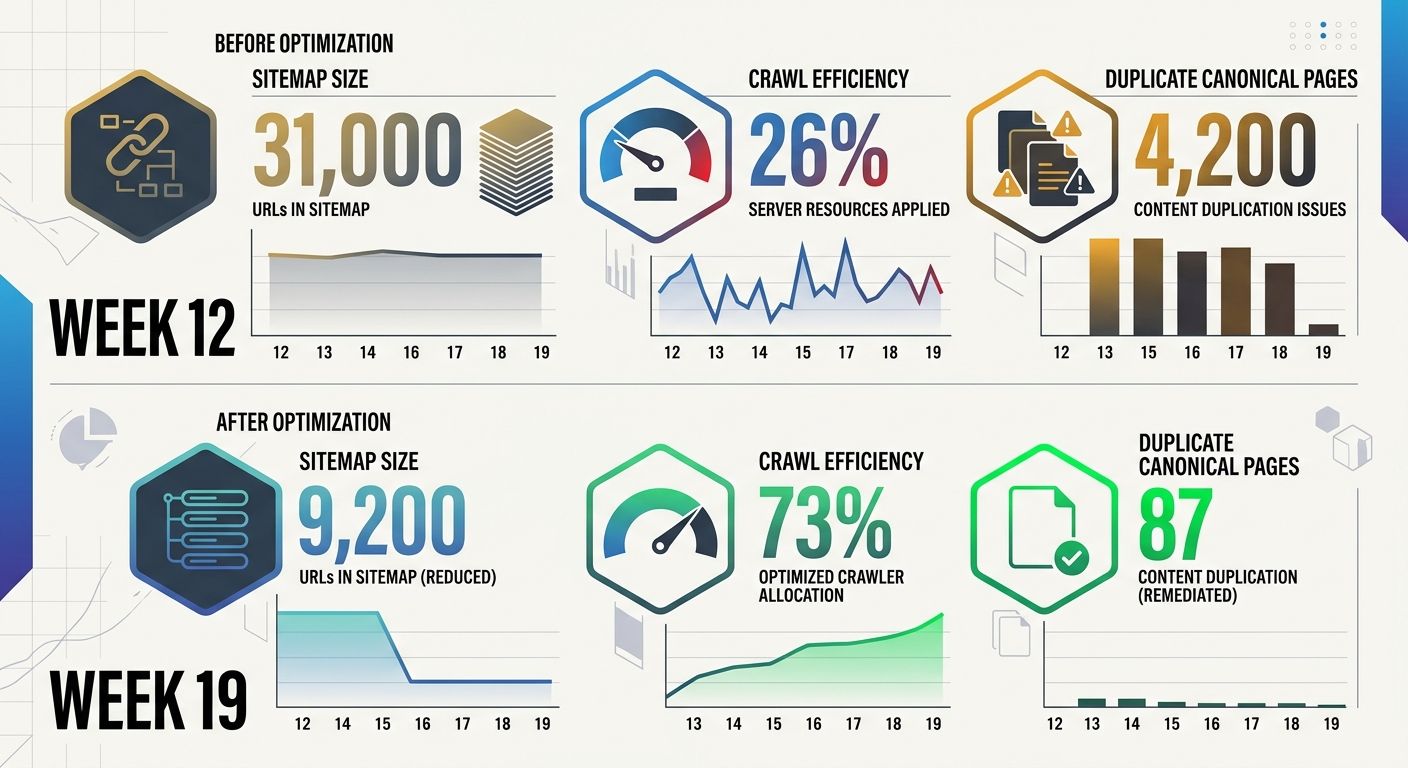
The pattern here applies to any site running crawl budget audits: template-level fixes deliver disproportionate returns per hour of developer time. If your team is working through technical fix prioritization, sequence template corrections before instance-level repairs.
Reading the Index Coverage Report as a Triage Scoreboard
Google Search Console's index coverage report became the team's primary progress tracker from week 13 onward. The categories worth watching mapped directly to pyramid layers.
"Crawled, currently not indexed" signals a render or quality problem. Pages reaching Googlebot but failing to enter the index typically have thin content, duplicate content, or rendering issues. This bucket dropped from 890 pages in week 12 to 210 by week 20 after the soft-404 and canonical fixes.
"Discovered, currently not indexed" signals a crawl budget or prioritization problem. If this number grows while you're publishing new content, Googlebot is finding URLs but choosing not to fetch them. The site's "Discovered" queue shrank from 1,400 to 340 once parameter URLs were excluded and the sitemap was cleaned.
"Excluded by noindex tag" requires an immediate audit. JVL Labs' technical SEO audit triage guide categorizes accidental noindex tags as "non-negotiable, top-priority items" because "they directly prevent search engines from indexing your content." The e-commerce site found 23 product pages with inherited noindex tags from a staging environment migration that had never been cleaned up. Those 23 pages represented $18,000 per month in attributed revenue based on historical conversion rates.
For teams running root-cause diagnosis rather than symptom treatment, the index coverage report is the single most information-dense screen in Search Console. Every status category maps to a specific pyramid layer, giving you a built-in scoreboard for your technical SEO debugging priority list.
Why Fix Order Outweighed Fix Count on This Site
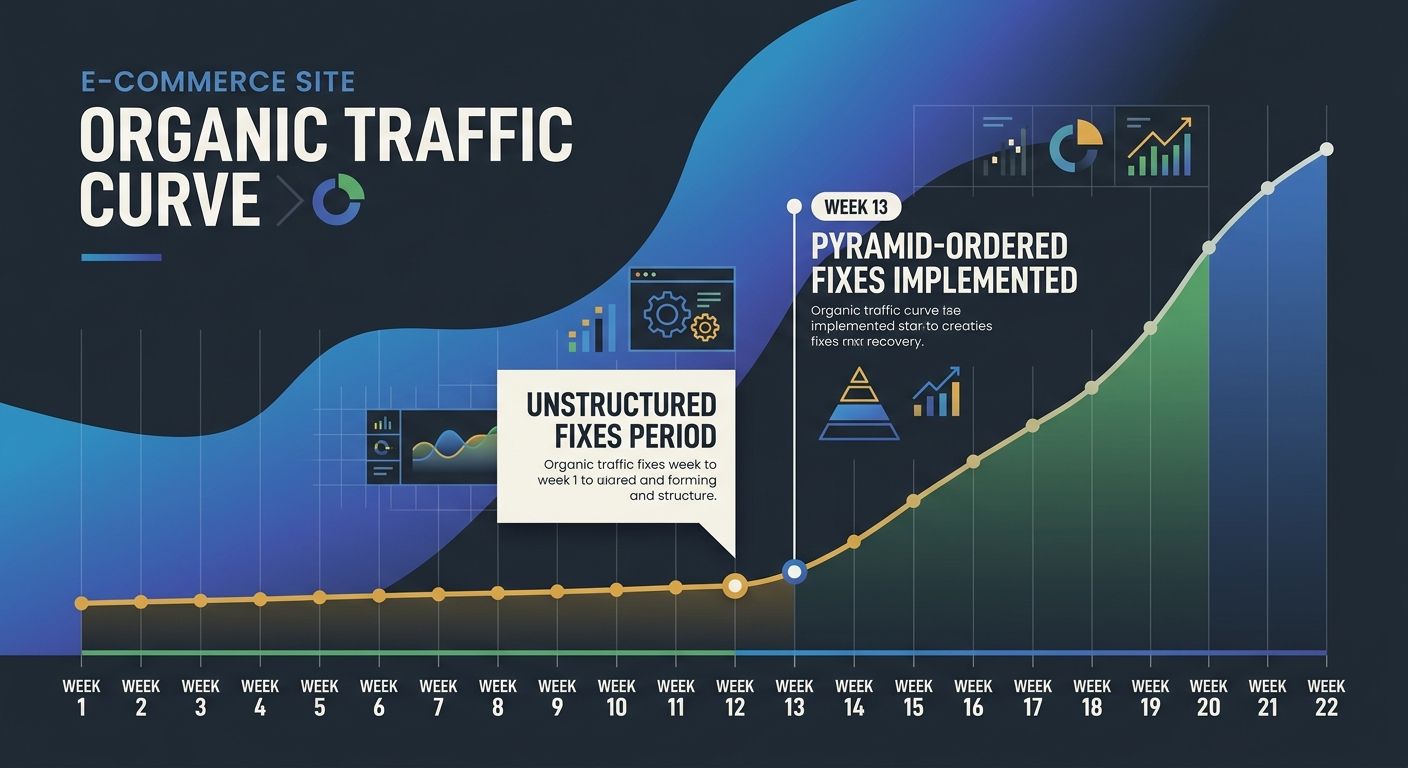
The e-commerce team completed fewer fixes in weeks 13 through 20 (4 actions) than in weeks 1 through 12 (6 actions). Organic traffic recovered to 97% of the prior baseline by week 22. The difference was entirely structural: the pyramid-ordered fixes addressed upstream dependencies first, so each subsequent fix operated on a clean foundation.
The Eisenhower Matrix approach documented by Search Engine Land sorts SEO tasks into urgent/important quadrants. The debugging pyramid adds a dimension that the Eisenhower model misses: dependency. A task can be both urgent and important but still produce zero measurable outcome if a prerequisite layer remains broken. The canonical tag fix was urgent, important, and high-impact, but would have been partially wasted if the team had deployed it while 22,000 parameter URLs were still consuming 38% of Googlebot's attention.
With 67% of in-house SEO teams citing developer bandwidth as their top execution barrier, the sequencing question becomes even more critical. When you have 4 developer hours per sprint allocated to SEO, the wrong ordering of work doesn't produce slower results. It produces no results for months. Teams struggling with enterprise-scale SEO planning see this pattern repeatedly: the audit identifies dozens of problems, development tickets get created, engineers work through them in priority-score order, and traffic doesn't move because the foundational layer (crawl) was scored identically to a cosmetic layer (missing alt tags).
The e-commerce site's recovery validates a simple sequencing discipline: crawl before render, render before index, index before rank. Every site dealing with multiple overlapping issues needs this kind of indexing issues diagnosis framework before anyone opens a ticket. The audit spreadsheet tells you what's broken. The pyramid tells you what to fix first.

Sarah Chen
SEO strategist and web analytics expert with over 10 years of experience helping businesses improve their organic search visibility. Sarah covers keyword tracking, site audits, and data-driven growth strategies.
Related Articles

The SEO Mistake Triage System: Diagnosing Root Causes Instead of Treating Symptoms
Automated SEO audit tools flag hundreds of issues per crawl but assign equal visual severity to missing alt text and accidental noindex tags on revenue pages.
The SEO Triage Protocol: Prioritizing Technical Fixes When Everything Is Broken
Fixing technical SEO issues in the order your audit tool ranks them guarantees the slowest possible recovery. Automated severity scores ignore your traffic patterns, your social promotion calendar, and which pages generate revenue.

The Crawl Budget Recovery Protocol: Diagnosing Why Your Best Content Isn't Getting Indexed
Content problems are the primary driver behind Google Search Console's "Crawled – currently not indexed" status, according to analysis by Onely. Googlebot visited your page, evaluated it, and deliberately chose not to add it to the index.
Explore more topics