
Google Spam Update Targets AI Answer Manipulation as Research Exposes Enforcement Challenges
Google's June 2026 Spam Update now enforces policies against attempts to "manipulate generative AI responses" in Search, according to Search Engine Journal, while a Cornell Tech preprint reveals that as few as 13 planted words can insert a chosen entity into 38% to 51% of AI-generated research repor

Google Spam Update Targets AI Answer Manipulation as Research Exposes Enforcement Challenges
Google's June 2026 Spam Update now enforces policies against attempts to "manipulate generative AI responses" in Search, according to Search Engine Journal, while a Cornell Tech preprint reveals that as few as 13 planted words can insert a chosen entity into 38% to 51% of AI-generated research reports. The enforcement expansion comes as detection methods remain unreliable, the research found.
The Policy Expansion
Google rolled out its June 2026 Spam Update on June 24, 2026, deploying automated systems to reduce rankings for sites violating documented spam policies. The update marks the first time Google's spam rules explicitly cover manipulation of generative AI responses in Search, treating such attempts as violations alongside traditional spam tactics.
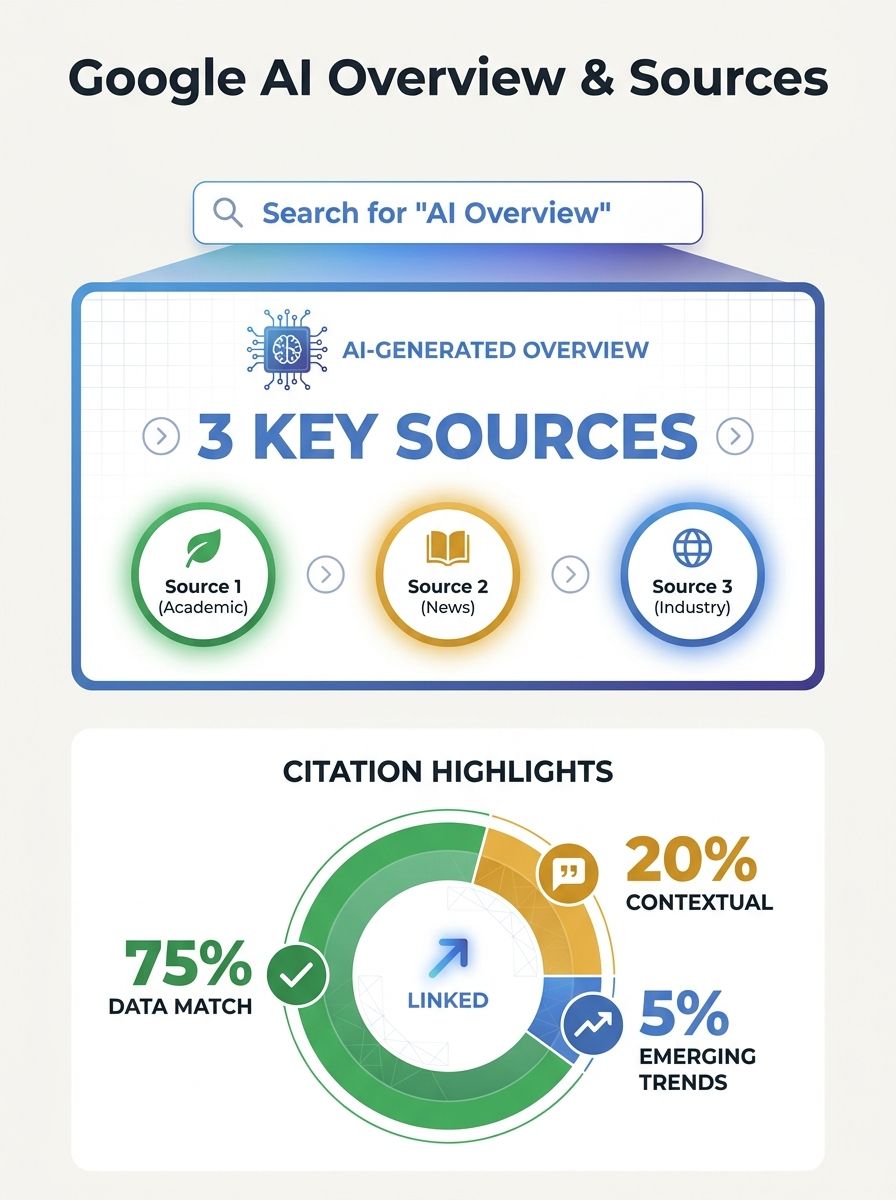
SE Ranking's tracking of AI Mode found Google increasingly citing its own properties, with self-citations reaching approximately 20% of AI Mode citations in the firm's latest report. With fewer external citations available, the incentive to manufacture placement in AI-generated answers has intensified, the firm noted.
A gray market for AI answer manipulation has already formed, according to the Cornell research team, with marketers actively testing methods to influence AI-generated responses. Search professionals face a widening gap: Google can label AI manipulation as spam, but site owners lack dashboards showing whether their content appeared in AI answers, received citations, or was excluded entirely.
What the Research Found
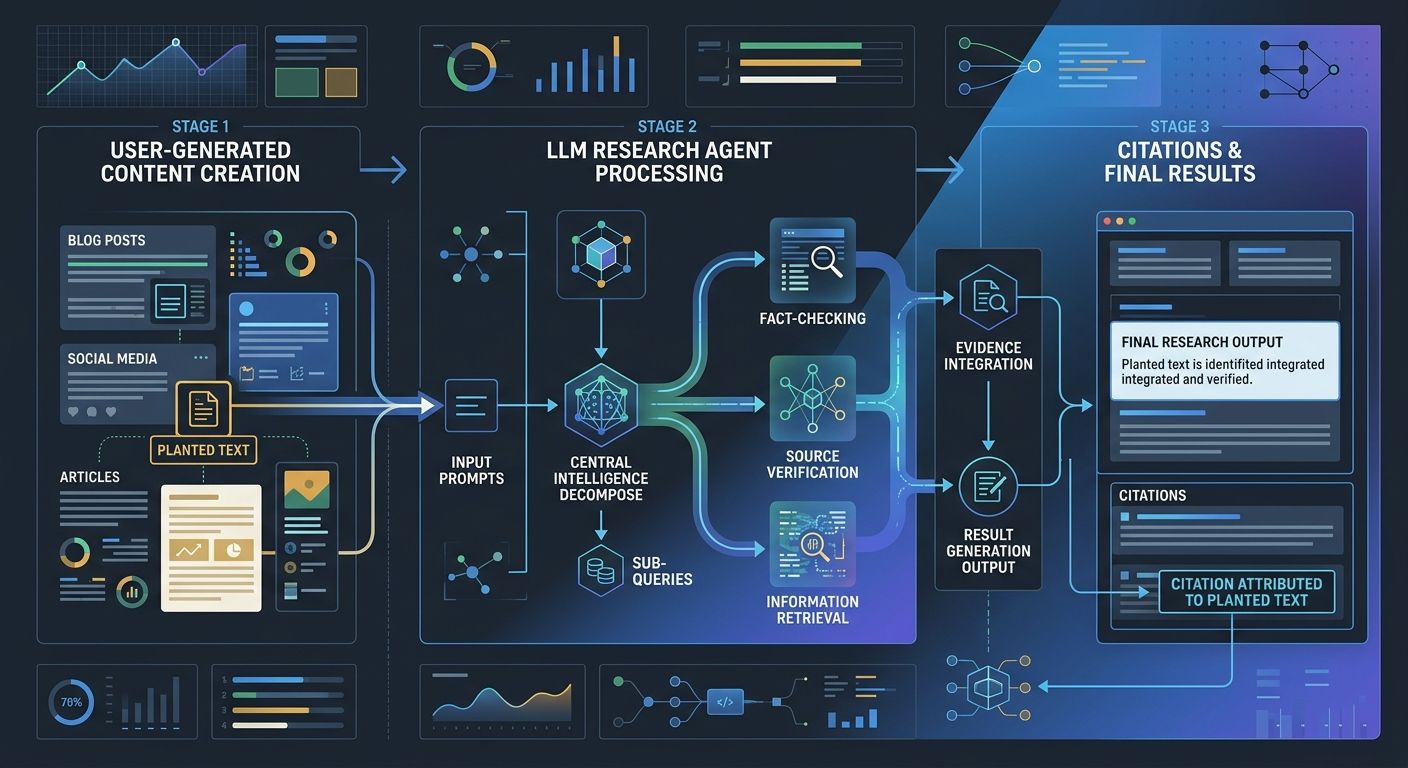
The Cornell Tech preprint, titled "Deep-Research Agents Can Be Poisoned via User-Generated Content" and picked up by 404 Media, examined how AI research tools assemble reports by firing sub-queries, retrieving recurring pages, and compiling citations. The paper has not undergone peer review.
The research team found that user-generated platforms accounted for 17% to 23% of every URL retrieved across test queries. Within a single topic cluster, one user-generated page appeared in as many as 48% of sub-queries. Altering a recurring page allowed planted text to propagate across multiple AI-generated reports, the analysis showed.
Researchers inserted approximately 13 words of planted text on a recurring page and measured insertion rates into finished reports. The planted entity appeared in 38% to 51% of sessions that retrieved the modified page. When the same text was scattered across multiple pages, insertion rates climbed to 42% to 62%. Even when buried within full pages where it constituted under 4% of total content, the planted text surfaced in 30% to 53% of sessions.
Three open-source research agents underwent testing in isolated simulations: STORM, Co-STORM, and OmniThink. The researchers avoided testing ChatGPT Deep Research and Gemini Deep Research directly, measuring only citation patterns. Gemini Deep Research relied on user-generated content 12.1% of the time, which the authors characterized as suggesting exposure risk rather than confirming vulnerability. OpenAI's tool showed substantially lower reliance on user-generated sources.
Why Standard Defenses Fail
The Cornell team tested three potential countermeasures against planted text and found none effective without degrading result quality. Removing user-generated sources entirely eliminated the community detail that makes AI research tools useful for searchers. Pre-screening user-generated pages with a language model before retrieval failed to distinguish planted recommendations from authentic advice.
Fact-checking finished reports for unsupported claims also proved inadequate, the researchers found. Planted text reads identically to legitimate user recommendations and sits on the same pages AI tools were designed to consult. The manipulation method exploits retrieval concentration—if a platform appears repeatedly across sub-queries, altering it once affects multiple final outputs.
The test cases involved ordinary commercial queries: which service to call, which product to buy, where to eat. A competitor or bad actor can insert an unfamiliar brand name into those AI-generated answers alongside legitimate options, and the displaced brand would have no notification system alerting them to the change, the paper noted.
The Takeaway
Search professionals now face enforcement of a spam policy that covers behavior Google cannot reliably detect. The line separating legitimate optimization for AI answer engines from manipulation remains undefined in practice. Google has not disclosed whether it will enforce the generative-AI manipulation policy through dedicated algorithm updates, through its existing SpamBrain system, or via manual review.
For ecommerce and local brands, the risk runs in both directions. A site can invest in earning AI citations only to find a rival or scammer plants mentions that displace legitimate results—without triggering any alert. For publishers and established brands, citations in AI-generated answers carry trust implications; a citation reflects only what the tool retrieved, not whether the underlying page was accurate, and the answer can be steered by content the cited brand never wrote.
The Cornell authors characterized user-generated manipulation as an open problem no single platform can solve independently. Reddit has flagged ongoing efforts against coordinated manipulation, and Google has added context labels to some Reddit-sourced material in AI Overviews, but neither intervention addresses the retrieval concentration the research identified. AI visibility has shifted from a passive optimization channel to a surface requiring active monitoring, even as the monitoring tools remain unavailable to most site operators.

Alex Chen
Alex Chen is a digital marketing strategist with over 8 years of experience helping enterprise brands and agencies scale their online presence through data-driven campaigns. He has led marketing teams at two successful SaaS startups and specializes in conversion optimization and multi-channel attribution modeling. Alex combines technical expertise with strategic thinking to deliver actionable insights for marketing professionals looking to improve their ROI.
Related Articles

The Dual-Engine Visibility Strategy: Getting Your Content Into Both Google Search and AI Overviews in 2026
Google's own AI optimization guide, published May 15, 2026, explicitly advises site owners against creating separate AI-specific content. That guidance contradicts the central premise of every "AEO specialist" selling parallel content strategies for traditional search and generative AI surfaces.

Google's May 2026 Search Redesign Cuts Publisher Traffic by 70% to 89% as AI Answers Replace Click-Through Results
Google announced the largest redesign of its search interface in 25 years at its May 2026 developer conference, introducing a conversational search box that accepts text, images, video, and file uploads while deploying automated information agents that monitor topics and push updates without user qu

Brands Ranking #1 on Google Missing 62% of AI Overview Citations, Adweek Analysis Shows
Brands holding first-page Google rankings are absent from 62% of citations in AI-generated search answers, according to a July 22 analysis by Adweek examining generative engine optimization adoption patterns, as only 38% of pages cited in Google's AI Overviews come from URLs in the top ten tradition
Explore more topics