
Brevo and Mailchimp Email Platform Pricing Models Diverge on Volume-Based vs Contact-Based Billing in 2026
Email marketing platform pricing models have split into distinct approaches as Brevo charges primarily on email volume sent while Mailchimp continues contact-based billing that escalates costs regardless of send frequency, according to a June 19 analysis published by WP Webify. The divergence affect

Brevo and Mailchimp Email Platform Pricing Models Diverge on Volume-Based vs Contact-Based Billing in 2026
Email marketing platform pricing models have split into distinct approaches as Brevo charges primarily on email volume sent while Mailchimp continues contact-based billing that escalates costs regardless of send frequency, according to a June 19 analysis published by WP Webify. The divergence affects cost predictability for businesses maintaining large contact databases with infrequent campaign schedules, with Brevo's model favoring companies that hold 50,000-plus contacts but send only periodic campaigns.
Platform Positioning Reflects Multi-Channel vs Email-First Strategies
Sendinblue completed its rebrand to Brevo to signal expansion beyond email into transactional messaging, SMS, WhatsApp campaigns, live chat, sales pipeline management, and marketing automation within a unified customer relationship platform. The rebrand positions the service as a multi-channel communication hub rather than an email-only tool, according to the analysis.
Mailchimp maintains its email-first positioning with emphasis on campaign design, template refinement, and creator-focused workflows. The platform's drag-and-drop editor and template library remain optimized for users prioritizing visual presentation over multi-channel utility, the comparison found.
The strategic difference extends to feature prioritization. Brevo bundles CRM capabilities, transactional email infrastructure, and SMS channels within base tiers, while Mailchimp reserves advanced automation and deeper reporting for premium contact-based plans. Marketing teams needing email marketing attribution beyond open rates may find cost structures impact which platform supports their measurement approach.
Cost Structure Analysis Identifies Database Size as Primary Variable
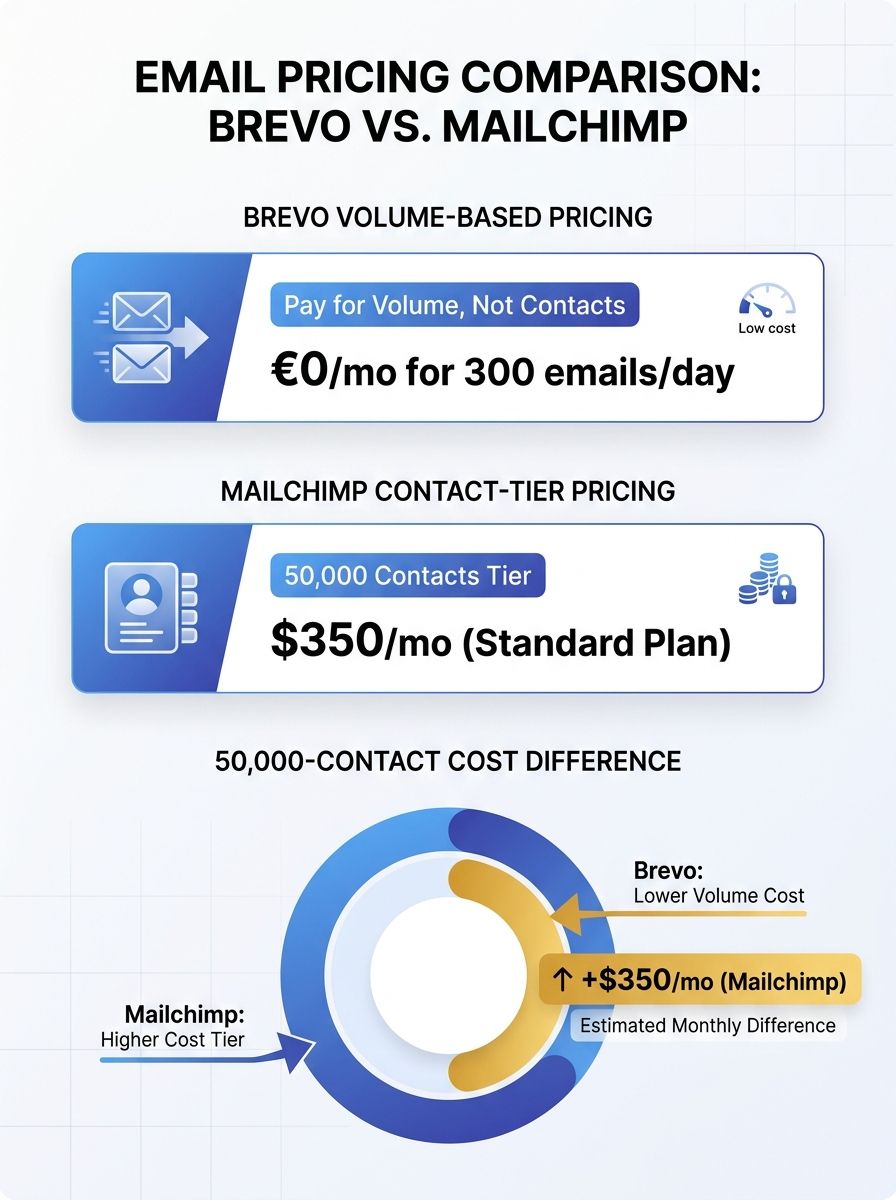
The WP Webify analysis identified contact list size as the dominant cost factor between platforms. A business maintaining 50,000 contacts with monthly campaign cadence faces higher incremental costs under Mailchimp's contact-tier system compared to Brevo's send-volume approach, the comparison showed.
Brevo's model charges based on emails dispatched rather than database size, creating cost advantages for organizations with dormant or seasonally-engaged segments. Inactive subscribers contribute to Mailchimp monthly fees under contact-count billing but incur no charge on Brevo until messages are sent to them, according to the pricing structure outlined in the analysis.
Mailchimp's free and entry tiers serve very small lists effectively, with competitive pricing for audiences under 2,000 contacts. Cost escalation occurs as businesses add contacts and unlock automation features tied to higher pricing tiers. Brevo's structure maintains more consistent per-email costs across volume increases, the analysis noted.
Automation and Template Capabilities Show Feature-Design Tradeoffs
Mailchimp's visual workflow builder and customer journey tools prioritize ease of adoption for teams implementing welcome sequences, abandoned cart recovery, and basic behavioral triggers. The interface design reduces learning curve for marketers new to automation logic, according to the platform comparison.
Brevo automation connects to broader CRM attributes, transactional email triggers, SMS workflows, and contact segmentation across channels. The analysis characterized Brevo's automation as "business-oriented and flexible," particularly when workflows span email, SMS, and contact pipeline stages. Integration with sales and support channels within the same platform enables attribution tracking across customer touchpoints.
Template quality and design workflow favor Mailchimp for teams prioritizing aesthetic refinement and brand presentation. Brevo templates serve professional campaign needs but lack the design polish Mailchimp maintains in its editor experience, the comparison concluded.
What Happens Next
Marketing teams evaluating email platforms in mid-2026 face a structural choice between contact-based and volume-based pricing models that directly impacts cost predictability as subscriber lists grow. Organizations with large databases sending selective campaigns gain material cost advantages under Brevo's volume pricing, while small brands and creators focused on design-heavy newsletters may prioritize Mailchimp's template experience despite higher per-contact costs.
The multi-channel positioning gap between platforms reflects broader shifts in marketing infrastructure, where CRM, transactional messaging, SMS, and email increasingly operate within unified systems rather than separate vendor stacks. Teams requiring cross-channel automation and content attribution across pipeline stages will need to evaluate whether integrated platforms like Brevo deliver operational efficiency gains that offset any template or interface polish advantages competitors maintain.
Platform selection decisions in 2026 increasingly hinge on send frequency patterns, database engagement rates, and whether automation workflows remain email-only or extend to SMS, transactional triggers, and CRM pipeline stages. Pricing model choice determines whether inactive subscribers represent fixed overhead or zero marginal cost in campaign budgets.

Sarah Chen
SEO strategist and web analytics expert with over 10 years of experience helping businesses improve their organic search visibility. Sarah covers keyword tracking, site audits, and data-driven growth strategies.
Related Articles
Marketing Consultant Publishes Three-Question Email Platform Framework with 2026 Pricing Benchmarks
A marketing consultant published a decision framework for email platform selection on August 29, 2026 showing businesses frequently overspend by selecting feature-rich platforms for workflows they never use, according to analysis from Lilach Bullock.

Email Marketing Teams Abandon Open Rates as Primary KPI Following Privacy-Driven Metric Collapse
B2B email marketing teams are replacing open rate tracking with conversion-focused metrics including click-to-open rate, revenue attribution, and deliverability health indicators, according to a June 17 analysis published by MarketBoats. Open rates jumped from 28% to 55% following Apple's Mail Priva

Marketing Automation Speed Race Masks Emerging Battle Over Proprietary Intelligence Layer
Ninety percent of marketing organizations now use AI agents operationally in their tech stack, not as pilot programs, according to Scott Brinker's Martech for 2026 research cited by EMARKETER, marking the first half of 2026 as the period when marketing automation platforms compressed campaign launch
Explore more topics