
The SEO Planning Breakdown: Why Your Strategy Fails at Scale (And How Enterprise Teams Fix It)
Enterprise SEO planning fails at scale because channel teams—email marketing, paid media, product—generate landing pages, redirect chains, and content independently, compounding technical debt faster than any SEO team can remediate.

The SEO Planning Breakdown: Why Your Strategy Fails at Scale (And How Enterprise Teams Fix It)
Enterprise SEO planning fails at scale because channel teams—email marketing, paid media, product—generate landing pages, redirect chains, and content independently, compounding technical debt faster than any SEO team can remediate. The breakdown is structural, and fixing it requires governance over how every marketing channel publishes to the domain.
How Email Campaign Infrastructure Fractures SEO Architecture
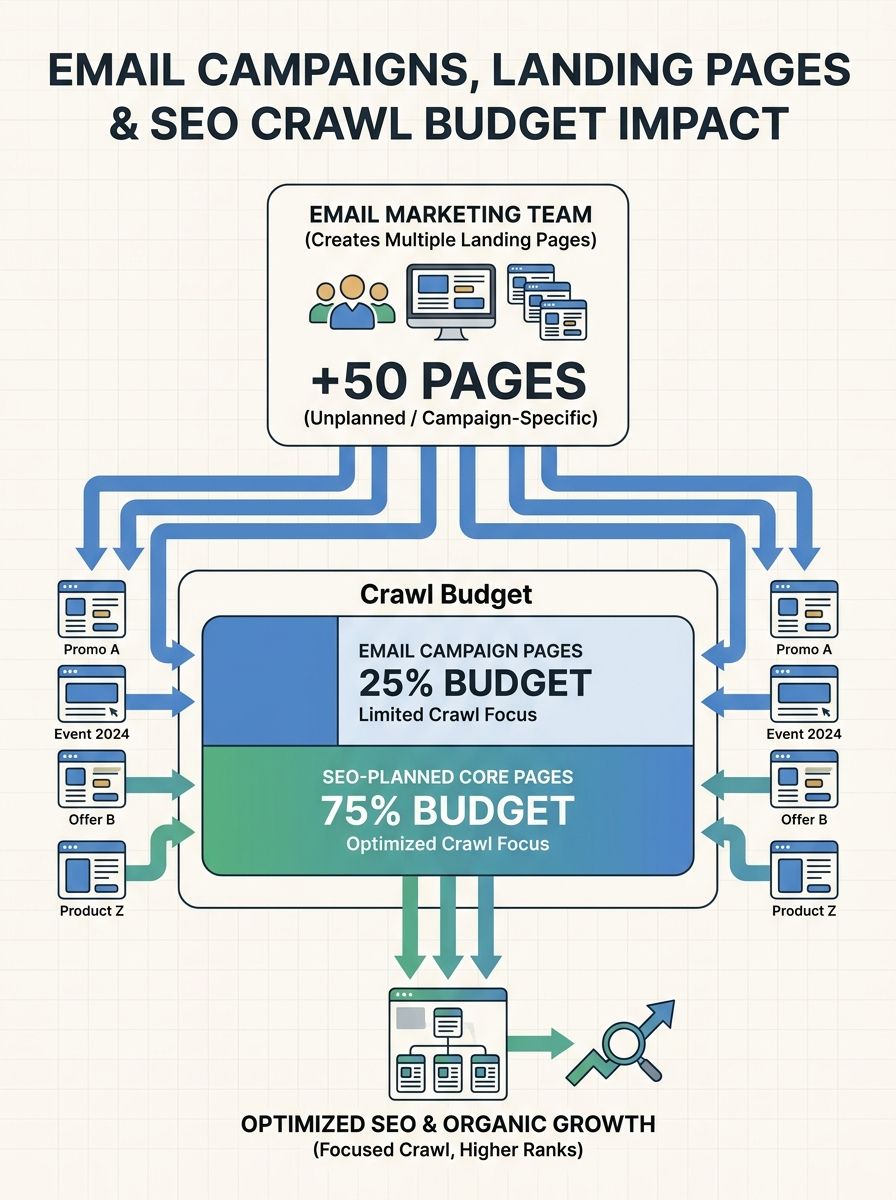
Why does enterprise SEO break specifically when email marketing scales? Because email teams are prolific page creators who operate outside SEO governance. Every nurture sequence, product launch email, and A/B test variant typically links to a dedicated landing page. At enterprise volume—where organizations send millions of emails monthly across dozens of segments—that page creation compounds into hundreds or thousands of URLs the SEO team never planned for and often doesn't know about.
These pages create three specific problems. First, they fragment keyword targeting. An email team building a landing page for a "cloud security" webinar promotion will naturally use the same terms the SEO team has already targeted with an organic pillar page. Without keyword governance, both pages compete for the same queries, and Google splits ranking signals between them. According to DeltaV Digital, keyword governance across teams is one of the core challenges that "don't exist at small scale" but become critical at enterprise volume.
Second, email landing pages often carry thin or duplicate content. They're designed for conversion, not search. But if they're indexable—and by default, they usually are—they dilute the domain's topical authority with dozens of shallow pages covering the same ground as carefully crafted SEO content.
Third, the URL proliferation drains crawl budget. If you've already investigated how site architecture affects crawl efficiency, you know that Google's crawlers have finite resources for any domain. Adding hundreds of campaign-specific URLs forces crawlers to spend time on pages designed for email recipients, not search users.
The Compounding Effect of Cross-Channel Publishing
The email team isn't the only contributor. Product marketing creates feature pages. Demand gen builds paid landing pages. Events teams publish conference microsites. Each group follows its own content calendar, its own naming conventions, and its own publishing timeline. The SEO team—if consulted at all—reviews pages after they've already been built and staged.
This sequence inversion is the mechanism behind most enterprise SEO planning failures. SEO input arrives too late in the production cycle to influence page architecture, URL structure, or keyword targeting. A 2026 framework from Improvado shows that 40-50% of typical marketing budgets go toward digital channels including social media, SEO, and paid ads. But that SEO budget integration rarely extends to controlling what other channel teams publish. The SEO line item covers tools, audits, and content production. It doesn't fund the governance layer that would prevent other teams from creating problems faster than SEO can solve them.
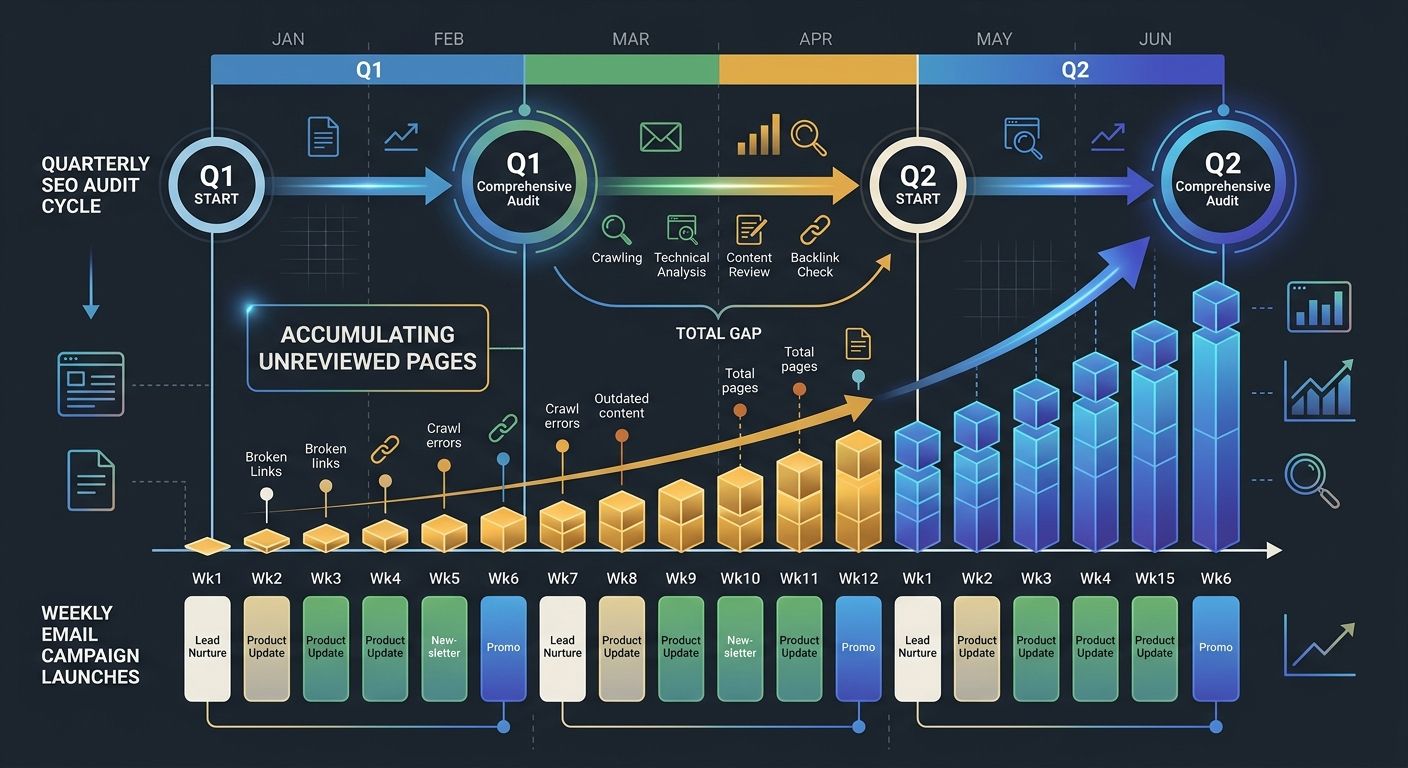
I've worked with enterprise teams where the email marketing department alone created 300+ new landing pages in a single quarter for campaign variants, localized offers, and event promotions. The SEO team had a quarterly audit cycle. By the time they discovered the indexation bloat, 200 of those pages had been live and crawled for 8-12 weeks, some accumulating backlinks from social shares, making cleanup complicated.
The Keyword Governance Breakdown
Enterprise keyword cannibalization follows a predictable pattern. The SEO team maps target keywords to specific URLs. They build content calendars around that mapping. Then an email marketing team—working from their own campaign brief, not the SEO keyword map—creates a landing page targeting functionally identical terms.
The overlap happens because both teams are doing their jobs correctly within their own workflows. Email marketers optimize landing pages for relevance to their campaign messaging. SEO teams optimize pages for search intent. When the target audience and the search audience care about the same topic, the resulting pages inevitably compete.
Fixing this requires what enterprise SEO practitioners call keyword governance: a centralized registry of which URLs own which keyword clusters, with a review gate that prevents new pages from publishing against already-claimed terms. As outlined in an enterprise SEO analysis by Outpace, the biggest challenges include "technical debt at scale, internal bureaucracy slowing implementation," and the organizational friction that makes governance feel like red tape to channel teams under deadline pressure.
The governance system works on three axes. I call it the Publishing Gate Score:
Term ownership check: Does an existing page already target this keyword cluster? If yes, the new page either links to the existing page or replaces it—never runs parallel.
Indexation decision: Should this page be indexable at all? Most email campaign landing pages should carry a noindex directive, preserving crawl budget for pages designed to rank.
Canonical alignment: If the page must exist as indexable, does it canonical to the primary keyword-owning URL? Misapplied canonicals undermine visibility, especially when sitemaps and internal links point in conflicting directions.
Organizations that implement this three-check gate before any page reaches production cut keyword cannibalization incidents measurably. The enterprise clients I've consulted with typically see 30-50% fewer competing URL pairs within two quarters of implementation, because the gate catches conflicts when they're cheap to fix—before publication—rather than after Google has already indexed both pages.
Crawl Budget Economics at Enterprise Scale
Google reduced its HTML crawl limit to 2MB per page in January 2026, tightening the efficiency requirements for enterprise domains. For sites running 50,000+ URLs, every page that gets crawled but shouldn't be represents wasted crawler resources—campaign landing pages, A/B test variants, and email preference center pages consuming attention meant for revenue-generating content.
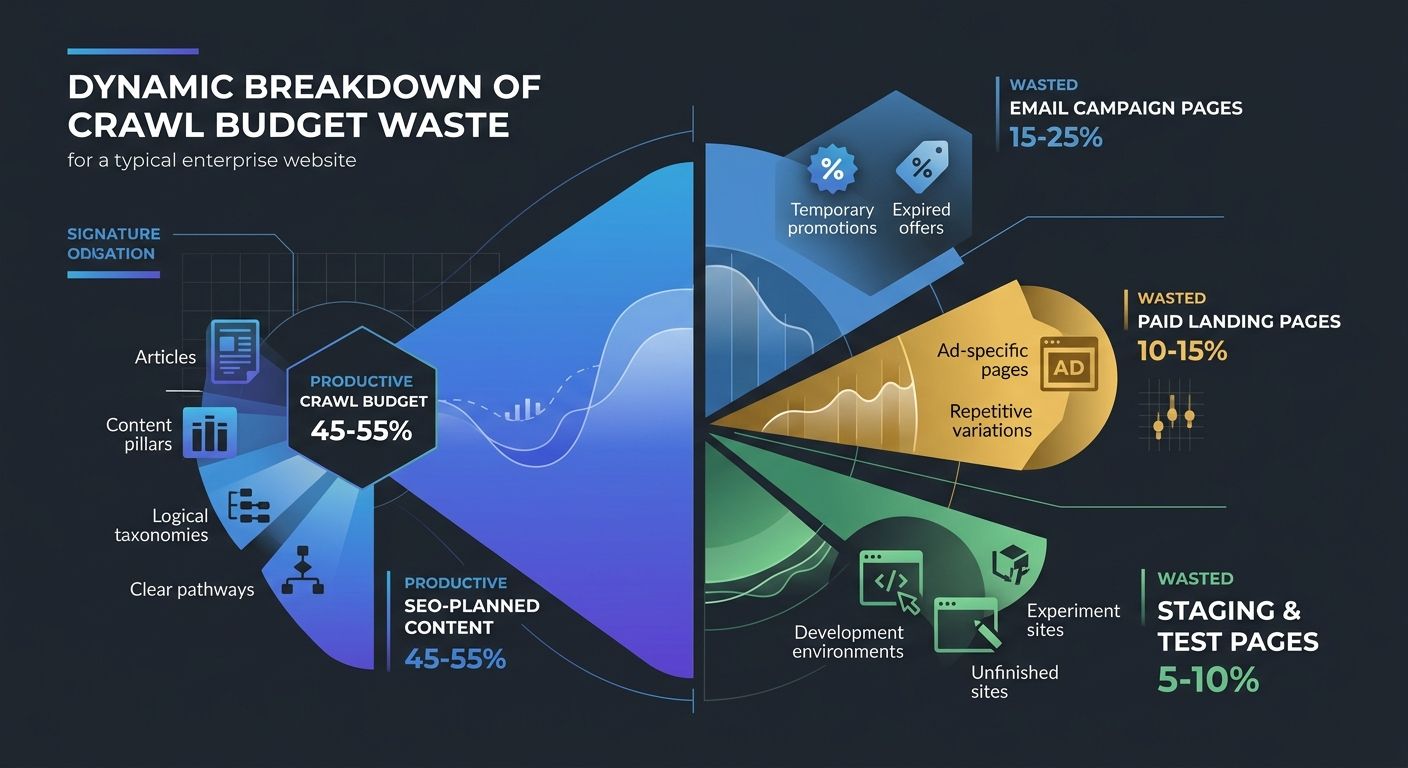
The math is direct. If an enterprise site has 80,000 indexable URLs but only 45,000 serve a search purpose, roughly 44% of crawl activity produces zero organic value. Email campaign infrastructure accounts for 15-25% of that waste in organizations I've audited, through UTM-parameterized URLs that get indexed, archived campaign pages that remain live, and landing page variants that were never consolidated.
The connection between site architecture and crawl budget is well-documented. What's less discussed is how email marketing workflows specifically generate crawl waste through three mechanisms: parameterized URLs without proper canonical tags, landing page variants that remain indexable after campaigns end, and auto-generated pages from marketing automation platforms that create URLs for every email, form, and workflow.
Cross-Functional SEO Alignment Through Shared Workflows
Enterprise SEO success depends on what BrightEdge describes as "coordinated efforts across multiple teams—development, content, marketing, legal, and product". The operative word is coordinated. Most enterprise organizations have mature workflows within each team. Email has its campaign calendar. Content has its editorial calendar. SEO has its optimization roadmap. The breakdown happens at the interfaces between these workflows, where handoffs don't exist and priorities conflict.
The fix involves three structural changes to how enterprise marketing teams operate:
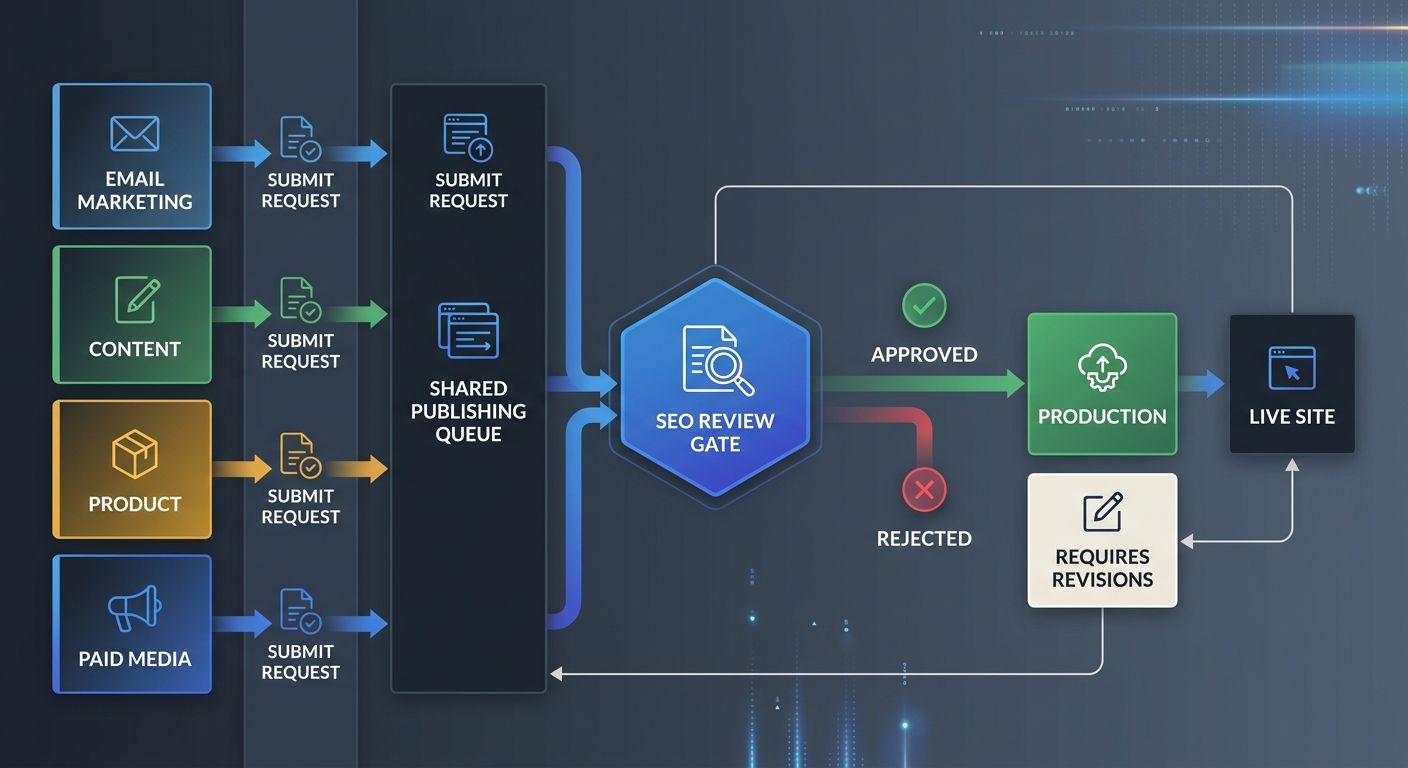
Shared publishing queue. Every team that creates web pages—email, content, product, events—submits new URLs through a single intake system. The SEO team reviews each submission against the keyword governance registry before the page goes live. This adds 24-48 hours to the publishing timeline, which is why executive sponsorship matters. Without C-suite backing, individual teams will route around the gate to meet their own deadlines.
Unified content calendar with SEO metadata. If you've looked at how documented content strategies affect team performance, you know that organizations with written strategies perform significantly better. The enterprise version of this requires every calendar entry—regardless of originating team—to include target keyword cluster, indexation decision, and canonical URL. This turns the calendar from a scheduling tool into a governance document that makes cross-functional SEO alignment operational rather than aspirational.
Quarterly cross-functional review. Representatives from email, paid, product, and content meet with the SEO team to review the previous quarter's publishing activity against search performance. This review surfaces patterns like repeated keyword conflicts, crawl budget drift, and content gaps that no single team can see from its own data. The SEO benchmarking cadence that works for smaller teams needs this additional cross-functional layer at enterprise scale.
Here's where the numbers matter: 58.7% of SEO professionals report measurable ROI improvements when they prioritize fixes using frameworks like RICE or the Impact-Effort Matrix. But those frameworks only work when the SEO team has visibility into what all channel teams are publishing. Without the shared workflow, the SEO team is scoring and prioritizing tasks based on incomplete information—optimizing individual pages while other teams create new problems at the same rate.
Where The Model Breaks
This governance model has real limitations that enterprise teams should understand before investing in it.
The biggest constraint is speed. Email marketing teams operate on campaign timelines measured in days, sometimes hours. A promotional email tied to a flash sale or partner co-marketing window can't wait 48 hours for SEO review without missing its deadline. The practical compromise is a tiered system: pages targeting keywords with monthly search volume above 500 go through the full Publishing Gate Score review. Pages targeting low-competition, branded, or event-specific terms get fast-track approval with automated checks only. This tiering prevents the gate from becoming the bottleneck that kills adoption.
The model also assumes the SEO team has enough capacity to review incoming requests from every channel. In organizations where SEO is a two-person function serving a 200-person marketing department, the review gate becomes a chokepoint that generates resentment rather than alignment. Scaling the gate requires either growing the SEO team, training email and content leads to perform basic keyword conflict checks themselves, or automating the term ownership lookup through tooling integration.
Cultural fit matters as much as process design. Enterprise SEO planning demands that email, paid, and content teams accept constraints on their publishing autonomy. Some organizations have the structural readiness for this—shared OKRs, integrated reporting, and leadership that treats the website as a shared asset rather than territory. Others treat each channel as an independent profit center with its own domain real estate. In the second type of organization, governance stalls regardless of how well-designed the workflow is. The SEO triage protocol that assumes a single team controlling the remediation queue has to adapt to distributed ownership where fixing a landing page owned by the email team requires that team's developer resources and sprint prioritization.
Search volume across traditional queries is projected to decline by 25% as AI chatbots absorb informational searches and drive up to 35% of "visits" through conversational interfaces. That shift raises the stakes of every decision covered in this article. Fewer organic search visits mean each visit carries more revenue value, and wasting crawl budget or diluting keyword authority with uncoordinated email campaign pages becomes proportionally more expensive. Corporate search strategy scaling in this environment means building the governance infrastructure now, while organic traffic still provides the volume to justify the investment—because the organizations that wait will be trying to build coordination systems during a traffic decline, with shrinking data and tighter budgets.

Sarah Chen
SEO strategist and web analytics expert with over 10 years of experience helping businesses improve their organic search visibility. Sarah covers keyword tracking, site audits, and data-driven growth strategies.
Related Articles

The Content Architecture Data Trap: How Poor Site Structure Silently Kills Your Internal Linking Strategy
Link equity flows top-down through a site hierarchy, with the homepage holding the most authority and each subsequent level receiving progressively less. ClickRank.

The Site Architecture Crawl Budget Audit: Reclaiming Lost SEO Performance Through Strategic Hierarchy Redesign
Social media campaign infrastructure is the single largest unaudited source of crawl waste on enterprise websites, and the teams creating the problem rarely know it exists.

The Content Production Bottleneck: Why Your Publishing Timeline Kills SEO Performance
Inefficient content production workflows reduce marketing team productivity by up to 40%, and 45% of teams report they can't keep pace with their own publishing targets in 2026.
Explore more topics