
Building a Technical SEO Governance Framework: From Guidelines to Enforcement
Every enterprise I've audited has SEO guidelines. They sit in a Google Doc somewhere, maybe a Confluence page, written by someone who left the company two years ago. And nobody follows them.
Building a Technical SEO Governance Framework: From Guidelines to Enforcement
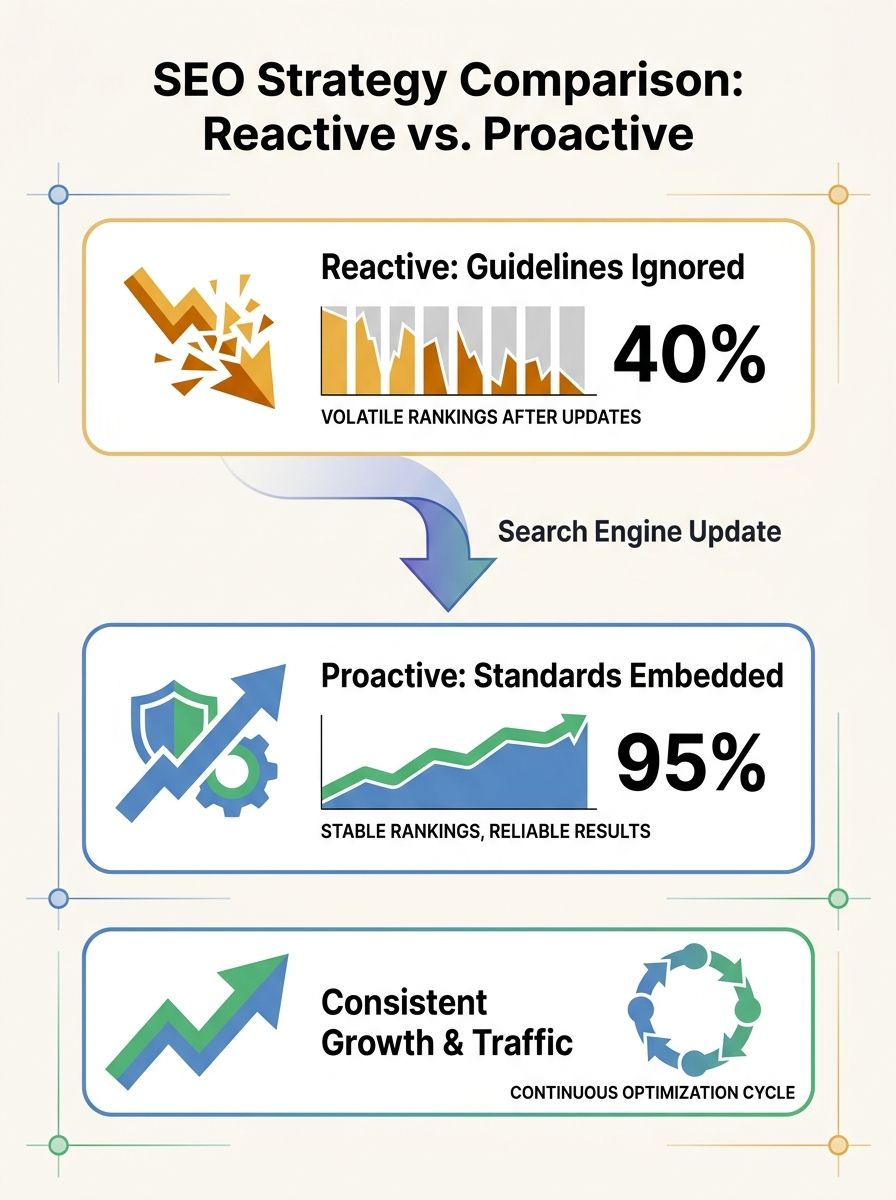
Every enterprise I've audited has SEO guidelines. They sit in a Google Doc somewhere, maybe a Confluence page, written by someone who left the company two years ago. And nobody follows them. The guidelines exist, the governance doesn't, and the organic search channel quietly bleeds out while teams argue about who broke what. An SEO governance framework isn't a document. It's an operating system. And the difference between companies that maintain their rankings through algorithm updates and those that panic every quarter comes down to whether they built enforcement into their process or just wrote down good intentions.
Why Guidelines Without Enforcement Are Just Suggestions
I worked with a 12,000-page B2B SaaS company that had beautifully written SEO standards. Detailed schema requirements. Internal linking rules. Meta description templates. The problem? Their engineering team had never seen the document. Their content team treated it as optional. And their product team shipped a new URL structure that wiped out 40% of their indexed pages because nobody in the approval chain was responsible for SEO sign-off.
This pattern repeats everywhere. As Search Engine Journal's analysis of modern SEO Centers of Excellence puts it, a governing CoE defines what qualifies for creation in the first place rather than reviewing content after publication. That's the critical shift. Governance happens upstream, not downstream. By the time you're reviewing a published page for SEO issues, you've already lost.
Effective governance models also reduce your exposure to algorithm volatility. According to ClickRank's enterprise governance research, documented standards and continuous monitoring reduce ranking shocks because algorithm updates typically target thin content, duplicate pages, poor user experience, and manipulative tactics. Governance eliminates those problems before they exist.
Actionable takeaway: Audit your current SEO documentation. If it's more than six months old, hasn't been referenced in a sprint planning session, and lacks an owner with enforcement authority, you don't have governance. You have a wishlist.
The Ownership Problem: Nobody and Everybody
The single biggest failure point in SEO governance is ambiguous ownership. When I ask "who owns SEO at your company?" and get three different answers from three different people, I already know the diagnosis.
Ambiguity about who owns what creates the exact coordination problems governance should solve, as documented in Passionfruit's enterprise SEO governance process framework. Their recommendation, and mine based on painful experience, is a clear RACI model with four distinct roles:
SEO Leadership owns the overall strategy, sets standards and priorities, and serves as the final decision authority for conflicts
Engineering Teams implement technical requirements and integrate SEO checkpoints into their deployment pipelines
Content Teams follow structural and intent-based requirements defined by the governance framework
Analytics/BI Teams monitor performance and flag deviations from established baselines
The SEO leadership role typically sits within marketing but must maintain authority across all SEO-impacting functions. This is where most companies falter. They give the SEO team responsibility without authority, which is a recipe for frustration and finger-pointing.
The Four Pillars of Technical SEO Enforcement
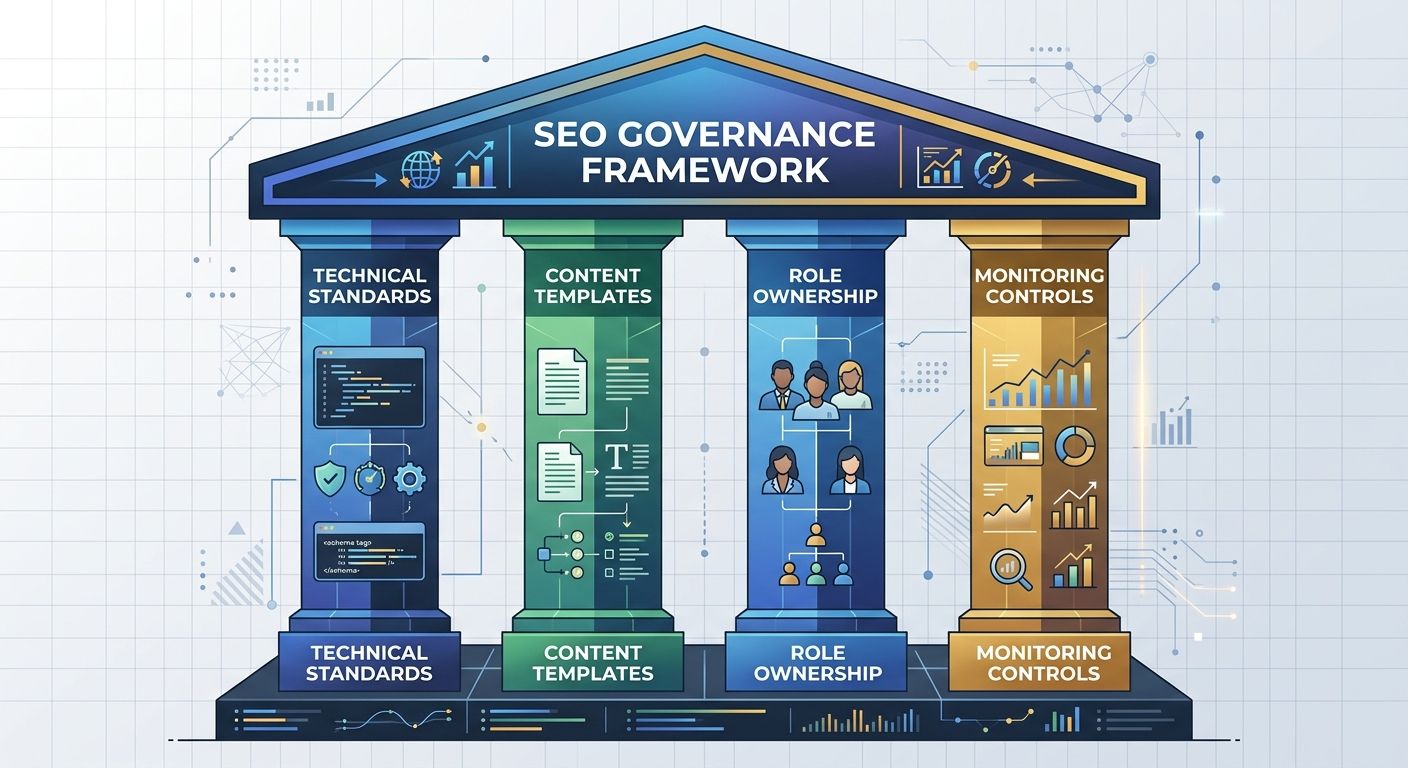
A working technical SEO enforcement system rests on four pillars. Skip any one of them and the whole structure wobbles.
Pillar 1: Non-Negotiable Technical Standards
Your framework needs a clear list of requirements that cannot be shipped without. Not suggestions. Requirements. These include:
Every page returns a proper HTTP status code (no soft 404s returning 200 OK)
Canonical tags are present and self-referencing on all indexable pages
Structured data validates against the latest schema.org specifications
Core Web Vitals meet thresholds: INP under 200ms, LCP under 2.5s, CLS under 0.1
Server-side rendering or Incremental Static Regeneration for all critical content
XML sitemaps auto-generated and updated within 24 hours of content changes
These standards get embedded into your CI/CD pipeline as automated checks. A pull request that introduces a page without a canonical tag should fail the same way a pull request with broken unit tests fails. That's the enforcement mechanism.
Pillar 2: Content Compliance Templates
Content compliance templates are where governance meets daily content operations. These aren't style guides. They're structural requirements that ensure every piece of content meets minimum SEO standards before anyone writes a single word.
A solid content compliance template includes:
Target keyword and search intent classification (navigational, informational, transactional, commercial)
Required heading structure (H1, H2, H3 hierarchy)
Internal linking minimums (I recommend at least 3 contextual links per 1,000 words)
Schema type assignment (Article, FAQ, HowTo, Product, etc.)
Entity definitions and relationships (more on this below)
Meta title and description character count ranges
If you're already thinking about how strategic internal linking architecture boosts SEO, you're on the right track. But the key difference in a governance framework is that linking isn't optional or left to the writer's judgment. The template specifies the minimum, the content brief identifies the target pages, and the review process checks compliance before publication.
Templates vetted by legal and compliance teams are also critical for regulated industries. They ensure consistency and reduce the risk of messaging that violates marketing regulations, especially in finance, healthcare, and investment sectors.
Actionable takeaway: Build your content compliance templates in whatever tool your content team already uses. If they're in Google Docs, the template lives in Google Docs. If they use Notion or Asana, put it there. A template nobody opens is the same as no template at all.
Pillar 3: Entity Management as a Governance Layer
Entity management SEO is the most overlooked component of governance, and it's becoming more important as AI answer engines rely on structured understanding of who you are, what you do, and how your products relate to each other.
Entity management in the governance context means maintaining a single source of truth for:
Your organization's name, description, and key attributes (used in Organization schema)
Product names, categories, and relationships
Author identities, credentials, and E-E-A-T signals
Location data for multi-location businesses
Topic taxonomy that maps your content to specific entities
When you're rebuilding your SEO strategy around AI recommendations, entity consistency becomes the foundation that determines whether AI systems understand and cite your content correctly. If your homepage calls your product "DataSync Pro," your blog calls it "DataSync," and your schema markup calls it "Datasync Professional," you're fragmenting your entity signals.
Pillar 4: Search Performance Controls
Search performance controls are the monitoring layer that tells you whether your governance framework is actually working. Without measurement, governance is theater.
Your control system should track:
Compliance rate: What percentage of new pages published this month met all template requirements?
Technical health score: How many pages pass automated checks without manual intervention?
Index coverage: Are the right pages indexed? Are the wrong pages excluded?
Crawl budget efficiency: What's the ratio of crawled pages to indexed pages?
Core Web Vitals pass rate: What percentage of your pages hit "Good" across all three metrics?
I recommend weekly automated reports and monthly manual deep dives. If your analytics dashboards aren't built on solid data architecture, your governance metrics will be unreliable too. Fix the measurement infrastructure first.
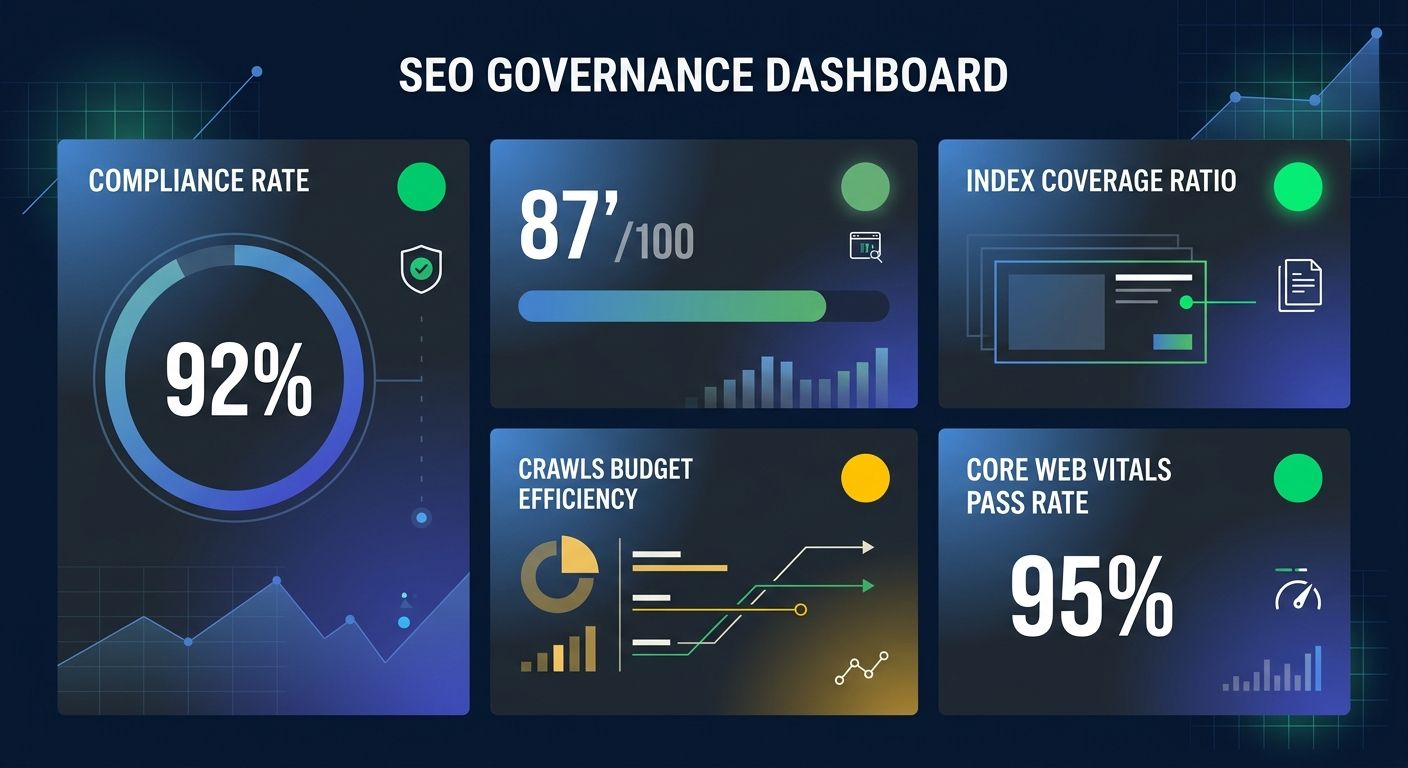
Actionable takeaway: Set a target compliance rate and treat it like any other business KPI. I push clients toward 95% compliance on new content within six months of implementing a governance framework. Anything below 80% means your enforcement mechanisms aren't working.
From Document to Operating System: Making Governance Stick
The hardest part of building an SEO governance framework isn't designing it. It's getting cross-functional teams to actually follow it. Here's what I've seen work.
Embed SEO Into Existing Workflows
Don't create a parallel SEO review process. That adds friction and gets skipped. Instead, insert SEO checkpoints into workflows that already exist:
Add SEO fields to your CMS content creation form (not a separate checklist, but required fields that block publishing)
Include SEO validation in your pre-deployment QA pipeline
Add an SEO impact assessment to your product team's RFC template
Build SEO compliance into your content calendar approval flow
When a company I worked with was planning a site migration that could have destroyed their rankings, having SEO governance baked into their deployment pipeline was the only thing that caught a redirect loop before it went live. The automated check flagged it. The engineer fixed it in 20 minutes. Without that control, it would have taken weeks to diagnose the traffic drop.
Make Violations Visible, Not Punitive
Governance fails when it feels like policing. The goal isn't to punish teams for SEO mistakes. It's to make the right thing easier than the wrong thing.
Publish a monthly compliance scorecard by team. Show which teams are hitting standards and which aren't. Make it visible to leadership. Most teams will self-correct when they see their numbers compared to peers. For the ones that don't, escalation paths should be clearly defined in your RACI model.
Conduct Quarterly Governance Reviews
Your framework needs to evolve. Quarterly reviews should ask:
Which standards are consistently violated? (This might mean the standard is unrealistic or poorly communicated)
Which new technical patterns have emerged that need governance? (AI crawler management, for example)
Are our content compliance templates still aligned with current search intent patterns?
What's our compliance trend line? Are we improving or backsliding?
If your content planning process already includes regular audits, add governance review to that cadence. Don't create yet another meeting.
The AI Crawler Wrinkle
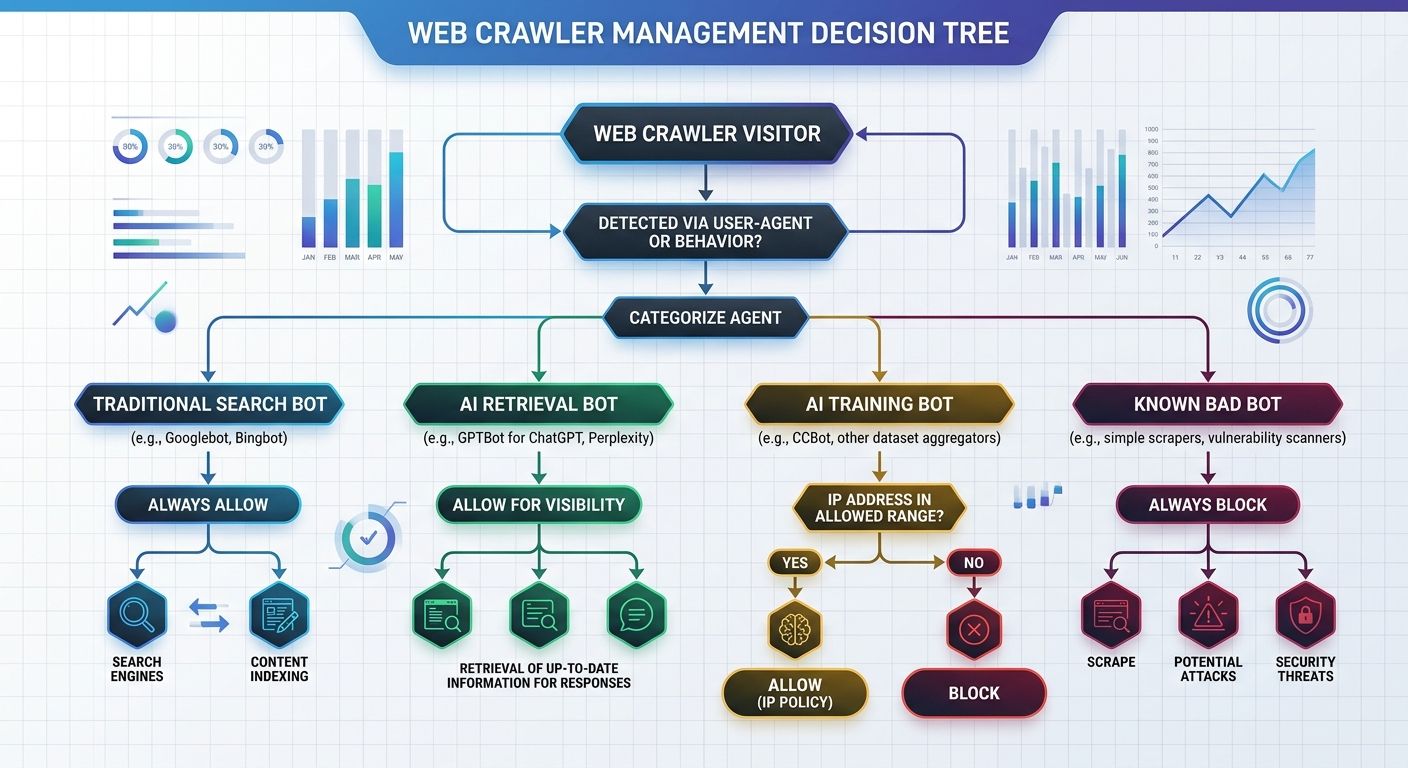
One governance area that's evolved rapidly is managing AI-specific crawlers. Your robots.txt policy now needs to differentiate between traditional search engine bots, AI training crawlers like GPTBot and Google-Extended, and AI retrieval crawlers like OAI-SearchBot and Claude-SearchBot. Blocking retrieval bots can make your content invisible in AI-generated answers, and AI-referred traffic converts at significantly higher rates than traditional organic search. Your governance framework should include a clear, documented policy for which bots are allowed and which are blocked, reviewed quarterly as the landscape shifts.
A Real Framework in Action
Let me share what a working governance framework looks like in practice. A mid-market e-commerce client with roughly 45,000 pages implemented this system over four months:
Month 1: Documented all technical standards. Created the RACI chart. Built content compliance templates. Audited existing entity representation across the site.
Month 2: Integrated automated SEO checks into their CI/CD pipeline. Added required SEO fields to their CMS. Set baseline measurements for all five search performance controls.
Month 3: Ran the first full compliance audit. Found that 62% of new pages met all requirements. Identified that the product team was the primary source of non-compliance (they didn't know the standards existed). Conducted training sessions.
Month 4: Compliance hit 84%. Core Web Vitals pass rate went from 71% to 93%. They pruned 8,000 zero-traffic pages that had accumulated over three years. Index coverage ratio improved by 31%.
Six months later, they sailed through a core algorithm update that hit their top competitor hard. The competitor dropped 35% in visibility. My client gained 12%. Same industry. Same keywords. Different governance.
The Implementation Sequence That Works
Stop writing guidelines that nobody reads. Start building enforcement that nobody can skip. Here's the sequence I recommend:
Map your current SEO decision-making process. Who touches what? Where do things break?
Define your non-negotiable technical standards. Keep the list short and absolute.
Build content compliance templates in the tools your teams already use.
Create your entity registry and assign an owner.
Set up automated checks in your deployment pipeline.
Establish your five core search performance controls and set targets.
Run your first compliance audit 30 days after implementation.
The companies that treat SEO as infrastructure rather than a marketing channel are the ones still standing after every algorithm update. Build the system. Enforce the standards. Measure the results. That's governance.

Sarah Chen
SEO strategist and web analytics expert with over 10 years of experience helping businesses improve their organic search visibility. Sarah covers keyword tracking, site audits, and data-driven growth strategies.
Explore more topics