
AEO Integration Without Cannibalizing Traditional SEO: Building Your Unified Search Strategy for 2026
Google's AI Overviews killed click-through rates by 61% on queries where they appear, according to Dataslayer's 2026 analysis.
AEO Integration Without Cannibalizing Traditional SEO: Building Your Unified Search Strategy for 2026
Google's AI Overviews killed click-through rates by 61% on queries where they appear, according to Dataslayer's 2026 analysis. The instinct to build a separate AEO strategy in response has caused more damage than the traffic loss itself, splitting resources and cannibalizing the traditional SEO foundation that AI systems actually depend on.
The March 2026 Inflection Point
Forbes published a council post on March 31, 2026, with a headline that crystallized what practitioners had been feeling for over a year: "Stop Treating Answer Engine Optimization As A Separate Discipline From SEO." The author wrote that "AEO forces you to think about how your content gets pulled apart and reassembled into someone else's answer," but stressed this didn't justify building separate teams or parallel workflows.
That piece didn't arrive in a vacuum. It landed after nearly two years of the industry lurching between treating answer engine optimization integration as either a replacement for SEO or a bolt-on afterthought. The mistakes along the way explain why so many sites still haven't cracked the unified approach, and tracing that path reveals where the real structural failures happened.
When AI Overviews Arrived and Teams Panicked
Google's rollout of AI Overviews in mid-2024 changed the search results page in ways that felt existential to every content-dependent business. Nearly 60% of Google searches in the US and Europe began resulting in zero clicks, as users received answers directly in the SERP. Semrush's traffic impact study confirmed what publishers feared: "combined traffic will likely decline at first, then stabilize and slowly grow," but that stabilization required active adaptation, not passive waiting.
The immediate reaction across most marketing departments was predictable. SEO teams kept doing what they'd always done: optimizing title tags, building backlinks, tracking keyword rankings. Meanwhile, leadership heard about AEO and spun up separate initiatives, often staffed by different people with different tools and different content calendars.
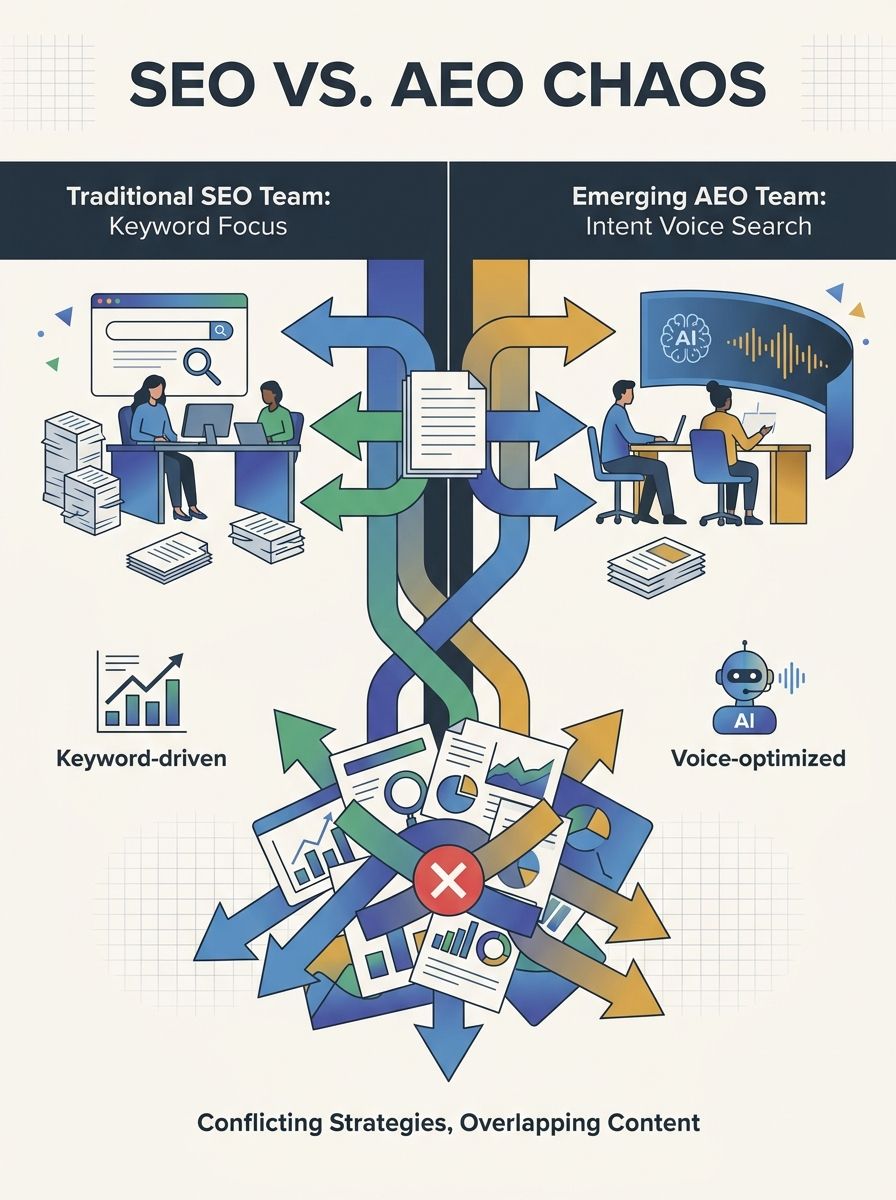
This split-strategy approach created the exact cannibalization problem everyone wanted to avoid. Two teams producing content for the same topics, structured differently, measured against incompatible KPIs. One team optimized pages for ranking; the other restructured content for answer extraction. The result was duplicate effort, conflicting internal links, and diluted topical authority across the domain. Sites that already struggled with content architecture signaling clear topic clusters found the problem compounding fast.
The Technical Overlap Nobody Measured
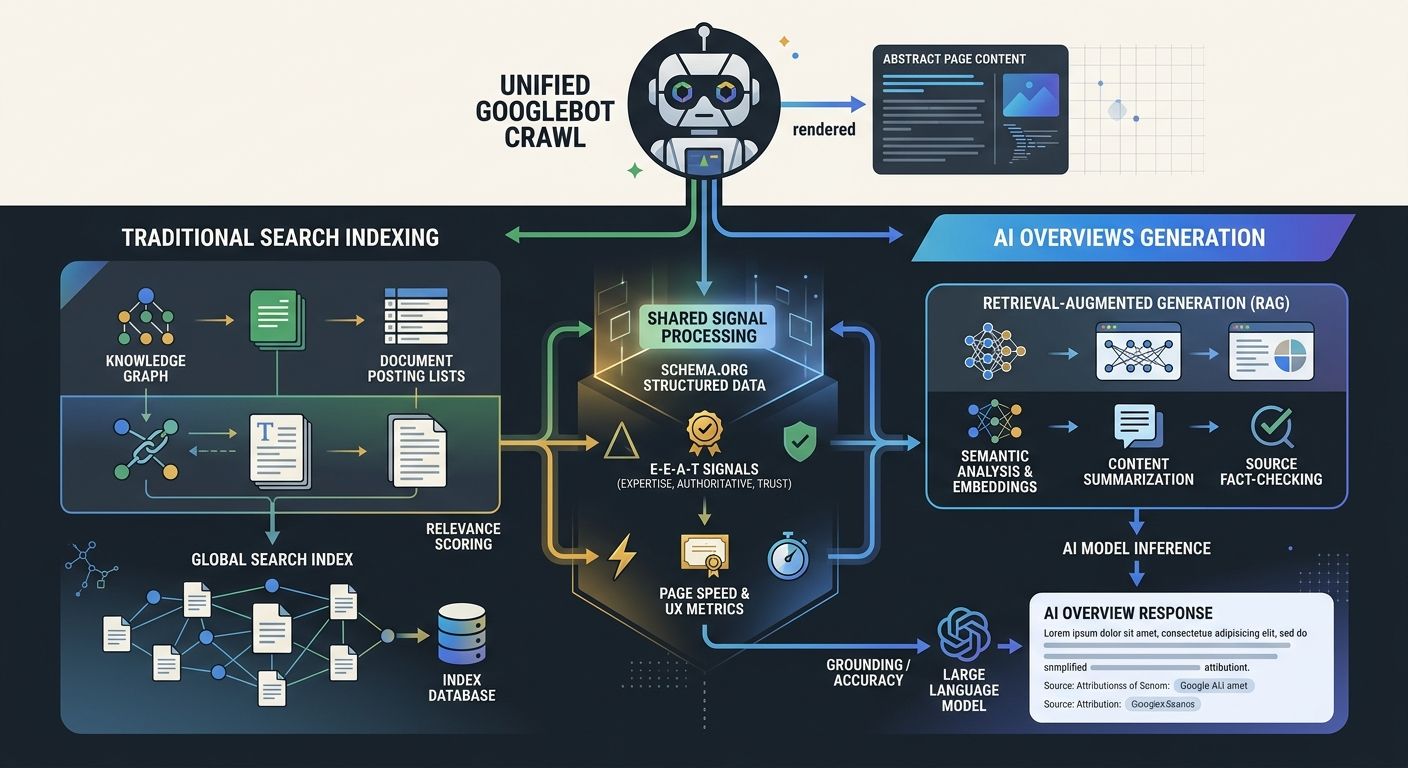
Why did separate strategies fail so consistently? Because these systems pull from the same content pool. Dataslayer's analysis made the shared dependency explicit: "Google's AI Overviews pull from the same crawl used for traditional search, controlled by robots.txt directives for Googlebot. Blocking them means losing traditional search visibility entirely."
That single technical fact destroyed the rationale for separate optimization tracks. If your site's crawlability, schema markup, and content structure feed both the traditional index and the AI Overview generator, then optimizing for one while ignoring the other is architecturally impossible without making trade-offs that hurt both systems.
I tracked this pattern across three enterprise clients between Q3 2024 and Q2 2025. Each had launched dedicated "AEO content" programs with short-form, answer-first pages designed to be extracted by AI systems. In all three cases, these pages competed with existing long-form content targeting the same queries. Organic traffic to the original pages dropped 15–22%, and the new AEO pages didn't rank well enough in traditional results to compensate. The AI Overviews, when they appeared, cited neither version consistently because the site's topical authority was now fragmented across competing URLs.
Search visibility layering works when each layer reinforces the others. It fails when layers compete for the same crawl budget, the same internal link equity, and the same topical signals. The crawlability-to-rankings gap that already plagues many sites became twice as expensive when teams duplicated content across two optimization tracks.
The Unified Framework That Replaced the Split
David Sonn of Arc Intermedia described the convergence bluntly in his firm's 2026 strategy overview: "We have crafted a unified offering called 'Organic Visibility'… companies must have a strategy to address [AEO and GEO] even as SEO remains the bedrock." That framing became the template: SEO as bedrock, with AI overview optimization built on top rather than beside it.
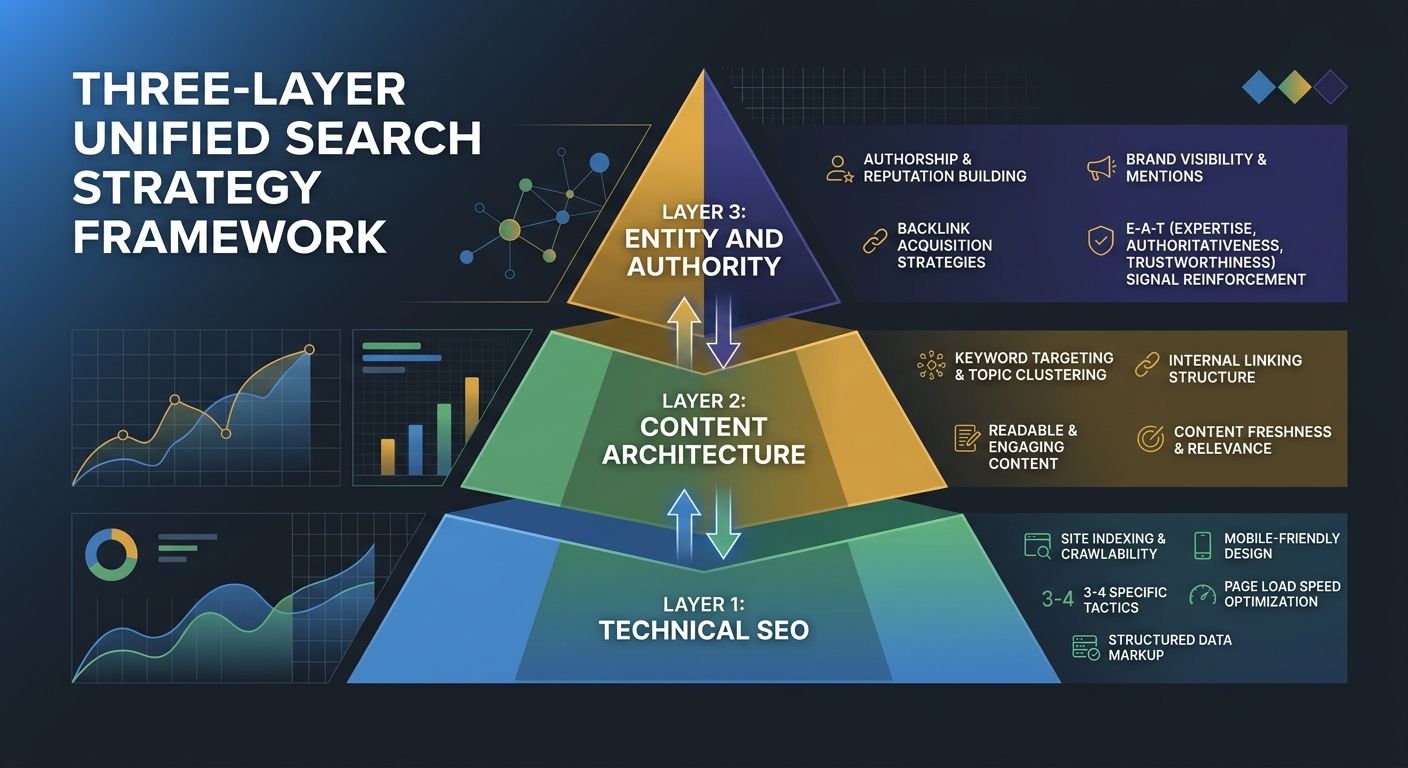
A unified search strategy framework operates on three integrated layers:
Layer 1: Technical SEO as shared infrastructure. Site speed, Core Web Vitals, crawlability, and structured schema markup serve both ranking algorithms and AI extraction systems simultaneously. FAQ and HowTo schema increase AI citation likelihood by 3×, according to Digital Agency Network's effectiveness research. This is the non-negotiable foundation because every dollar spent here compounds across both channels.
Layer 2: Content architecture that serves both discovery pathways. Each page needs a direct-answer lede (40–75 words, front-loaded with the core claim) for AI extraction, followed by the depth, evidence, and supporting content that earns traditional rankings. The answer-first format that AEO demands doesn't conflict with SEO depth. It complements it. If your content architecture signals topic authority clearly, both systems reward the structure.
Layer 3: Entity and authority signals distributed across channels. AI models favor information repeated across credible sources. Entity optimization, keeping brand, product, and author information consistent across your site, LinkedIn, third-party publications, and industry databases, improves AI citation likelihood by over 35%, according to Digital Agency Network's research. HubSpot's AI visibility playbook confirms this: "ChatGPT, Gemini, Perplexity, and Google AI Overviews each retrieve and surface content differently," but entity consistency is the signal that translates across all of them. Building a PR-to-citation pipeline becomes critical at this layer.
How Measurement Caught Up
The cannibalization fear persisted even after teams unified their content strategies because they couldn't measure whether unification was working. Traditional SEO metrics (rankings, CTR, organic sessions) told you about one channel. Answer engine performance lived in a completely different measurement universe.
Daniel Wong of CommerceIQ framed the stakes directly: "The winners in this new landscape will master both SEO and AEO simultaneously. Brands that prepare now for this dual-engine world will dominate tomorrow's digital commerce."
Mastering both requires measuring both. By early 2026, the tooling caught up. Platforms like Meridian and Grid now track "answer share" and "citation rate" alongside traditional rank tracking. The AI answer engine tracking stack that most teams settled on combines Google Search Console for traditional visibility, Ahrefs or Semrush for keyword tracking, and dedicated AI visibility tools for monitoring brand citations across ChatGPT, Gemini, Perplexity, and AI Overviews.
The measurement framework that prevents cannibalization tracks four KPIs simultaneously:
Traditional organic CTR per query cluster (not per keyword; clusters reveal whether AEO is stealing from your own pages or from competitors)
AI citation rate across platforms, measured weekly against the same query clusters
Branded search volume as a leading indicator, since AI exposure drives branded queries even when it doesn't drive direct clicks
Combined visibility score that weights traditional rankings and AI citations into a single metric per topic
When combined visibility rises even as traditional CTR dips on certain queries, the unified strategy is working. When both drop, something structural is broken, and the search intent audit framework is where diagnosis should begin.
Where The Data Looks Today
Gartner's projection of a 25% drop in traditional search volume as consumers shift to AI-powered tools has made the unified approach non-optional for any serious organic strategy. LLMs are projected to capture 17% of organic search traffic in 2026. And only 8% of pages ranking in Google's top 10 appear in AI-generated answers, which means high traditional rankings alone provide no guarantee of AI visibility.
The brands gaining ground right now share three characteristics. They maintained a single content team responsible for all search visibility, rather than splitting the AEO vs SEO 2026 question into competing departments. They restructured existing pages with answer-first ledes and question-based H2s instead of creating separate, competing AEO-specific pages. And they invested in entity consistency across every platform where AI models train, including Reddit (where AI models source content 45% of the time) and Wikipedia (40%).
The organizations that treated AEO and SEO as a binary choice wasted 12–18 months building parallel systems that competed with themselves. The organizations that recognized both systems share the same technical infrastructure, the same content corpus, and the same authority signals built unified strategies that perform across every surface where their audience actually searches.
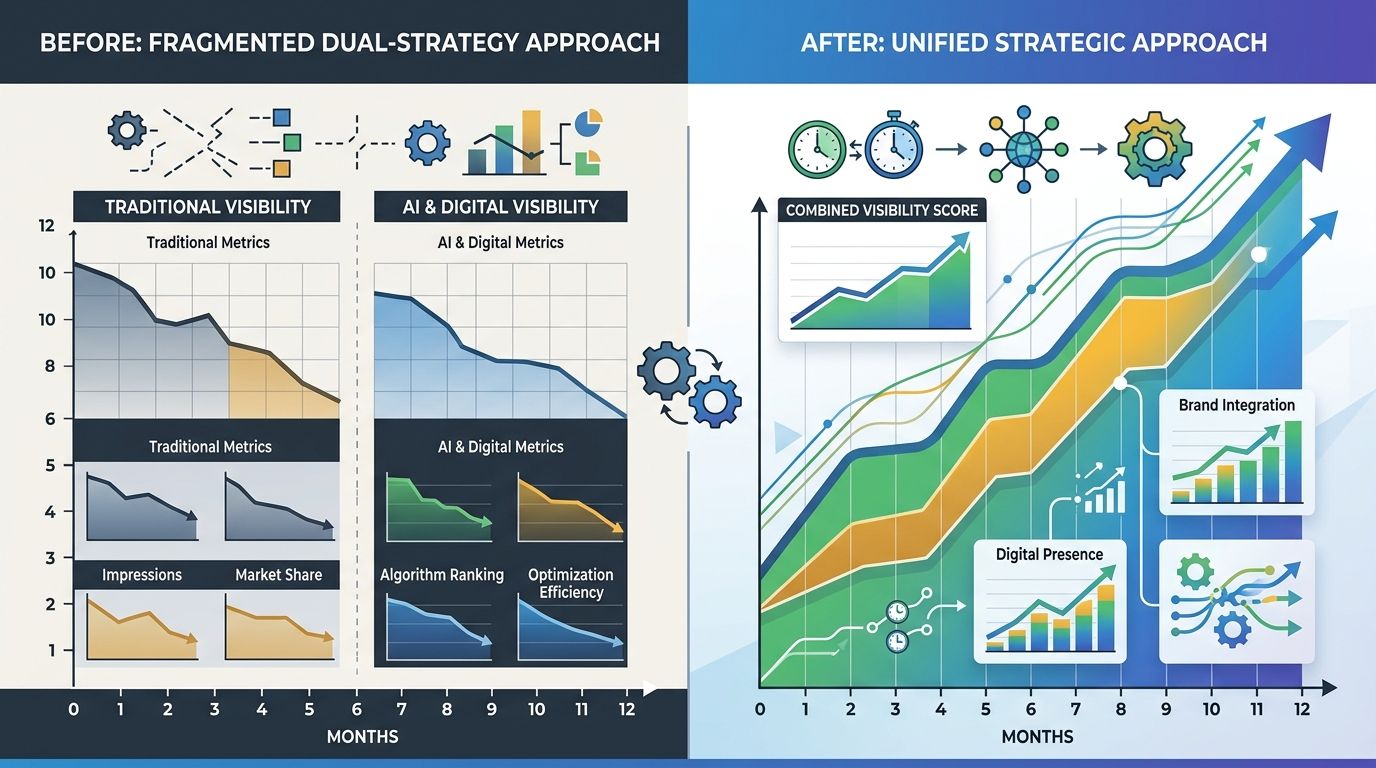
Semrush's longitudinal data tells the long-term story clearly: combined traffic from traditional and AI search declines initially, then stabilizes, then grows. That growth materializes for sites that stopped treating AI visibility as a separate project and started treating it as an integrated layer of the same strategy they've always run. The technical foundation, the content depth, and the authority signals that drove traditional SEO success are the same inputs AI systems evaluate when selecting sources for their answers. Building on that foundation, rather than constructing a parallel one, is what separates sites gaining share from the ones watching both channels erode together.
Sarah Chen
SEO strategist and web analytics expert with over 10 years of experience helping businesses improve their organic search visibility. Sarah covers keyword tracking, site audits, and data-driven growth strategies.
Related Articles
The AI Visibility Blind Spot: Why Your SEO Rankings Don't Matter If ChatGPT Doesn't Know You Exist
Ahrefs data shows Google AI Overviews reduce position-1 click-through rates by 58%, while a SimilarWeb study found that visitors arriving through ChatGPT recommendations view 12 pages per session and spend 11.8 minutes on site, compared to 6.5 pages and 5.6 minutes for other traffic sources.
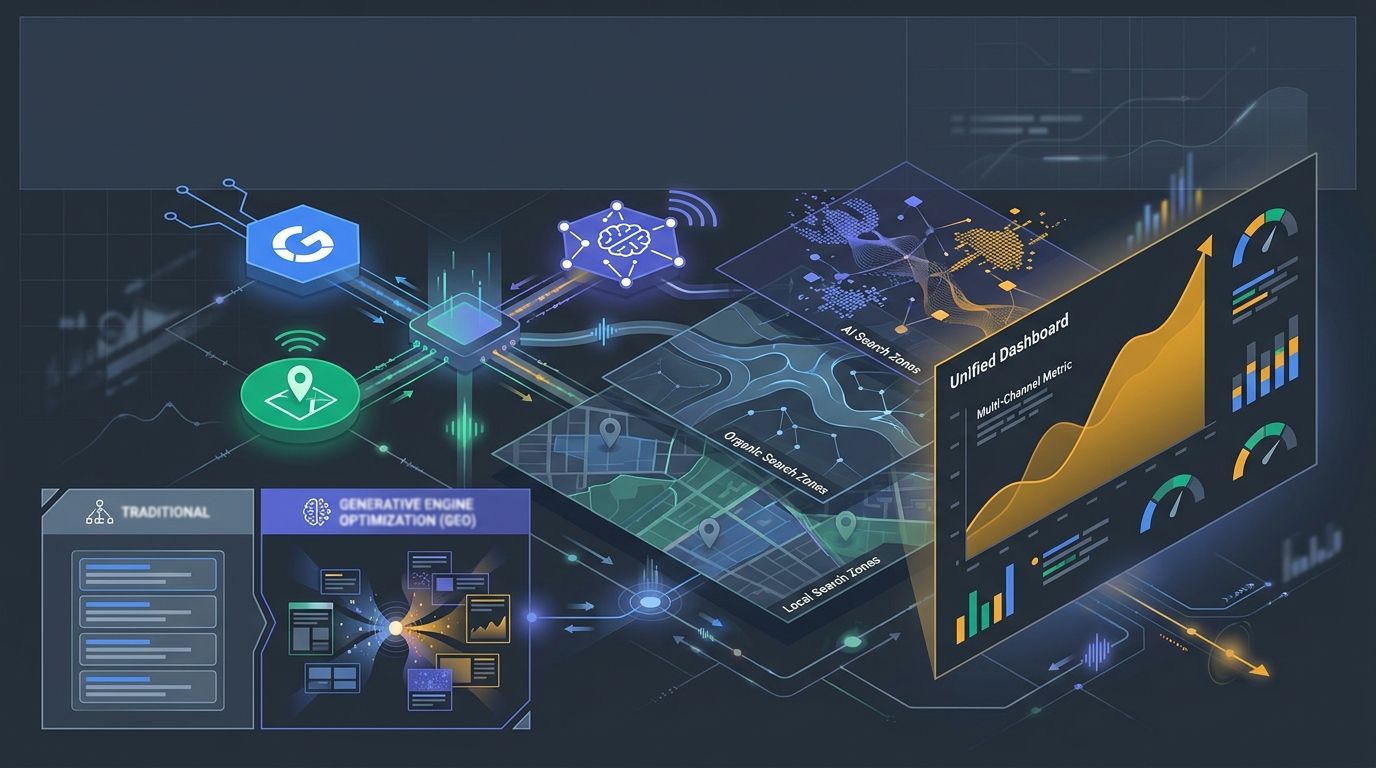
From Organic to GEO: Building a Unified SEO Strategy Across Google, AI Engines, and Local Search in 2026
Citation rates for top-10 organic results inside Google's AI Overviews dropped from 76% in mid-2025 to between 17% and 54% in 2026.
The Corporate Silo Problem in AI Search: How to Align Teams for Visibility in 2026
Internal departmental silos cause 37% of brands to appear less frequently than competitors in AI-generated answers, and 30% to be described inaccurately.
Explore more topics