
The Site Architecture Crawl Budget Audit: Reclaiming Lost SEO Performance Through Strategic Hierarchy Redesign
Social media campaign infrastructure is the single largest unaudited source of crawl waste on enterprise websites, and the teams creating the problem rarely know it exists.

The Site Architecture Crawl Budget Audit: Reclaiming Lost SEO Performance Through Strategic Hierarchy Redesign
Social media campaign infrastructure is the single largest unaudited source of crawl waste on enterprise websites, and the teams creating the problem rarely know it exists.
Every campaign landing page, UTM-parameterized URL, and promotional content hub your social team launches adds low-value URLs that compete with revenue pages for Google's limited crawl resources. Enterprise case studies document sites achieving a 72% reduction in indexed URLs while simultaneously growing monthly sessions to 30 million, according to ALM Corp's technical SEO framework. The fix begins with auditing where social campaigns create architectural drag.
Campaign Landing Pages Compound Into Architecture Bloat
Your social team launches a new campaign landing page every two to four weeks. Each one gets a unique URL, custom design, and dedicated ad spend. Traffic spikes, engagement looks strong, and the campaign wraps. The page stays live. Multiply that by 24 campaigns a year across 3 social channels, and you've added 72 or more orphaned URLs to your site in 12 months, each one sitting deep in your hierarchy with no internal links pointing to it after the campaign ends.
This creates a crawl waste diagnosis problem that compounds silently. Siteimprove's technical audit research warns that "foundational issues like crawl errors, broken redirects, and poor site speed can go unnoticed for months and silently degrade your search performance and waste your content budget." Campaign landing pages fit this pattern precisely. They're created outside the normal content workflow, rarely appear in XML sitemaps, and almost never receive the canonical tag treatment they need.
The architectural damage goes beyond the pages themselves. Seobility's crawl budget guide establishes that all subpages should sit no more than 4 to 5 clicks from the homepage to preserve efficient crawling. Social campaign pages routinely violate this rule. A typical campaign URL like /campaigns/summer-2025/social/instagram/offer-a sits 5 to 7 clicks deep, assuming it's linked from the site at all. Many campaign pages are only accessible through paid social ads, making them functionally invisible to internal link crawl paths while still consuming crawl budget when Googlebot discovers them through external backlinks or cached URLs.
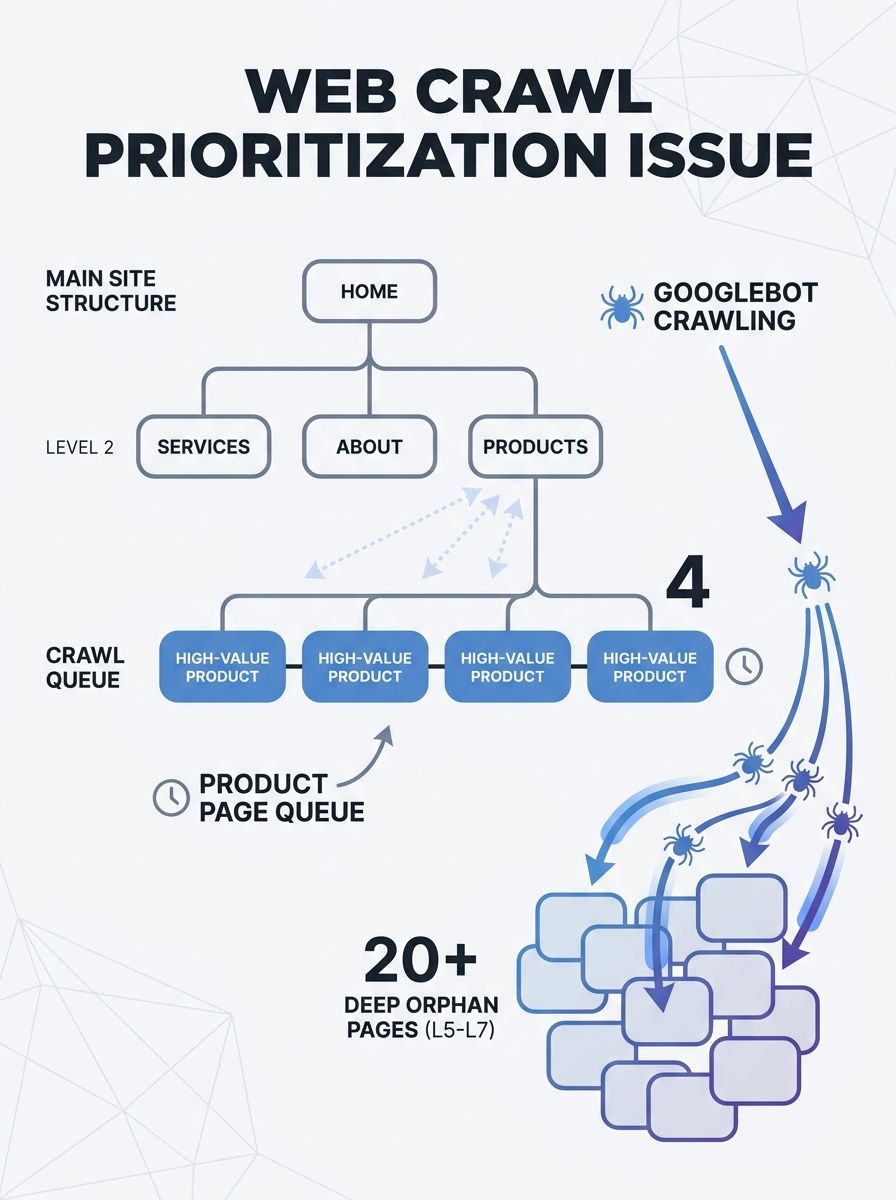
If you're already working through a process of diagnosing SEO root causes rather than treating symptoms, campaign URL bloat should rank near the top of your checklist. Enterprise SEO audits with backlogs exceeding 1,400 tickets typically indicate fundamental architecture failures, and 60–80% of those individual tickets resolve automatically when fixes target the template and CMS level rather than individual pages.
Parameter Proliferation Fragments Your Crawl Budget
UTM parameters are the silent killer of crawl budget optimization. Every time your social team shares a link with tracking parameters, that URL becomes a distinct crawlable address in Google's index unless your site explicitly handles it. A single blog post shared across Facebook, LinkedIn, Instagram, and X with campaign-specific UTM tags generates at minimum 4 duplicate URLs. Add A/B test variants for copy, audience segmentation tags, and platform-specific parameters, and that one blog post can spawn 12 to 20 crawlable URL variations.
Search Engine Land's site redesign checklist frames the principle clearly: "Search performance starts with structure. Prioritize information architecture, on-page SEO, and technical SEO. Think of your site structure and URLs as valuable real estate." Parameterized duplicates dilute that real estate by splitting crawl attention across identical content.
The information hierarchy SEO damage extends beyond raw crawl waste. When Google encounters multiple versions of the same page, it has to make a judgment call about which version to index. If your parameterized social URLs accumulate backlinks from shares and syndication, Google may index the UTM version instead of your clean canonical URL. Your analytics then show organic traffic landing on campaign-tagged URLs, corrupting attribution data and creating a feedback loop where both your social reporting and SEO reporting become unreliable.
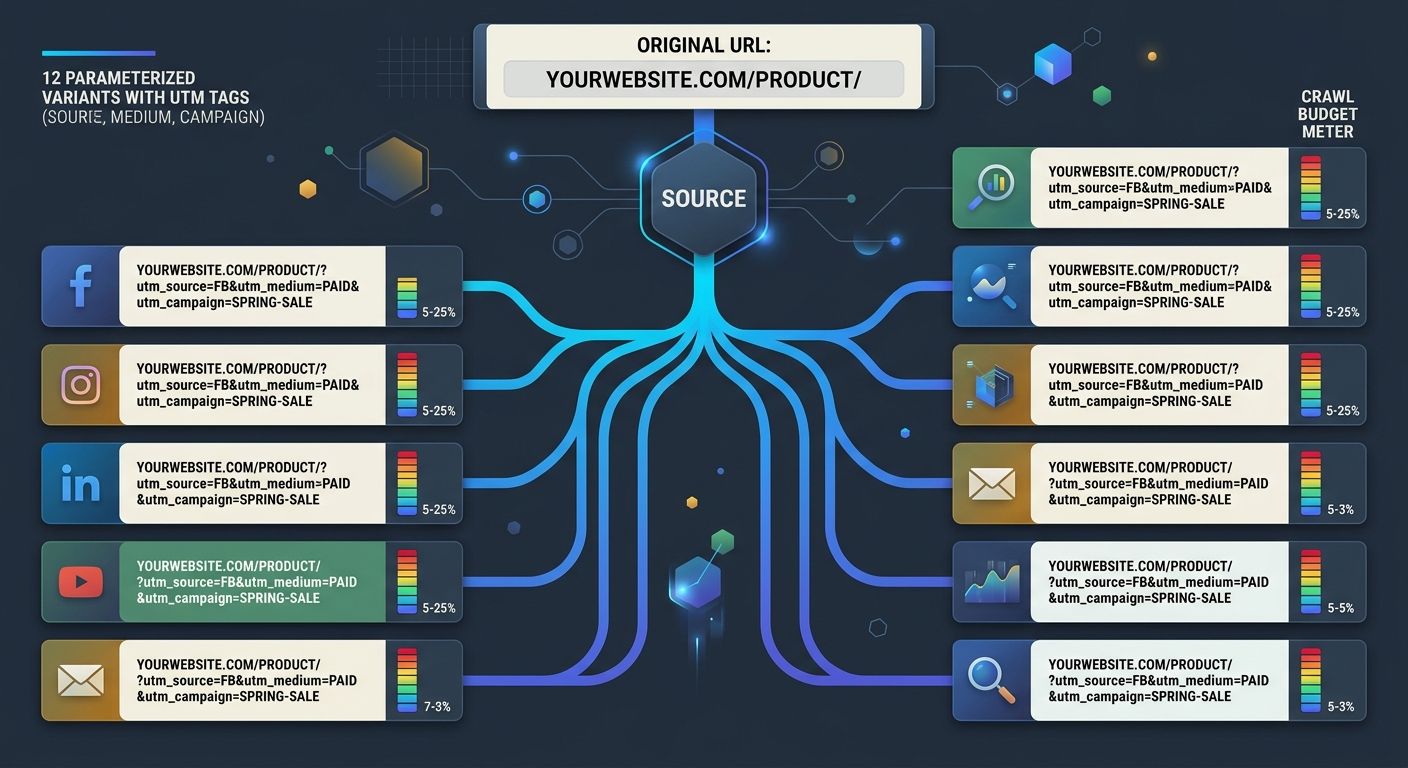
Teams that understand how internal linking architecture builds topic authority already grasp why parameter pollution matters. Internal links pointing to clean URLs concentrate authority. Social shares scattering across parameterized variants fragment it.
The fix requires coordination between social and SEO teams. Self-referencing canonical tags on every page, proper parameter handling configuration, and a URL governance policy that your social team actually follows. ALM Corp's enterprise SEO framework positions crawl budget optimization as "a systems discipline" at "the intersection of information architecture, log analysis, rendering strategy, canonicalization, sitemap governance, internal linking, server performance, and content quality control." Parameter management sits squarely in that intersection.
Social Content Hubs Break Information Hierarchy
Beyond individual campaign pages and parameter variants, social teams often build dedicated content sections that fracture your site's information hierarchy. Think /social-hub/, /community/, /trending/, /creator-spotlight/, or platform-specific landing sections like /tiktok-exclusives/. These sections make sense from a social media strategy perspective. They give social audiences a destination. But they create parallel content hierarchies that compete with your primary site structure for crawl attention and indexing priority.

Hierarchical indexing, as described in information indexing research, organizes data in a tree-like structure where information is arranged in a hierarchy of categories. This hierarchy directly influences the order in which search results appear. When your social content hub duplicates topics already covered in your blog or resource center, you're creating competing branches in that tree, and Google has to decide which branch deserves indexing priority.
I've seen enterprise sites where the /social/ directory contained 400 to 800 pages, many of which were lightly modified reposts of existing blog content optimized for social sharing. The original blog posts sat at click depth 2 or 3 with strong internal linking. The social variants sat at click depth 4 or 5 with minimal internal links and no canonical pointers back to the originals. The site's overall crawl efficiency suffered measurably, with Googlebot spending 30% to 40% of its crawl budget on these low-priority social sections.
This pattern aligns with what we've previously documented about how site architecture wastes crawling resources. The structural issue replicates every time the social team launches a new content series or seasonal hub without coordinating with the SEO team on canonical strategy and hierarchy placement.
The Three-Layer Social Crawl Waste Audit
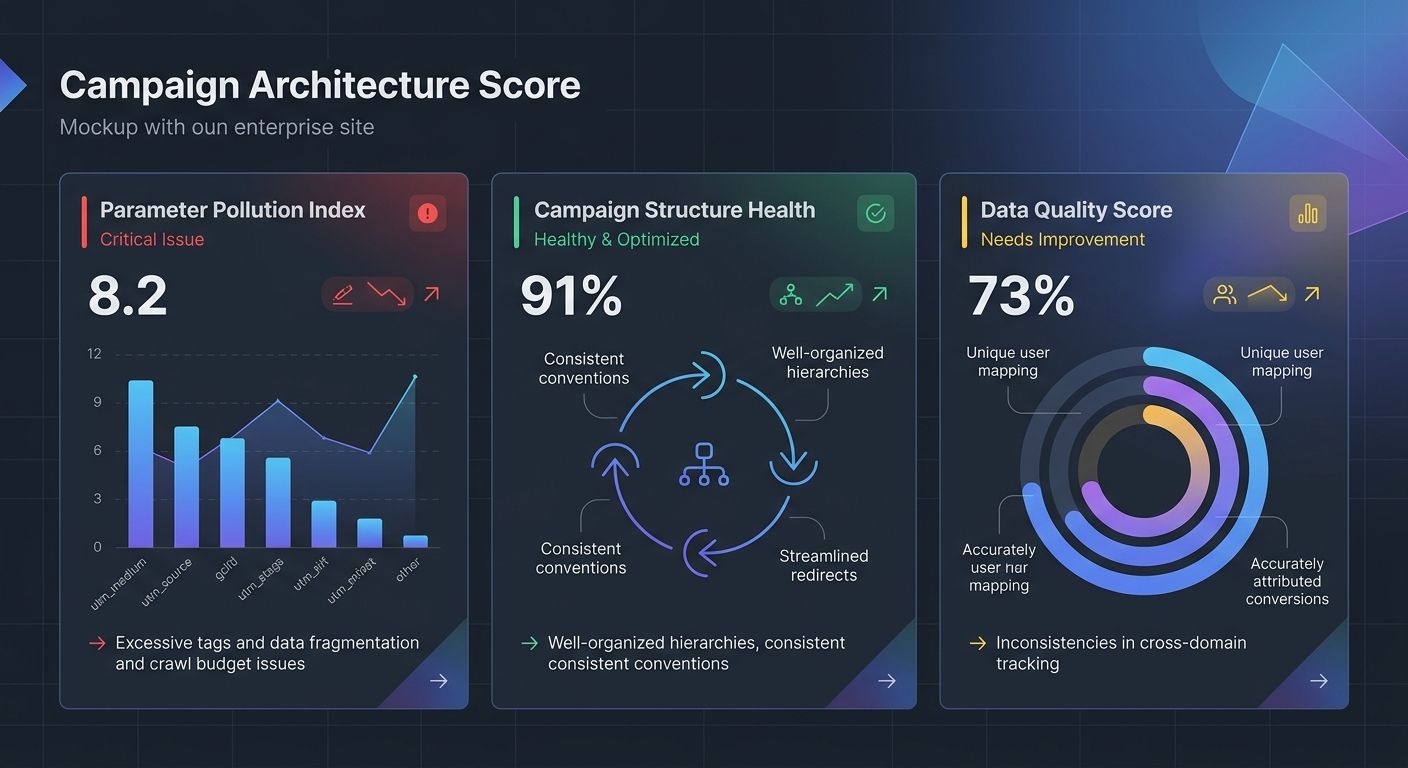
I propose evaluating social-driven crawl waste across three specific dimensions, what I'm calling the Campaign Architecture Score:
Audit Layer | What You Measure | Red Flag Threshold | Tool |
|---|---|---|---|
Campaign URL Inventory | Total live campaign pages with zero internal links | More than 50 orphaned campaign URLs | Screaming Frog crawl filtered by /campaign/ directory |
Parameter Pollution Index | Ratio of parameterized URLs to clean URLs in crawl logs | Parameterized URLs exceed 3× clean URL count | Server log analysis + Google Search Console URL Parameters |
Hub Hierarchy Depth | Average click depth of social content sections vs. primary content | Social content averaging 2+ clicks deeper than blog/resource content | Site crawler with click depth reporting |
Sites scoring red on 2 or more layers should treat social campaign architecture as the priority fix before running any other site architecture audit. The structural gains from consolidating campaign URLs, implementing canonical tags, and flattening social hub hierarchy typically cascade into the broader crawl efficiency improvements that prioritized technical SEO triage aims to achieve.
Where This Leaves Social Marketing Teams
The contrarian claim holds up under scrutiny. Social media campaign infrastructure generates crawl waste at a rate and scale that SEO teams rarely account for, because the URL creation happens outside their workflow. The problem compounds monthly, degrades information hierarchy SEO signals quarter over quarter, and creates a crawl waste diagnosis challenge that page-level audits can't solve.
The organizational implication is uncomfortable but necessary: social teams need architectural literacy. Not deep technical SEO expertise, but a working understanding of three concepts. First, every URL they create consumes a finite resource (crawl budget). Second, tracking parameters require canonical tag coordination. Third, content hubs need to integrate into existing site hierarchy rather than creating parallel structures.
This isn't a social-versus-SEO tension. Both teams benefit when campaign pages get proper canonical treatment, because clean URL structures produce better analytics data for social attribution too. Teams that have already worked through benchmarking cadences for SEO tracking can incorporate Campaign Architecture Score checks into their monthly review cycle, catching parameter pollution and orphaned campaign pages before they compound into quarterly-scale crawl budget problems.
The strategic hierarchy redesign that reclaims lost SEO performance almost always starts with auditing what your social campaigns have built in the shadows. The architecture problems you can see in a standard crawl report are the ones someone intentionally created. The ones your social team created accidentally, at scale, month after month, are where the recoverable performance lives.

Alex Chen
Alex Chen is a digital marketing strategist with over 8 years of experience helping enterprise brands and agencies scale their online presence through data-driven campaigns. He has led marketing teams at two successful SaaS startups and specializes in conversion optimization and multi-channel attribution modeling. Alex combines technical expertise with strategic thinking to deliver actionable insights for marketing professionals looking to improve their ROI.
Related Articles

The SEO Triage Protocol: Prioritizing Technical Fixes When Everything Is Broken
Fixing technical SEO issues in the order your audit tool ranks them guarantees the slowest possible recovery. Automated severity scores ignore your traffic patterns, your social promotion calendar, and which pages generate revenue.

Site Architecture for SEO: Structure That Ranks & Scales
Restructuring site architecture has produced up to 175% increases in traffic and conversions in documented cases.

The SEO Planning Breakdown: Why Your Strategy Fails at Scale (And How Enterprise Teams Fix It)
Enterprise SEO planning fails at scale because channel teams—email marketing, paid media, product—generate landing pages, redirect chains, and content independently, compounding technical debt faster than any SEO team can remediate.
Explore more topics