
Google Issues Manual Action Against Forum with 100,000+ AI-Generated Responses, Labeling Them Thin Content
Google issued a manual action on July 17, 2026, suppressing over 500,000 forum posts on windowsforum.

Google Issues Manual Action Against Forum with 100,000+ AI-Generated Responses, Labeling Them Thin Content
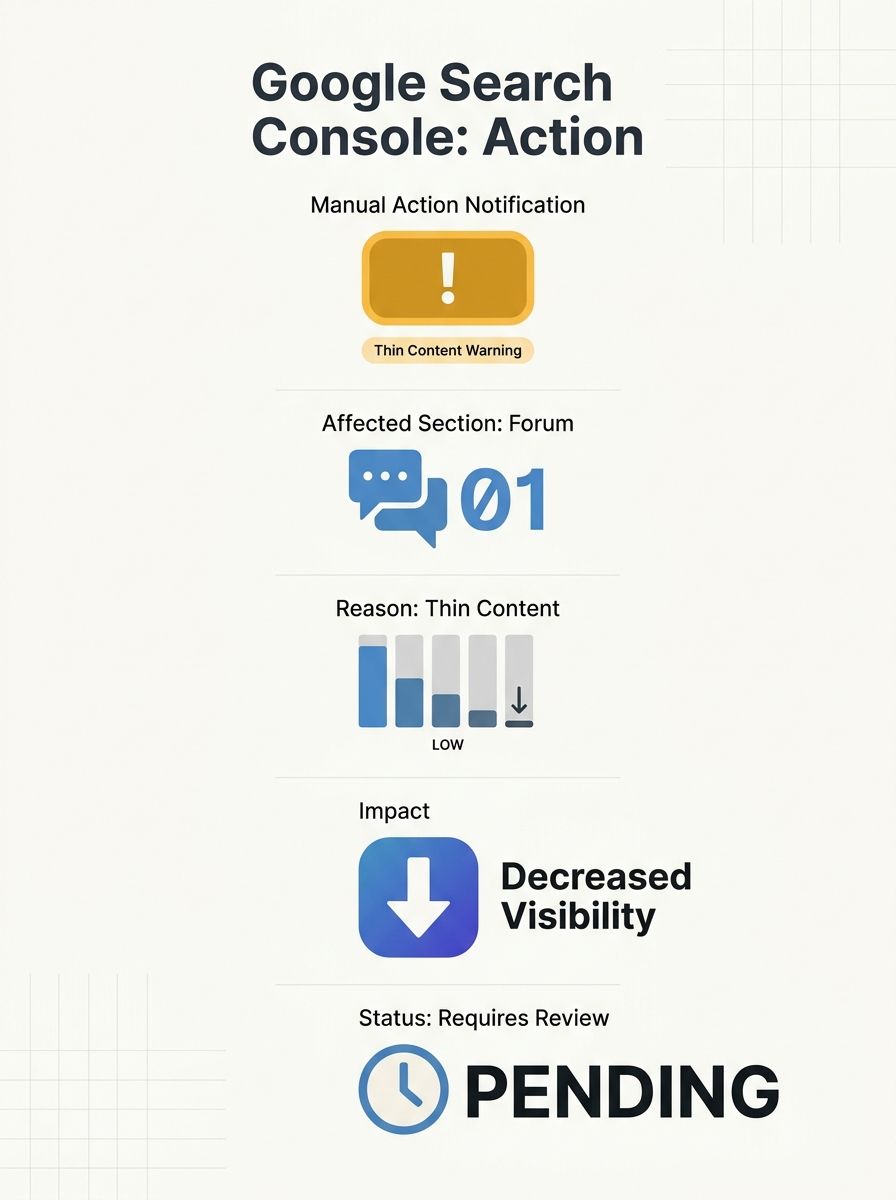
Google issued a manual action on July 17, 2026, suppressing over 500,000 forum posts on windowsforum.com under a "thin content with little or no added value" classification, according to a July 26 Reddit post by the site's owner, while the site's AI chatbot has posted over 100,000 responses since 2023, leading SEO professionals to suspect Google is penalizing AI-generated content under thin-content guidelines.
The partial manual action specifically targeted the site's /threads/ URL pattern, covering 168,290 visible threads spanning twenty years of content, according to the site owner's detailed account. The notification, designated WNC-651700, did not provide example URLs despite the scale of the suppression.
AI Chatbot Activity Precedes Enforcement Action
Australian SEO specialist Gagan Ghotra identified the forum's AI chatbot as a probable trigger for the manual action, posting evidence on Twitter July 26 showing the bot had generated over 100,000 forum responses since becoming active in 2023. The forum characterizes the AI system as a "staff member" in its user interface, according to screenshots shared by Ghotra.
The targeted /threads/ section contains user-generated discussion content, while two other sections the site owner described as "obvious candidates for a thin-content finding" received no penalty. An archived knowledge base and syndicated headline feed, totaling 11,927 threads with a mean age of 12.5 years, remained unaffected despite fitting traditional thin-content criteria more closely.
"This material has been crawled, indexed, and ranked continuously through Panda, Penguin, the September 2023 helpful content update, and through the community's migration from its original domain," the site owner wrote, noting the archived content survived fifteen years and every major Google algorithm update without penalty.
Traditional Thin Content Definitions Don't Match Penalty Pattern
Google's documented thin-content categories include syndicated content, affiliate sites duplicating merchant descriptions, and article-marketing material, according to former Google engineer Matt Cutts' guidance. Cutts defined valuable content as material site owners write themselves with "original insight or research or analysis" that demonstrates actual expertise.
The enforcement pattern suggests Google may be applying expertise and experience requirements—core components of the E-E-A-T framework covered in previous analyses of Google's evolving quality guidelines—to forum contexts where AI-generated responses lack authentic human experience. AI chatbots process "received knowledge" from external sources rather than generating insights from direct experience, according to the analysis shared by multiple SEO professionals commenting on the case.
Reddit user Stablogger, responding to the manual action, noted that "you have repetitive or pretty much empty threads on every single forum, you have them on Reddit, too," questioning why this specific forum faced enforcement while similar patterns persist elsewhere. The site owner reported receiving no prior algorithmic penalties through multiple core updates and domain migrations.
What This Means for Marketing Managers
Marketing teams running community forums or user-generated content platforms with AI moderation or response tools face immediate audit requirements. The windowsforum.com case demonstrates Google will issue manual actions targeting AI-generated responses even when traditional thin-content violations go unpenalized on the same domain, shifting the enforcement focus from content volume to authenticity signals.
Content strategies relying on AI chatbots for forum engagement, customer support threads, or community Q&A sections should implement clear disclosure protocols and evaluate whether automated responses provide genuine value beyond summarizing existing documentation. The enforcement pattern suggests Google's manual review team specifically scrutinizes whether content demonstrates actual human experience rather than synthesized information, particularly in contexts where users expect peer-to-peer expertise sharing.
Organizations with similar AI-augmented community features should audit their Google Search Console for partial manual actions and review whether automated response volumes trigger thin-content classifications, particularly as Google refines enforcement around AI-generated content quality standards that prioritize experiential authenticity over topical coverage.

Sarah Chen
SEO strategist and web analytics expert with over 10 years of experience helping businesses improve their organic search visibility. Sarah covers keyword tracking, site audits, and data-driven growth strategies.
Related Articles

Google Spam Update Targets AI Answer Manipulation as Research Exposes Enforcement Challenges
Google's June 2026 Spam Update now enforces policies against attempts to "manipulate generative AI responses" in Search, according to Search Engine Journal, while a Cornell Tech preprint reveals that as few as 13 planted words can insert a chosen entity into 38% to 51% of AI-generated research repor

Google's May 2026 Search Redesign Cuts Publisher Traffic by 70% to 89% as AI Answers Replace Click-Through Results
Google announced the largest redesign of its search interface in 25 years at its May 2026 developer conference, introducing a conversational search box that accepts text, images, video, and file uploads while deploying automated information agents that monitor topics and push updates without user qu

Full Throttle SEO Warns Against Content Volume Approach for AI Search Optimization
Ivy Boyter, founder of Full Throttle SEO, cautioned businesses July 12 against producing high volumes of content to gain AI search visibility, arguing the strategy repeats content bloat and keyword cannibalization mistakes that damaged websites during the traditional SEO era, according to a statemen
Explore more topics