
Google's May 2026 Search Redesign Cuts Publisher Traffic by 70% to 89% as AI Answers Replace Click-Through Results
Google announced the largest redesign of its search interface in 25 years at its May 2026 developer conference, introducing a conversational search box that accepts text, images, video, and file uploads while deploying automated information agents that monitor topics and push updates without user qu

Google's May 2026 Search Redesign Cuts Publisher Traffic by 70% to 89% as AI Answers Replace Click-Through Results
Google announced the largest redesign of its search interface in 25 years at its May 2026 developer conference, introducing a conversational search box that accepts text, images, video, and file uploads while deploying automated information agents that monitor topics and push updates without user queries, according to analysis published by Gadget. The redesign has produced documented traffic losses of 70% to 89% across multiple publishers, with 58% to 60% of U.S. searches now ending without any external site visit.
The shift marks the end of traditional search-driven traffic models that sustained online publishers for two decades. HubSpot reported losing 70% to 80% of its search-driven traffic following the update, while U.S. media company DMG documented drops as steep as 89% for certain query categories, the analysis shows. NPR characterized the change as "an extinction-level event for online news."
Click-through rates for top-ranked results have collapsed where AI-generated answers appear. The top search result on queries displaying AI summaries now receives click-through rates between 11% and 13%, down from 27% before the redesign, according to data from SISTRIX cited in the report. Between 58% and 60% of all Google searches in the United States now conclude without the user visiting any external website.
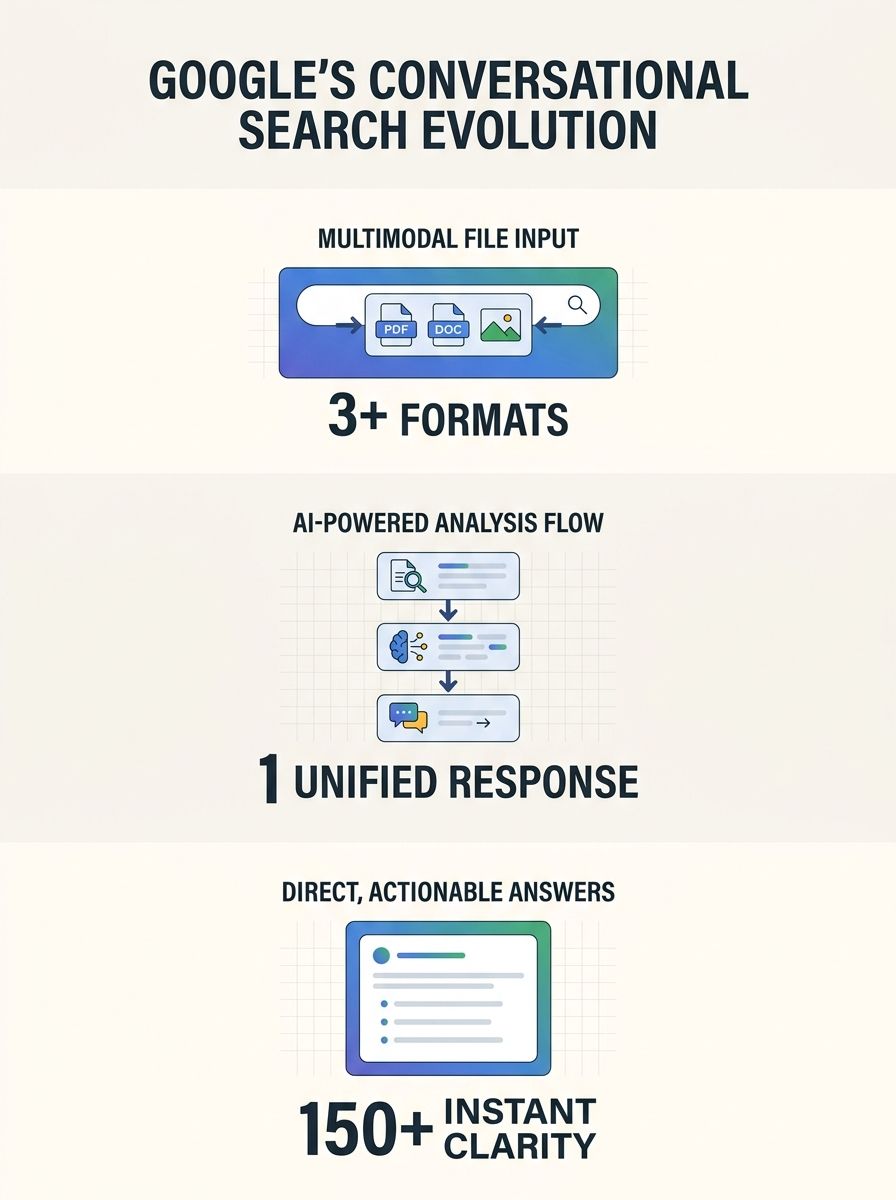
Conversational Interface Replaces Traditional Query Model
Google's redesigned search box functions as a multi-turn conversation rather than a single-query tool. Users submit follow-up questions without restarting their search, upload screenshots to find similar products, or deploy what Google calls "information agents", automated monitors that track topics and deliver updates over time without further input.
The interface accepts text queries, images, video files, documents, and URLs as search inputs. Users can ask Google to compare products across uploaded images, analyze documents for specific information, or maintain ongoing monitoring of selected topics through agent-based automation.
This architectural shift directly reduces the volume of searches that require clicking through to publisher sites. Searches that previously sent users to external pages for answers now resolve inside Google's interface through AI-generated summaries and conversational refinement.
Question-and-Answer Display Panels Deprecated in May 2026
Google removed the expandable question-and-answer panels that previously appeared beneath search listings in May 2026, adding a deprecation notice to developer documentation in the same month. The Search Console report tracking those panels will disappear in June 2026, with programming interface support ending in August 2026, according to the technical documentation.
The removal follows a three-year withdrawal that began in August 2023, when Google restricted the panels to government and health websites. Seven other structured data display types were retired during 2025 as part of Google's pruning of what it considers low-value visual features.
The deprecation does not eliminate the value of question-and-answer formatted content for AI citation purposes. AI search tools including Google's own summaries, ChatGPT, Perplexity, and Gemini draw heavily on clearly structured question-and-answer content when assembling responses, the analysis notes. Pages that state questions directly and provide immediate answers remain optimized for AI extraction even without the visual display treatment.
Content Quality Sites Report Traffic Increases Against Trend
A subset of publishers focusing on original reporting and expert analysis have seen traffic increases during the same period that produced widespread losses. Gadget, the publication that published the analysis, reported traffic growth exceeding five times its April 2025 baseline, sustained consistently over the past year.
An Ahrefs study conducted in February 2026 found that only 38% of pages cited inside Google's AI-generated answers ranked in the top ten traditional search results. The signals that earn citation in AI summaries differ from the signals that produce high rankings in classic link-based results, the study concluded. Content with unique reporting, institutional authority, or direct first-hand experience earned citation across both AI and traditional search surfaces.
The documented categories holding citation share include original reporting, expert opinion on developing topics, first-hand accounts, and work produced by writers with verifiable authority or direct subject experience. AI systems cite these content types at higher rates than algorithmically optimized pages lacking original contribution, according to the analysis of March 2026 algorithm update impacts.
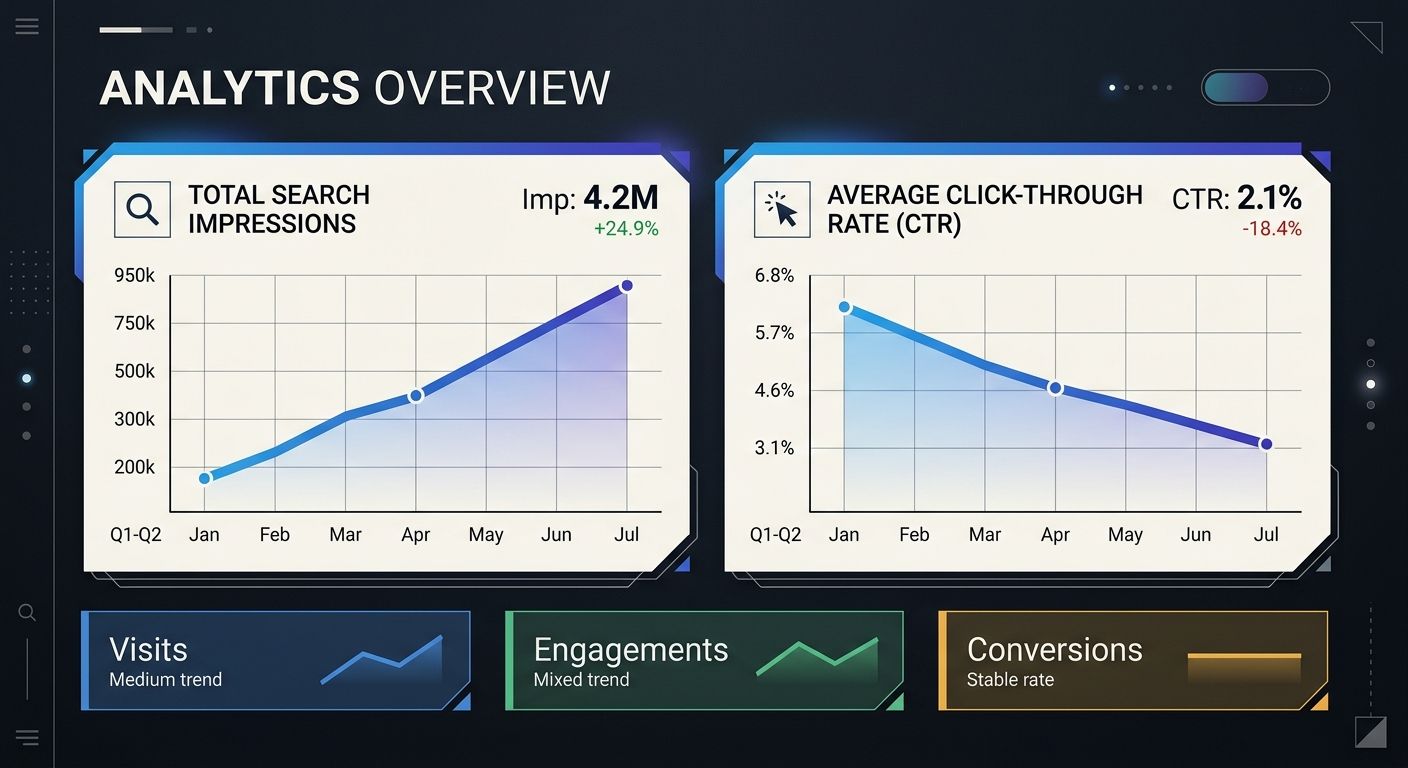
Measurement Models Shift From Click Volume to Impression Share
Publishers tracking performance against 2022 or 2023 traffic benchmarks are measuring against conditions that no longer exist, the report states. The operationally relevant metric is now whether content earns citation inside AI-generated answers, not whether it generates click-through traffic.
Google Search Console impressions rising while clicks fall represents normal performance under the current search model rather than failure. Impressions indicate that Google's systems consider content relevant and authoritative enough to extract for AI summaries; clicks measure only the subset of users who need information beyond the summary, the analysis explains.
This creates a measurement gap for publishers whose analytics platforms track only traditional traffic sources. Content performing well in AI-driven search environments may appear to be underperforming in legacy dashboards that prioritize click volume over citation frequency.
Structured Data Markup Value Remains Uncertain After Panel Removal
The technical markup that powered question-and-answer display panels, schema.org FAQPage structured data, no longer produces visible search features, but its function as a comprehension aid for AI systems remains unsettled. Google has not published guidance on whether the markup continues to influence AI answer generation after the display deprecation.
Removing the markup costs nothing to maintain but is harder to reverse if future developments demonstrate continued AI citation value. Publishers who delete FAQ sections or strip underlying structured data based solely on the panel removal risk losing citation advantage if the markup continues to aid AI content extraction, the report cautions.
Direct Audience Development Becomes Traffic Insurance Strategy
Readers arriving via newsletters, bookmarks, or direct visits represent traffic insulated from algorithm changes and AI summary impacts. Building a direct audience is no longer only a distribution tactic but functions as insurance against the components of search optimization now outside publisher control, according to the analysis.
A newsletter list or registered user base influences how content surfaces in personalized AI-driven results, converting direct audience development into a search strategy rather than a search alternative. Publishers with loyal direct audiences experience less exposure to Google's interface changes, AI Overview expansions, and future search redesigns.
The shift affects how publishers should allocate resources between SEO optimization and owned-audience development. Content that builds direct reader relationships now serves dual functions: it generates immediate traffic independent of search platforms and creates signals that improve AI citation rates through demonstrated authority and reader loyalty.
Marketing Implications
SEO specialists and content strategists must separate measurement models from pre-2026 benchmarks and recognize that citation inside AI answers represents success even when click-through rates decline. Google Search Console impressions should be tracked separately from clicks, with rising impressions during falling clicks interpreted as normal rather than failure.
Content production should prioritize the categories AI systems cite most frequently: original reporting with named sources and dates, expert analysis of developing situations, first-hand accounts, and work by writers with verifiable authority. The Ahrefs finding that 62% of AI-cited pages do not rank in traditional top-ten results demonstrates that AI citation signals differ from link-based ranking signals, requiring separate optimization strategies.
Publishers should maintain FAQ sections and question-and-answer formatted content despite the May 2026 panel deprecation, as this structure remains among the most efficient formats for AI extraction. The decision to retain or remove underlying FAQPage schema markup is less clear, but keeping it costs nothing while removing it creates reversal friction if future developments demonstrate continued value. Direct audience development through newsletters and registered users now functions as both distribution channel and search strategy, insulating publishers from algorithm dependency while generating authority signals that improve AI citation rates.

Alex Chen
Alex Chen is a digital marketing strategist with over 8 years of experience helping enterprise brands and agencies scale their online presence through data-driven campaigns. He has led marketing teams at two successful SaaS startups and specializes in conversion optimization and multi-channel attribution modeling. Alex combines technical expertise with strategic thinking to deliver actionable insights for marketing professionals looking to improve their ROI.
Related Articles
AI Overviews Now Trigger on 48% of Google Searches, Slashing Organic CTR Up to 61%
AI Overviews now appear on 48 percent of all Google search queries—a 58 percent increase over the past three months—and zero-click searches have climbed to 83 percent on queries that trigger the feature, according to data published by Quasa on May 24. The shift has driven organic click-through rate

Google Responds to "SEO Is Dead" Panic After I/O, Points Industry to Real Economic Risk
Google issued an official statement on May 21 clarifying that AI Mode is not the default Search experience, one day after the Google I/O 2026 keynote triggered widespread claims that traditional SEO had become obsolete. The @NewsFromGoogle account stated users "will continue to get a range of result
Ranking #1 on Google Now Delivers 58% Fewer Clicks Than It Used To, Gravitate Analysis Finds
First-position organic search results on Google now generate 58% fewer clicks when AI Overviews appear on the page compared to traditional search results, according to an analysis released July 9 by Gravitate, a Vancouver-based digital marketing agency.
Explore more topics