
Google Removes Campaign-Level Language Targeting from Search Ads Starting Late September
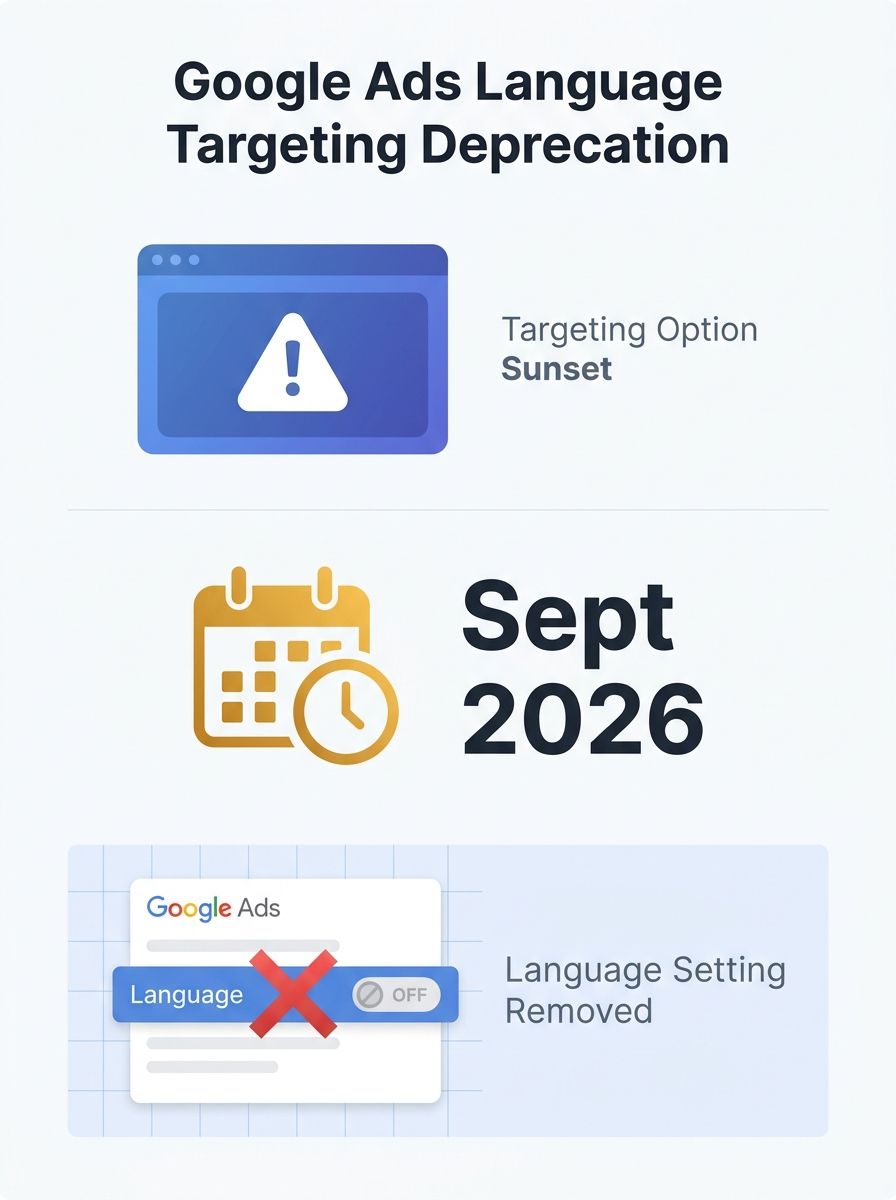
Google will remove campaign-level language targeting settings from Search campaigns and Performance Max Search inventory in late September 2026, shifting language matching entirely to automated signals derived from ad creative, landing pages, and user behavior data, according to Search Engine Journa

Google Removes Campaign-Level Language Targeting from Search Ads Starting Late September
Google will remove campaign-level language targeting settings from Search campaigns and Performance Max Search inventory in late September 2026, shifting language matching entirely to automated signals derived from ad creative, landing pages, and user behavior data, according to Search Engine Journal. The platform announced the change on August 13, 2026, telling advertisers that Google AI will determine language eligibility for each user rather than relying on advertiser-set campaign parameters.
The change eliminates a campaign configuration option that advertisers have used since Google Ads launched, replacing advertiser control with algorithmic interpretation of which languages users understand. Google confirmed the update affects Search campaigns and the Search inventory portion of Performance Max campaigns, while other Performance Max channels will continue using campaign-level language settings.
How Language Matching Will Work Under the New System
Google will determine ad eligibility by analyzing the language of the ad creative and landing page, then cross-referencing that against signals indicating which languages a user comprehends, according to the company's announcement. Those signals include query language, browser and device settings, and behavioral patterns identified through Google AI.
When multiple language options qualify for a single user, Google's ad group prioritization algorithm will select which language to serve. The system will prioritize matching the query language when the search phrase contains clear language indicators, Google said. For brand searches where the brand name remains identical across languages, the platform will rely on the user's preferred language as determined by historical search behavior and device settings.
An insurance advertiser managing both English and Spanish campaigns, for example, will no longer set language parameters at the campaign level. Instead, Google will evaluate whether a user searching for "car insurance" understands English, Spanish, or both languages, then select an ad and landing page combination accordingly. If the user regularly searches in both languages, ads in either could become eligible depending on Google's real-time language determination.
The shift mirrors Google's broader automation strategy documented in recent analyses, where AI systems are reshaping paid search infrastructure from keyword-driven to intent-based matching.
Regulatory Compliance Concerns Remain Unresolved
Advertisers in regulated industries raised documentation concerns during a virtual roundtable Google held before the public announcement, focusing on how they will prove equitable ad delivery when language eligibility becomes an automated determination rather than an advertiser-controlled setting.
An insurance advertiser at the roundtable asked how the company could demonstrate that ads reached both English-speaking and Spanish-speaking audiences when Google's AI, not the campaign configuration, determines which users see which language version. Google responded that providing creative in both languages signals intent to reach both groups, but the company did not announce additional reporting that would show advertisers which languages were served or how performance varied by language.
That reporting gap creates potential compliance challenges for advertisers required to document delivery decisions for regulatory purposes or internal audits. Google has not indicated whether language-specific performance data will be added to existing reporting interfaces.
Performance Max Adds Multilingual Creative Complication
The update intersects with Performance Max asset generation in ways that could produce unexpected language pairings, according to questions raised during the roundtable. An advertiser targeting Quebec through Performance Max could see the platform's asset generation system create French ad copy based on campaign inputs and regional signals, then serve that French creative to users searching in English if Google determines the user understands both languages.
Google confirmed that scenario is possible under the new system. Asset generation occurs first, producing creative in whatever language the automation selects. Language comprehension checks happen afterward, determining whether the user understands the generated ad and associated landing page. The two processes operate independently.
Developers using the Google Ads API received instructions to stop sending language criteria when creating or updating Search campaigns, though existing language criteria can remain in campaign configurations without affecting Search targeting. Google stated that advertisers using the API should prepare for the late September rollout by updating their campaign creation and management workflows.
What Happens Next
Advertisers using separate campaigns for different languages do not need to restructure those accounts before the September rollout, according to Google's guidance. The platform will continue recognizing language distinctions through creative and landing page analysis rather than campaign settings. Accounts maintaining English-only and Spanish-only campaign separation will see Google use those creative assets as the primary language signal.
The removal of advertiser-controlled language targeting follows Google's pattern of eliminating manual campaign levers in favor of automated optimization, a shift that has accelerated across the platform's advertising products since 2024. The absence of language-specific reporting leaves advertisers with limited visibility into how Google's AI interprets user language comprehension and makes serving decisions, particularly in multilingual markets where users regularly switch between languages.
Regulated advertisers and those operating under compliance frameworks requiring documented delivery proof face the most immediate operational questions. Without additional reporting dimensions showing which language was served to which users, demonstrating equitable access or compliance with language-specific advertising requirements becomes dependent on Google's internal algorithms rather than verifiable campaign data.

Alex Chen
Alex Chen is a digital marketing strategist with over 8 years of experience helping enterprise brands and agencies scale their online presence through data-driven campaigns. He has led marketing teams at two successful SaaS startups and specializes in conversion optimization and multi-channel attribution modeling. Alex combines technical expertise with strategic thinking to deliver actionable insights for marketing professionals looking to improve their ROI.
Related Articles

Google Assigns Two-Week Rollout to September 2026 Spam Update, Adds Image Search Filter to Search Console
Google began rolling out its September 2026 spam update on September 24 with a two-week completion window, the longest rollout timeframe the company has assigned to any spam update this year, according to Search Engine Journal. The update applies globally across all languages.

Google Publishes First Official Guide for AI Search Visibility as Agencies Double Down on Generative Engine Optimization
Google released its first official guidance for optimizing content in AI-generated search features in mid-May 2026, marking the company's most explicit acknowledgment that generative engine optimization has become a distinct practice alongside traditional search engine optimization, according to doc

Three Conversion Tracking Configuration Errors Systematically Degrade Google Smart Bidding Performance, Technical Analysis Shows
Improperly normalized personally identifiable information, misconfigured Consent Mode signals, and mismatched conversion values degrade Google Smart Bidding algorithms by feeding them incomplete or inaccurate data, according to a technical analysis published by Search Engine Journal on August 20, 20
Explore more topics